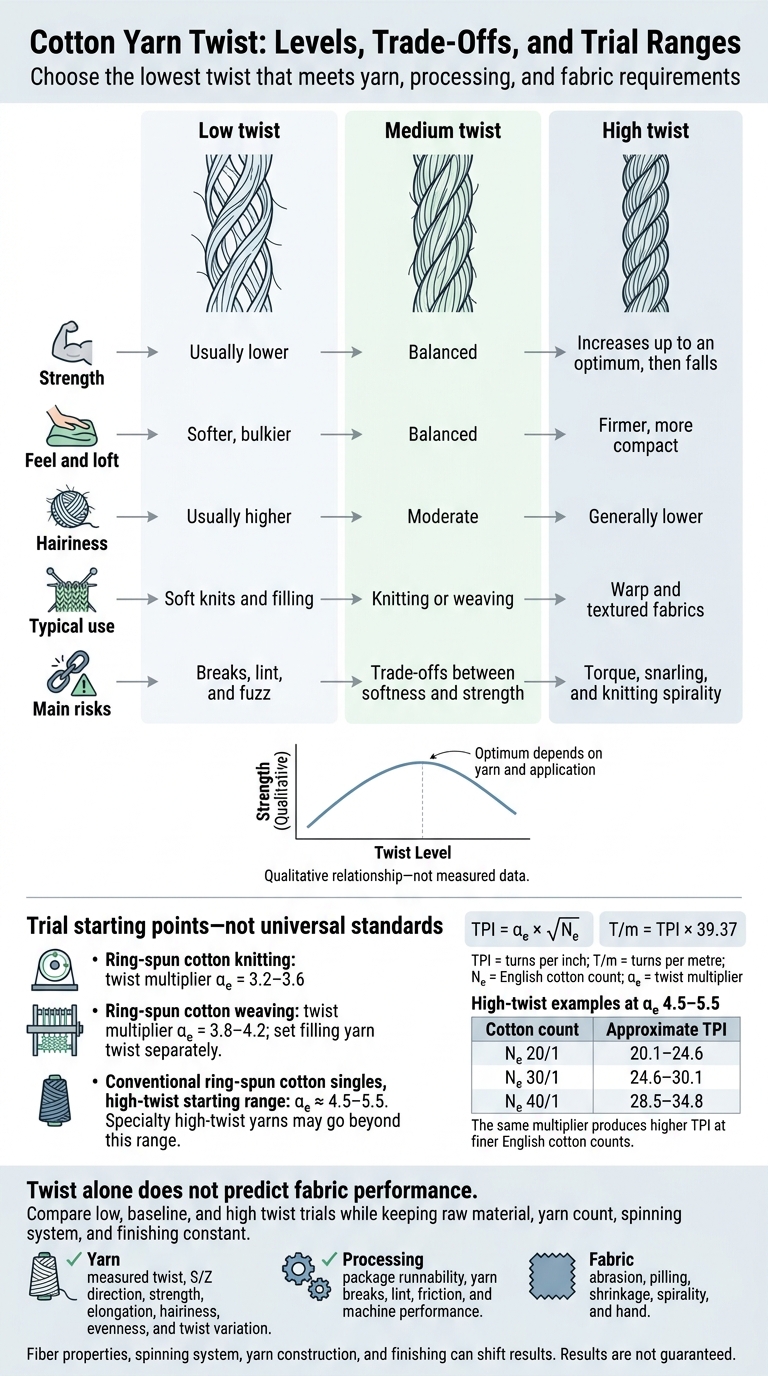
The best cotton yarn twist is the lowest level that meets strength, processing, and fabric needs. For ring-spun cotton, trial starting points include twist multipliers (αe) of 3.2–3.6 for knitting and 3.8–4.2 for weaving, with filling yarn set separately. These are guides - not fixed standards.
Twist must match yarn count. Calculate turns per inch (TPI) = αe × √Ne, where Ne is the English cotton count. Then check the result against fiber properties, spinning method, and end use.
Quick Comparison
| Factor | Low twist | Medium twist | High twist |
|---|---|---|---|
| Strength | Usually lower | Balanced | Increases up to an optimum, then falls |
| Feel and loft | Softer, bulkier | Balanced | Firmer, more compact |
| Hairiness | Usually higher | Moderate | Generally lower |
| Typical use | Soft knits and filling | Knitting or weaving | Warp and textured fabrics |
| Main risks | Breaks, lint, and fuzz | Trade-offs between softness and strength | Torque, snarling, and knitting spirality |
Twist alone does not predict fabric performance. Approval should include measured twist and S/Z direction, strength, elongation, hairiness, evenness, machine trials, and fabric checks for abrasion, pilling, shrinkage, and hand.
Cotton Yarn Twist: Levels, Trade-Offs, and Trial Ranges
1. Low-Twist Cotton Yarn
Count-Adjusted Low-Twist Guidance
Low twist depends on yarn count and spinning system. The usable TPI or T/m range changes with yarn fineness and spinning method. Compact spinning can use less twist than conventional ring spinning while keeping the yarn intact. That lower twist also affects strength, hairiness, and processing performance.
Strength and Surface Feel
At the same yarn count, lower twist usually produces a softer hand, more loft, and better fabric cover than medium twist. But it also holds fibers less tightly. Softness alone doesn’t mean low hairiness - you need to check both.
Combing can partly offset strength loss and increased hairiness by removing short fibers, leaving a longer, more even fiber base. Ask for single-yarn tensile strength, unevenness (U%), thin-place, and hairiness results. Use these measurements to judge whether the yarn is ready for knitting or weaving trials.
Knitting and Weaving Performance
Low twist works better for comfort-first soft knits and filling yarn than for warp yarn, which must withstand loom tension. Test at production settings and watch for breaks, hairiness, and weak thin places. Yarn clearing during winding helps remove weak sections. Moving to medium twist increases strength, with some loss of softness.
sbb-itb-0e617ca
2. Medium-Twist Cotton Yarn
Count-Adjusted Twist Ranges
Medium twist is a middle-ground setting - not a fixed TPI or T/m value. For Ne 20/1–Ne 40/1 yarns, the target depends on fiber length, spinning system, and end use. Specify twist separately in TPI or T/m, and check it with a twist tester. Medium twist is a practical step up when low-twist yarn is too weak for processing.
Strength and Surface Feel
Medium twist balances softness, strength, and ease of processing. Longer fibers can reach that balance with less twist, so the fiber lot matters just as much as the nominal twist setting.
Knitting and Weaving Performance
Keep medium twist softer for knitting and firmer for warp yarns. Ring or compact spinning suits yarns that need low hairiness and high strength. Rotor spinning is a better fit when cost and productivity matter more than strength.
Specify twist direction, hairiness limits, and tensile strength and elongation results under ASTM D2256 or ISO 2062.
Textile Yarns - Twisting / Plying
3. High-Twist Cotton Yarn
Medium twist balances strength and softness. High twist makes the yarn more compact and better suited to warp use, trading softness for tighter fiber control.
Count-Specific Twist Ranges
The right high-twist level depends on yarn count, spinning system, and end use. Mills check it through twist tests and trial runs.
For conventional ring-spun cotton singles, αe of roughly 4.5–5.5 is a starting range for high twist - not a specification for every yarn:
| Cotton count | Twist multiplier (αe) | Approximate TPI |
|---|---|---|
| Ne 20/1 | 4.5–5.5 | 20.1–24.6 |
| Ne 30/1 | 4.5–5.5 | 24.6–30.1 |
| Ne 40/1 | 4.5–5.5 | 28.5–34.8 |
These ranges favor a firmer hand, lower loft, and suitability for warp use. Specialty high-twist yarns may go beyond them.
Strength and Surface Feel
Compared with medium twist, higher twist binds fibers more tightly, reduces hairiness, and makes the yarn more compact. The trade-off is a firmer hand and lower loft. Strength increases up to an optimum point, then drops if twist goes too far.
Knitting and Weaving Performance
High-twist yarn is best suited to warp yarns exposed to loom tension, as long as its strength allows reliable processing. For knitting, use it when the goal is a firmer hand or texture, and watch for twist-related spirality. Run fabric trials to check how the higher twist affects hand and shrinkage.
Twist Trade-Offs: Strength, Softness, and Surface
Use the table below with the count-specific ranges above to compare samples before choosing a production twist range. Keep yarn count, fiber length, fineness, and spinning system the same. These are starting points for testing, not universal limits.
| Property | Low twist | Medium twist | High twist |
|---|---|---|---|
| Tensile strength | Often lower because fibers have less cohesion | Usually balances strength and flexibility | Often higher up to an optimum; too much twist can reduce axial strength |
| Softness | Typically softer | Balanced hand | Often firmer |
| Hairiness | Usually higher | Moderate | Generally lower |
| Loft | Usually bulkier and more compressible | Moderate | Usually lower |
| Cover | Bulky cover, but coverage can be uneven if the structure is too open | Balanced cover and compactness | Dense, compact cover; may reduce openness |
| Abrasion resistance | Often lower; fibers can pull out more easily | Usually improved | Often higher, depending on fabric structure |
| Torque / snarl tendency | Generally less torque | Moderate | Higher torque, with more risk of snarling or spirality |
| Main drawbacks | Weakness, lint, and fuzzing | Competing performance targets | Firmness, reduced loft, and torque |
Fiber properties, spinning system, yarn construction, and finishing can shift these results. Adding twist increases strength only up to an optimum. Beyond that point, fiber angle and internal stress reduce axial strength.
Warmth, absorbency, pilling, and drape need fabric trials - you can't judge them from yarn twist alone. Keep yarn count, fiber blend, construction, weight, and finishing as consistent as possible. Measure abrasion and pilling alongside hand and drape to narrow the twist range before matching it to knitting, warp, or filling use.
Twist Requirements for Knitting, Warp, and Filling
Match twist to the end use. Knitting usually needs less twist, while weaving generally needs more, especially for warp.
Specify twist by application. Record TPI or TPM, S/Z direction, and single-thread strength in the yarn specification.
Use the table to guide application priorities - not as a set of universal limits.
| Application | Desired properties | Twist level | Insufficient-twist risk | Too much twist |
|---|---|---|---|---|
| Knitting | Softness, evenness, low hairiness | Lower, as long as the yarn runs reliably | Breaks and holes | Firmer hand and possible shrinkage changes |
| Weaving | High strength and resistance to repeated tension | Generally higher, especially for warp | Breaks during warping and weaving; loom stops | Harsh hand and shrinkage changes |
Once you’ve set the application, check how the yarn behaves during processing. During winding, verify that electronic clearing detects thin places, thick places, and neps without unnecessary cuts. Control package density and winding tension so the yarn unwinds smoothly.
During warping, sizing, and weaving, assess twist alongside hairiness, evenness, size application, machine speed, and tension. For knitting, track lint, friction, and yarn breaks.
Check spirality and dimensional stability after dyeing, finishing, and laundering. Before changing twist, compare fabric results with yarn test reports. Unevenness and fiber maturity also affect appearance.
Conclusion: Select a Twist Range and Test It
Choose the lowest twist that meets yarn, processing, and fabric requirements. Use these trial adjustments to narrow the range:
| Goal | Trial adjustment | Checks before approval |
|---|---|---|
| Softer hand | Lower twist in small steps | Strength, elongation, hairiness, pilling, hand |
| Greater warp durability | Increase twist in small steps | Abrasion, strength, sizing response, loom breaks |
| Reduced hairiness | Test a modest twist increase or revised fiber preparation | Hairiness, imperfections, shedding, appearance |
| Fewer knitting problems | Test lower twist if torque is excessive | Snarling, feeder behavior, breaks, fabric distortion |
Set the count, construction, fiber preparation, spinning system, and end use first. Then choose a starting αe and convert it using TPI = αe × √Ne and T/m = TPI × 39.37. Treat αe 3.2–3.6 for knitting and 3.8–4.2 for ring-spun cotton weaving as trial ranges - not universal limits. Set filling yarn twist separately.
Compare low, baseline, and high twist trials. Keep raw material, count, spinning system, and finishing constant. Measure strength, elongation, hairiness, evenness, abrasion, and twist variation. Base approval on those measurements, package runnability, machine performance, and fabric results.
Use ASTM D1423/D1423M or ISO 2061 for direct counting. For applicable single-yarn untwist–retwist testing, consider ASTM D1422/D1422M or ISO 17202. This approximate method is less accurate than direct counting. Check each standard’s scope and edition before testing.
Document the standard and edition, conditioning conditions, specimen preparation and length, test tension, sampling, spinning system, and test method. Make adjustments in small steps, then record the approved twist range, tolerance, and acceptance criteria.
FAQs
How do I set acceptable twist tolerances?
Use the twist multiplier formula, TM = TPI / √Ne, to set a baseline for your yarn count and application. Weaving usually needs more twist than knitting.
Test breaking strength and twist angles, then track tenacity, elongation, and hairiness. Longer, more uniform fibers need less twist, which improves softness. For consistent measurements, keep testing conditions at 70°F ± 2°F and 65% ± 2% relative humidity.
Should I change twist when switching cotton lots?
Yes - check twist levels when switching cotton lots. Fiber length, fineness, and maturity affect how fibers interlock. Longer, higher-quality fibers generally need less twist for strength, while shorter or less regular fibers need more.
Leaving twist settings unchanged can cause over-twisting, which may damage fibers and create yarn defects, or under-twisting, which leaves yarn weak. Track tenacity and fiber uniformity to match twist settings to each lot.
How does plying affect my twist requirements?
Plying brings multiple single yarns together, changing the yarn’s structure and twist requirements. Ply twist, often applied in the opposite direction of the singles, helps balance softness and strength while improving stability, uniformity, and durability. Adjust the twist settings to meet the finished yarn’s performance needs - whether for weaving or specialty textiles - without making it too stiff or over-twisted.