If you can’t prove where cotton came from, you can lose the sale. In the U.S., brands, auditors, and Customs now want bale-level records that follow cotton from the farm to the finished product. That means a clear file trail from grower → gin → merchant → mill → manufacturer → brand, often tied back to the Permanent Bale Identification (PBI) tag and USDA classing records.
Here’s the short version:
- General origin claims are no longer enough.
- CBP can detain shipments if cotton records break at any step under UFLPA review.
- Marketing claims like 100% U.S. cotton or regenerative cotton need proof, not supplier promises.
- Gins, merchants, and mills are now judged by how well they keep bale-linked records.
- Digital tools and fiber testing can help, but they do not replace invoices, shipping records, intake logs, and bale files.
- U.S. upland cotton makes up about 97% of U.S. production, so record control at scale matters.
- Missing records can also lead to extra origin testing that may cost $400 to $1,200 per test.
What buyers usually want is simple:
- Farm and field IDs
- Gin intake and bale records
- PBI-linked USDA classing data
- Purchase orders, invoices, and bills of lading
- Mill input/output records
- Program records for claims tied to Trust Protocol or Better Cotton
If I had to boil the whole topic down to one line, it would be this: cotton transparency now means proving each handoff with records that match.
That is the standard brands, auditors, and regulators are using now.
How Banned Cotton Still Muddies Cotton's Supply Chain Transparency
sbb-itb-0e617ca
Why Brands and Regulators Now Require Verifiable Cotton Records
Brands and regulators now expect bale-to-product records that can stand up in an audit. If that proof is missing, the fallout can be expensive: shipments may be detained, contracts can disappear, and access to premium programs can dry up. So the issue isn't just paperwork. It's whether every handoff in the supply chain can be proven.
Brand Risk, Sourcing Claims, and Greenwashing Exposure
If a brand sells a product as 100% U.S. cotton or regenerative cotton, that claim needs hard proof behind it. A supplier's verbal assurance isn't enough. NGOs and watchdog groups actively check fiber and sustainability claims, and weak records can lead to public blowback and legal pressure.
When a brand can't prove origin or sustainability claims with bale-level records and a documented chain of custody, the damage can spread fast. Products may need to be relabeled, recalled, or pulled from a collection. ESG scores can take a hit. A company can also lose its place on preferred-supplier lists.
Some brands are turning to platforms like TextileGenesis to tighten this up. In verified cotton programs, the platform assigns digital tokens to specific fiber lots and tracks them from fiber through finished goods. That gives brands an audit-ready record they can hand to auditors when questions come up.
That pressure doesn't stop with marketing language. It now reaches straight into import compliance.
Forced-Labor Compliance and Import Enforcement
The UFLPA and Section 307 of the Tariff Act push traceability demands all the way back to the farm. CBP treats cotton as a high-risk commodity and expects importers to document the full supply chain, from the cotton's origin at the bale level through final production of the finished product. In plain terms, buyers need records at every step.
That usually includes:
- Purchase orders
- Invoices
- Bills of lading
- Inventory records tied to each handoff
If any upstream party, whether it's a gin, merchant, or spinning mill, can't produce those records, importers may decide not to source from that business at all. The reason is simple: no one wants to risk a CBP detention or denial over a weak paper trail. An undocumented supplier upstream can turn into a problem for everyone downstream.
That is why demand keeps growing for records that begin at the bale and stay with the cotton across each transfer.
ESG Reporting and Due-Diligence Rules
These same records now do double duty in ESG reporting. Cotton is a major Scope 3 input, so brands need farm-linked data to support climate disclosures.
Large buyers are starting to ask for more than a country or region of origin. They want farm or region identifiers tied to each bale, along with data on production practices like tillage, irrigation, and fertilizer use. They also want proof of participation in recognized programs such as the U.S. Cotton Trust Protocol.
Without that upstream data, brands can't confidently connect emissions cuts or water savings to the cotton that actually ended up in their products. And when that link is weak, ESG reports can face credibility problems. Suppliers that can provide verified, farm-linked data are in a stronger spot when buyers build preferred material portfolios and longer-term ESG-aligned sourcing plans.
What Buyers and Auditors Expect to See From Farm Through Brand
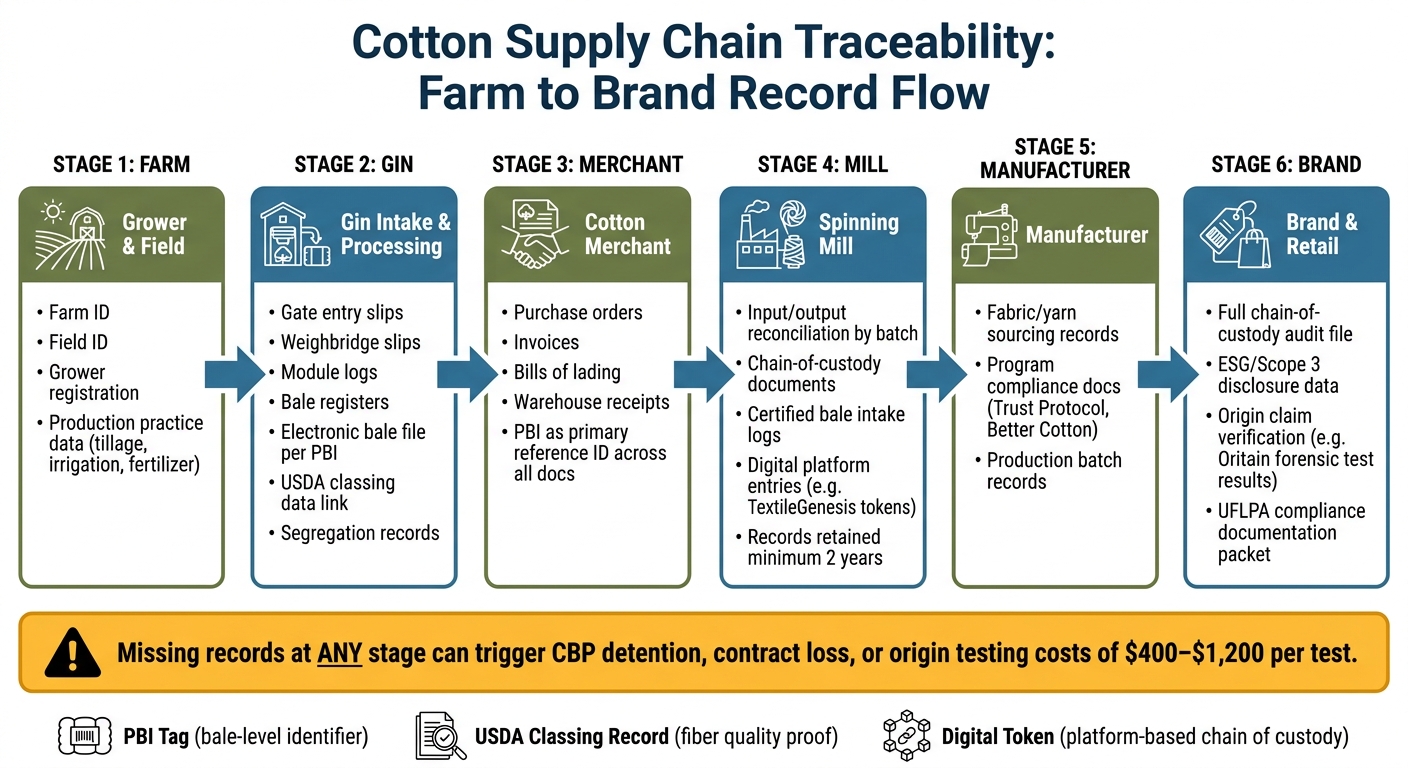
Cotton Supply Chain Traceability: Farm to Brand Record Flow
When a brand, auditor, or regulator asks for proof, broad sourcing claims won't cut it. They want records that line up at every handoff. If one document says one thing and the next says another, that's where problems start.
Farm, Module, and Gin Records That Support Bale-Level Traceability
The paper trail starts at the farm. Buyers and auditors expect records that identify the grower and tie the cotton back to farm and field IDs. When that cotton reaches the gin, those same IDs should connect straight to gate entry slips, weighbridge slips, gin intake logs, module logs, and bale registers.
Gins should maintain an electronic bale file for each PBI. That file should link the bale to the grower, field, module, scale ticket, gin run, segregation note, and USDA classing data. Each PBI should also connect to USDA classing results in the National Database.
Segregation records matter as well, especially when cotton is headed into a certified program such as the U.S. Cotton Trust Protocol or Better Cotton. Auditors check whether certified and non-certified cotton stayed separate from intake through pressing. They also review processing records to see whether yield ratios make sense.
Merchant and Mill Chain-of-Custody Documents
After cotton leaves the gin, the record-keeping load moves to merchants and mills. At each transfer of ownership, auditors expect a clean, unbroken set of documents that includes purchase orders, invoices, delivery notes, warehouse receipts, and bills of lading.
Mills get even more scrutiny because auditors test whether the math works. They compare input weights with output weights by batch or time period to confirm that a mill claiming 100% U.S. cotton or Better Cotton actually received enough certified bales to support that claim. Chain-of-custody rules usually require keeping the related records for at least two years. Some programs also ask for PBI entries in a digital traceability platform, with paper records to back them up.
For UFLPA compliance, merchants should use the PBI number as the main reference ID across all records. Contracts, invoices, and shipping documents should point to the same bale IDs. That lets import authorities trace mill intake back to specific bales, and then back to farms, without unexplained breaks in the file.
Documentation Levels and Their Compliance Value
This is the point where record depth can make or break an audit or import review.
| Documentation Level | What It Includes | Strengths | Limitations | Audit Readiness | UFLPA / Import Compliance | Premium Program Fit |
|---|---|---|---|---|---|---|
| Minimal documentation | Basic origin statements, invoices, and supplier declarations | Low cost, easy to maintain | No bale-level linkage; gaps are common | Low | Usually insufficient for CBP review | Limited |
| Chain-of-custody system | PBI-linked bale records, purchase orders, invoices, delivery notes, warehouse receipts, input-output reconciliation | Traceable by bale or lot; supports most audit requests | Depends on consistent record-keeping across all parties | Moderate to high | Can support a complete documentation packet when records are complete and consistent | Usually adequate for many sourcing and certification requests |
| Advanced traceability with digital and scientific verification | All chain-of-custody documents plus digital platform tokens, scientific origin testing, and geolocation farm data | Strongest support for origin claims; independently verifiable | Higher cost; requires platform participation and testing agreements | High | Helps strengthen the evidence package | Meets the most demanding brand and audit requirements |
These records carry more weight when they are paired with digital tracking and scientific origin checks.
Digital Tools and Verification Methods Used in Cotton Traceability
These records get a lot more useful once they’re digitized, scanned, and checked by an outside party.
USDA Classing Data, PBI Tags, and Bale-Level Digital Records
At the bale level, digital traceability usually starts with the PBI tag and the USDA classing record tied to that bale. Together, they turn paper files into proof you can search, pull, and review later.
Here’s how it works. When a gin sends bale samples to one of USDA’s ten classing offices across the Cotton Belt, staff scan the PBI tag and test the cotton using High Volume Instrument (HVI) testing. The results cover length, strength, length uniformity, micronaire, color, and trash, and USDA stores that data under the bale’s record in the USDA National Cotton Database.
This is a controlled source, not an open public lookup. Access is limited to the cotton owner or an authorized agent. USDA keeps the data for the current crop year and the previous four crop years. For buyers farther down the chain, that bale record connects fiber quality to a specific gin, classing office, and bale number.
Once that record is created, the next job is simple in theory and messy in practice: keep it tied to the cotton at every handoff.
RFID, QR Codes, and Transaction-Based Traceability Platforms
This is where RFID tags and QR codes come in. They cut down on manual-entry mistakes and make bale movement easier to see as cotton moves through gins and warehouses. Think of them as a running scan trail. If people scan at the right time, the record stays clean. If they don’t, gaps show up fast.
Transaction-based platforms push that idea further by digitizing transfers between each supply chain tier. TextileGenesis, for example, uses digital tokens to track shipments or material lots across fiber, yarn, fabric, and finished goods. In Supima’s AQRe project, spinners entered PBI numbers directly so those tokens could follow the cotton through the value chain. The platform helps organize records across many parties instead of leaving each company to manage its own silo.
Digital systems help a lot, but they still work best when there’s another layer checking the origin claim itself.
Origin Verification Through Scientific Testing
Scientific testing adds that outside check by matching isotopic and elemental signatures to growing regions. In plain English, the fiber carries a kind of location fingerprint based on where it grew.
Oritain has built a reference database of Origin Fingerprints that covers about 90% of global cotton-growing regions. Local growing conditions leave measurable traces in the fiber, and those traces can be tested in fiber, yarn, or fabric form.
The U.S. Cotton Trust Protocol said that, starting in May 2026, randomized supplier samples would be tested by Oritain using isotopic and trace-element analysis to validate claimed U.S. origin. That kind of result can support an origin claim. But it does not replace bale records, chain-of-custody documents, or mill intake logs.
Each tool checks a different part of the paper trail.
| Verification Method | What It Confirms | Key Limitation |
|---|---|---|
| PBI + USDA classing data | Bale identity and fiber quality | Does not prove full downstream chain of custody |
| RFID / QR / scan systems | Bale movement and scan history | Depends on consistent scanning discipline |
| TextileGenesis (Fibercoin model) | Transaction-based digital chain of custody across tiers | Complements, not replaces, physical documentation |
| Oritain forensic testing | Likely geographic origin of the fiber | Does not replace chain-of-custody records |
Practical Value for Growers, Gins, and Marketers - and Key Takeaways
How Transparency Protects Market Access and Supports Premium Programs
Good records help protect market access. Brands that source U.S. cotton for premium and sustainability programs often need to confirm origin fast. If a gin or merchant can pull PBI-linked bale records and chain-of-custody files right away, that helps them move deals forward with less friction. For growers, gins, and marketers, that can mean fewer buyer delays and faster approval for sourcing claims.
Premium programs put a lot of weight on fast, bale-level proof of origin. And there’s a money angle too. Origin tests can cost $400–$1,200 per test when records are missing or messy. Clean files from the farm to the gin can cut down on how often those tests are needed.
How cottongins.org Fits Into Supply Chain Mapping
Supply chain mapping usually starts with a simple question: Which gin handled this bale? That’s where cottongins.org comes in.
For brands, merchants, and mills building U.S. cotton supply chain maps, cottongins.org offers a directory of U.S. cotton gins by location. That gives teams a practical way to identify facilities and sort the sourcing details they need to document domestic origin.
The Records and Systems That Matter Most Now
Transparency starts at the farm and the gin. After that, every handoff needs a paper trail. If one link is missing, the whole chain gets harder to check. That’s why digital tools work best when the underlying records follow the same format and can be reviewed without guesswork.
At the gin level, a few data fields matter most:
- Supplier code
- Farm or farmer ID
- Bale or lot ID
- Quantity
- Date
- Location
- Transport details
- Program reference
Keep those records searchable by bale and by transaction. That small step can save a lot of time when a buyer asks for proof on short notice.
FAQs
What is bale-level traceability?
Bale-level traceability means each cotton bale can be uniquely identified and tracked as it moves from the gin through the supply chain.
It relies on a 12-digit Permanent Bale Identification (PBI) tag and barcode assigned at the gin. When that PBI is linked to USDA fiber quality data and digital platforms, it helps verify origin, maintain chain of custody, and support regulatory and sustainability compliance.
Which records matter most for UFLPA reviews?
For UFLPA reviews, businesses need clear records that show where each bale came from and help prove the supply chain is free from forced labor.
The main records include Certificates of Origin, phytosanitary certificates, 10-digit HTS codes, chain-of-custody documents, Permanent Bale Identification (PBI) numbers checked against USDA master lists, and shipping and transaction records.
Under U.S. Customs and Border Protection guidance, companies generally need to keep these records for at least five years.
Do digital tools replace paper records?
Yes. Digital tools can replace paper records by automating data collection and using a central platform. That cuts delays, reduces messy handoffs, and helps prevent transcription mistakes.
They also let teams record information right at the source instead of copying it over later. From there, the same system can generate documents like shipping papers and invoices, track inventory in real time, and build a clearer audit trail with far less manual work.