Choose yarn count for the finished product - not just the finest yarn a mill can spin. Start with fabric weight, feel, and durability. For reference, 30 Ne is about 19.7 tex: higher Ne means finer yarn, while higher tex means coarser yarn.
A sound choice rests on three checks:
- Product fit: Match the count and ply to the fabric construction, knitting gauge, and customer requirements.
- Mill fit: Check cotton-lot data, equipment limits, and cotton supply for repeat orders.
- Trial results: Test yarn and finished-fabric performance, then compare cost per pound of yarn that meets specification.
The final count needs to pass all three checks. Record the approved blend, settings, and test results so repeat orders stay within the agreed limits.
IDEAL YARN COUNTS FOR A 100% COTTON SINGLE JERSEY FABRIC
sbb-itb-0e617ca
Step 1: Convert Units and Select a Starting Count
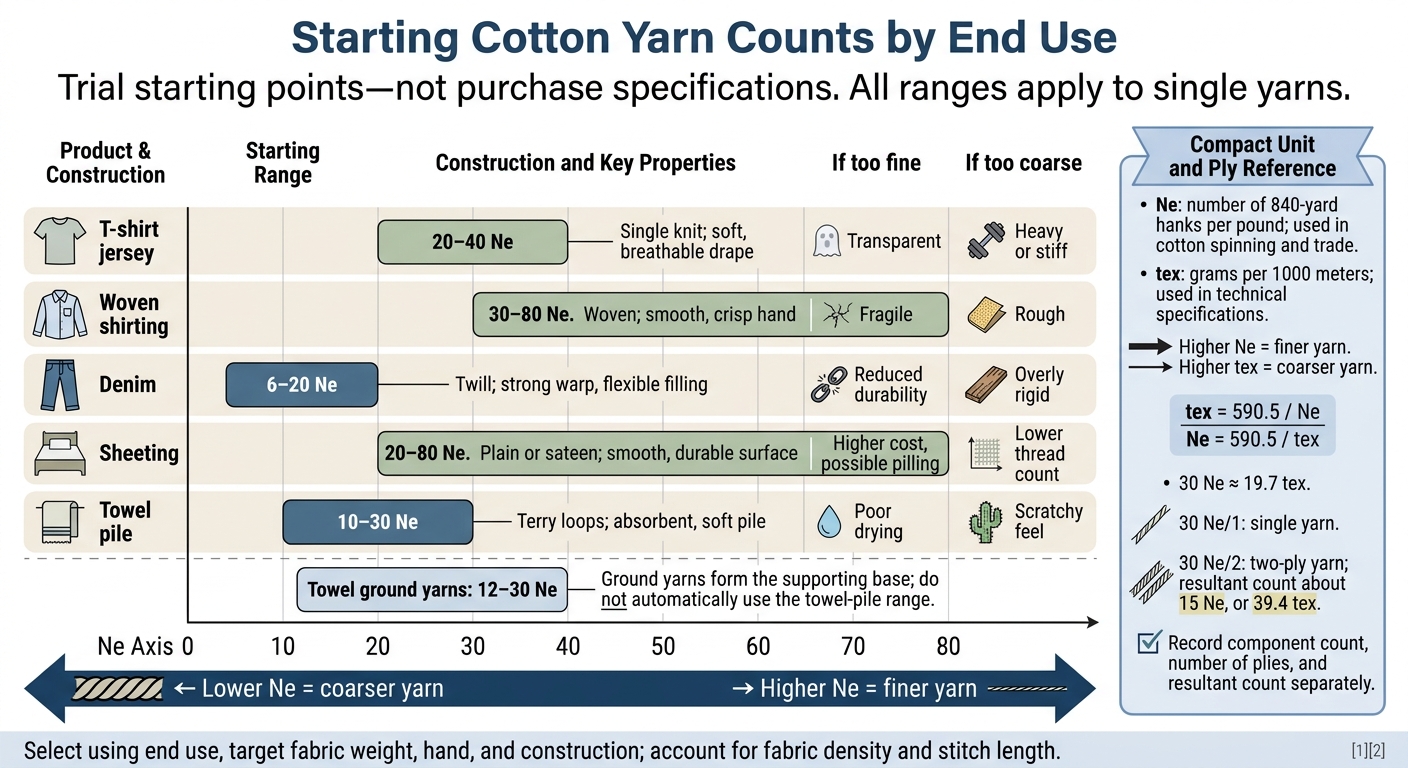
Cotton Yarn Count Ranges by Product
Convert Between Ne and tex
Ne counts the number of 840-yard hanks per pound. Tex measures yarn weight in grams per 1,000 meters.
To switch units, use tex = 590.5 / Ne or Ne = 590.5 / tex.
| Feature | English cotton count (Ne) | tex |
|---|---|---|
| Definition | 840-yard hanks per pound | Grams per 1,000 meters |
| Mill usage | Cotton spinning and trade | Technical specifications |
Thus, 30 Ne ≈ 19.7 tex.
Record both units, and specify whether the yarn is single or plied.
Record a single yarn as 30 Ne/1 and a two-ply yarn as 30 Ne/2. A 30 Ne/2 yarn has half the single-yarn count: about 15 Ne, or 39.4 tex.
Keep the component count, number of plies, and resultant count in separate fields. This helps production teams distinguish strand fineness from finished-yarn thickness.
Match Count Ranges to Cotton Products
Once you've converted to one unit, narrow your starting range by end use, target fabric weight, hand, and construction. These ranges are trial starting points - not purchase specs. Every range below applies to single yarns.
| Product | Starting range | Construction and key properties | If too fine / if too coarse |
|---|---|---|---|
| T-shirt jersey | 20–40 Ne | Single knit; soft, breathable drape | Transparent / Heavy or stiff |
| Woven shirting | 30–80 Ne | Woven; smooth, crisp hand | Fragile / Rough |
| Denim | 6–20 Ne | Twill; strong warp, flexible filling | Reduced durability / Overly rigid |
| Sheeting | 20–80 Ne | Plain or sateen; smooth, durable surface | Higher cost, possible pilling / Lower thread count |
| Towel pile | 10–30 Ne | Terry loops; absorbent, soft pile | Poor drying / Scratchy feel |
Don't automatically use the towel-pile range for ground yarns. Ground yarns form the supporting base and have a separate starting range of 12–30 Ne. Shortlist counts based on fabric weight and construction, then account for density and stitch length - both can change the final choice.
Step 2: Check Cotton Quality and Mill Limits
Once you’ve selected a starting count, check that the cotton lot and mill can support it.
Check Fiber Data Against Mill Limits
Compare the candidate count from Step 1 with lot-specific HVI reports and the approval checks below. Use the mill’s limits - not a universal cotton specification.
| Check | Pass condition | Fail condition |
|---|---|---|
| Fiber length | Meets the mill’s minimum for the count and spinning system | Below the approved minimum |
| Length uniformity | Meets the mill’s limit for consistent drafting | Below the limit |
| Micronaire | Within the approved blend range | Outside the approved range; below 3.0 needs particular scrutiny |
| Strength | Meets the mill’s HVI strength minimum | Below the requirement for the cotton type and count |
| Maturity | Meets the agreed maturity specification | Low maturity creates concerns about neps and uneven dyeing |
| Cleanliness | Trash and seed-coat fragments stay within mill limits | Excess contamination threatens yield or fabric appearance |
Micronaire reflects both fineness and maturity, so read it alongside length and strength. 3.5–4.9 is a common screening range for ring spinning, while readings below 3.0 need particular scrutiny. A maturity ratio above 0.85 is preferred.
If the lot passes, check whether the spinning line can maintain the selected count at production speed.
Check Spinning, Weaving, and Knitting Limits
Check the actual spinning line - not just its rated count range. Review preparation, drafting, and output limits. Finer counts put tighter demands on spinning and may lower productivity. Factor combing waste into capacity and cost checks: combing commonly removes 15–25% of fiber as noil.
Confirm knitting gauge with the knitting team. For weaving, check warp strength, sizing, abrasion, and finishing limits. Review winding and electronic clearing settings to keep thick places, thin places, and foreign fibers from passing downstream.
Next, check whether the same cotton can be supplied for repeat production.
Confirm Cotton Supply for Repeat Orders
Approve the supply plan, not just the sample. Confirm there’s enough suitable cotton for the initial run and that the blend can be sourced again for repeat orders.
Keep bale-blending records for color, micronaire, and staple length. Get lot-specific quality records directly from suppliers, too. A supplier listing alone does not prove the cotton suits the selected count.
Step 3: Test Quality, Performance, and Cost
Measure Yarn and Fabric Results
Once the count passes fiber and mill checks, test it in trial production under controlled settings. Use a twist tester to measure turns per inch or meter. Incorrect twist can change hand, strength, and shrinkage independently of count. Match gauge, stitch length, tension, and finishing to the trial plan. Record only setting changes that affect results.
Record count, strength, elongation, evenness, hairiness, thick places, thin places, and neps. Use ASTM D2256 or ISO 2062 for tensile testing. Then test the finished fabric against the customer’s acceptance limits for weight, shrinkage, pilling, colorfastness, and seam quality.
Compare Fine, Medium, and Coarse Counts
Use trial results to compare these count bands before final approval. Treat them as a reference - not as new selection rules.
| Count category | Count range | Typical applications | Key trade-off |
|---|---|---|---|
| Fine | Above Ne 40/1 | Lightweight knits, premium shirting | Needs combed fiber and ring or compact spinning |
| Medium | Ne 20/1–40/1 | Standard T-shirts, everyday pullovers | Suits many everyday products |
| Coarse | Below Ne 20/1 | Heavy sweaters, denim, towels, workwear | Often rotor-spun for cost |
Final performance still depends on fiber quality, twist, construction, and finishing.
Approve Production Quality and Cost Targets
Approve the trial when yarn strength, imperfections, fabric weight, and finished performance meet the agreed limits - and those results hold in production-scale runs. Confirm cotton availability and production efficiency, too.
Once performance meets the limits, compare cost per pound of usable yarn on the same basis for every trial: divide total production cost by the pounds of yarn that meet specification. Include cotton, processing, and waste costs in each trial. If a trial fails, adjust count, twist, or construction, then repeat the failed tests.
Conclusion: Record and Approve the Selected Count
After trial validation, document the approved count and the evidence behind it. The selected count must meet quality and cost targets through spinning, fabric formation, and finishing.
Complete the Mill Approval Checklist
Use this checklist before releasing the order:
- Count specification: Record the count system, target and tolerance, ply, twist level, and twist direction.
- Cotton and process: Include fiber-lot HVI data, bale blend, spinning method, approved machine settings, and process limits.
- Test evidence: Attach yarn results, fabric trial approval, and the approved cost result.
- Customer requirements: Confirm required certificates, sourcing approvals, quality approvals, and buyer sign-off.
Archive the approved settings, lot numbers, blending sheets, and test results so repeat orders match the approved run. Reapproval is required when the cotton blend, spinning system, key machine settings, fabric weight (GSM), or knitting gauge changes.
FAQs
Can I predict fabric GSM from yarn count?
Yarn count alone can’t reliably predict fabric GSM. A higher Ne means a finer yarn. Yarn count affects yarn thickness, how the fabric feels, and its likely weight, but final GSM also depends on the knit or weave construction, stitch density, and other process factors.
Mills typically control and check fabric weight during knitting or weaving rather than convert yarn count directly to GSM.
When should I choose plied yarn over singles?
Choose plied yarn when you need more strength, thickness, or performance than a single strand can deliver. Twisting two or more strands together changes both the yarn count and its physical properties.
For example, 8/2 Ne means two strands of 8-count yarn twisted together, producing an effective count of 4 Ne. The result is a heavier, more durable yarn for uses that call for extra weight or structural integrity.
How can I reduce pilling without changing yarn count?
Focus on reducing yarn hairiness and short-fiber content, not changing fineness. When short-fiber content is high, use combed preparation rather than carded, and choose longer, stronger cotton fibers. Preserve fiber length during ginning and cleaning: avoid overly aggressive cleaning that can cause excessive fiber breakage. Use adequate twist and maintain a consistent yarn structure to limit wear and fuzzing. [3]