If you farm cotton, GPS autosteer can cut waste fast. On a 1,235-acre cotton farm, research tied guidance to $58,300 a year in chemical and fertilizer savings and $68,700 total annual profit gain. And by 2023, 86% of U.S. cotton growers were already using autosteer.
Here’s the short version:
- Cotton takes many passes, so small steering errors stack up
- Overlaps waste seed, fertilizer, and chemicals
- Skips leave acres untreated or uneven
- Autosteer keeps passes lined up, even during long days or night work
- Planting, spraying, and strip-till tend to show the fastest payback
- Higher accuracy matters more when input costs are high
- A simple check is: acres × passes × cost per acre × overlap cut
I’d boil the article down to this: autosteer pays when it cuts overlap on the passes that cost you the most. For cotton, that usually means planting and in-season application work, where a few inches off-line can turn into extra seed, extra spray, more fuel, and more labor by season’s end.
Quick Comparison
| Guidance option | Best fit in cotton | Accuracy | Cost impact |
|---|---|---|---|
| Manual / lightbar | Basic tillage | Lowest | Little to no input savings |
| SF1 | Broadcast work | ~6 in. | Small savings |
| SF3 | Planting, spraying | ~3 in. | Strong fit for many farms |
| RTK | Strip-till, repeat tracks | <1 in. | Highest savings on exact-pass jobs |
If I were sizing this up for my own farm, I’d focus on three numbers first: acres, pass count, and input cost per acre.
Where Cotton Growers Lose Money Without Autosteer
Overlap and skips in planting, spraying, and tillage
When steering drifts even a little, costs go up without adding any extra output. Overlaps put seed, fertilizer, or chemicals on the same strip twice. Skips leave parts of the field untreated, which can drag down yield potential. Those are the exact trouble spots autosteer cuts back in day-to-day cotton work.
The biggest hit usually comes from chemical and fertilizer applications. In a modeled 500-hectare (about 1,235-acre) cotton farm, chemical and fertilizer savings made up $58,300 of the total $68,700 annual profit gain from tractor guidance. Seed isn't cheap either. With seed costs topping $600 per bag, planting overlap burns cash right away.
These losses get worse when operators are working long hours or trying to finish in poor light.
Fatigue, night work, and operator inconsistency
Cotton planting and spraying windows are tight. When the weather gives growers a shot, they often run long days and keep going after dark to cover acres. That's when manual steering tends to slip. Long hours and low-light conditions make it harder to stay consistent, which leads to more skips and overlap.
Dust and fog add another layer of trouble. It gets tougher to hold a straight line and keep the same spacing from pass to pass. Without autosteer, fatigue shows up in the field as uneven coverage, missed areas, and inputs that don't pay off.
The waste doesn't stay tied to one pass. It shows up across planting, spraying, and tillage.
Why repeated cotton passes turn small errors into real losses
A small steering mistake on one pass may not look like much. But over a season, with repeated cotton passes, those little misses stack up into real dollar-per-acre losses. Manual steering also covers fewer acres per hour, which pushes up fuel, labor, and equipment wear.
On a 500-hectare cotton operation, guidance systems cut labor by 105 hours and engine hours by 70 per year.
sbb-itb-0e617ca
How GPS Autosteer Systems Reduce Those Costs
How the system works on a cotton tractor
GPS autosteer on a cotton tractor comes down to four main parts: a GPS/GNSS receiver on the cab roof, a correction signal that tightens satellite accuracy, a steering controller that moves the tractor’s steering mechanism, and an in-cab display where the operator sets guidance lines and watches overlap.
The operator sets an A-B line or a curved track. From there, the steering controller keeps the tractor on that path with very little manual input. That steady line helps cut overlap and missed rows on every pass across the field. And that’s where the money side starts to show up.
Common systems growers may use
Cotton farms don’t all run the same setup. A lot depends on the job being done.
At Fiveash Family Farm in Georgia, Trimble autosteer on Case IH tractors and Raven AutoBoom section control are used to keep strip-till, planting, and spraying lined up. Older tractors and non-Deere models can also be fitted with universal kits like the John Deere ATU 300, which mounts right to the steering column.
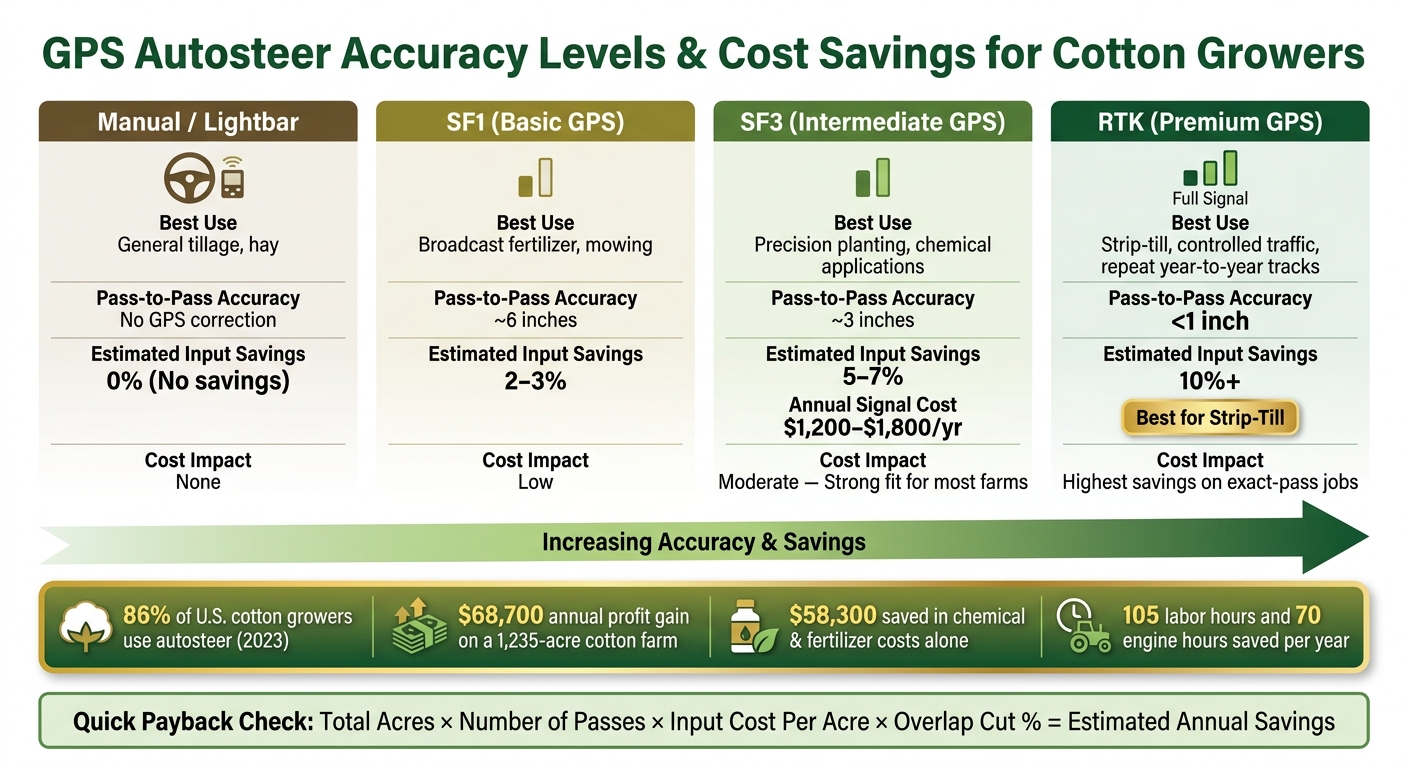
Accuracy levels and how they affect savings
After the steering hardware is installed, the correction signal is what decides how tightly the tractor stays on line. That accuracy level shapes how much overlap or gap is left in the field, and that directly affects input costs. The tighter the line, the less room there is for waste.
Higher accuracy matters most on passes where the same lines need to be repeated and the inputs are expensive enough that small misses hurt.
| Accuracy Level | Pass-to-Pass Accuracy | Typical Cotton Use |
|---|---|---|
| SF1 (Basic) | ~6 inches | Tillage, broadcast fertilizer |
| SF3 (Intermediate) | ~3 inches | Precision planting, chemical applications |
| RTK (Premium) | <1 inch | Strip-till, controlled traffic, repeatable year-to-year tracks |
For tillage and broadcast work, SF1 is often enough. For planting and spraying, though, SF3 or RTK can pay back fast. Cotton seed can cost as much as $600 per bag, so even a small amount of overlap can get expensive in a hurry.
"RTK is what you need for strip-till, controlled traffic patterns, repeated row spacing on the exact same tracks every year, and any operation where the cost of even small overlap on inputs adds up." - Koenig Equipment
SF3 correction signals run about $1,200 to $1,800 per year. In a full cotton season, that’s a small line item next to the input savings it can help protect.
Digital solutions for tractor GPS guidance and autosteer
How 86% of Growers Are Cutting Costs in Real Cotton Operations
GPS Autosteer Accuracy Levels: Cost Savings for Cotton Growers
Those field-level savings stand out most in planting, spraying, and strip-till. In one modeled 1,235-acre cotton operation, guidance cut chemical and fertilizer costs by $58,300 and seed costs by $3,500, which pushed annual profit up by $68,700. The reason is pretty simple: tighter pass-to-pass accuracy means fewer overlaps and less waste.
How reduced overlap lowers seed, fertilizer, and chemical costs
Cotton seed can cost as much as $600 per bag, so overlap during planting isn't just annoying - it hits the budget fast. When autosteer keeps the tractor on a steady line, growers can avoid the extra passes that often happen with manual steering.
That gets even better at the field edge. Automatic Section Control (ASC) turns off rows or nozzles on ground that's already been covered, which helps cut overlap on odd-shaped fields and headlands.
Fuel, labor, and acres-per-day efficiency
Cleaner passes also mean fewer corrections, less time spent fighting the wheel, and steadier field coverage over the day. At about $11.78 per hour, fewer labor hours show up as direct operating-cost savings. And when operators don't have to steer every second, fatigue tends to drop during long planting and spraying days.
Comparison table: Manual driving vs. lightbar vs. autosteer vs. RTK
The cost savings grow as guidance gets better. Here’s how common cotton guidance levels stack up by use case and expected input savings.
| Guidance Level | Best Use Case in Cotton | Estimated Input Savings |
|---|---|---|
| Manual / Lightbar | General tillage, hay | No savings |
| SF1 (Basic GPS) | Broadcast fertilizer, mowing | Low (2–3%) |
| SF3 (Intermediate) | Planting, spraying | Moderate (5–7%) |
| RTK (Premium) | Strip-till, repeat tracks | High (10%+) |
The biggest payoff usually comes from the passes with the highest input cost and the smallest margin for overlap.
Which Cotton Operations See the Fastest Payback
Planting and strip-till payback
The fastest payback usually shows up on passes where accuracy has to be dead-on and inputs cost a lot. That’s why planting and strip-till tend to move to the front of the line. Seed is expensive, and row position needs to stay exact. If your implement offsets are wrong on day one, you can wipe out the accuracy edge in a hurry.
RTK becomes a big deal when the planter has to come back to the same strips season after season.
Once planting is done, the next place savings tend to show up is in repeated in-season passes.
Spraying, fertilizing, and defoliation
Every in-season pass creates another shot at overlap or skips. For spraying and fertilizing, mid-tier guidance is often enough to get the job done. When you pair autosteer with Automatic Section Control (ASC), you can cut repeat coverage on wide booms, like the 90-foot setup at Fiveash Family Farm in Donalsonville, GA.
That’s where the money usually leaks out. Less overlap is the main source of savings. Operator comfort is nice, but it’s not the main thing paying the bill.
A simple payback check for your own acres
A simple way to size up payback is to use this math: total annual acres × number of passes × input cost per acre × overlap cut, then add labor hours and fuel gallons saved.
A cautious starting point is a 5% to 10% overlap cut. SF3 annual fees run $1,200 to $1,800 per year. Farms under 100 to 200 acres often need more acres packed into those passes to make the yearly fee pencil out. On the other hand, operations around 1,000 acres or more can stack savings much faster across planting, spraying, and defoliation passes.
So when you run the numbers, focus on three things:
- Acres
- Pass count
- Input cost
Conclusion: The Main Reasons GPS Autosteer Pays on Cotton Acres
Autosteer pays because cotton demands a lot of passes, and small steering mistakes add up fast. A little overlap here and a missed strip there can turn into wasted seed, extra chemical use, more fuel burned, and more labor hours over the course of a season.
That’s why the math is pretty simple. More passes mean more chances to waste money. Tighter guidance cuts overlap and skips, which helps protect high-cost seed and trims chemical waste on every trip across the field.
Those field-level savings stand out even more when they also reduce operator strain and tractor time. Growers also see labor gains, with fewer hours behind the wheel and less fatigue during long days.
Payback tends to come fastest on bigger acreages and in systems with several high-cost passes. For most cotton farms, autosteer earns its keep when it cuts overlap on the passes that cost the most. Match the guidance accuracy to the job.
FAQs
How do I know if autosteer will pay on my cotton acres?
Look at your total acres, field shape, and day-to-day goals. Bigger farms often get paid back sooner because the cost is spread over more acres. Smaller farms have to look harder at the upfront price and ask a simple question: will the time and input savings be enough to make it worth it?
Put most of your attention on jobs where precise steering helps you avoid costly overlap and skips. RTK often makes sense for strip-till, cover crops, and repeatable rows. For general tillage or broadcast work, standard accuracy may be all you need.
What accuracy level do I need for planting, spraying, and strip-till?
It depends on the job.
For planting and spraying, an intermediate correction signal with about 3-inch pass-to-pass accuracy is often enough. That’s why it’s a common pick for many producers.
For strip-till, RTK is usually the better fit. It delivers sub-inch pass-to-pass accuracy plus year-to-year repeatability. In plain English, that means exact tracks, precise row spacing, and tighter control over traffic patterns.
Can autosteer be added to older cotton tractors?
Yes. Autosteer systems can often be added to older cotton tractors with guidance systems bought separately and connected to the equipment already in place.
Because these systems are built to be more affordable and fairly simple to install and calibrate, they can help growers upgrade older machinery without buying a new tractor.