30 Ne ≈ 50.8 Nm ≈ 19.7 tex ≈ 177 denier - all describe the same yarn count. I use these conversions to compare supplier specs, but I check the unit and ply before treating two yarns as a match.
Here’s my checklist:
- Read the direction: Higher Ne or Nm means finer yarn; higher tex, denier, or dtex means coarser yarn.
- Convert without early rounding: For example, tex ≈ 590.5 ÷ Ne. Keep intermediate values unrounded.
- Write a clear spec: Include the count system, ply, spinning system, and agreed tolerances - not just “30 count.”
- Check the shipment: Request a lot-specific report and verify count through conditioned mass-and-length testing, such as ASTM D1907.
<u>A conversion compares numbers; it does not verify the delivered yarn.</u> I treat raw cotton quality and yarn performance as separate checks.
Yarn count conversion factors | Part-1
sbb-itb-0e617ca
How Yarn Count Systems Measure Fineness
Yarn count measures fineness in one of two ways: length per mass or mass per length. Indirect systems use length per mass, while direct systems use mass per length.
Indirect Systems: Ne and Nm
English cotton count (Ne) counts the number of 840-yard hanks that weigh exactly one pound. Metric count (Nm) counts the number of 1,000-meter lengths per kilogram. Both use the indirect system: a higher count means finer yarn.
Notation also shows ply: Ne 30/1 means 30-count single-ply yarn. Avoid “30s” unless the supplier also states the count system and ply.
Direct Systems: Tex and Denier
Tex measures grams per 1,000 meters, while denier measures grams per 9,000 meters. Denier is used mainly for filament yarns. Decitex (dtex) measures grams per 10,000 meters, with 1 tex = 10 dtex. In direct systems, a higher count means heavier, coarser yarn.
Yarn Count System Reference Table
Check the measurement basis in this table before reading a yarn specification.
| System | Symbol | Measurement basis | Type | Higher number means | Common use |
|---|---|---|---|---|---|
| English cotton count | Ne | Number of 840-yard hanks per 1 pound | Indirect | Finer yarn | U.S. and UK cotton yarn |
| Metric count | Nm | Number of 1,000-meter lengths per 1 kilogram | Indirect | Finer yarn | International standard for various fibers |
| Tex | tex | Grams per 1,000 meters | Direct | Heavier, coarser yarn | Common metric system for yarns |
| Denier | den or D | Grams per 9,000 meters | Direct | Heavier, coarser yarn | Mainly for filament yarns |
| Decitex | dtex | Grams per 10,000 meters | Direct | Heavier, coarser yarn | Fine filaments and microfibers |
These measurement bases set the formulas below for converting between Ne, Nm, tex, and denier.
Yarn Count Conversion Formulas and Examples
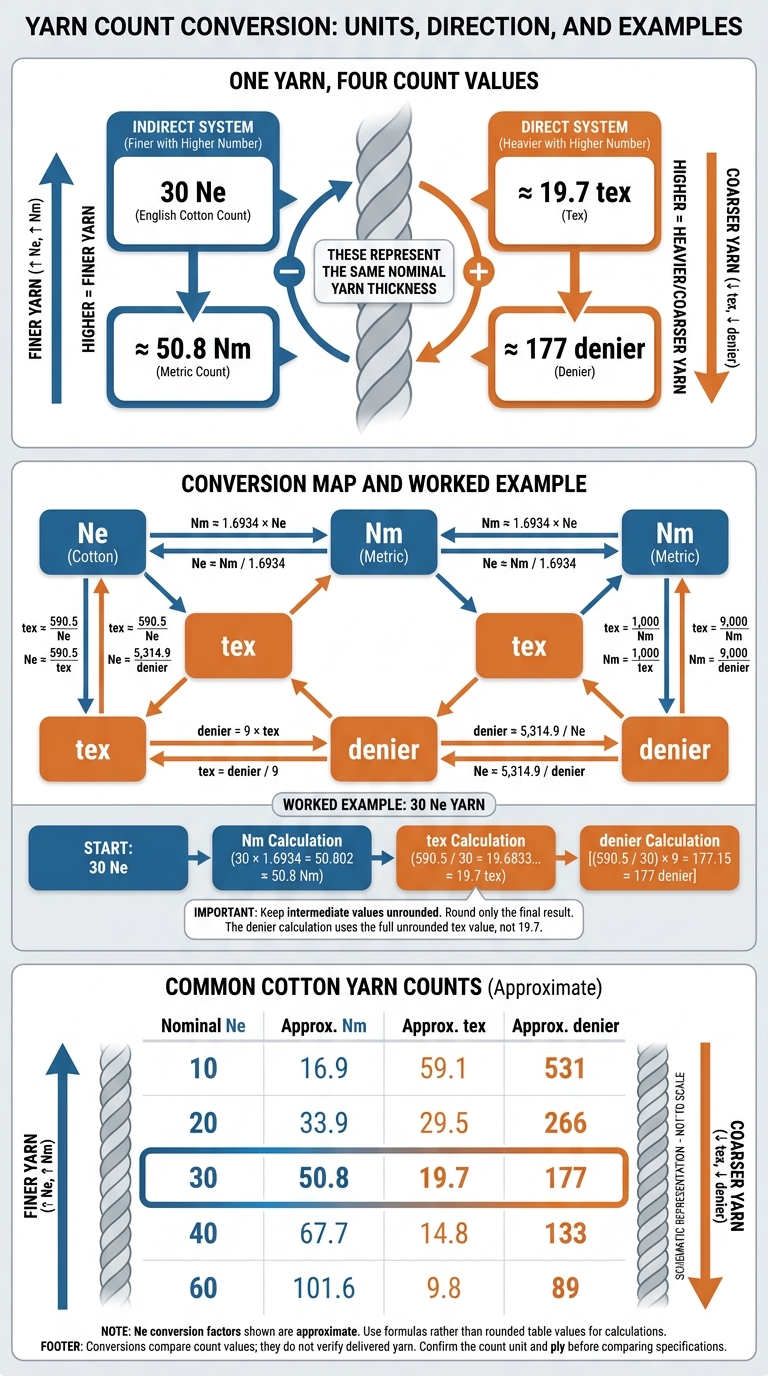
Yarn Count Conversion: Ne, Nm, Tex and Denier
Conversion Formulas in Both Directions
Use these formulas to convert between Ne, Nm, tex, and denier based on the measurement bases above.
| Conversion pair | Forward formula | Reverse formula |
|---|---|---|
| Ne ↔ tex | tex ≈ 590.5 / Ne | Ne ≈ 590.5 / tex |
| Nm ↔ tex | tex = 1,000 / Nm | Nm = 1,000 / tex |
| Ne ↔ Nm | Nm ≈ 1.6934 × Ne | Ne ≈ Nm / 1.6934 |
| tex ↔ denier | denier = 9 × tex | tex = denier / 9 |
| Ne ↔ denier | denier ≈ 5,314.9 / Ne | Ne ≈ 5,314.9 / denier |
| Nm ↔ denier | denier = 9,000 / Nm | Nm = 9,000 / denier |
Ne conversions are approximate because Ne is defined by 840-yard hanks. Keep intermediate values unrounded and round only the final result.
Worked Example: Converting 30 Ne
To Nm: 30 × 1.6934 = 50.802 ≈ 50.8 Nm.
To tex: 590.5 / 30 = 19.6833… ≈ 19.7 tex.
To denier: (590.5 / 30) × 9 = 177.15 ≈ 177 denier.
Use the full tex value - not the rounded 19.7 - in the denier calculation.
Conversion Table for Common Cotton Yarn Counts
| Nominal Ne | Approx. Nm | Approx. tex | Approx. denier |
|---|---|---|---|
| 10 | 16.9 | 59.1 | 531 |
| 20 | 33.9 | 29.5 | 266 |
| 30 | 50.8 | 19.7 | 177 |
| 40 | 67.7 | 14.8 | 133 |
| 60 | 101.6 | 9.8 | 89 |
These table values are approximate. For exact conversion work, use the formulas above, keeping in mind that the Ne conversion factors are approximate.
Use the conversions to compare supplier specs and check incoming yarn against its stated count unit.
Using Yarn Counts in Purchasing and Quality Control
Use the conversion table to compare supplier specs before issuing a purchase order. Yarn count applies to spun yarn - not raw cotton quality. Ginning separates lint from seed; spinning sets the count. Conversions help align purchase orders, but they don’t tell you how the yarn will perform.
Confirm Units and Yarn Construction
After confirming the unit, spell out the yarn construction. Include the count, ply, and spinning system on every spec.
Ne 40/2 identifies two-ply yarn.
Check the supplier’s notation and confirm whether the count refers to a single ply or the finished yarn. Set tolerances for count, evenness, imperfections, hairiness, strength, and elongation. Record lot numbers and production dates in technical records, and request a lot-specific test report with each shipment.
Avoid Common Conversion Errors
Check unit labels before converting so you don’t mix up Ne and Nm or reverse the units. Converting the result back can catch arithmetic or transcription errors, but it cannot verify the delivered yarn. Label every result with its unit.
Verify Yarn Count by Measuring Mass and Length
When a shipment arrives, check the lot against the written spec. Test samples from that actual lot: condition them using the agreed method, then measure a known length and its mass. Record the conditioning conditions, sampling method, and results, and compare the results with the agreed tolerances.
Use the same conditioning method each time - not processing moisture targets. Count testing does not assess raw fiber quality or yarn performance, so request separate fiber and yarn reports.
Conclusion: Keep Yarn Count Specifications Consistent
Apply the same conversion logic to every spec sheet: higher Ne or Nm means finer yarn; higher tex or denier means coarser yarn.
30 Ne ≈ 50.8 Nm ≈ 19.7 tex ≈ 177 denier.
Each value expresses the same yarn in a different count system.
Before approving a specification, confirm the count system and yarn construction. Keep full precision until the final rounding step, and record both the original and converted values.
Use conversions to compare yarn counts, but test the shipped lot to confirm its actual count. A conversion alone doesn't prove the delivered count. Verify it with standardized mass-and-length testing, such as ASTM D1907, and record both the stated count and the test result in the lot file.
FAQs
How do I convert the count of plied yarn?
To calculate the count of plied yarn, factor in how many strands are twisted together. Combining strands increases the weight per unit of length, so you get less length per unit of weight.
For example, 8/2 Ne means two strands of 8-count yarn twisted together. Divide 8 by 2 to get an effective count of 4 Ne. The first number is the count of each individual yarn; the second is the number of strands.
Can yarns with the same count perform differently?
Yes. Yarns with the same count can still differ in strength, hairiness, and evenness. These differences come from the spinning technology, fiber quality, and processing methods used.
Ring-spun, compact-spun, and rotor-spun yarns don’t always perform the same way. The raw cotton blend, whether the fibers are carded or combed, and manufacturing settings such as twist levels also affect the finished fabric’s texture, durability, and appearance.
How does moisture affect yarn count testing?
Cotton absorbs moisture from the air, so its weight changes with humidity. Yarn count testing weighs a set length of yarn, which means moisture changes can affect the results’ accuracy.
The industry maintains a moisture regain range of 8% to 10% during processing to keep measurements consistent. When checking yarn specifications, account for moisture so the measured weight reflects the fiber’s mass - not the water it has absorbed.