I start with compatible cotton lots - not the cheapest bales - to target stronger yarn at a lower cost per pound. That means checking fiber length, strength, maturity, and short-fiber content, then testing the blend under fixed mill settings.
My checklist is simple:
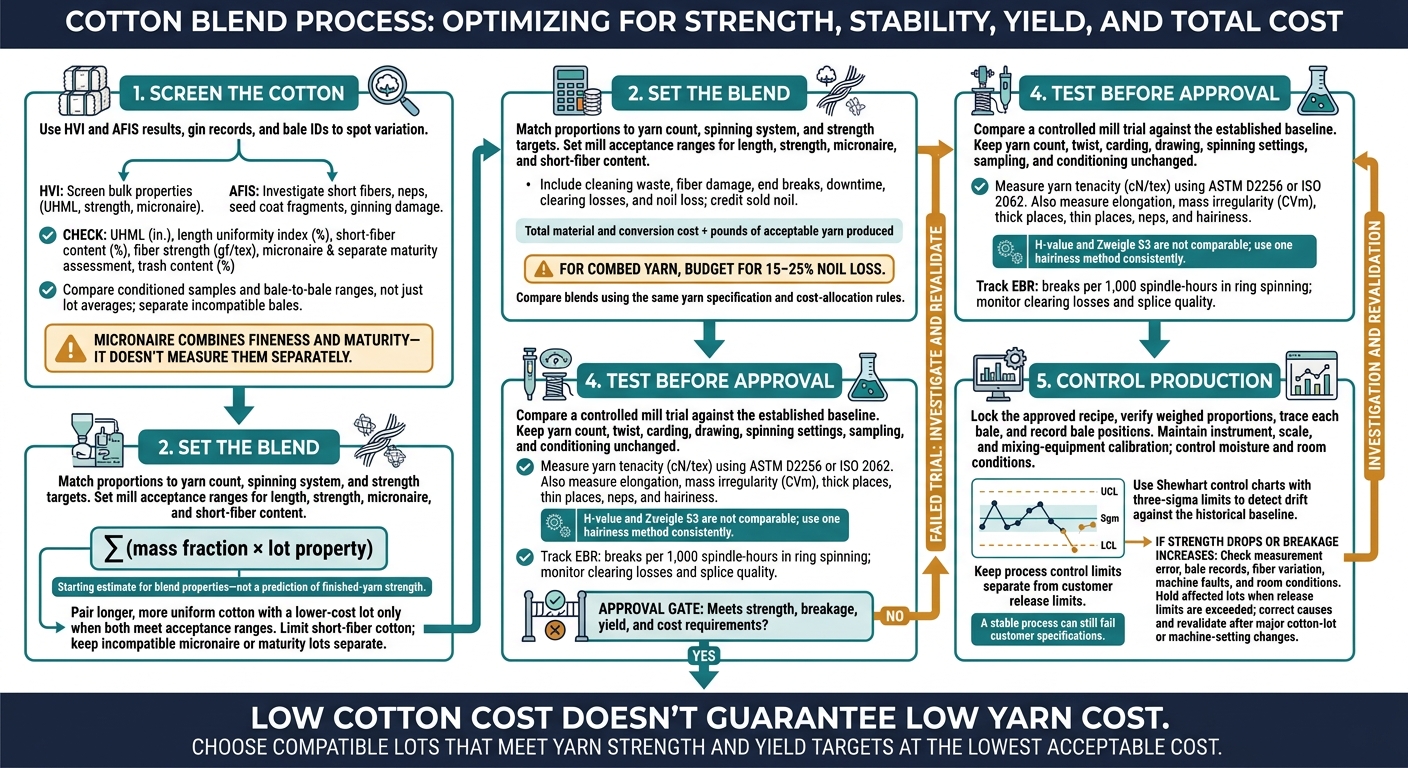
- Screen the cotton: Use HVI and AFIS results, gin records, and bale IDs to spot variation.
- Set the blend: Match proportions to yarn count, spinning system, and strength targets.
- Count the losses: Compare cost in $/lb of saleable yarn, including waste and downtime. For combed yarn, budget for 15–25% noil loss.
- Test before approval: Check yarn strength, evenness, hairiness, and end breaks - not strength alone.
- Control production: Lock the approved recipe, trace each bale, and keep <u>process control limits separate from customer release limits</u>.
My rule: a lower cotton price only pays off if your blend meets yarn specifications without losing the savings to waste or breakage.
Cotton Blending: 5 Steps to Stronger, Cost-Efficient Yarn
Test Fibers and Select Compatible Lots
Fiber Properties That Affect Yarn Strength
Screen lots using the full set of properties, rather than checking one metric at a time. Micronaire combines fineness and maturity - it doesn’t measure them separately. If low micronaire points to possible neps or processing waste, check maturity on its own.
| Measurement | What it tells you | Why it matters |
|---|---|---|
| Upper half mean length (UHML), in. | Average length of the longer half of fibers | Helps assess strength, evenness, and hairiness |
| Length uniformity index, % | Mean length relative to UHML | Helps assess drafting stability and yarn evenness |
| Short-fiber content (SFC), % | Share of fibers below the test’s short-length cutoff | Higher levels can increase irregularity, hairiness, and waste |
| Fiber strength, grams-force per tex (gf/tex) | Fiber tenacity | Helps assess strength potential and breakage risk |
| Micronaire and maturity | Combined fineness/maturity indicator and separate maturity assessment | Affect neps, dye uptake, and processing waste |
| Trash content, % | Nonfiber material | Affects appearance grade and waste |
Together, these measurements help you screen cotton for blend compatibility.
USDA Classing, HVI, and AFIS Testing
Link each USDA classing report to the bale’s identity, crop year, origin, and storage history. Use High Volume Instrument (HVI) testing to select lots based on bulk properties such as UHML, strength, and micronaire. Use Advanced Fiber Information System (AFIS) analysis to investigate suspected ginning damage, short fibers, neps, and seed coat fragments, including causes of unexpected waste.
Compare conditioned samples and bale-to-bale ranges - not just lot averages. The Spinning Consistency Index (SCI) combines HVI properties to estimate spinning potential, but it can’t account for fiber arrangement in yarn or spinning variation.
Use HVI to sort candidate bales and AFIS to explain outliers.
Gin Records and Bale Separation
Keep classing data, gin records, ginning settings, storage history, and blend sheets linked to each bale. That lets you trace deviations to specific bales rather than the full shipment.
Separate bales that fall outside the mill’s compatible property ranges, especially for micronaire and maturity. Retest suspect cotton for breakage damage. Also investigate seed coat fragments: they may survive carding and show up as dark specks in fabric.
Once you’ve identified compatible lots, set blend ratios based on yarn targets and cost.
sbb-itb-0e617ca
Design Blends Around Yarn Requirements and Cost
After identifying compatible lots, set the yarn count, spinning system, and strength target. Set mill acceptance ranges for staple length, strength, micronaire, and short-fiber content. The blend needs to meet the strength target without disrupting stable spinning.
Blend Proportions and Weighted Estimates
Use Σ(mass fraction × lot property) to screen fiber properties. This gives a starting estimate for the blend - not a prediction of finished-yarn strength - because the calculation can miss interactions between fibers.
Pairing Lots and Managing Mixing Risks
Pair longer, more uniform cotton with a lower-cost lot only if both meet the mill’s acceptance ranges. Limit short-fiber cotton, and keep bales with very different micronaire or maturity separate. Avoid adding tiny amounts of premium cotton that cause drafting mismatch and unevenness. Drafting mismatch increases end breaks and makes strength less consistent.
| Property difference | Benefit | Processing risk | Control |
|---|---|---|---|
| Longer, more uniform cotton paired with an acceptable lower-cost lot | Strength potential while controlling material cost | Uneven drafting if length distributions differ sharply | Review length distributions and adjust roller settings if needed |
| Higher short-fiber content in the cheaper lot | Lower purchase cost | More irregularity and end breaks | Limit its share and monitor uniformity |
| Very different micronaire or maturity | More purchasing flexibility | Neps and uneven dye uptake | Keep incompatible bales separate |
Lock the laydown ratio before production starts, and keep it constant. Record bale positions, and use opening and blending equipment to spread fibers evenly. If the blend underperforms, check fiber variation before changing the recipe.
Compare Yarn Performance and Total Cost
Rank blends by yarn performance and cost per pound of acceptable yarn. Aim for the lowest acceptable cost at the required strength.
| Blend approach | Advantage | Disadvantage | What should justify selection |
|---|---|---|---|
| High-strength | Greater strength potential | Higher cotton purchase cost | Required yarn strength and fewer end breaks |
| Cost-optimized | Lower material spending | Waste or downtime may erase savings | Lower cost per pound of acceptable yarn |
| Consistency-focused | Narrower property variation | Less purchasing flexibility | Stable spinning and fewer end breaks |
Calculate cost per pound of acceptable yarn by dividing total material and conversion cost by the pounds of acceptable yarn produced. Express the result in $/lb.
Include cleaning waste, fiber damage, end breaks, downtime, clearing losses, and noil loss. Credit sold noil, and budget for 15–25% noil loss in combed blends. Use the same yarn specification and cost-allocation rules when comparing blends.
Next, test the blend in production and use the results to set release limits.
Validate Blends and Control Production
Measure Yarn Strength and Spinning Stability
Once a blend passes compatibility and cost screening, test it in a controlled mill trial against the mill’s established baseline. Keep yarn count, twist, carding, drawing, and spinning settings unchanged. Use the same sampling and conditioning procedures for baseline and test lots so the results reflect the blend alone.
Measure tenacity (cN/tex) using ASTM D2256 or ISO 2062. Record elongation, mass irregularity (CVm), thick places, thin places, neps, and hairiness. Stick with one hairiness method throughout: H-value and Zweigle S3 are not comparable.
Track EBR as breaks per 1,000 spindle-hours in ring spinning. Keep winding-clearer settings comparable, and monitor clearing losses and splice quality. Higher average strength isn't enough to approve a blend if it also causes more breakage or reduces saleable yarn yield.
Set Release Limits and Correct Deviations
Document the approved blend recipe, then check bale identities and weighed proportions against it. Maintain calibration schedules for testing instruments, scales, and mixing equipment. Keep fiber moisture and room conditions within operating ranges. Verify repeatability before treating a strength shift as a blend problem.
If the trial passes, lock the recipe into process control. Use Shewhart control charts with three-sigma limits to track yarn count and quality against the historical baseline and detect drift from the approved blend. Keep process limits separate from customer-based release limits. A stable process can still produce yarn that fails customer specifications.
If strength drops or breakage increases, check for measurement error, bale-record discrepancies, fiber variation, machine faults, and changes in room conditions. Hold the affected lot when release limits are exceeded, correct the cause, and revalidate after major changes to cotton lots or machine settings.
Conclusion: Select, Test, and Control the Blend
After the trial, choose compatible lots that meet yarn strength and yield targets at the lowest acceptable cost. Select lots for the yarn target, not average bale properties. Approve the blend only when mill trials confirm that it meets strength, breakage, and cost requirements.
Low cotton cost doesn’t guarantee low yarn cost. Include downtime, waste, clearing losses, and combing noil in the total cost. Combing typically removes 15–25% of the fiber, leaving less saleable yarn.
Link gin classing records and bale IDs to mill blend sheets, production dates, and yarn test results. These records help mills reproduce approved blends across shipments and production runs.
FAQs
How do I choose a starting blend ratio?
Start with your yarn-count requirements. Use USDA classing data and High Volume Instrument (HVI) measurements to group bales with compatible fiber length, strength, and micronaire. Target micronaire of 3.7–4.2 and short fiber content below 8–10%.
Keep superior-quality cotton additions at or above 20–25%; smaller additions can disrupt drafting. Use computerized bale management to keep blends consistent, and maintain blending sheets so you can repeat blends that work well.
How many trial runs should I test before approval?
The provided search results don’t state how many trial runs cotton blend approval requires. Industry best practices call for approving a yarn sample or lab dip before bulk production.
For sliver quality evaluation, standard preparation involves 5 to 10 drawbox passes to align fibers before testing strength, length, and maturity. Use calibrated equipment to verify sample count, tensile strength, elongation, and evenness.
When does stronger cotton justify its higher cost?
Stronger cotton is worth the higher price when production savings or premium product value exceed the added raw material cost. High-strength lint, typically 28 to 32 g/tex, lets mills spin at higher speeds, which can cut mill processing costs by 5% to 10%.
Stronger fibers are also needed for fine-count yarns and durable goods like denim or towels, where they can reduce breakage by 10% to 15%.