If I were sizing up cotton robots in 2026, I’d keep this simple: buy for scouting, spot spraying, supervised tractor work, and harvest flow, but not for boll picking.
Here’s the short answer:
- Working now: drone scouting, AI crop monitoring, camera-based spot spraying, supervised-autonomy tractors, and harvest logistics tools
- Worth watching: robotic weeders and post-harvest cleanup robots
- Hold off on: full robotic cotton picking
Why? Because the gap is clear in the numbers.
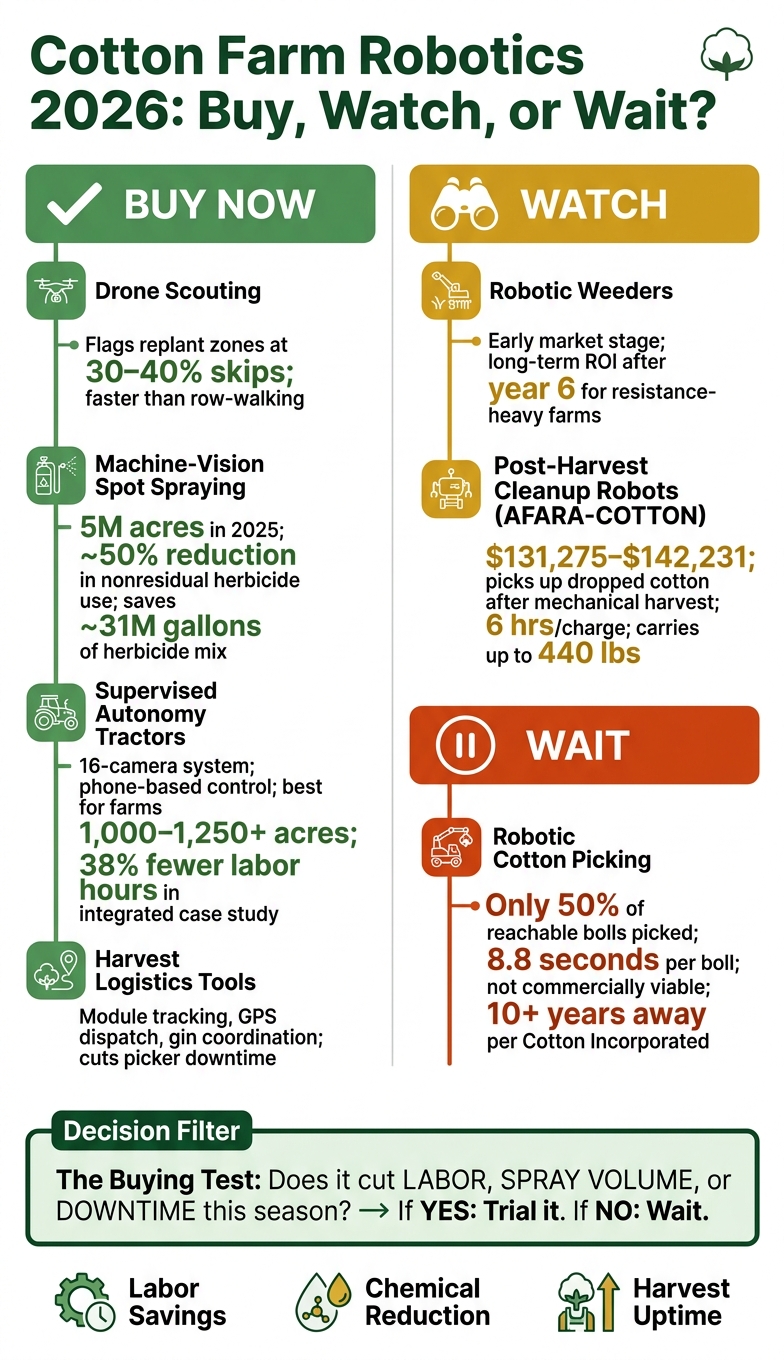
- John Deere said See & Spray covered 5 million acres in 2025 and cut nonresidual herbicide use by about 50%
- Drone imaging can help flag replant zones when skips reach about 30% to 40%
- One research cotton-picking robot reached only about 50% of reachable bolls at 8.8 seconds per boll
- Afara’s cleanup robot is priced around $131,275 to $142,231, but it cleans up dropped cotton after harvest, not the crop on the plant
So if you’re deciding where to put money, I’d use a plain filter: does it cut labor, spray volume, or downtime this season? If yes, it deserves a trial. If not, I’d wait.
Cotton Farm Robotics 2026: What's Ready, What to Watch, and What to Skip
Quick Comparison
| Tool | Where it fits | Status in 2026 | Main payoff | Main limit |
|---|---|---|---|---|
| Drone scouting | Stand counts, stress checks, replant calls | Sold now | Faster field checks | Weather, battery life, data workflow |
| Spot spraying | Midseason weed control | Sold now | Less herbicide use | Best before canopy closes |
| Supervised tractor autonomy | Tillage, bed prep, planting | Sold now / expanding | Less operator time | Needs RTK, mapping, cell service |
| Robotic weeders | Early weed control | Early market stage | Less hand weeding | Still early for many cotton farms |
| Harvest logistics tools | Module flow, truck dispatch, gin timing | Sold now | Less picker downtime | Needs tight coordination |
| Robotic cotton picking | Harvest | Not ready | Limited today | Too slow, too many misses |
I’d read the rest of the article through one lens: what is ready for day-to-day cotton acres, and what still belongs on the watch list.
sbb-itb-0e617ca
Field-Ready Robotics from Planting Through Midseason
Autonomous Tractors and Supervised Autonomy for Tillage and Planting
Autonomy makes the most sense on repetitive jobs like strip-till, pre-plant tillage, bed prep, and planting. In cotton, these are long, repeatable passes where the operator often does little beyond keeping the machine moving. That’s exactly where autonomous and supervised-autonomy tractors fit.
John Deere's autonomous tillage solution lets a grower start the machine in the field and activate it from a phone. From there, it follows a pre-mapped route on its own while the operator handles something else. The setup relies on RTK-guided GPS for sub-inch accuracy, plus pre-mapped boundaries, obstacles, and no-go zones. It also needs steady cell service so the supervisor can get alerts and check progress from a distance.
For most farms, the math tends to work at about 1,000-1,250 acres and up, where hardware and subscription costs can be spread across enough ground. On large cotton farms that already use precision guidance and digital field maps, supervised autonomy is often less of a leap than it sounds. The bigger change is teaching staff when to step in, not asking them to sit and watch a tractor all day.
That makes autonomy a practical planting-season tool. After that, the next gains usually come from finding problems early and spraying only where it pays.
Drone Scouting, Imagery, and AI Crop Monitoring
Drone scouting shines in the early season, especially for stand counts during the first 7-21 days after emergence. The flight itself isn’t the point. The point is making faster calls on stand counts, stress, and replanting.
Research at North Carolina State University used post-emergence UAV imagery and image analysis to count plants, find skips, and guide replant decisions. Compared with manual row-walking, the approach gave faster coverage and a more objective read on the field. Their work points to fields with 30-40% skips as replant candidates, which gives growers a data-backed threshold instead of a rough guess from the cab. Commercial platforms and regional service providers have pushed this further with automated stand count tools that build population maps and flag problem zones within hours of a flight.
As the season moves on, drones stay useful by mapping crop vigor, nutrient stress, and water variation across pivot corners, ridge tops, and low spots. Multispectral imagery can reveal patterns that are hard to spot from a truck, like early nitrogen deficiency, waterlogged areas after heavy rain, or uneven growth linked to planter performance. Flights tend to work best in steady mid-morning light with few shadows, and fields need safe takeoff and landing areas that meet U.S. UAV rules.
Those maps give growers a much clearer target. Instead of scouting an entire field the hard way, they can focus on the places most likely to need replanting, field checks, or a spray pass before the crop closes the row.
Machine-Vision Spot Spraying and Robotic Weed Control
In cotton, herbicide-resistant weeds, especially pigweed, make machine-vision spot spraying a strong fit. Camera-guided sprayers scan the field in real time and trigger individual nozzles only where weeds show up. In many field trials, growers in row crop systems have reported herbicide volume cuts of 60-80%, though results depend on weed pressure and field conditions.
John Deere's See & Spray and other camera-guided sprayers follow the same basic idea. They work best when weeds are still small and easy to spot against bare soil or open row middles, before canopy closure makes detection harder. That matters a lot in fields with heavy pigweed pressure, where missed applications can add to resistance risk. Ground speed and steady lighting also affect how well the system detects weeds, so results are best when growers stay within the manufacturer’s speed range.
Robotic weeders that use laser or mechanical tools with machine vision are a step earlier in cotton than camera-based spot sprayers. They show where this space is heading, but on most cotton farms today, they’re still too early for routine use.
After canopy closure, the focus starts to change. At that point, the bigger win is less about spraying fewer weeds and more about managing the crop for harvest.
Harvest Support Robotics and What Is Still Limited
Once the crop is set, robotics stops being mostly about field passes and starts being about harvest pace and moving cotton without slowdowns.
What Harvest Robotics Can and Cannot Do Today
Robotic cotton picking is not ready for routine commercial use in 2026. The problem is hard in plain, practical ways. A machine has to find open bolls tucked inside a messy canopy, move fast enough to pay for itself, and handle fiber gently enough to avoid contamination or lint loss. Then it has to do that in dust, heat, and uneven field conditions for a full season.
Mississippi State University researchers reported in February 2024 that their robotic cotton harvester detected 78% of ripe bolls, successfully localized 70% of those in 3D space, and picked 83% of the ones it localized. That works out to about 50% of reachable bolls at 8.8 seconds per boll. For commercial-scale U.S. cotton, that's still far from the pace growers need.
Cotton Incorporated has also noted that autonomous cotton pickers were not likely to be commercially available for another ten years during earlier development stages. So where does that leave growers? In practical terms, autonomous cotton picking belongs on the watch list, not on the shopping list, unless you're part of a controlled research trial.
A better example of where commercial robotics is landing right now is AFARA-COTTON, launched by Afara Agricultural Technologies in March 2024. This machine is built for post-harvest cleanup after mechanical picking, not for harvesting itself. It uses cameras, LiDAR, and ultrasonic sensors, plus suction-cup pickup, to collect cotton spilled on the ground. It runs up to 6 hours per charge and carries up to 440 lbs. onboard. Reported pricing was roughly $131,275–$142,231 for the two-row model.
That matters because it shows the market's current direction. The first wave isn't replacing the picker. It's handling the tasks around the picker.
The bigger opening, at least for now, is getting harvested cotton from field to gin with less waste and less waiting.
Automation Around Module Handling, Staging, and Field-to-Gin Flow
The near-term payoff is in harvest logistics, not picking automation. In many cases, the bottleneck isn't the machine in the row. It's picker downtime, module staging mix-ups, and weak coordination between field output and gin intake.
On-board module-building pickers like the Case IH Module Express 625 combine picking and module forming in one pass, which cuts harvest and labor needs. That's a direct gain. Fewer steps usually means fewer delays.
After modules are built, transport becomes the next pressure point. GPS telematics, digital dispatching, and fleet coordination tools can line up truck schedules with picker output, cut wait time, and keep modules moving with fewer manual check-ins. It's not flashy, but this is where a lot of the day-to-day value shows up.
Round modules can usually fit four to six on a flatbed trailer and can be loaded in minutes with a forklift or tractor. That kind of speed matters during a tight harvest window. A picker sitting still while trucks are out of place is like a checkout line with no cashier - everything backs up fast.
For growers planning field-to-gin routing, gin capacity within a reasonable haul distance can matter just as much as any automation tool. Gin-location resources can help identify U.S. gin locations when mapping delivery timing and regional service coverage, especially when harvest windows are tight and delays in gin intake can affect fiber quality.
These systems make the most sense when measured by a few plain metrics:
- Labor saved
- Uptime gained
- Payback period
Costs, Labor Impact, and the Best Robotics to Evaluate Now
Picking is still the weak spot. So the main issue isn't which robot looks the most advanced. It's which one pays back today.
Comparison Table: Maturity, Labor Savings, Cost, and Limits
These tools aren't at the same stage, and they don't fix the same choke points. The table below is best used to compare payback potential, not bells and whistles. The filters that follow help narrow the list to the farms most likely to get money back from the purchase.
| Technology | Maturity | Labor Savings | Primary Value | Upfront Cost | Key Limits in Cotton |
|---|---|---|---|---|---|
| Autonomous tractors | Emerging to commercial | High | Reduces operator time in tillage and planting | High | Needs mapped fields, reliable connectivity, and dealer support |
| Drone scouting | Commercial | Moderate | Faster, wider field coverage and better crop visibility | Low to moderate | Battery life, weather, and imagery workflow integration |
| Machine-vision spot sprayers | Commercial, scaling | High | Reduces herbicide use and manual weeding labor | High | Dense weed pressure, dust/heat, calibration |
| Robotic weeders | Emerging | Moderate to high | Reduces hand-weeding labor and input pressure | High upfront cost | Field shape, weed density, early-stage reliability |
| Harvest robotics (picking systems) | Early-stage / pilot | Minimal today | Limited picking support today | High | Not yet cost-competitive for full picking |
| Harvest logistics automation | Commercial | Moderate | Smoother module flow and less downtime | Moderate to high | Requires coordination across picker, truck, and gin |
One economics study found that autonomous tractors beat conventional equipment on ROI only when labor topped $140 per hour in baseline scenarios. That's a high bar. In plain English, autonomy tends to make the most sense where labor shortages are baked into the operation, not just a headache once in a while. A Monarch MK-V autonomous tractor costs about $90,000, and autonomy subscriptions run around $800 per month.
The Filters Growers Apply Before Spending Money on Robotics
Most growers don't begin with the machine. They begin with the pain point. What's draining time or cash? And can a machine handle that job well enough, often enough, to cover its cost?
A few filters tend to sort the field fast:
- Acreage: Fixed costs spread better across larger farms. Smaller operations often get more out of hired drone or spray services.
- Labor scarcity: Robotics pay back faster where qualified operators are hard to find during planting and spraying windows.
- Herbicide resistance: Spot sprayers and robotic weeders make more sense where resistance is already leading to repeat passes and higher chemical costs.
Those filters make the shortlist much clearer.
Best-Fit Use Cases by Operation Type
Large, multi-operator farms dealing with labor complexity at planting and harvest are strong candidates for autonomous tractors and linked harvest logistics. They usually have enough acreage to spread fixed costs, and they often already have the management setup needed for software, mapping, and connectivity. One cited case study reported 38% fewer labor hours, 21% less fertilizer use, and 17% higher yield per square meter when autonomous systems were well integrated.
Operations that struggle to find qualified operators during planting and tillage windows should usually start with supervised autonomy. After that, drone scouting can be a lower-cost way in. A single operator can cover many more acres per day with drones, which turns scouting from a stop-and-go chore into a steadier flow of field data.
Farms already dealing with higher weed-control costs from resistance have one of the clearest cases for robotic weeders and machine-vision spot sprayers. Economic modeling shows that farms looking at long-term resistance and input costs often see higher profits after year six with weed robots, even if the first few years look flat because of purchase costs.
Operations that need better early-season visibility before making the jump into full machine autonomy are a good match for drone platforms and AI crop monitoring. For many farms, drones are the lowest-risk first move.
Conclusion: What Cotton Growers Should Trial, Watch, and Hold Off On
After planting, scouting, spraying, and harvest support, the buying question comes down to one thing: what pays back now? The 2026 takeaway is straightforward. Buy robotics for jobs they’ve already proven they can do, not for big claims that still need time in the field.
Three categories are worth a close look right now: drone scouting, targeted spraying, and IPM decisions; camera-based spot spraying; and supervised autonomy on repetitive field passes like tillage and cultivation. These tools already have commercial use and documented results in cotton. John Deere said customers used See & Spray across 5 million acres in 2025 and saw nearly 50% average reductions in nonresidual herbicide use, which saved nearly 31 million gallons of herbicide mix. That puts the payoff in plain sight: labor, chemicals, and downtime.
Supervised tractor autonomy fits the same pattern. Deere’s second-generation autonomous tillage system uses 16 cameras and phone-based control, making it a strong match for repetitive work that doesn’t need someone in the cab for every pass. That’s the key idea here. Use autonomy on repeatable passes, not on work that calls for constant judgment.
Harvest robotics is still the weakest area, so the near-term value is in support work, not picking. Module tracking and field-to-gin coordination are worth a look in operations where downtime can hurt quality. But fully robotic cotton picking is still in development. Current picking concepts still fall short on speed, accuracy, and gentle boll handling for commercial acres. Afara’s robot handles cleanup after mechanical harvest; it does not replace the picker.
So the filter is simple: trial tools that already have commercial use, local support, and a clear on-farm payoff. Watch the rest until they show they can work at scale. If a tool cuts labor, chemicals, or downtime now, it deserves a trial. If not, hold the capital.
FAQs
Which cotton robots are worth buying now?
In 2026, cotton growers should put their money into proven tools that are already in commercial use and show a clear return through lower input costs and less labor.
That means focusing on equipment and systems that can trim waste without turning the farm into a science project.
A few standouts:
- Camera-guided sprayers like John Deere See & Spray for targeted weed control
- Carbon Robotics LaserWeeder for mechanical weeding
- Multispectral and thermal drone platforms for scouting and irrigation
If you're deciding where to start, GPS auto-steer and section control are often the easiest first step because the savings show up fast in fuel, overlap, and operator fatigue.
A smart rollout matters too. Instead of going all in at once, trial new tools on 10% of acreage before moving to full adoption. That gives you a clean way to check performance, labor impact, and payback under your own field conditions.
How many acres do I need for robotics to pay off?
For full agricultural robotics and precision tech suites, farms usually need at least 500 acres to make the investment make sense.
If your operation is smaller, start with lower-cost tools like free mobile apps and shared drone platforms. That gives you a way to try new systems without putting too much money on the line upfront.
A simple way to check ROI, no matter your farm size, is to test new tools on 10% of your farm before rolling them out more broadly.
Why isn’t robotic cotton picking ready yet?
Robotic cotton picking is still at an early stage. It’s not yet a field-ready, commercial option.
Automation is making headway in planting, weeding, and scouting. But fully autonomous cotton harvesting is still in the trial phase.
That matters because current mechanical harvesters already handle most U.S. cotton production, and they do the job well. So, for now, the main goal isn’t to swap them out for robotic pickers. It’s to keep improving the systems farmers already use and trust.