Storing imported cotton can be costly due to customs duties. Bonded warehousing offers a way to defer or eliminate these charges until the cotton is sold domestically or re-exported.
Here’s what you need to know:
- What It Is: Bonded warehouses are secure, government-licensed facilities where goods can be stored duty-free for up to five years.
- Key Benefits:
- Defer customs duties until withdrawal, freeing up cash flow.
- Avoid duties entirely for cotton re-exported to foreign markets.
- Perform limited activities (like sorting or cleaning) without triggering duties.
- Cost Savings Example: A $200,000 cotton shipment with a 25% tariff could save $50,000 in upfront costs.
- Compliance: Facilities meet strict CBP security standards, and operators handle detailed inventory tracking to ensure legal compliance.
- Flexibility: Cotton can be stored until market conditions improve or tariffs drop.
This approach simplifies customs processes, improves cash flow, and offers secure, duty-free storage for cotton producers and gin operators.
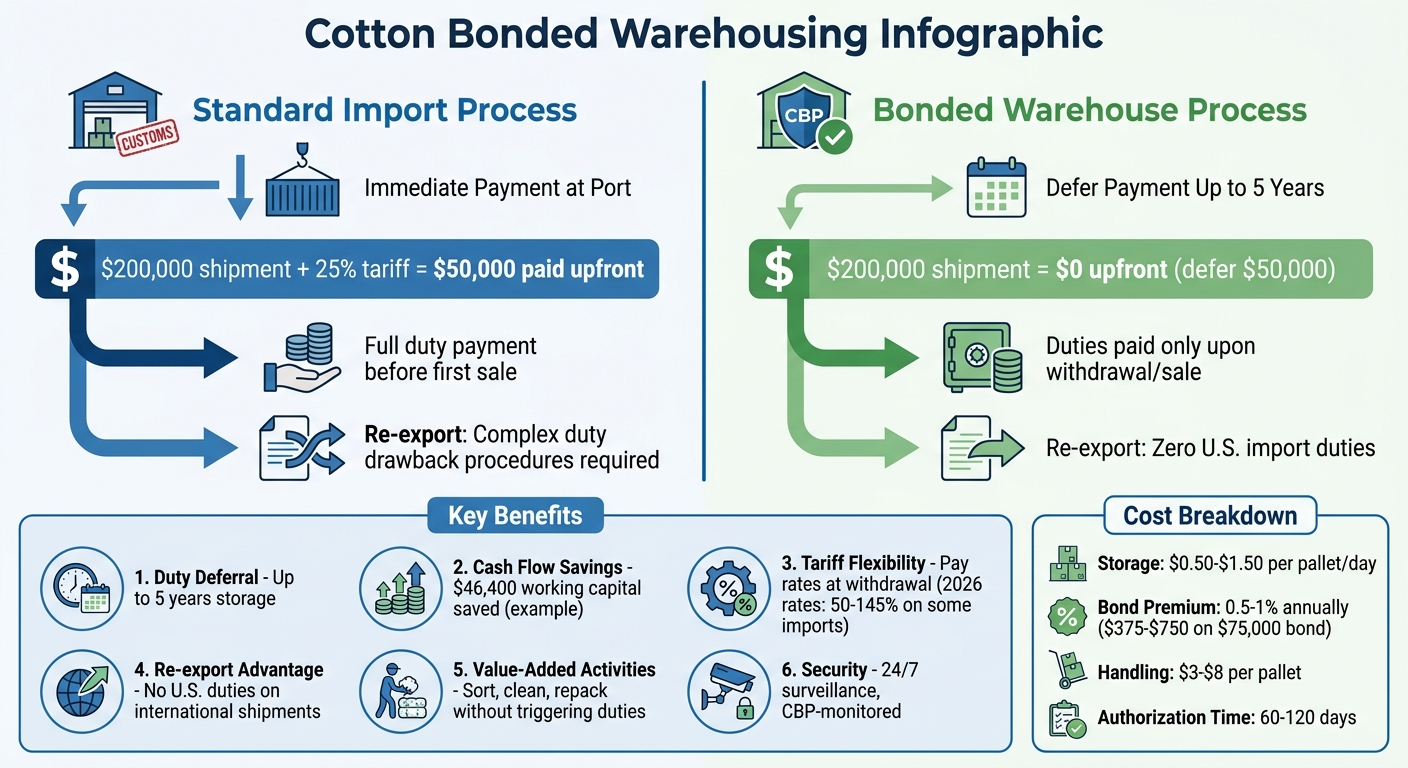
Cotton Bonded Warehousing vs Standard Import: Cost Comparison and Key Benefits
Regulatory Benefits of Cotton Bonded Warehousing
Deferred Customs Duties and Taxes
When cotton arrives at a U.S. port, you have two options: pay duties immediately or file a warehouse entry (Type 21 or 22) to transfer the cotton into a bonded warehouse. Choosing the latter lets you delay duty payments until the cotton is withdrawn, aligning tax payments with actual sales rather than requiring a hefty upfront payment at import.
Another advantage? Duties are calculated based on the tariff rates in effect at the time of withdrawal, not the date of import. If tariff rates drop during the storage period, you’ll pay the lower rate. For instance, in 2026, tariff rates ranged from 50% to 145% on certain imports, alongside a temporary 10% global surcharge implemented on February 24, 2026.
"The key financial difference from standard importing is timing. In a normal import, you pay 100 percent of duties before you sell a single unit. With a bonded warehouse, duty payments track your sales velocity." – Siddharth Sharma, Nventory US
If the cotton is destined for export markets, it can be shipped directly from the bonded warehouse without incurring U.S. import duties. Additionally, if the cotton is damaged or unsellable, you can avoid duty payments by arranging CBP-supervised destruction. Activities like cleaning, sorting, repacking, or quality testing within the bonded warehouse won’t trigger duty payments unless they qualify as full-scale manufacturing.
This system doesn’t just defer duties - it also simplifies customs procedures.
Simplified Customs Compliance
In addition to delaying duty payments, bonded warehouses streamline regulatory processes by adhering to strict compliance standards overseen by CBP. These facilities are equipped with essential security measures like fencing, surveillance systems, and controlled access, while operators handle detailed inventory tracking to ensure every bale is accounted for - from receipt to withdrawal.
A customs broker typically manages the transfer process into the bonded warehouse using CBP Form 7512, ensuring all documentation is in order. When it’s time to release the cotton into the U.S. market, you’ll file CBP Form 7501 (Entry Summary) and pay duties based on the current rates. This centralized approach reduces the administrative hassle of managing multiple import entries and payments.
The compliance infrastructure of bonded warehouses also provides an added layer of protection during CBP audits. Facilities are required to keep records for at least five years and must be ready for unannounced inspections, reducing the risk of compliance violations.
Storage Duration and Regulatory Requirements
Beyond tariff and compliance benefits, bonded warehouses offer flexible storage options to help operators navigate market conditions. Under 19 USC § 1557, cotton can remain in a bonded warehouse for up to five years from the date of importation. This extended timeframe allows you to wait out temporary tariff surcharges - like the 150-day Section 122 surcharge - or hold inventory until demand increases.
However, the five-year limit is non-negotiable. To avoid penalties or forced withdrawal, set reminders at the four-year mark to plan liquidation or re-export. Maintaining bonded status also requires an active continuous customs bond (Activity Code 1) throughout the storage period. Annual premiums for these bonds typically range from 0.5% to 1% of the bond value, translating to around $5–$10 per $1,000 of duty liability.
Many cotton operators choose Class 3 public bonded warehouses, where they can lease storage space without having to manage the facility or customs bond themselves. Before storing cotton, it’s crucial to verify the warehouse operator’s CBP license and review their latest audit results to avoid potential disruptions.
sbb-itb-0e617ca
Financial and Operational Advantages
Improved Inventory Management
Bonded warehouses leverage advanced Warehouse Management Systems (WMS) to provide real-time tracking of cotton inventory. This includes monitoring storage status, pending withdrawals, and export readiness. These systems are designed to integrate bonded inventory tracking, ensuring withdrawal deadlines are met and generating automated alerts to avoid customs delays or missed deadlines.
With government-mandated security measures like 24/7 surveillance and restricted access, high-value cotton is well-protected. This level of precision in tracking not only safeguards inventory but also lays the groundwork for operational and financial efficiencies.
Cost Savings and Cash Flow Optimization
Bonded warehousing offers more than just operational perks - it delivers clear financial benefits. For instance, consider a $200,000 cotton shipment subject to a 25% tariff. Duty deferral on this shipment would free up $50,000 in working capital. This liquidity can then be reinvested into other critical areas of the business, such as operations, equipment, or marketing efforts.
"For a brand scaling quickly, that capital is the difference between hiring more CS agents or running another ad campaign." – Closo
A real-world example from 2025 involving a North American distributor highlighted a 17% reduction in landed costs, a 40% decrease in administrative labor, and zero compliance issues over a year. While this case wasn't specific to cotton, it underscores the financial benefits that bonded warehousing can provide for agricultural commodities.
Storage costs for bonded warehouses generally range between $0.50 and $1.50 per pallet per day, with handling fees of $3 to $8 per pallet for inbound and outbound movements. Although bonded storage rates are typically 1.5x to 4x higher than standard rates, the savings from duty deferral and re-export opportunities often outweigh these higher costs.
Access to Transportation Hubs
Strategically located bonded warehouses further amplify supply chain efficiency. Facilities near major ports help reduce drayage and overall transportation costs. This proximity is especially beneficial for heavy-bulk commodities like cotton, as it minimizes expenses and improves delivery times, ensuring faster "time to customer".
"Choosing the right location for your US bonded facility is about more than just rent. It's about the 'time to customer.'" – CLOSO
When evaluating locations, prioritize warehouses situated at key intersections of major rail lines and international airports, like those in the Atlanta hub. These multi-modal access points allow for flexible shipping options and enable inventory to be prepped for immediate distribution once it clears bond. By combining advanced inventory tracking, cost deferral, and strategic location, bonded warehousing strengthens supply chains, making them more agile and efficient.
Strengthening Supply Chain Resilience
Reducing Supply Chain Risks
Bonded warehouses play a critical role in minimizing supply chain disruptions. By relocating cotton to inland bonded facilities, operators can bypass the chaos of congested ports and steer clear of hefty demurrage and detention fees that accumulate when cargo gets stuck at overcrowded terminals. This inland approach not only eases port congestion but also eliminates additional costs.
With a five-year storage window, producers gain the ability to wait out tough market conditions. If cotton becomes damaged or unsellable, it can be destroyed by U.S. Customs and Border Protection (CBP) to avoid paying duties on unusable goods.
"In today's volatile trade environment, customs bonded storage has become a crucial strategy for import/export professionals looking to manage costs and risk." - Commonwealth Inc.
Security is another cornerstone of bonded warehousing. These facilities are equipped with advanced measures like biometric scanners and 24/7 surveillance, creating a highly secure environment for safeguarding valuable fiber. Such measures align with the robust security protocols highlighted earlier, reinforcing supply chain integrity. Additionally, bonded warehouses help businesses stay compliant with regulatory requirements, such as the Uyghur Forced Labor Prevention Act (UFLPA). This compliance is vital, especially considering that in July 2024, U.S. Customs & Border Protection detained over $16 million worth of apparel, footwear, and textile shipments due to UFLPA enforcement. By managing shifting tariff rules and regulatory risks, bonded storage not only ensures compliance but also mitigates the risk of costly border detentions. This strategy enhances both operational security and financial stability.
Responding to Market Demand
Beyond mitigating risks, bonded warehouses provide the flexibility to quickly adapt to changing market conditions. By positioning cotton inventory closer to key markets, businesses can respond efficiently to rising demand. Duties are calculated based on current rates, allowing companies to release goods strategically to take advantage of favorable tariffs. Additionally, bonded warehouses enable value-added processes like cleaning, sorting, grading, and repackaging, transforming them into more than just storage spaces - they become hubs for market agility.
If domestic demand slows while international opportunities grow, cotton can be re-exported directly from a bonded warehouse without incurring U.S. import duties. This adaptability allows businesses to shift inventory rapidly, optimizing revenue potential in a dynamic global market.
How to Implement Bonded Warehousing
Licensing and Authorization Process
Getting bonded warehouse authorization from U.S. Customs and Border Protection (CBP) takes careful preparation. The process usually takes 60 to 120 days from the time you submit your application.
First, figure out which warehouse class fits your operation. For example:
- Class 2: For large producers managing their own stock.
- Class 3: For third-party logistics providers handling cotton for multiple clients.
- Class 4: For heavy or bulky items like cotton bales that need extra storage space.
Next, you'll need to submit CBP Form 301 (Customs Bond Application) along with supporting documents. These include facility blueprints, a written description of the premises, proof of financial responsibility, fire underwriter certification, and details about your security measures (like fencing, alarm systems, and access controls). The local CBP port director will set the bond amount based on your estimated inventory value. For instance, storing $5 million in inventory with a 10% duty rate defers $500,000 in payments. At a 6% financing cost, this could save you about $30,000 annually.
CBP will also conduct an on-site inspection to ensure your security measures, layout, and inventory tracking systems meet their standards before granting approval. Once approved, staying compliant is essential to keep your operation running smoothly.
Compliance Tips for Cotton Operators
To enjoy the benefits of duty deferral and smoother customs procedures, you’ll need to maintain strict compliance. Using a Warehouse Management System (WMS) with bonded-specific features is a smart move. It can automate CBP reporting and create the necessary audit trails, which are difficult to manage manually.
"Bonded warehousing works best when inventory movement is fully controlled and clearly documented." - CTC Distributing
Keep bonded goods physically separated from non-bonded goods. Alternatively, use a CBP-approved recordkeeping system to track everything accurately. Conduct quarterly compliance reviews to ensure your physical inventory matches your digital records before CBP inspections. Records must be kept for at least five years.
Additionally, CBP expects strong security measures, so consider background checks for key personnel. If you need to sort or repackage cotton, make sure to record these activities as "manipulation" and get CBP approval to avoid penalties.
Working with Customs Professionals
Once authorized, working with customs professionals can make managing bonded warehousing much easier. Customs brokers and logistics experts can handle warehouse entries and in-bond transfers, moving your cargo from ports to your facility. They can also help you secure continuous customs bonds (activity code 1), which generally cost 0.5% to 1% of the bond value annually. For example, a $75,000 bond would cost between $375 and $750 per year.
To ensure bonded warehousing is cost-effective, review your past 12 months' duties by HTS code. This will help you confirm that the deferral benefits outweigh administrative costs. Plan for an extra 2% to 5% on top of storage costs to cover customs broker fees, entry filings, and possible CBP examination fees. Choose a broker with a solid compliance record, as poor documentation can lead to CBP audits that may delay shipments for 45 days or more. Since duties are assessed at the rate in effect during withdrawal, consult with professionals to speed up withdrawals if tariff increases are expected.
Conclusion
Key Points Recap
Cotton bonded warehousing offers three main perks that can directly benefit your bottom line: deferred duty payments, simplified regulations, and supply chain flexibility. By storing cotton in a CBP-authorized facility, you can delay paying import duties for up to five years. Here’s an example: a mid-size importer handling a $200,000 shipment with a 25% tariff could save about $46,400 in working capital by opting for bonded storage instead of paying duties upfront. Real-world examples back up these advantages.
Additionally, if you re-export cotton straight from the bonded warehouse to international destinations, you won’t owe U.S. import duties at all. This eliminates the hassle of navigating duty drawback procedures. Beyond cost savings, bonded warehouses also provide secure, government-monitored storage with strict access controls and 24/7 surveillance. They even allow for minor adjustments, like sorting, cleaning, or repackaging, without triggering duty payments - giving you the flexibility to tailor cotton for specific markets.
Final Thoughts
These benefits highlight why bonded warehousing is a smart option for cotton operators. For businesses facing high duty rates - especially under the 2026 tariff environment, where some categories could see rates as high as 50% to 145% - this approach is worth exploring. Start by assessing your annual duty expenses to see if the deferral savings outweigh the associated costs, such as bond premiums (typically 0.5% to 1% of the bond value annually) and storage fees (around $0.50 to $1.50 per pallet per day).
For many cotton businesses, working with a Class 3 public bonded warehouse strikes the right balance between compliance and cost management. Bonded warehousing can reshape how you manage cash flow, improve your ability to meet market demand, and safeguard your margins in an unpredictable trade environment.
Bonded Warehouse: Stop Paying Duties Too Soon
FAQs
Is my cotton eligible for bonded warehousing?
Your cotton might be eligible for bonded warehousing if it is imported and stored in a U.S. Customs and Border Protection (CBP)-approved bonded warehouse. These warehouses provide secure storage and allow for deferral of customs duties, which can simplify regulatory compliance and help manage inventory more efficiently.
What paperwork do I need to move cotton into and out of bond?
To transport cotton into or out of a bonded warehouse, you'll need to submit the appropriate customs documentation, such as CBP Form 7512 (Transportation Entry and Manifest of Goods Subject to CBP Inspection and Permit). It's crucial to follow all U.S. Customs and Border Protection (CBP) rules, keep detailed and accurate records, and correctly declare the goods during both the entry and release processes. Double-check that all forms are fully completed and align with bonded warehousing regulations to avoid any compliance issues.
How do I know if bonded storage will save me money?
Bonded storage offers a smart way to manage costs by delaying customs duties for as long as five years, which can help improve cash flow. With this setup, you only pay duties when the goods are taken out of storage. Plus, if tariffs drop in the future, you could end up paying less. Even better, if the goods are re-exported, you won’t owe any duties at all.
That said, it’s important to weigh the setup and operational costs involved. When managed well, bonded storage can significantly reduce import expenses and give your cash flow a boost.