Cotton-spinning quality control starts with bale testing - not finished-yarn inspection. Test incoming cotton, track changes through production, and release yarn only after results meet customer limits. Compare defects per 1,000 meters and end breaks per 1,000 spindle-hours to keep checks consistent.
The control loop covers:
- Raw cotton: Use HVI and AFIS results to select bales and plan blends.
- Production: Check cleaning, fiber damage, sliver variation, roving, and spinning.
- Finished yarn: Test count, evenness, strength, elongation, hairiness, and package quality.
- Corrections and release: Trace faults, adjust the source, retest under the same conditions, and document approval.
The rule is simple: measure, find the cause, adjust, and verify. Yarn clearing removes faults; process control helps prevent them.
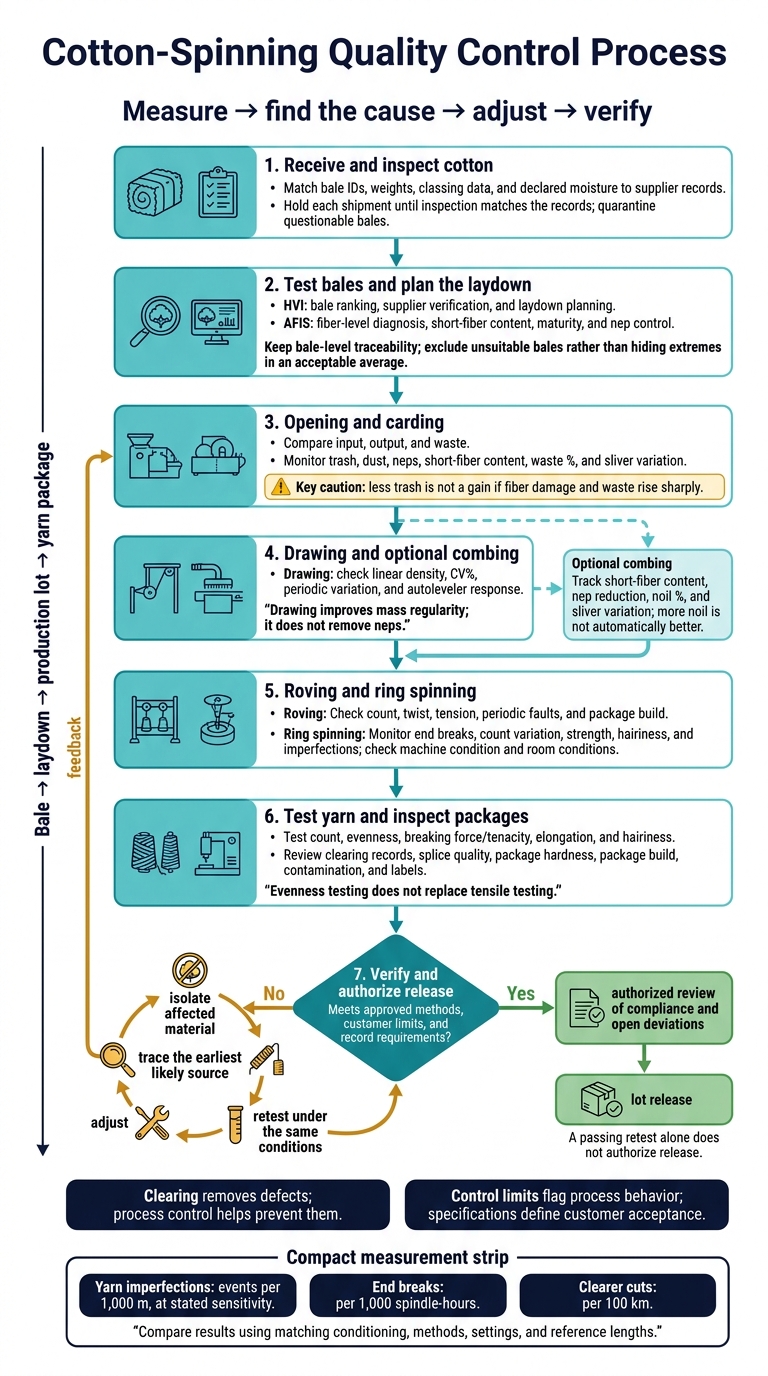
Cotton Spinning Quality Control: Bale to Yarn Release
S.Q.C. Standard for Spinning Process
sbb-itb-0e617ca
Raw Cotton Testing and Bale Selection
Start with incoming cotton, then use the test results to plan the laydown.
Begin QC at receiving: hold each shipment until the inspection matches the records. Check bale IDs, weights, classing data, and declared moisture against the supplier’s bale list. Record the carrier, arrival date in MM/DD/YYYY format, supplier, bale count, storage location, and acceptance decision. Inspect wrapping, bands, ties, and labels. Look for wet spots, heating, mold, oil, chemical odors, exposed fiber, excessive compression damage, and visible foreign material. Photograph and quarantine questionable bales.
Sample across lots, gins, regions, and bale positions - not just the bales that are easiest to reach. USDA classing samples combine fiber from both sides of a bale and weigh about 0.5 lb (0.23 kg). Keep bale-level results unless the approved sampling method allows samples to be combined. Use a calibrated moisture meter to check representative bales, and investigate abnormal readings before blending. Moisture affects storage safety, opening behavior, and measured strength.
Fiber Properties That Affect Yarn Quality
Length and length uniformity affect drafting control. Excessive short-fiber content (SFC) increases the risk of unevenness, hairiness, waste, and end breaks. Strength and elongation affect how well fibers withstand processing stresses and how the yarn performs in tensile testing.
Micronaire reflects both fineness and maturity - not fineness alone. Assess maturity separately because immature fibers can contribute to neps and uneven dyeing. Color affects appearance, while trash and dust add to the cleaning load. Fiber neps and seed-coat neps can survive preparation and become yarn imperfections.
HVI and AFIS: What They Measure
Use HVI to classify and select bales, and AFIS to diagnose fiber-level issues during preparation. Check the manufacturer’s documentation against the installed configuration. Uster AFIS NLM measures neps, seed-coat neps, length, short-fiber content, maturity, and immature-fiber content. Measuring trash and dust may require the optional Trash Module.
| Comparison | HVI | AFIS |
|---|---|---|
| Typical samples | Raw bale fiber and classing samples | Bale fiber, card mat, sliver, and roving |
| Measurements | Bundle length and length uniformity, strength, elongation, micronaire, color, trash and leaf data, moisture, and selected maturity data; additional outputs depend on configuration | Single-fiber length, short-fiber content (SFC), fineness, maturity, fiber neps, seed-coat neps, and optional trash and dust |
| Decisions supported | Bale ranking, supplier verification, and laydown planning | Preparation-stage comparisons, nep control, and fiber-damage investigations |
| Limits | Bundle results do not describe every individual fiber; moisture affects comparisons | Results depend on sample preparation, conditioning, material state, and installed modules |
Using Fiber Test Results to Plan Laydowns
Match the laydown to yarn count, spinning system, strength, end use, and dyeing requirements. Keep average properties and bale-to-bale variation within approved mill ranges. Exclude unsuitable bales rather than hiding extremes in an acceptable average. Consistent length, maturity, micronaire, and SFC support steadier drafting.
Keep each bale’s ID, gin, classing results, moisture readings, and laydown position, including any authorized substitutions. Link these records to downstream production lots so teams can trace contamination or fiber-quality concerns. Use the laydown as the baseline for opening, carding, and downstream checks.
Process Monitoring from Opening to Spinning
After bale selection, track quality from opening through ring spinning. Measure input, output, and waste - not just the finished yarn. Opening and carding remove contaminants, but too much mechanical action can create neps, shorten fibers, and increase waste. Link each measurement to one adjustment and one retest to help stop defects before yarn packaging.
| Stage | Material sampled | Main metrics | Adjustment area | Verification test |
|---|---|---|---|---|
| Opening and blowroom | Feed tufts, cleaned fiber, waste | Trash, dust, contamination, waste %, fiber damage | Opening, cleaning, and feed settings | Input/output waste, trash/dust results, visual contamination |
| Carding | Feed mat and card sliver | Neps, trash, short-fiber content, sliver linear density, CV% | Feed, card settings, wire, and suction | Nep, trash, and SFC results; sliver CV% across cards and shifts |
| Drawing | Input and output sliver | Linear density, CV%, periodic variation, doubling, autoleveler response | Draft, roller spacing, and autoleveler settings | Sliver count, CV%, spectrograms |
| Combing, where used | Comber lap, combed sliver, noil | SFC, nep reduction, trash removal, noil %, sliver variation | Nipper, detaching, and feed settings | Fiber length, neps, noil %, sliver uniformity |
| Roving | Roving and bobbins | Linear density, twist, stretch, tension, periodic faults, package build | Draft, twist, flyer, and tension settings | Roving count and CV%, package hardness and bobbin shape |
| Ring spinning | Yarn, end-down records, packages | Count variation, end-down rate, strength, hairiness, imperfections, package quality | Drafting, spindle, traveler, twist, and room conditions | Yarn results, online data, package quality |
Blowroom and Carding: Cleaning and Fiber Damage
Compare matched samples before and after changes to laydown, cleaning intensity, or maintenance. Keep the production rate steady, and let the changed material pass fully through the equipment before sampling again. Less trash isn't a gain if short-fiber content and waste climb sharply. Check each card separately. If output neps increase while input fiber stays stable, inspect clothing, settings, maintenance, and production rate. If sliver-mass variation increases, check feed consistency, chute plugging, and autoleveling.
Calculate cleaning and nep-removal efficiency using matched input and output samples, not final sliver values alone. Track trash removal and nep removal separately; they don't necessarily move together. USTER guidance puts normal card-room cleaning efficiency at about 70% to 75%, but mill limits must also account for fiber damage, waste, and downstream performance.
Drawing and Combing: Sliver Quality
Use carding to control contamination and nep load, and drawing to stabilize sliver mass. At drawing, compare input and output linear density and CV% over short and longer test lengths. Keep those lengths consistent between comparisons. Increasing CV% can signal drafting drift. Check doubling and autoleveler response across cans and heads, and use spectrograms to locate repeating faults. Drawing improves mass regularity; it doesn't remove neps. Set draft and roller spacing using measured fiber length and equipment guidance.
Where combing is used, track noil, short-fiber content, nep reduction, and sliver variation. More noil isn't automatically better.
Roving and Spinning: Draft, Twist, and End Breaks
Check roving count, twist, tension, periodic faults, and bobbin shape before changing ring-spinning settings. If sliver quality stays stable but roving count, twist, stretch, or periodic faults change, investigate the roving frame. Stable roving is the starting point for stable ring spinning.
At ring spinning, inspect cots, aprons, spacers, rollers, spindle bearings, and travelers. Track room temperature and humidity, along with end breaks by position. Report end breaks per 1,000 spindle-hours. Breaks at specific positions point to machine faults. Increases across several machines call for checks of incoming material and room conditions. Verify fixes with yarn tests and end-down trends before defects reach packaging.
Yarn Testing, Metrics, and Online Clearing
Once process controls stabilize the yarn, test the finished package before release. This check verifies raw cotton selection and process monitoring. Release yarn against the full quality profile - not averages alone. Review laboratory results, package consistency, clearing records, and package inspection together to spot defects and guide release decisions. Record conditioning, test settings, sample length, instrument configuration, and limits so results remain comparable. ASTM D1425/D1425M covers capacitance evenness testing; ASTM D2256/D2256M covers single-strand tensile testing.
| Metric | Definition and unit | Process meaning | Likely causes of abnormal results | Corrective-action direction |
|---|---|---|---|---|
| Nominal yarn count | Yarn count: tex, denier, or cotton count (Ne) | Linear density and suitability for the customer’s process | Incorrect feed, draft, count settings, or moisture | Verify weighing and conditioning; check draft, feed, and count settings |
| Count CV | Variation between test portions or packages, % | Between-package consistency | Uneven feed, inconsistent roving, drafting instability, or lot differences | Separate package variation from within-yarn variation; inspect machine zones and blend control |
| U% | Mean absolute deviation from average mass, % | Within-yarn unevenness | Poor fiber control or drafting waves | Check preparation and drafting |
| CVm% | Standard deviation of mass divided by mean mass, % | Within-yarn mass variation | Feed variation or periodic mechanical faults | Analyze spectrograms; correct the source |
| Thin places | Local mass deficits; events per 1,000 m at the stated sensitivity | Potential weak points and fabric faults | Fiber loss, unstable drafting, poor sliver joints, or roller lapping | Inspect drafting zones, cots, aprons, suction, card clothing, and sliver continuity |
| Thick places | Local mass excesses; events per 1,000 m at the stated sensitivity | Risk of streaks and processing stops | Fiber clumps, sliver doubling, laps, or feed disturbances | Check feed, carding, roller cleaning, sliver joints, and synchronization |
| Neps | Compact mass concentrations; events per 1,000 m at the stated sensitivity | Risk of visible fabric defects | Immature fibers, entanglement, damaged clothing, or inadequate opening | Review bale mix, cleaning intensity, card flats, cylinder speed, and wire |
| Breaking force / tenacity | Maximum load before rupture; tenacity divides that load by linear density. Units: cN or N; cN/tex or cN/dtex | Load-bearing capacity, absolute and count-normalized | Weak fibers, low twist, or thin places | Verify fiber quality, count, twist, and weak points before adjusting twist or drafting |
| Elongation at break | Extension before rupture, % | Stretch available during winding, weaving, and knitting | Fiber maturity, twist, spinning system, moisture, or test conditions | Check conditioning, twist, blend, drafting, and fiber damage |
| Hairiness, H | Dimensionless index of protruding fiber length measured over a 1 cm sensor length | Surface appearance, friction, and lint risk | Short fibers, poor fiber control, twist variation, or traveler/spindle issues | Check preparation, twist, spindle components, traveler, suction, and compact-spinning settings |
| Package hardness and density | Instrument-specific units or controlled scale | Unwinding stability | Incorrect winding tension, package build, moisture, or spindle speed | Adjust winding; quarantine damaged or excessively hard packages |
| Cleared faults and splices | Counts per package or length; splice quality where available | Fault removal and joint reliability | Incorrect clearer settings, poor splicing, contamination, or unstable winding | Adjust clearing curves and splice settings; investigate upstream faults |
Count and evenness set the baseline. Strength and hairiness help determine how the yarn will perform in use.
Yarn Count, Unevenness, and Imperfections
Tex measures grams per 1,000 meters; Ne measures 840-yard hanks per pound. Higher tex means coarser yarn; higher Ne means finer yarn. Use count CV to compare portions or packages, and U% and CVm% to assess variation along the yarn. Differences between packages point toward feed delivery and machine settings. Periodic variation within the yarn calls for spectrogram analysis.
Compare results using matching thresholds and reference lengths. Common USTER settings are −50% thin, +50% thick, and +200% nep for ring and air-jet yarns, and +280% nep for open-end yarns. Report events per 1,000 m, and record the instrument’s measuring reference length and fault-length classification.
Yarn Strength, Elongation, and Hairiness
Evenness testing does not replace tensile testing or strength measurement. USTER Tester 6 supports separate sensor configurations: CS for CVm and imperfections, OH for conventional hairiness, and HL for hairiness-length classification. Measuring breaking force, tenacity, and elongation requires dedicated tensile equipment, such as USTER Tensorapid 5 or Tensojet 5. Hairiness H is a dimensionless index of protruding fiber length measured over a 1 cm sensor length.
Electronic Yarn Clearers and Package Checks
During winding, an electronic clearer detects faults outside the configured limits. It triggers removal of the defective section, followed by reconnection with a splice or knot. Match settings to customer needs, the fault profile, and downstream sensitivity - not the tightest possible setting. Track cuts per 100 km and fault classes, since tighter limits can increase waste and joints.
Before release, check splice strength and profile, package hardness, ribboning, slough-off, and contamination. Verify that labels show count, composition, lot, package identity, and test status. Use these results to confirm the lot for release, while recognizing that clearing removes defects; it does not prevent their upstream cause.
Conclusion: Verify Corrections and Control Yarn Quality
Use test results to confirm that corrections work and reduce avoidable waste.
Check Results, Find Causes, and Retest
After winding, clearing, and package inspection, confirm the fix before releasing the lot.
Before changing production, check the sample ID, lot, position, method, settings, and instrument status. Isolate affected material and compare results by lot, machine, position, and shift. When practical, change one major variable at a time. Then retest under the same conditions to check that the correction improves results without causing another problem.
Trace each symptom to its earliest likely source, then retest to verify the fix.
| Finding | Cause → fix → verification |
|---|---|
| High neps or thick imperfections | Use HVI/AFIS data and card checks to locate the source → address laydown, airflow, cleaning, card settings, or clothing → test sliver and yarn neps. |
| High unevenness or count variation | Trace sliver variation, leveling, roller settings, aprons, and roving tension → address the main upstream cause → test count, CVm%, and periodicity. |
| Low strength or elongation | Check conditioning, fiber strength and length, twist, draft, travelers, spindle speed, and machine condition → address the cause within product and equipment limits → repeat tensile tests and check end-down rates. |
| Excessive hairiness | Check AFIS short-fiber data, guides, travelers, spindles, and winding settings → address fiber preparation, damaged contact surfaces, or process tension → test hairiness and inspect package appearance. |
Sampling Plans, Limits, and Responsibilities
Once the correction is defined, lock the sampling plan before retesting. Set lot boundaries, package and specimen counts, test frequency, methods, acceptance criteria, escalation triggers, and retest rules. ASTM D2258/D2258M provides a framework for sampling yarn shipments.
Assign clear roles: operators flag and segregate material, the laboratory validates results, engineers investigate causes, and quality management authorizes release.
Control limits are not customer specifications. Control limits flag unusual behavior in a stable process. Specifications define customer acceptance. Escalate specification failures, control-limit breaches, and sustained trends. Require confirmation testing after adjustments, maintenance, blend changes, or failed results.
Test Equipment, Records, and Lot Release
After retesting, release the lot only when it meets the approved method, limits, and record requirements. Match the equipment to the metric and the decision it supports. Use recognized methods, including ISO 2060 for linear density, ISO 16549 for evenness, and ISO 2062 for single-end tensile testing. Confirm the applicable edition.
Keep bale-to-package links, sample IDs, calibration history, original and repeat results, and dated setting changes. Release requires authorized review of compliance and open deviations - not just a passing retest.
FAQs
How often should my mill test yarn quality?
Test yarn evenness frequently - or continuously - during spinning to spot problems early, keep quality consistent, and maintain steady production. Test sliver daily, checking nep count, nep size, fiber cleanliness, and fiber rupture to help limit yarn breaks.
Use these checks to reduce waste and keep the final product in line with customer specifications and industry standards.
How do I set quality limits for different yarn uses?
Set quality limits based on contract specifications and end-use needs. A yarn count CV% of 1.5% or lower is typically ideal, while acceptable cotton U% levels generally range from 8% to 11%. Compare strength, hairiness, and evenness against Uster statistics.
Choose combed yarn for greater uniformity in high-end products such as luxury apparel. Carded yarn is sufficient for everyday items such as denim.
Which quality tests should a small spinning mill prioritize?
Test every incoming bale with HVI for staple length, strength, uniformity, and micronaire. Run daily AFIS tests on sliver to check nep counts, fiber cleanliness, and short fiber content.
During production, use an evenness tester to track yarn mass variation (U% and CV%), hairiness, and imperfections. Support these tests with stable relative humidity, ideally 50% to 60%, and regular maintenance checks focused on carding precision and roller settings.