If you can’t trace a bale back to the field and forward to the finished product, you can lose time, sales, and market access.
I’d sum up the 2026 rules like this: keep bale-level records, keep them linked at every handoff, and be ready to pull them fast. CBP is asking for transaction records, bale IDs, supplier documents, production records, and supply-chain maps, not just statements. That matters even more now that 6,947 shipments were stopped in FY 2025, and U.S. cotton output is sitting around 14.3–14.4 million 480-lb bales.
Here’s the article in plain English:
- Growers need field records that show where cotton was grown, when, and on which parcel
- Gins need intake tickets tied to the grower and field, plus Permanent Bale Identification (PBI) tags on each bale
- Warehouses and merchants need shipment and storage records that keep each bale ID in place
- Mills need receiving logs, laydown plans, batch records, and lot tracking that connect bale IDs to yarn, fabric, and finished goods
- Record retention should be at least 5 years
- Affidavits alone are not enough; buyers and customs teams want document trails
- System checks like barcode scans, RFID, ERP links, and supplier spot checks help cut record gaps
The main point is simple: traceability is now a records job as much as a cotton job. This piece explains what to keep, how long to keep it, and where most chains break.
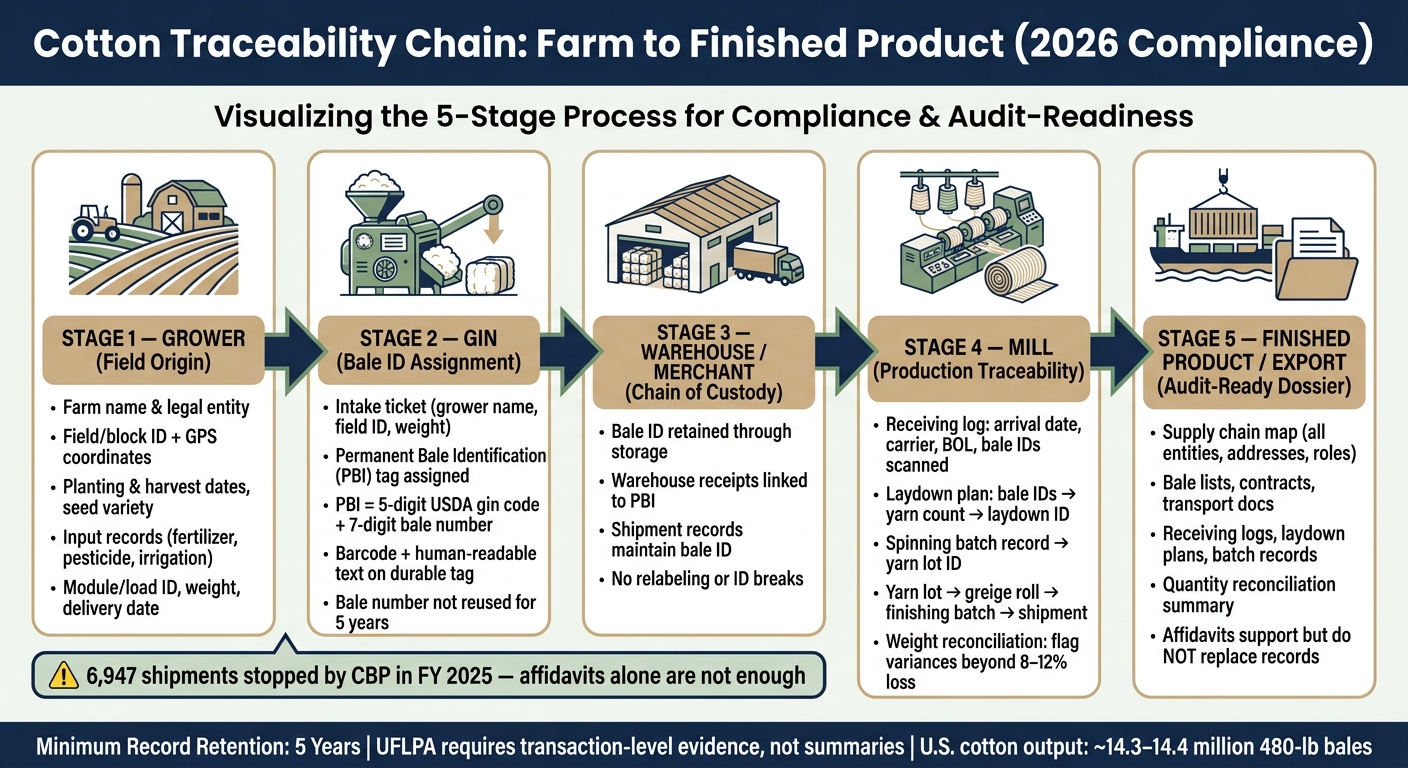
Cotton Traceability Chain: Farm to Finished Product (2026 Compliance)
GenuTrace Kinset Cotton Traceability 2026
sbb-itb-0e617ca
Required records from farm to gin: proving where cotton came from
The most common problem is simple: the paper trail breaks between the farm, gin, and bale records. A grower may have clean field files. A gin may have neat bale data. But if those records don't connect, they don't prove much by themselves. The proof has to start in the field and stay connected all the way through the gin.
Grower records that establish field-level origin
Every traceable bale begins with a field origin record for each field or block. At a minimum, that record should include:
- Farm name and legal entity
- Field or block ID
- GPS coordinates or a legal description, such as section, township, and range, so an auditor can identify the parcel
- Crop year, planting and harvest dates, seed variety
- Input records for fertilizers, irrigation, and pesticide applications, including product names, dates, rates, and equipment used
- Module or load ID, weight, and delivery date so the gin can match intake to the field
This is the core link. If the field record is vague, the rest of the chain gets shaky fast.
Gin intake, bale ID, and warehouse records that complete origin proof
When seed cotton arrives at the gin, the intake ticket should show the grower name, field or block ID, and delivery weight. That is what carries field-level origin into the bale record.
Every bale that gets pressed must have a Permanent Bale Identification (PBI) tag. The PBI is a 12-digit code: a 5-digit USDA gin code plus a 7-digit bale number, shown as both a barcode and readable text. The tag must be durable and easy to see for scanning. The 7-digit bale number is not reused for five years within a gin code, which helps avoid ID collisions across crop years.
From there, each PBI should connect back to the grower, field ID, bale weight sheet, USDA classing reference, warehouse receipt, storage location, and shipment record. Every handoff has to keep that link in place. If one piece drops off, the chain weakens.
Once those IDs are set, mills need to keep them attached through transport and production.
How long to keep records and what mills and buyers will expect
USDA's National Cotton Database stores PBI-based bale data for the current crop year plus the previous four crop years. That makes five years the practical minimum for record retention.
UFLPA guidance sets the bar higher than a simple statement of origin. Importers and their suppliers are expected to provide transaction-level records that tie raw fiber to specific farms or regions as clear and convincing evidence, not summaries or declarations.
In plain terms, mills and buyers will want to see the full chain, including grower field records, gin intake tickets, PBI numbers, warehouse receipts, and shipment documents. Fast access matters. If records are hard to find, delays, disputes, and lost market access can follow.
Those records only matter if mills can keep them connected through every production lot.
Mill chain of custody: keeping bale records intact through production
Once the gin assigns the bale ID, the mill has to keep that ID attached at every step. No gaps. No relabeling. Receiving, storage, and production records should all carry the same identifier. CBP expects records that trace cotton from bale-level origin all the way to the finished product.
Documents that link supplier, transport, and mill transactions
Each purchase document should name the bale ID or lot ID instead of a vague label like "raw cotton shipment." Purchase orders and contracts should require an attached bale list. Invoices should tie back to the PO or contract number and the lot. Bills of lading and packing lists should show container or truck numbers linked to an attached bale list.
At the mill gate, the receiving log should record:
- Arrival date
- Carrier name
- Bill of lading number
- Each bale ID scanned at intake
When the ERP creates the receiving record, it should connect the PO, invoice, and bale IDs in the same entry.
Mill production records that connect bales to yarn and fabric lots
After intake, those same IDs need to stay in place through blending and conversion. A laydown plan helps keep bale identity tied to production. Before spinning starts, the laydown plan should show which bale IDs will be combined, the target yarn count, and the assigned laydown ID. That laydown ID should then carry into the production order, the spinning batch record, and the yarn output log.
From there, yarn lot IDs should connect to greige roll IDs in weaving or knitting. Those greige roll IDs should connect to finishing batch numbers in dyeing and processing, and then to the final shipment documents. The paper trail should move in one straight line.
Weight checks matter here too. Reconcile input weight against output and waste for each batch. Typical processing losses are 8–12%. If variances keep showing up beyond that range, that's a red flag for a recording issue.
Supplier verification and audit readiness steps for mills
Before shipment, mills should confirm that supplier records match the physical bale trail. When bringing on a new cotton supplier, mills should collect the supplier's legal entity name, registration number, physical address, and a list of the gins and farms they source from. Spot checks can do a lot of work here. Comparing supplier bale lists against gin warehouse records is one of the most direct ways to confirm origin records.
Mills should also keep a supply chain map for each product line or sourcing contract. That map should name every entity from farm and gin through supplier, spinner, fabric mill, and dyehouse, along with full addresses and roles. For each shipment, the traceability dossier should include:
- Supply chain map
- Bale lists
- Contracts
- Transport documents
- Receiving logs
- Laydown plans
- Batch records
- Quantity reconciliation summary
Affidavits can support the dossier, but they do not replace traceability records.
Traceability systems and workflows that cut compliance risk
Once origin records are in place, the next problem is simple: not losing the thread during day-to-day work. If bale IDs, lot labels, and production records drift out of sync, compliance risk climbs fast. Good systems keep those records tied together from the start.
Bale tracking tools: PBI, barcode, RFID, and lot controls
Assign the PBI at the gin, carry it through storage and transport, and verify it again when the mill receives the bale. That one habit helps cut manual re-entry mistakes and makes mismatches easier to spot before production begins.
RFID tags and 2D codes can capture field and module data for later bale matching, reducing intake mismatches and strengthening bale-to-field tracing at the gin.
For mills, segregated storage by lot and clear lot labels are the minimum controls worth putting in place. Keep lots separate so bale origin can be matched to yarn or fabric runs without manual sorting.
When bale identity stays stable through storage and transport, software can move that same ID through purchasing and production without breaks.
ERP modules and digital chain-of-custody platforms
An ERP traceability module should link purchasing, inventory, production, and shipping in one record. That helps prevent ID breaks between receiving, laydown, production, and shipment at the mill level.
Cloud-based chain-of-custody platforms capture transaction data, timestamps, and audit trails across handoffs. User permissions matter here. Procurement staff should handle purchasing and receiving, while production teams manage laydown and production records. Clear permissions help keep the audit trail accurate without slowing day-to-day work.
The last control is checking that upstream gin details match the supplier record.
Using cottongins.org to support gin verification and supply-chain mapping
That check starts with accurate gin identity data.
Use cottongins.org to verify gin name, address, county, and state before onboarding a supplier. Mills and merchants can cross-check gin names and locations against supplier-provided information, which helps confirm the gin record before shipment. For gins, keeping directory details current makes it easier for downstream buyers to verify facility identity during supplier onboarding and audits.
The next section turns these requirements into a direct action checklist for growers, gins, and mills.
2026 action checklist for growers, gins, and mills
Here’s how to turn traceability rules into day-to-day operating practice without letting the paperwork take over the whole business.
What growers and gins should do now
Start with field IDs. Every record - planting logs, input applications, harvest data, and delivery tickets - should use the same field codes: farm name, field ID, and GPS coordinates. When those codes stay consistent, each bale can be traced back to one field. Keep seed, planting, fertilizer, pesticide, and irrigation records in one system so nothing gets split across folders, spreadsheets, or software tools.
At the hauling stage, log each truck with the date, time, field of origin, weight, and driver. Then connect that record to the grower ID, field code, and gin lot ID. At the gin and warehouse, check bale labels at the press and again at warehouse entry with scanner checks. Keep digital copies of gin tickets, classing reports, warehouse shipping orders, and bale lists in sync and sorted by crop year and lot. That way, if someone asks about a bale ID, staff can trace it back to the grower delivery fast.
Once those origin records are in good shape, mills need to make sure the same IDs stay intact through sourcing and production.
What mills should do now
Map every upstream supplier now. Ask for gin-level origin information for each lot, and flag any shipment that arrives with missing bale IDs or missing gin data. Then update purchase terms so bale-level documentation is plainly required.
That should include:
- Bale ID lists linked to gin and classing data
- Origin declarations
- Chain-of-custody documents
- A supplier commitment to answer traceability data requests within a fixed deadline
It also helps to run a test before an audit forces the issue. Take one recent inbound shipment and trace it backward from mill receiving to the gin. Then trace it forward through production to finished goods. Follow the trail through merchant and gin records, then through bale laydown sheets, spinning logs, and yarn or fabric lot IDs. Write down every gap, ID mismatch, and manual handoff. That kind of dry run shows where system changes or document rules need work before a buyer, customs agency, or auditor starts asking hard questions.
That discipline is what keeps product moving when buyers or regulators ask for proof.
Conclusion: the records and controls that protect market access
Under the 2026 traceability regime, UFLPA guidance expects documentation "from the origin of the cotton at the bale level to the final production of the finished product", including a numbered flow chart and maps identifying all entities and steps in the production process. Field-level origin records, correct bale IDs, linked chain-of-custody documents, and fast retrieval systems are now the baseline for staying audit-ready and keeping product moving.
FAQs
What happens if a bale ID is missing?
If a bale ID is missing or something doesn’t line up, look into it right away. Start by checking for unrecorded returns, damaged bales, supplier shipping mistakes, or weight shifts caused by moisture.
Then confirm the cotton’s accuracy and origin using USDA and FAS databases. After that, update your digital records, log any changes, and relabel the bale with a Permanent Bale Identification (PBI) tag that uses a unique 12-digit number.
Who is responsible at each handoff?
Responsibility is shared, but each party is accountable for the records it creates and verifies.
- Growers handle field and input records, along with module identification.
- Transport and warehousing teams preserve bale or module identity and maintain custody records.
- Gins log the bale’s Permanent Bale Identification (PBI), weight, and quality data. They also reconcile farm-to-gin volumes.
- Mills validate provenance and certificates, maintain segregation or volume reconciliation, and keep custody records.
How can we prepare for a traceability audit?
Keep your records organized, easy to access, and consistent across the supply chain. Use one central database to connect raw material lots to finished output. That database should include farm or group registration numbers, origin, harvest volumes, transport dates, and mapped PBI tags or module IDs.
You’ll also need to keep Transaction Certificates, invoices, volume reconciliation logs, and any test results required by the program. If certified cotton is part of the mix, keep certified and non-certified batches physically separate.
It also helps to put a few internal controls in place:
- Run internal audits
- Train staff
- Assign clear ownership for documentation
- Retain samples and records for at least three years
This kind of recordkeeping does more than check a box. It helps you trace material flow, avoid mix-ups, and stay ready if someone asks for proof.