Weed control is critical for cotton farming, as unchecked weeds can reduce yields by up to 90%. Modern solutions focus on precision tools, herbicide resistance management, and integrated approaches. Key highlights include:
- Weed Challenges: Palmer amaranth and waterhemp are the most problematic weeds, with growing herbicide resistance making control harder.
- Precision Technologies: AI-driven sprayers like John Deere's See & Spray can cut herbicide use by 43–76%, saving costs and slowing resistance.
- Mechanical Solutions: Tools like the LaserWeeder™ eliminate weeds without chemicals, reducing labor needs and improving efficiency.
- Integrated Strategies: Combining cover crops, herbicide rotation, and season-long plans helps reduce weed pressure and protect yields.
- Impact on Ginning: Cleaner fields lead to better fiber quality and higher market value.
Virginia Farmer Uses Cover Crops in Cotton to Manage Weeds
Weed Challenges Facing U.S. Cotton Growers
Weeds do more than just compete with cotton for sunlight, water, and nutrients - they can also contaminate harvested fiber, which reduces its market value at the gin. To tackle this issue effectively, growers need to understand which weeds cause the most harm and why they’re becoming tougher to manage. Let’s take a closer look at the key problem weeds and the growing challenge of herbicide resistance.
Key Problem Weeds and Regional Differences
Palmer amaranth (Amaranthus palmeri) stands out as the most damaging weed in U.S. cotton fields. This plant thrives in hot climates, grows at an astonishing speed, and can produce up to 600,000 seeds per plant. Its seed bank is incredibly persistent, making it nearly impossible to eradicate. Research shows that just ten Palmer amaranth plants per 30 feet of row can slash lint yield by 57% and reduce canopy biomass by 50%.
Another major issue for cotton growers is waterhemp (Amaranthus tuberculatus), which is particularly troublesome in the Midwest. Like Palmer amaranth, waterhemp grows aggressively and competes fiercely with cotton for essential resources like light and nutrients.
"Weeds can hinder cotton growth through allelopathic chemicals." - Leslie Beck, Extension Weed Specialist, New Mexico State University
Regional differences add another layer of complexity. Palmer amaranth is the dominant threat in the Southeast and Southwest, while waterhemp is more common in the Mid-South and Midwest. In Central Arizona, Palmer amaranth thrives in the hot, dry conditions, often outgrowing cotton if it’s not managed early in the season.
But it’s not just their aggressive nature that makes these weeds so problematic. They’re also evolving resistance to herbicides, making them even harder to control.
The Rise of Herbicide Resistance
One of the biggest challenges facing cotton growers today is herbicide resistance. Over-reliance on a single herbicide mode of action has created conditions where resistant weeds thrive. These resistant plants survive treatment, pass their traits to the next generation, and eventually lead to entire populations that are nearly immune to previously effective solutions.
"The over-reliance on specific herbicide modes of action has led to the rapid development of resistance in weed populations, making effective management increasingly challenging." - Jason K. Norsworthy, Professor, University of Arkansas
Herbicide-resistant Palmer amaranth is now a widespread issue across many cotton-growing states. A study conducted in Arkansas in November 2024 revealed that even newer herbicides vary greatly in their effectiveness, with some achieving only 73% control. Considering the sheer number of seeds Palmer amaranth can produce, that level of control isn’t nearly enough. This growing resistance highlights the need for more diverse and integrated weed management strategies.
Precision Herbicide Application Technologies
In the battle against herbicide resistance in cotton farming, applying more chemicals isn’t the fix. Instead, the focus needs to shift toward smarter spraying - targeting weeds directly rather than blanketing entire fields with herbicide.
Sensor-Based and Site-Specific Spraying
Camera-guided sprayers are changing the game in cotton weed control. Tools like John Deere's See & Spray combine artificial intelligence with cameras mounted along the boom to identify weeds in real time and apply herbicide only where it’s needed.
"The system uses artificial intelligence in combination with the cameras mounted along the boom to apply non-residual herbicides to weeds with pinpoint accuracy." - Mark Schaffner, RDO Equipment Co.
A University of Arkansas three-year study found that See & Spray cut post-emergence herbicide use by 43% to 59% compared to traditional broadcast spraying. In Iowa, similar precision spraying technology slashed herbicide use by an average of 76%, saving growers nearly $6,500 per field. This targeted approach not only reduces costs but also helps slow the spread of herbicide resistance.
New Herbicide Systems and Formulations for Cotton
Precision application works hand-in-hand with advanced herbicide systems that use multiple modes of action to combat resistant weeds. Bayer's XtendFlex® cotton and Corteva Agriscience's Enlist® cotton are two standout examples. These systems allow growers to rotate between chemistries - such as dicamba, glyphosate, glufosinate, and 2,4-D - throughout the growing season, addressing resistance challenges with flexible treatment options.
"Enlist® cotton allows for a customizable weed control program, which is essential in today's challenging agricultural landscape." - Corteva Agriscience
Digital Tools for Recordkeeping and Decision Support
Precision data also plays a critical role in modern weed management. Digital platforms like John Deere's See & Spray Gen 2 stream spray activity directly to the Operations Center, while tools such as PIX4Dfields and Case IH's SenseApply help create targeted spray prescriptions. These technologies not only improve efficiency but also generate detailed field records, aiding compliance and refining weed control strategies over time .
Mechanical and Autonomous Weeding Solutions
When it comes to managing weeds in cotton fields, chemical herbicides have long been the go-to solution. However, with increasing resistance to these chemicals, growers are turning to mechanical and autonomous technologies to fill the gap. These tools provide practical, non-chemical options that complement existing spray programs, offering a more balanced approach to weed control.
Modern Inter-Row and In-Row Cultivators
Camera-guided cultivators have come a long way from traditional row-crop tillers. Take the Kverneland Onyx inter-row cultivator, for instance. It combines GPS-GEOCONTROL with adjustable depth settings, achieving up to 87% weeding efficiency while preserving soil moisture through shallow tillage.
"The Kverneland Onyx cultivator promotes seed emergence and restores water and air flow, stimulating soil life." - Kverneland Group
Another standout is LEMKEN's IC-Weeder AI, launched in 2025. This system uses intelligent camera steering to distinguish crops from weeds in real time, even in dense weed infestations. By reducing the need for post-emergence herbicide applications, these tools directly contribute to managing herbicide resistance. And as these technologies evolve, autonomous platforms are pushing the boundaries even further.
Autonomous Weeding Platforms
Fully autonomous weeding platforms are no longer just experimental - they’re now making their way into commercial cotton fields. Carbon Robotics' LaserWeeder™ is a prime example. Using high-powered lasers, it eliminates up to 99% of weeds, targeting over 5,000 weeds per minute with sub-millimeter precision, equating to the work of a 75-person crew.
"The LaserWeeder™ can shoot over 5,000 weeds per minute with sub-millimeter accuracy." - Carbon Robotics
Similarly, Verdant Robotics' SharpShooter™ uses precision spot-spraying to target weeds as small as 2 mm seedlings. It can cover 50–60 acres per day while reducing chemical use by up to 99% compared to traditional broadcast methods. A University of Georgia study in May 2024 showed that an autonomous diode laser weeding robot achieved a 72.35% weed elimination rate in cotton fields in a single pass, with each weed treated in just 8 seconds.
"Autonomous solutions reduce the need for labor, cut costs, and enhance productivity." - CMCanicius Mwitta, Researcher, University of Georgia
High-Energy and Physical Weed Control Methods
Electrical weeding is another emerging technology gaining traction in cotton farming. For instance, Zasso's inter-row electrical weeder prototype, tested at Texas A&M University, demonstrated effective weed control with minimal soil disruption. This approach is particularly valuable for cotton, as it avoids disturbing root systems and reduces the risk of erosion. Researchers are now exploring how these directed-energy tools can fit into season-long weed management programs, especially in areas where herbicide resistance limits chemical options.
"With this, we are using photons for weed control. It's not just a new tool – it's a new way of thinking about how we manage weeds." - Thierry Besançon, Associate Professor, Rutgers University
sbb-itb-0e617ca
Integrated Weed Management Strategies
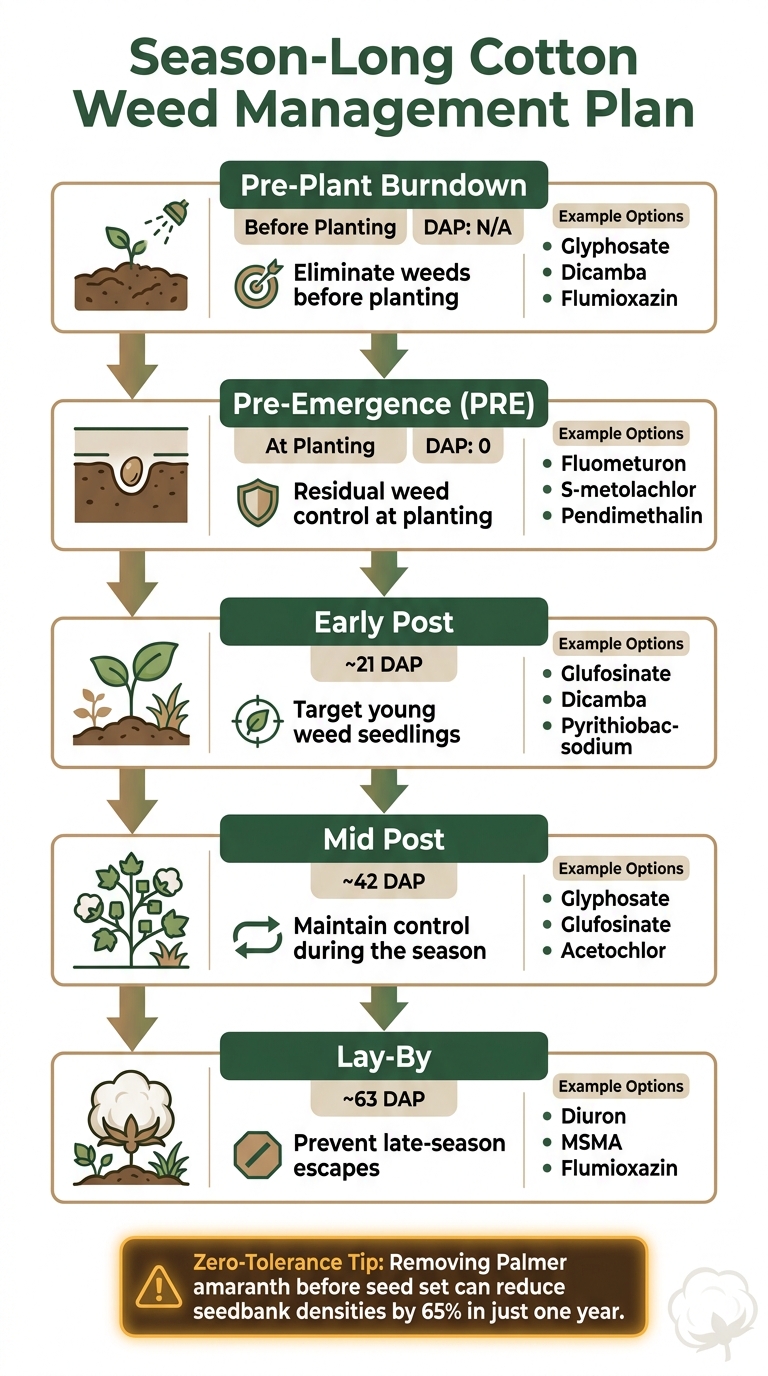
Season-Long Cotton Weed Management Plan: Timing, Purpose & Herbicide Options
Integrated weed management is all about combining multiple tactics to achieve long-term control. No single method can handle weeds alone. Instead, a mix of chemical, mechanical, cultural, and biological strategies works together, with each one filling in the gaps left by the others. This layered approach is what helps growers stay ahead of resistance issues rather than constantly playing catch-up.
Cover Crops and Crop Residue Management
Cover crops like cereal rye can significantly reduce weed populations. For instance, in cotton fields, cereal rye has been shown to cut Palmer amaranth densities by 63% to 83%, provided it’s managed properly. The trick lies in biomass - fields need at least 2,750 lbs. per acre of rye residue to see meaningful results. Extending the termination period by two weeks can boost biomass by 44%–63%, creating a denser barrier that suppresses weed growth.
Between 2017 and 2020, Texas A&M AgriLife Research ran trials near Lamesa, TX, comparing rye and wheat cover crops at different seeding rates. The findings? Later termination consistently led to higher biomass levels, while cotton lint yields in these high-residue systems matched those of conventional tillage. Plus, the added bonus of better soil protection made it a win-win. However, timing is key - terminate cover crops at least two weeks before planting to avoid any negative effects on cotton seedlings. Using a roller-crimper along with a planter equipped with row cleaners ensures solid seed-to-soil contact.
Beyond cover crops, rotating crops and herbicides is another way to keep resistance from taking hold.
Crop Rotation and Herbicide Rotation for Resistance Management
When dealing with tough weeds like Palmer amaranth, rotating herbicide modes of action (MOA) is essential. Trait-stacked cotton systems like XtendFlex® and Enlist® make this easier by allowing growers to rotate herbicides within the same season.
- XtendFlex® cotton tolerates dicamba, glufosinate, and glyphosate, though its label prohibits tank-mixing dicamba and glufosinate due to volatility risks. Sequential applications are required.
- Enlist® cotton tolerates 2,4-D, glufosinate, and glyphosate, and allows tank-mixing glufosinate and 2,4-D, which is particularly effective for managing larger Palmer amaranth plants.
Switching between these systems across seasons further reduces resistance pressure, offering growers more flexibility in their weed management plans.
Building a Season-Long Weed Management Plan
In cotton, the first few weeks after planting are critical. Uncontrolled weeds during this period can cause major yield losses. A well-coordinated, season-long weed management plan ensures consistent suppression by sequencing herbicide applications throughout the growing season. Here’s a breakdown of how it might look:
| Timing | Purpose | Example Options |
|---|---|---|
| Pre-plant Burndown | Eliminate weeds before planting | Glyphosate, Dicamba, Flumioxazin |
| Pre-emergence (PRE) | Residual weed control at planting | Fluometuron, S-metolachlor, Pendimethalin |
| Early Post (~21 DAP) | Target young weed seedlings | Glufosinate, Dicamba, Pyrithiobac-sodium |
| Mid Post (~42 DAP) | Maintain control during the season | Glyphosate, Glufosinate, Acetochlor |
| Lay-by (~63 DAP) | Prevent late-season escapes | Diuron, MSMA, Flumioxazin |
The lay-by application is often underestimated but crucial. Applying directed herbicides as the cotton canopy closes helps prevent late-season weeds from escaping and replenishing the seedbank. For fields with heavy Palmer amaranth pressure, adopting a zero-tolerance approach - removing any weeds before they set seed - can reduce seedbank densities by 65% in just one year. Over time, this approach compounds, making weed management easier with each passing season.
How Weed Control Affects Ginning and Market Results
How Weed Contamination Affects Fiber Quality and Gin Performance
The conditions in the field have a direct impact on how well a gin operates. Weeds like Palmer amaranth, field bindweed, and Johnsongrass are often spread by harvesting equipment, introducing unwanted organic material into the harvested lint. This contamination slows down gin processing and reduces fiber quality. Early-season weed pressure can also disrupt square and boll formation, further affecting the end product. Additionally, weeds can act as hosts for pests and diseases, which can further degrade fiber quality. On top of that, herbicide-induced stress on crops can impair boll development and the uniformity of fibers. Researchers at Kansas State University are currently studying this issue through precision spray trials to better understand how these factors influence ginning outcomes.
Because of these challenges, managing fields with ginning requirements in mind becomes a crucial part of the process.
Using cottongins.org to Support Weed Management Planning
Choosing the right gin isn’t just about logistics - it’s a key part of maintaining quality. cottongins.org offers a comprehensive directory of U.S. cotton gins, organized by county and state. This tool not only helps growers coordinate harvest logistics but also keeps them updated with regular information. By knowing where their cotton will be processed, growers can make better decisions about weed control timing and harvest schedules to meet the specific needs of their chosen gin.
When field data is combined with insights from the gin, weed management strategies can be fine-tuned to ensure consistent fiber quality and better market results.
Using Field Data and Gin Feedback to Improve Weed Programs
Feedback from gins, paired with in-season field data - like pigweed counts or plant height - can highlight how late-season weeds and herbicide stress have affected the crop’s value. Reports on lint and seed quality from the gin can reveal whether these issues have quietly reduced the marketable value of the cotton.
"We are looking forward to lint and seed quality evaluations, as well as an economic analysis, that will be coming forward this spring." - Igor Gustavo Rezende Lima, Kansas State University
To improve year after year, it’s essential to connect field performance with ginning outcomes. A plan that stops at lay-by without considering gin feedback is incomplete. Use that feedback to adjust strategies - whether it’s herbicide timing, application methods, or even variety selection - for the next season. The goal is to refine the program so that each year produces cleaner, higher-quality cotton.
Conclusion: Better Weed Management for Cleaner Cotton Fields
The strategies and tools discussed here all share a common goal: achieving more effective results with fewer resources. Advanced systems like the John Deere See & Spray™ Ultimate are leading the way by targeting weeds with precision. These systems reduce herbicide usage by 28–62% while maintaining weed control levels close to 94%. Meanwhile, electrical weeding prototypes from Zasso offer over 95% control of broadleaf weeds with less than 1% crop injury - all without disturbing the soil. These aren't just theoretical solutions - they're actively being tested and refined in U.S. cotton fields.
Success doesn't hinge on a single tool. The most effective growers are combining these innovations with strong Integrated Weed Management (IWM) practices. This means starting with clean fields, applying residual herbicides, rotating modes of action, and leveraging cover crops to combat aggressive weeds like Palmer amaranth. This layered approach is what keeps resistant weeds from taking over, year after year.
"Through these trials, we have shown the ability to reduce herbicide volumes, keep the fields' weed population in control like broadcast spray applications while making fewer trips across the field. That's time and dollars saved." - Dr. Sarah Ganske, Assistant Professor and Extension Weed Science Specialist, Kansas State University
A key connection in all of this is the link between field performance and ginning outcomes. Cleaner fields lead to less organic contamination at the gin, improved fiber consistency, and stronger market performance. By tracking weed pressure, herbicide applications, and gin reports season after season, growers can gather the insights needed to refine their practices and keep improving.
Cleaner cotton fields come down to making the right choices at every step: selecting the best burndown, applying the right residuals, timing post-emergence treatments effectively, and adopting the right technology for your operation. The tools are already here - now it’s about putting them into action.
FAQs
How do I choose the right weed tools for my cotton acres?
Begin by mapping weeds every year to keep track of species and spot trends in your fields. This practice helps you understand weed dynamics and tailor your management strategies effectively.
To combat resistance, use a diverse strategy that combines herbicide-tolerant traits with rotated modes of action (MOAs) and layered residual herbicides. This approach reduces the chances of weeds developing resistance over time.
Incorporate non-chemical methods into your plan as well. Techniques like planting cover crops, rotating crops, and using precision tools - such as targeted sprayers or inter-row electrical weeders - can significantly enhance weed control.
Finally, always adhere to herbicide label requirements and consult with local Extension specialists. They can provide guidance tailored to your specific region and conditions.
What’s the best way to slow herbicide resistance in pigweed?
To tackle herbicide resistance in pigweed, adopting an integrated weed management strategy is key. Here's how you can approach it:
- Begin with a pre-plant burndown application combined with residual herbicides to target weeds early.
- Use a mix of at least two effective modes of action (MOAs) in your herbicide rotation and tank mixtures.
- Apply post-emergence herbicides promptly, making sure weeds are no taller than 4 inches for maximum effectiveness.
- Incorporate non-chemical tactics such as crop rotation, cover crops, and tillage to disrupt the weed's growth cycle and reduce reliance on herbicides.
By combining chemical and non-chemical methods, you can better manage pigweed and slow down resistance development.
How can cleaner fields improve gin results and price?
Cleaner fields play a key role in improving ginning efficiency and the quality of lint by cutting down on the amount of foreign material in harvested cotton. When weeds are managed effectively, crops mature more uniformly, and bolls grow to a consistent size, which makes mechanical harvesting much smoother. This leads to cleaner and more uniform cotton modules with fewer immature fibers, helping gins process the cotton more efficiently. The result? Better turnout, higher lint grades, and increased profitability for farmers.
Related Blog Posts
- Effective Weed Control Strategies for Cotton Farmers: Complete Guide
- Integrated Weed Management in Cotton Farming: Strategies for Effective Control
- Advanced Cotton Crop Management: Digital Innovations and Sustainable Practices for Enhanced Yield
- Managing Herbicide Resistance in Cotton: Strategies and Innovations That Work