Cotton farming faces challenges with synthetic pesticides, including environmental harm, pest resistance, and rising costs. Natural pesticides offer a safer, effective solution by targeting pests without disrupting ecosystems. These alternatives, like microbial, botanical, and mineral-based options, deliver results while preserving beneficial insects and reducing residues.
Key takeaways:
- Types of natural pesticides: Microbial (Bacillus thuringiensis, Beauveria bassiana), botanical (neem oil, pyrethrins), and mineral-based (kaolin clay, insecticidal soaps).
- Target pests: Chewing insects (bollworms, armyworms), sucking insects (aphids, whiteflies), and mites.
- Field results: Neem reduced pink bollworm infestations by 62.7% in trials. Beauveria bassiana seed coatings cut aphid populations by 29.9%.
- Integrated Pest Management (IPM): Combining natural pesticides with techniques like intercropping and pheromone traps led to a 46.55% reduction in pesticide use and 25.38% higher yields in cotton trials.
Natural pesticides, when used with proper scouting and application methods, help farmers reduce costs, improve crop health, and manage pests effectively.
Proudly Pesticide-Free: Celebrating 10 years of organic & agroecological cotton farming in Ethiopia
sbb-itb-0e617ca
Main Types of Natural Pesticides for Cotton
Natural pesticides for cotton generally fall into three main categories: microbial, botanical, and mineral-based. Each type offers unique methods for managing pests effectively.
Microbial Pesticides
Microbial pesticides are gaining attention for their targeted pest control. For example, Bacillus thuringiensis (Bt) is known for disrupting the gut of bollworms, while Beauveria bassiana infects insects by attaching spores to their exoskeletons and penetrating their bodies.
Researchers in Tamil Nadu discovered a local strain of B. bassiana (Isolate B5) in cotton soils. In lab tests, this strain achieved an impressive 96.67% mortality rate against cotton aphids (Aphis gossypii) within seven days at a concentration of 1 × 10⁸ spores/mL.
"The isolate B5 proved to be a promising candidate for the development of biopesticides for sustainable cotton aphid management in Tamil Nadu, India." - Journal of Cotton Research
Beyond sprays, B. bassiana is being explored as a seed treatment. In October 2024, researchers at the University of Ioannina tested Velifer® (a B. bassiana strain from BASF) as a seed coating. Over 150 days, seeds treated with Velifer® reduced Aphis gossypii populations by 29.9% and boosted chlorophyll levels by 32% compared to untreated seeds.
"The two seed coatings can significantly enhance the growth performance of cotton and reduce the abundance of A. gossypii." - Vasileios Papantzikos, University of Ioannina
These advancements in microbial pesticides set the stage for complementary strategies using plant-based solutions.
Botanical Extracts
Botanical pesticides, like neem oil from Azadirachta indica, are widely used for their versatility. Neem’s active ingredient, azadirachtin, works by repelling pests, disrupting feeding, and interfering with their growth and reproduction. This multi-pronged approach reduces the chance of pests developing resistance.
Pyrethrins, extracted from chrysanthemum flowers, provide quick action against pests like caterpillars and aphids. Meanwhile, essential oils such as clove and rosemary demonstrate contact toxicity against soft-bodied pests. However, these botanical extracts degrade quickly under sunlight, which helps manage residues but may limit their effectiveness in the field.
To address challenges like rapid degradation and mixing issues, researchers are developing nanoformulations. These encapsulate botanical extracts in materials like chitosan or use silver nanoparticles derived from neem. For instance, neem nanoformulations have achieved 60%–93.33% mortality rates in Helicoverpa armigera larvae.
"Botanical nanoformulations such as silver and zinc nanoparticles, nano-emulsions, and polymeric carriers enhance efficacy, stability, and environmental sustainability." - Renatus Laurent Luneja, School of Life Sciences and Bioengineering
Botanical solutions work well alongside biological methods, but physical approaches also play a role in pest control.
Mineral-Based and Soap Products
Mineral-based pesticides primarily act through physical mechanisms. Kaolin clay, for example, forms a thin white film on plants, confusing and deterring pests like thrips without using toxins.
Potassium salts of fatty acids, commonly known as insecticidal soaps, break down the cell membranes of soft-bodied pests such as aphids, mites, and whiteflies. These soaps leave no residue and degrade quickly, making them ideal for use close to harvest. Additionally, metallic oxide nanoparticles like zinc and copper oxides are being studied for their pest-deterrent and antimicrobial properties, though this research is still in its early stages.
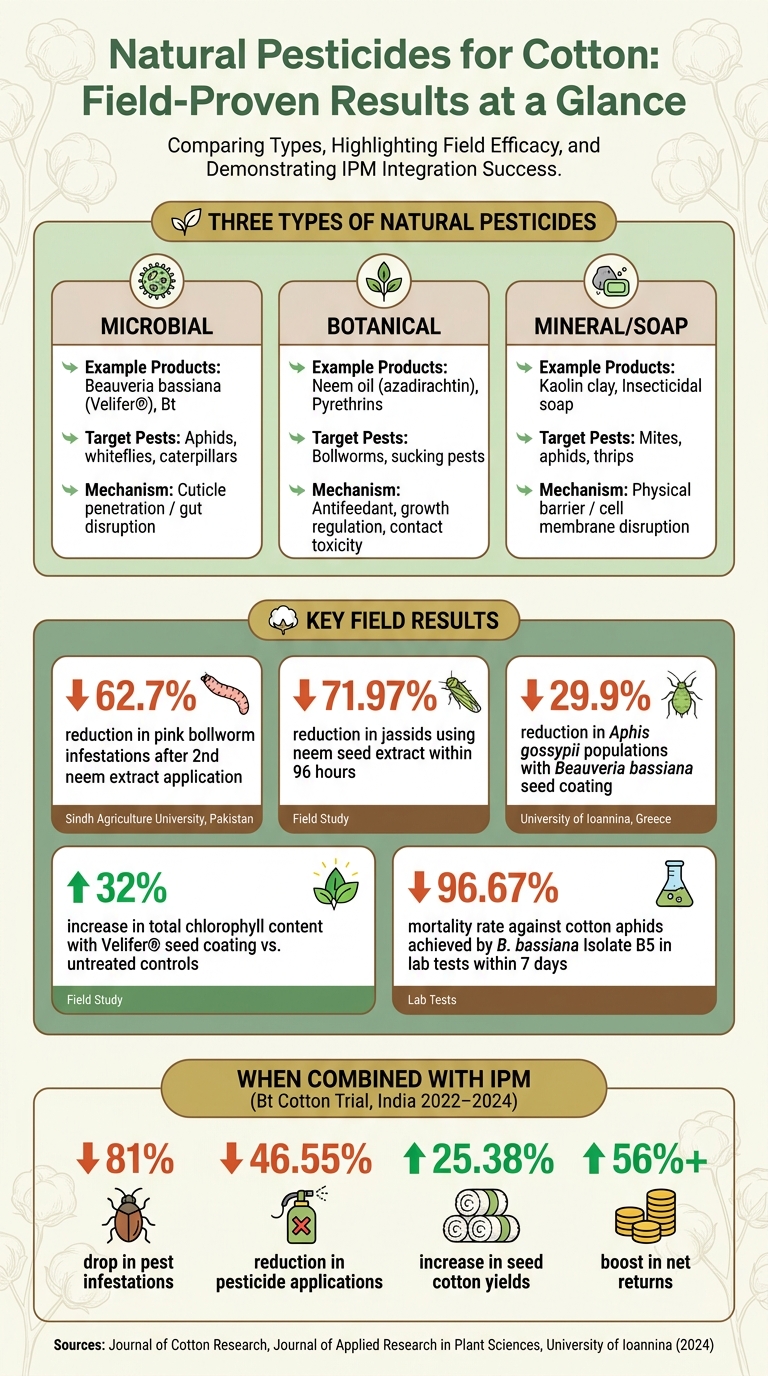
| Category | Example Products | Target Pests | How It Works |
|---|---|---|---|
| Microbial | Beauveria bassiana (Velifer®), Bt | Aphids, whiteflies, caterpillars | Cuticle penetration, gut disruption |
| Botanical | Neem oil (azadirachtin), pyrethrins | Bollworms, sucking pests | Antifeedant, growth regulation, contact toxicity |
| Mineral/Soap | Kaolin clay, insecticidal soap | Mites, aphids, thrips | Physical barrier, cell membrane disruption |
Field Results: How Natural Pesticides Perform in Cotton
Natural Pesticides for Cotton: Types, Targets & Proven Field Results
Neem-Based Products in the Field
Neem has consistently proven to be a standout performer among plant-based pesticides. A study published in November 2025 in the Journal of Applied Research in Plant Sciences by researchers Perwaiz Paryal and colleagues at Sindh Agriculture University, Pakistan, tested neem extract against the pink bollworm (Pectinophora gossypiella). The results were impressive: neem extract reduced infestations by 57.2% after the first application, climbing to 62.7% after the second application. These results far outpaced eucalyptus (42.13%) and Calotropis (49.5%).
Neem also excels against sucking pests. In separate trials, neem seed extract achieved a 71.97% reduction in jassids and a 67.65% reduction in thrips within just 96 hours of application. While asafoetida slightly outperformed neem in controlling whiteflies - showing a 60.18% reduction compared to neem's 59.38% - neem still demonstrates broad-spectrum effectiveness for managing sucking pests. Alongside these botanical solutions, microbial insecticides have also shown strong results in the field.
Microbial Insecticides in Practice
Microbial products have delivered equally promising outcomes. A 150-day semi-field trial conducted in October 2024 by researchers at the University of Ioannina, Greece, led by Spiridon Mantzoukas, evaluated Beauveria bassiana (marketed as Velifer® by BASF) as a seed coating for cotton. Seeds treated with Velifer® showed a 29.9% reduction in Aphis gossypii populations and a 32% increase in total chlorophyll content compared to untreated controls. Interestingly, single-strain B. bassiana coatings outperformed combined treatments with Bacillus amyloliquefaciens, which only achieved a 22.4% aphid reduction. This difference likely stems from microbial competition between the two strains. These findings highlight the potential of microbial insecticides as a natural alternative to synthetic chemicals.
Combining Natural Pesticides with IPM
When natural pesticides are integrated into an Integrated Pest Management (IPM) program, the results are even more striking. Between 2022 and 2024, an IPM package for Bt cotton in Khandwa district, Madhya Pradesh, India, combined neem oil sprays, pheromone traps, and cowpea intercropping. This approach led to an 81% drop in pest infestations, a 46.55% reduction in pesticide applications, and a 25.38% increase in seed cotton yields compared to conventional farming practices.
Another example comes from a 2026 study in Benin, West Africa. Researchers found that pairing biopesticides with cotton-soybean intercropping allowed farmers transitioning away from synthetic methods to maintain or surpass the profitability of conventional farming. The additional soybean income helped offset lower cotton yields, while biopesticides effectively controlled bollworm populations without harming beneficial predator species. These examples clearly demonstrate that natural pesticides achieve their best results when integrated into a holistic farm management strategy rather than being used as a one-to-one replacement for synthetic sprays.
How to Use Natural Pesticides on Your Cotton Farm
Using natural pesticides effectively can make a big difference in maintaining a healthy cotton crop. Success depends on careful field monitoring, proper application techniques, and strict adherence to safety protocols. Below, we’ll walk through the steps to apply these natural solutions efficiently on your farm.
Scouting and Timing Applications
Regular field inspections are key. Aim to scout your fields at least once a week to track pest activity, assess plant damage, and identify beneficial insect populations. Natural pesticides should only be applied when pest levels hit the economic threshold - this ensures you’re using them effectively and not unnecessarily. Tools like the Beat Bucket Method, drop cloths, and sweep nets are excellent for gauging pest densities and spotting helpful predators in the field.
Application Methods and Equipment
Choosing the right application method is crucial for even distribution and maximum effectiveness. Here are some common approaches:
- Seed Treatment (e.g., Beejamirit): Protects young cotton plants during their early growth stages.
- Basal Application (e.g., Ghanajeevamirit): Improves soil health while suppressing pests at the root level.
- Irrigation/Fertigation (e.g., Jeevamirit): Provides ongoing pest control by delivering liquid formulations through irrigation systems.
For foliar sprays, especially oil-based botanical solutions, aim for a concentration of 1–2% vol/vol. Adding adjuvants like alkylsilicone surfactants can enhance coverage and penetration. Timing is also important - apply sprays in the late afternoon to minimize UV damage and ensure better droplet absorption.
Safety and Regulatory Requirements
Always prioritize safety and follow regulations when working with natural pesticides. In the U.S., these products are regulated under the Federal Insecticide, Fungicide, and Rodenticide Act (FIFRA) and must meet EPA standards. Carefully follow label instructions for application rates, site restrictions, and required personal protective equipment (PPE). Compliance with the Worker Protection Standard (WPS) is also essential to protect everyone involved in pesticide applications.
For organic cotton, make sure the pesticides align with USDA National Organic Program (NOP) and OMRI standards. Reviewing EPA Reregistration Eligibility Decision (RED) documents and checking state-specific requirements can help ensure your practices are both safe and legal.
Conclusion and Next Steps
Natural pesticides offer cotton farmers an effective way to cut costs, protect their fields, and combat pest resistance.
Key Benefits at a Glance
Field-tested Integrated Pest Management (IPM) programs using natural pesticides have shown impressive results. They can reduce spray frequency by 46.55%, increase seed cotton yields by 25.38%, and boost net returns by more than 56%. Beyond financial gains, these products are biodegradable and help preserve beneficial predators, which naturally manage pests over time. To fully harness these advantages, keeping accurate records is crucial.
Tracking Results Through Record-Keeping
Good record-keeping is the backbone of a successful pest management strategy. By tracking pest counts, beneficial insect sightings, application dates, and crop conditions after treatments, farmers can make timely and informed adjustments. Monitoring predator-to-pest ratios is especially important. For example, an increase in beneficial insects like Chrysoperla carnea (lacewings) or Orius sp. (pirate bugs) signals that your program is on the right track. Over time, these records will reveal patterns, helping you decide the best times for application and pinpoint where your inputs yield the highest returns.
What's Ahead for Natural Pesticides in Cotton
The future of natural pesticides looks promising, with innovations like botanical nanoformulations and AI-driven strain discovery on the horizon. The global biopesticide market is currently growing at a 10%–20% compound annual growth rate (CAGR), outpacing synthetic chemicals, and is expected to match the market size of chemical pesticides by 2040. New advancements, such as UV-protective coatings for microbial products, are also enhancing the stability and effectiveness of natural pesticides. Pamela G. Marrone, CEO and Founder of Invasive Species Corporation, emphasized this shift:
"Biologicals will reach the size of the chemical pesticide market by 2040."
For cotton farmers, these developments mean access to better tools, improved formulations, and increased support from both the market and regulators. By adopting these strategies now, farmers can position themselves to benefit from the cutting-edge advancements that lie ahead. The growing potential of natural pesticides is reshaping modern cotton farming.
FAQs
Which natural pesticide works best for my cotton pest?
The most effective natural pesticide varies depending on the pest you're dealing with. For African bollworm, Bolldex (nucleopolyhedrovirus) has shown results comparable to synthetic pesticides. When it comes to the pink bollworm, neem extract is a reliable choice. To control sucking pests, neem oil and green manure, such as Dhancha (Sesbania bispinosa), are effective options. Moreover, oil-based Clitoria ternatea formulations help prevent feeding and egg-laying in Helicoverpa species, all while sparing beneficial insects.
How often should I spray natural pesticides in cotton?
Natural pesticides, such as neem oil, generally break down and lose their toxicity within 96 hours. However, they can still effectively manage pests for up to a week. Instead of sticking to a rigid spraying schedule, it's better to apply these pesticides based on field observations and the severity of pest infestations. This method, when used as part of an integrated pest management plan, supports healthier crops and consistent yields while cutting back on the use of chemical pesticides.
Can natural pesticides fit into my IPM plan and cut costs?
Natural pesticides can play a key role in an integrated pest management (IPM) plan while helping to lower costs. Tools such as botanical extracts, microbial biopesticides, and pheromones are effective at managing pests, all while safeguarding beneficial insects and reducing reliance on pricey synthetic chemicals. Research from field studies has shown that these approaches can reduce pesticide usage by up to 50% and enhance the benefit-cost ratio - all without sacrificing crop yields.