Key Takeaways:
- Integrated Pest Management (IPM): A data-driven approach combining biological controls, selective chemical use, and pest monitoring to reduce pesticide reliance while maintaining cotton yields.
- Proven Results: IPM has reduced pesticide use by 46.55%, increased seed cotton yields by 25.38%, and boosted net returns by over 56% in studies.
- Non-Chemical Methods: Techniques like crop residue removal, intercropping with cowpea, and using biopesticides such as Trichogramma wasps or neem oil effectively manage pests.
- Precision Tools: AI-powered sensors, GPS-guided sprayers, and drones enable targeted pest control, cutting costs and minimizing environmental impact.
- Local Support: Resources like cottongins.org help farmers access gin-level data and adopt region-specific pest management strategies.
Southern IPM Hour: Water-Deficit Cotton Production System Management and Recommendations
sbb-itb-0e617ca
Integrated Pest Management (IPM): The Core Framework
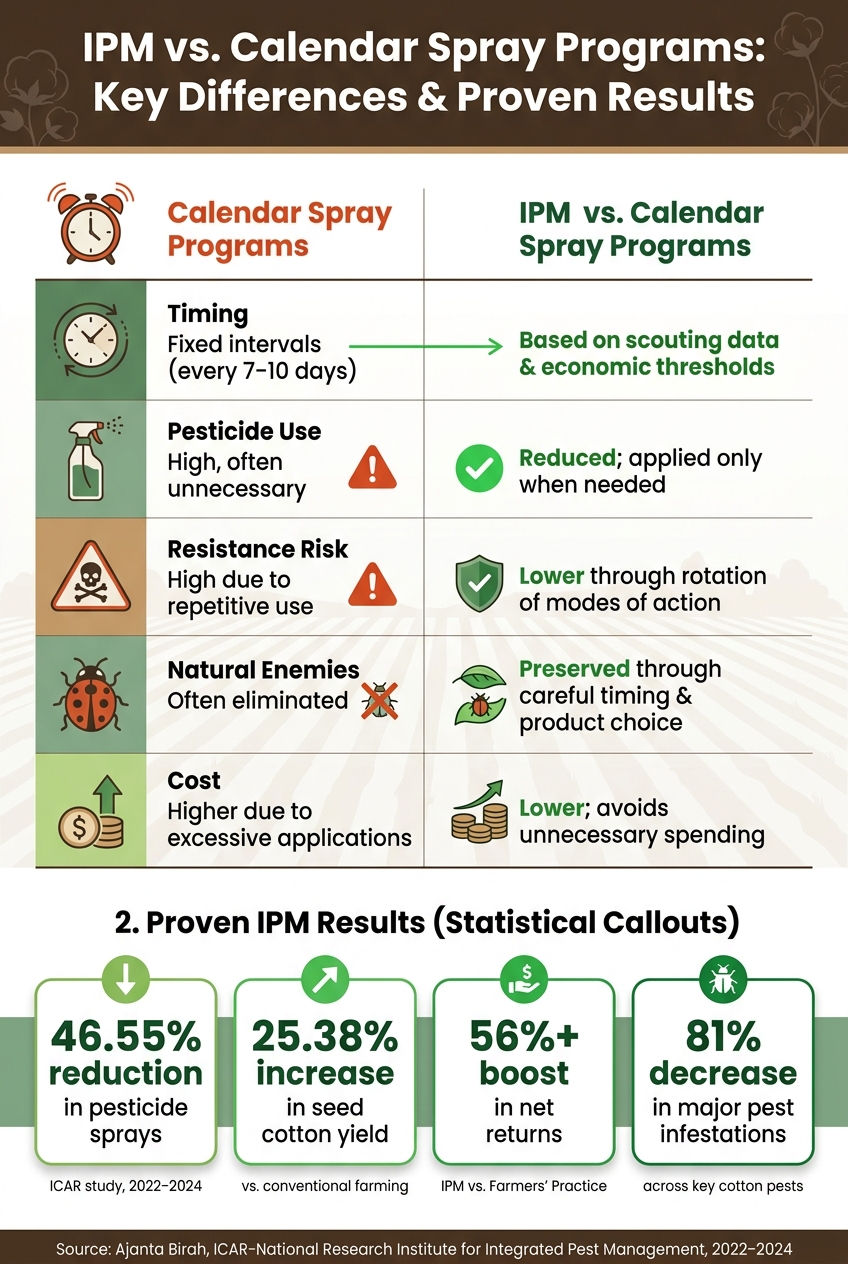
IPM vs. Calendar Spray Programs: Key Differences & Proven Results
IPM is more than just a collection of pest control methods - it's a strategic system that relies on data-driven decisions. Instead of applying treatments on a fixed schedule, growers use real-time field observations to determine the best timing for action. This approach has become essential for sustainable cotton farming.
Core Principles of IPM in Cotton Farming
At the heart of IPM is a straightforward concept:
"The integrated pest management concept assumes that pests will be present to some degree and, at low levels, do not cause significant economic losses." - Texas A&M AgriLife Extension Service
By carefully monitoring pest populations and their natural predators, farmers can intervene only when pests surpass economic thresholds. Beneficial insects like big-eyed bugs, lacewings, and spiders often keep pests in check when their populations are below these levels.
IPM integrates several strategies for effective pest control, including:
- Cultural practices: Adjusting planting schedules and destroying crop residues to disrupt pest life cycles.
- Biological conservation: Protecting natural predators that help suppress pests.
- Host plant resistance: Using Bt cotton varieties that are less vulnerable to certain pests.
- Chemical treatments: Applying insecticides selectively and rotating modes of action to prevent resistance.
This balanced approach has led to impressive results. In Texas, foliar insecticide use has dropped by two-thirds since 2000, while cotton yields have increased by 50%.
These principles guide the detailed field monitoring process described below.
Field Monitoring and Pest Identification
Effective IPM starts with consistent field monitoring. Farmers or scouts should check fields at least weekly - and ideally twice a week - to evaluate pest densities, crop damage, and the presence of beneficial insects.
Here’s a quick breakdown of common scouting methods used in cotton farming:
| Sampling Method | Best Used For | Key Technique |
|---|---|---|
| Sweep Net | Mobile pests and adult insects | Perform 25–50 sweeps within the top 10 inches using a 15-inch net. |
| Beat Bucket | Plant bugs and predatory insects | Shake 2–3 plants into a 5-gallon bucket and count the insects before they escape. |
| Drop Cloth | Row-dwelling pests and stink bugs | Shake 5 feet of a row onto a 36 x 42-inch cloth; repeat at least 16 times across the field. |
| Visual Scouting | Aphids, fruit damage, small larvae | Inspect whole plants and terminals for eggs or larvae smaller than ¼ inch. |
| Pheromone Traps | Pink bollworm and moths | Use synthetic pheromones to monitor mating cycles and population density. |
Texas A&M AgriLife Extension also recommends taking 34 beat bucket samples per field at the first bloom and repeating this process 2–3 weeks later. This ensures that predator populations are strong enough to handle pest pressure.
Calendar Spray Programs vs. IPM: A Side-by-Side Comparison
When comparing IPM to traditional calendar-based spray programs, the benefits of IPM become clear.
Calendar-based programs involve applying pesticides at fixed intervals, such as every 7–10 days, regardless of pest levels. While simple, this method can waste resources and contribute to resistance. As the National Cotton Council of America notes:
"Ineffective, routine pesticide sprays waste resources."
In contrast, IPM tailors treatments to actual field conditions. Decisions are based on scouting data and economic thresholds, and selective chemicals are used to minimize harm to beneficial insects. Here’s how the two approaches differ:
| Feature | Calendar Spray Programs | Integrated Pest Management (IPM) |
|---|---|---|
| Timing | Fixed intervals | Based on scouting and thresholds |
| Pesticide Use | High, often unnecessary | Reduced; applied only when needed |
| Resistance Risk | High due to repetitive use | Lower through rotation of modes of action |
| Natural Enemies | Often eliminated | Preserved through careful timing and product choice |
| Cost | Higher due to excessive applications | Lower; avoids unnecessary spending |
A study conducted from 2022 to 2024 by the ICAR-National Research Institute for Integrated Pest Management in India highlights IPM's real-world effectiveness. Led by researcher Ajanta Birah, the study showed that an IPM package - including timely sowing, cowpea intercropping, neem oil, and SPLAT pheromone formulations - reduced pesticide sprays by 46.55%, decreased major pest infestations by up to 81%, and boosted seed cotton yield by 25.38% compared to conventional methods.
Non-Chemical Pest Control Methods for Cotton
Reducing chemical use doesn’t mean sacrificing yields or tolerating more pest damage. Cotton farmers have access to a variety of methods - ranging from cultural to biological approaches - that can help manage pests effectively while maintaining productivity.
Cultural Practices That Reduce Pest Pressure
Sometimes, the best pest control methods are rooted in how and when you farm. For example, sowing cotton at the right time can help the crop avoid peak pest activity. Similarly, destroying crop residues after harvest eliminates overwintering sites for pests like the pink bollworm. If crop debris is left in the field, pests can survive the off-season and reinfest the next planting.
Intercropping cotton with cowpea is another effective technique. Cowpea provides habitat and food for beneficial insects, which in turn suppress pest populations. Between 2018 and 2021, researchers from the ICAR-National Research Centre for Integrated Pest Management tested this strategy in Wakhari village, Maharashtra, India. Led by Ajanta Birah and Anoop Kumar, the team combined cowpea intercropping with other cultural practices like residue management and conservation of natural enemies. The results were impressive - pesticide use dropped by nearly 50%, cotton yields increased by 28.49%, and net profits were 42.6% higher compared to conventional farming methods. These results show that such practices could be viable for U.S. cotton growers looking for more sustainable options.
| Cultural Practice | Primary Benefit | Target Pests |
|---|---|---|
| Cowpea Intercropping | Reduces pest incidence | Sucking pests, Bollworms |
| Residue Destruction | Eliminates overwintering sites | Pink bollworm |
| Border Cropping | Acts as a physical/biological barrier | Sucking pests |
| Timely Sowing | Avoids peak pest populations | Lepidopteran pests |
While cultural practices are a great start, biological controls can take pest management to the next level.
Biological Control Options for Cotton
Biological controls work by directly targeting pests at specific stages of their development. For instance, Trichogramma wasps lay eggs inside moth eggs, stopping pests before they can develop further.
Biopesticides are another powerful tool. Bacillus thuringiensis (Bt), a bacterial agent, is highly effective against bollworms and budworms, while Beauveria bassiana, a naturally occurring fungus, targets a wide range of pests without harming beneficial insects. For pink bollworm, pheromone-based products like SPLAT disrupt mating cycles, reducing future pest populations without relying on chemicals.
"IPM adoption significantly reduced pest infestations up to 81% over FP [Farmers’ Practice] across major pests, accompanied by higher populations of beneficial insects." - Ajanta Birah, ICAR-National Research Institute for Integrated Pest Management
Timing is key for biological controls. They work best against eggs and early-stage larvae, as older larvae are often harder to manage. This makes early pest monitoring critical.
When biological methods alone aren’t enough, low-toxicity options can provide additional support.
Low-Toxicity Alternatives to Conventional Pesticides
For situations requiring extra pest control, reduced-risk pesticides offer a middle ground. Neem oil (Azadirachtin 1500 ppm) is a botanical pesticide effective against sucking pests and bollworms, with minimal impact on beneficial insects. Other options include Flonicamid for sucking pests, and selective insecticides like Spinetoram and Emamectin benzoate, which cause less harm to non-target species compared to broad-spectrum pyrethroids.
Viral biopesticides are also gaining attention. During the 2017–2018 cotton seasons in Rustenburg, South Africa, researchers Lawrence N. Malinga and Mark D. Laing evaluated Bolldex® - a nucleopolyhedrovirus (HearNPV) - against the African bollworm (Helicoverpa armigera), a pest responsible for over $2 billion in global crop damage annually. In 2018, Bolldex® achieved a peak seed cotton yield of 6,818 lbs/acre and kept pest levels below economic thresholds, performing as well as the synthetic pyrethroid Karate®.
"Biopesticides are one of the promising alternatives for managing environmental pollution." - Lawrence N. Malinga, Agricultural Research Council–Industrial Crops
To avoid resistance, it’s crucial to rotate pest control methods. The Insecticide Resistance Action Committee (IRAC) assigns group numbers to different modes of action, making it easier for farmers to alternate treatments. For example, Bt products belong to Group 11. Rotating these groups ensures pests don’t adapt to a single method over time.
Precision Agriculture Tools for Targeted Pest Control
Precision agriculture tools take the data-driven approach of Integrated Pest Management (IPM) to the next level, helping cotton growers focus their pest control efforts on specific areas at the right time. Instead of treating entire fields as a precaution, these tools provide actionable data, improving efficiency and reducing unnecessary chemical use.
Remote Sensing and Data-Driven Scouting
Manual scouting for pests can be tedious and often misses early signs of outbreaks. Modern technology is changing that. For example, in September 2025, researchers from Georgia Southern University and the City of Millen tested the FlightSensor by FarmSense in Jenkins County, Georgia. This project, supported by Georgia Tech and the University of Georgia Cooperative Extension, used AI-powered infrared sensors to identify pest species based on their wingbeat patterns. These sensors were deployed across eight large cotton fields, providing farmers with real-time data on pest activity. This allowed them to apply pesticides only when and where they were needed, reducing chemical residues in the soil and air.
"AI tools can help farmers pinpoint exactly where pest outbreaks are likely – before they happen. That means they can treat only the areas that need it, saving time, labor and pesticide costs." - Debra Lam, Atin Adhikari, and James E. Thomas
Despite the potential benefits, adoption remains low. Currently, only 13% of Georgia farmers are using precision agriculture methods. This leaves room for significant gains in efficiency and sustainability. Once pest hotspots are identified, precision tools can make targeted applications far more effective.
GPS-Guided Sprayers and Variable-Rate Applications
Drone technology is leading the way in targeted pest control. In an April 2024 study, researchers led by A. G. Sreenivas from the University of Agricultural Sciences, Raichur, demonstrated the effectiveness of drone-mounted sprayers in Bt cotton fields. By applying insecticides at 25% below the standard recommended dose (469 g a.i./ha instead of 625 g a.i./ha), drones achieved the same level of pest control as conventional methods. The key was maintaining a 1.2-meter altitude for even application and minimal drift.
"There is a scope to reduce the pesticide dosage when used with drone-mounted sprayers without compromising pest reduction and yield levels." - A. G. Sreenivas et al., Department of Agricultural Entomology, University of Agricultural Sciences
This 25% reduction in chemical use not only lowers costs but also lessens the environmental impact. These tools make it possible to apply pesticides more precisely, ensuring that only the necessary areas are treated.
Using Gin-Level Data to Improve Field Pest Management
The benefits of precision tools extend beyond the field. Gin-level yield data, which tracks seed cotton output after harvest, can provide valuable insights into the effectiveness of pest management strategies. By comparing gin yields with pesticide application records and scouting data, farmers can identify which approaches worked best, where biological controls succeeded, and what adjustments might be needed for future seasons.
Platforms like cottongins.org make it easier to link field decisions to gin-level outcomes, promoting traceability and reinforcing sustainable practices. For instance, in a 2022–2024 field study by ICAR, farms implementing precision practices saw a 25.38% yield increase and a 46.55% reduction in pesticide use. These results underscore how data-backed decisions can lead to both environmental and financial benefits, making the case for a smarter, more targeted approach to pest control.
Measuring and Maintaining Pest Management Success
Key Metrics for Evaluating Pest Management Outcomes
When it comes to pest management, tracking measurable results is critical to ensure you're hitting the mark - reducing chemical use without sacrificing yield. To gauge success, focus on metrics like pest levels, the frequency of pesticide applications, crop yield, and overall net returns.
One noteworthy IPM (Integrated Pest Management) trial reinforced earlier findings, showcasing substantial improvements over standard practices. Beyond just yield, keeping an eye on beneficial insect populations can reveal a lot about your system's health. If their numbers are climbing, it’s a good sign your system is becoming more resilient. On the flip side, a decline might indicate that chemical use is throwing the natural balance off course.
Another key measure? The benefit-to-cost ratio. For instance, in IPM trials conducted between 2018 and 2021 in Wakhari village, Jalna district, Maharashtra, India, researchers from the ICAR-National Research Centre for Integrated Pest Management observed a peak ratio of 3.96 in IPM-managed fields compared to 2.97 in conventional ones. This highlights that sustainable pest management can also make financial sense.
Keeping Records and Reporting on Pest Management Practices
Good pest management isn’t just about applying the right strategies - it’s also about keeping detailed records. Documenting every spray application, scouting observation, pheromone trap reading, and biological control measure creates a solid database to evaluate what’s working. Over time, these records help identify trends and refine your approach.
Accurate logs also play a big role in market access. Buyers and certifiers are increasingly looking for evidence of responsible practices, and thorough records can provide that proof. Tools like cottongins.org make it easier for growers to connect farm-level decisions with outcomes at the gin, improving traceability and simplifying sustainability reporting.
Conclusion: Balancing Productivity and Responsible Pest Control
Tracking results and maintaining meticulous records are cornerstones of a well-rounded pest management strategy. Sustainable pest management doesn’t mean choosing between productivity and environmental care - it’s about achieving both. By adhering to IPM principles, monitoring the right metrics, and keeping detailed records, growers can adapt to changing pest pressures, cut costs, and meet growing market expectations for responsibly farmed cotton. The data makes it clear: sustainable pest management can lead to strong yields while reducing environmental impact.
FAQs
How do I set economic thresholds for my cotton pests?
Monitoring pest populations consistently is key to effective pest management. Compare your findings to established economic thresholds to determine if action is necessary. These thresholds should be adjusted based on factors like the crop's growth stage, the specific pest involved, and economic factors such as treatment costs versus potential yield loss.
Only intervene when pest levels surpass these thresholds, ensuring that the cost of treatment is justified by the potential to protect your yield. Take into account additional factors like weather conditions, the crop's development stage, and the presence of beneficial insects. This approach helps reduce chemical use while maintaining productivity and making more sustainable management decisions.
Which non-chemical controls work best for early-season pests in cotton?
Eco-friendly ways to manage early-season cotton pests include using biological agents like neem oil and natural predators such as Trichogramma wasps, lady beetles, spiders, and minute pirate bugs. These methods not only keep pests in check but also reduce reliance on chemicals, promoting more sustainable cotton farming.
What’s the simplest way to start using precision tools without overspending?
The easiest entry point for incorporating precision tools into pest management is by emphasizing targeted field scouting and applying insecticides only when necessary and at appropriate rates. Regular scouting allows you to monitor pest levels closely, ensuring interventions are both timely and efficient. By relying on economic thresholds and combining strategies like crop rotation or preserving natural habitats, you can cut costs, minimize chemical use, and support environmentally friendly pest control practices.