Cotton research is paying now, not years from now. From seed choice to irrigation timing to gin controls, the article shows that the best R&D work is adding money in four places: more lint, lower input use, better fiber value, and lower cost per bale.
If I boil it down, the message is simple: when margins are tight, research-backed decisions can protect profit. The article points to field gains like $140 per acre from better variety selection, 9% to 21% less irrigation with soil-water scheduling, $18 per acre from IPM programs, and gin-side gains of $10 to $20 per bale from computerized process control. It also ties those farm and gin results to a program-level mean ROI of 30.6.
Here’s the article in plain English:
- Variety research can add yield, improve fiber quality, and trim some pest costs.
- Water and fertility research can cut waste and hold yield steadier under pressure.
- IPM research can lower spray use and reduce avoidable cost.
- Gin research can lower energy use, improve moisture control, and help protect bale value.
- ROI should be judged by net return per acre or per bale, not by upfront cost alone.
A few numbers stand out:
- Seed-cotton cost reached about $0.40 to $0.50+ per lb by 2024
- Fertilizer operating cost was about $235.39 per planted acre
- SDI work showed 15% to 30% higher yield in some cases
- Modern gins used about 34.5 kWh per bale versus about 53 kWh in older comparisons
- Resistant varieties in nematode fields added $190 to $319 per acre
The core point: I’d read this article as a case for using research where it fixes a clear bottleneck on your farm or in your gin.
| Area | What the article says R&D improves | Example ROI signal |
|---|---|---|
| Varieties | Yield, fiber quality, stress tolerance | +$140/acre in one example |
| Irrigation | Water use and yield protection | 9%–21% less irrigation in some work |
| IPM | Spray use, control cost, yield loss | About +$18/acre |
| Gin systems | Energy use, moisture control, fiber value | +$10 to $20/bale from CPCS |
So if you want the short answer, here it is: cotton R&D is delivering strong returns because it cuts costly mistakes and improves output at the same time.
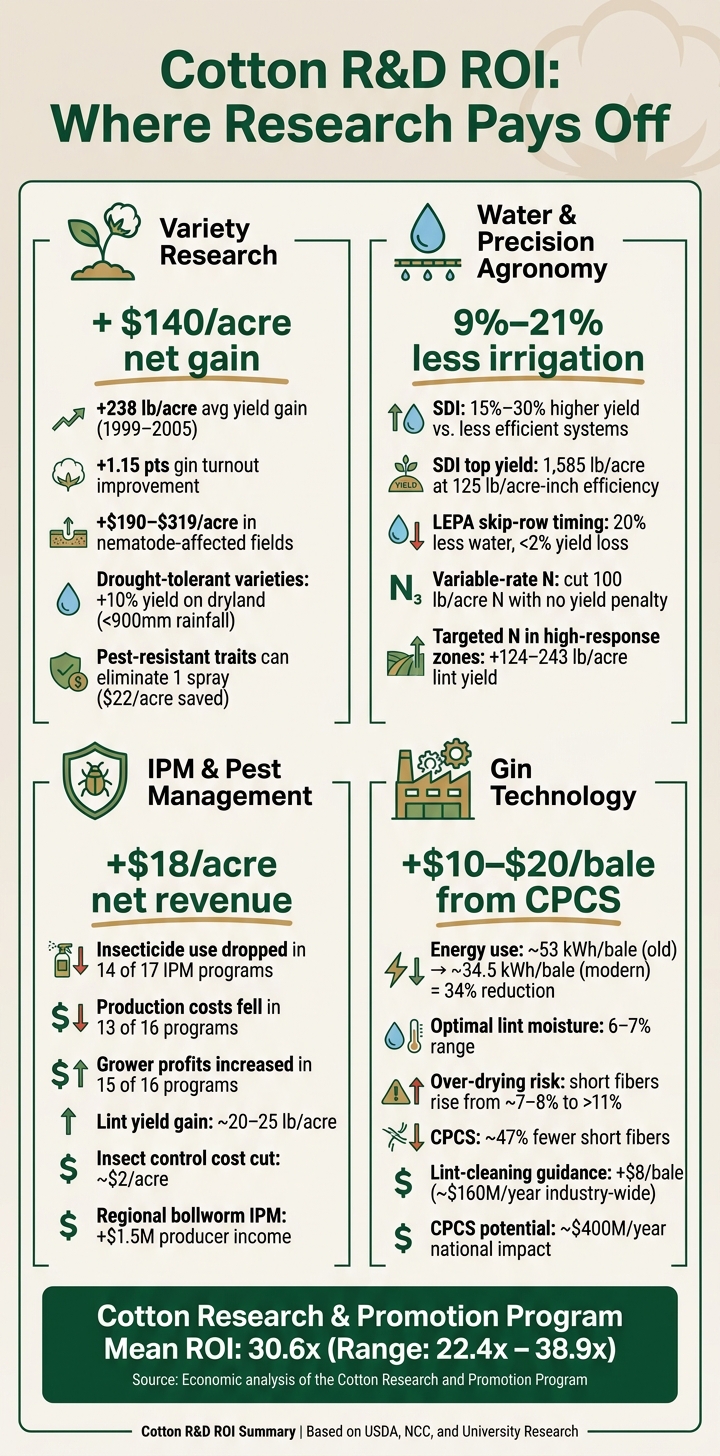
Cotton R&D ROI by Category: Field & Gin Gains at a Glance
Higher-Yielding Varieties Are Raising Revenue and Reducing Risk
Yield, Fiber Quality, and Resilience Gains from Variety Research
Modern breeding now links higher yield with better fiber quality and stronger stress tolerance. In plain terms, variety choice is where growers set a big part of their yield, quality, and risk outlook before the planter ever rolls.
The numbers back that up. Between 1999–2000 and 2004–2005, National Cotton Council data showed average yield increased by 238 lb/acre, gin turnout increased by 1.15 points, and quality value improved by 1.96 cents/lb. That makes seed selection one of the first big ROI calls of the season.
Stress tolerance matters because it helps protect income when weather turns against you. USDA-ERS found that drought-tolerant cotton varieties increased yields on nonirrigated land by 10% in areas with annual precipitation below 900 mm. For dryland and deficit-irrigated growers, a gain like that can smooth out some of the ups and downs that come with a dry year.
Resistance to pests and disease adds another layer of protection. Breeding programs have added resistance and tolerance to major cotton diseases and pests, including key wilts, nematodes, and insect pests, helping protect yield and cut the need for chemical treatments. For example, DP 493 was released with resistance to race 18 of bacterial blight and tolerance to Fusarium wilt, Verticillium wilt, and reniform nematode, while still holding strong yield and fiber quality.
On fields that deal with steady pest or disease pressure, those traits can make a big difference. In rough seasons, they can help avoid yield losses of 5%–15%, and in some cases they can also remove the need for an in-season spray.
How Growers Can Calculate Variety ROI by Field and Season
The math is pretty direct: add the yield gain, fiber premium, and spray savings, then subtract seed and technology costs. The trait itself doesn't pay the bill. The field-level dollar return does.
A grower comparing varieties using local OVT data estimates their current variety yields 750 lb/acre, while a candidate variety yields 900 lb/acre on similar soils. At $0.80/lb lint, that 150 lb/acre gap adds $120/acre in revenue. If the new variety also earns a 2-cent/lb fiber premium, that adds another $18/acre at 900 lb/acre. If seed and technology fees run $20/acre higher but pest resistance eliminates one $22/acre insecticide application, the net cost change is actually a $2/acre reduction. Net gain: $140/acre, or $70,000 on 500 acres.
The University of Arizona's variety-testing program defines top performers as varieties in the upper-right quadrant: above average in both lint yield and fiber quality. That's a smart target. The goal isn't just to plant the highest-yielding variety on paper. It's to choose the one that delivers the best quality-adjusted revenue under your field conditions.
A practical way to do that is to pull together a few data points:
- Use 2–3 years of Extension trial results
- Review classing data with your gin manager
- Match drought- or disease-resistant varieties to marginal acres
- Put premium fiber varieties on irrigated fields
Over time, yield maps, classing reports, and net returns by variety give you a much clearer picture of what is paying and what is just taking up acres. After a few seasons, variety selection stops being a guess and starts looking a lot more like a repeatable farm decision made with data.
Once the variety is set, the next ROI gains come from putting water, nutrients, and pest control exactly where the crop needs them.
sbb-itb-0e617ca
Precision Agronomy, Water Management, and IPM Are Converting Research Into Margin
Precision Agronomy Tools That Improve Input Efficiency
Once variety selection is locked in, the next profit leak usually comes from treating every acre the same when fields don't behave the same way. Yield maps, soil electrical conductivity surveys, remotely sensed NDVI, and zone-based soil sampling all point to the same thing: field response changes by zone. So when nitrogen goes out at one flat rate, growers often spend too much in low-response areas and not enough in high-response areas.
Research backs that up. A Clemson precision-ag study found that a variable-rate nitrogen method cut nitrogen use by about 100 lb/acre in cotton compared with grower standard rates, with no yield penalty. Other work found that adding only about 20–23 lb/acre of N in high-response zones increased lint yield by about 243 lb/acre and 124 lb/acre across two seasons. That’s the game after variety choice: putting water, fertility, and sprays in the right place instead of spreading them evenly just because it’s simpler.
That same zone-based approach also applies to irrigation.
Irrigation Research That Protects Yield With Fewer Inches of Water
Water is often the hardest limit in cotton production, especially in the Texas High Plains and other semi-arid areas. When water is tight, every inch has to pull its weight.
Texas research on subsurface drip irrigation (SDI) showed 15% to 30% higher cotton yield than less efficient systems, along with better fiber quality and higher crop water productivity. In one Texas demonstration, SDI produced the top yield at 1,585 lb/acre and the top crop water-use efficiency at 125 lb/acre-inch. Furrow irrigation ranked as the least efficient system in that comparison.
Timing matters too. LEPA research found that skipping irrigation from germination through 550 growing degree days used 20% less seasonal irrigation, with less than 2% yield loss compared with fully irrigated treatments. Plant-based scheduling work in the southeastern U.S. showed that using a more stressful irrigation threshold of −0.7 MPa cut irrigation by up to 10% with no drop in lint yield.
Cotton doesn't respond the same way to water stress all season. It is most sensitive during flowering, which is why irrigation payback usually comes from protecting that period instead of watering on autopilot.
Water savings can vanish in a hurry if pest pressure gets out of hand.
IPM and Pest Research That Lowers Control Costs and Yield Loss
Calendar sprays can feel safe, but they often do three expensive things at once: add cost, knock back beneficial insects, and push resistance faster. Research-backed integrated pest management (IPM) takes a different route by tying spray decisions to scouting and economic thresholds.
The results are hard to ignore. Reviews of cotton IPM programs found that insecticide use dropped in 14 of 17 programs with enough data, production costs fell in 13 of 16 programs, and grower profits increased in 15 of 16 programs after IPM adoption. Bollworm community IPM programs in Arkansas, Texas, and the Southeast reported:
- lint yield gains of about 20 to 25 lb/acre
- insect control cost cuts near $2/acre
- net revenue increases of about $18/acre
In one regional effort, coordinated bollworm IPM cut pesticide use by tens of thousands of pounds of active ingredient and increased producer income by about $1.5 million.
Texas A&M Extension recommends scouting at least once, and preferably twice, each week to identify pest species, density, and damage level before making any spray decision. Trait rotation and chemistry rotation also matter. They help keep resistance management on track and reduce the hidden expense of repeat rescue sprays after one mode of action stops working.
The same margin logic shows up again at the gin, where modernization can lower cost per bale while helping protect fiber value.
Let's Talk About ROI
Gin Technology Upgrades Are Cutting Cost per Bale and Protecting Fiber Value
Old gin equipment does more than slow production. It chips away at margin on every bale.
Aging or poorly run drying systems can over-dry seed cotton and damage fiber. Manual controls also make moisture levels swing from bale to bale. That often leads to higher power costs, more labor time, and lower bale value.
Where Modernization Creates Measurable Gin ROI
One of the clearest gains from gin upgrades is lower energy use. Energy audits of U.S. saw gins found average electricity use of about 34.5 kWh per bale, down from roughly 53 kWh per bale several decades ago. That's about a 34% drop in energy use per bale, even though gins now press bales to nearly twice the density seen in the early 1960s and handle cotton three to six times faster.
Moisture control has a direct effect on fiber quality and bale value. Research shows that keeping lint moisture in the 6–7% range during ginning helps preserve fiber length and strength while limiting short fibers. Push drying too far - from around 6% down to 2.6% moisture - and short fibers under 0.5 inch can climb from roughly 7–8% to more than 11%. That drop in quality can show up fast. Moisture on the other end of the range matters too. Bale moisture above 7.5% held for six months can hurt color and overall quality in storage.
Computerized process control systems, or CPCS, connect these gains in a practical way. They automate dryer temperature, material flow, moisture restoration, press operation, and fire suppression. That cuts the variation that comes with manual operation. Research estimates that CPCS-based fiber quality gains can add $10–$20 per bale in grower profit, with a possible national effect of $400 million per year for U.S. growers.
Lint cleaning is another area where updated guidance has paid off. USDA guidance on when to use one, two, or three stages of saw-type lint cleaners has added about $8 per bale in value. Across the industry, that works out to an estimated $160 million per year in added income.
How to Track ROI From Modernization Projects
The best place to start is with a baseline. Track the same operating and quality numbers before and after each upgrade so you can see what's working and what's not.
Focus on:
- kWh or fuel use per bale
- Bales per hour
- Labor hours per bale
- Fiber-quality outcomes
That kind of side-by-side tracking helps pinpoint which changes are fixing the most expensive bottlenecks first, whether that's drying, cleaning, moisture control, automation, or monitoring. It also makes it much easier to see which projects are paying back within one to three seasons.
| Metric | Older Gin Setup | Modernized Gin Setup |
|---|---|---|
| Electricity use per bale | ~53 kWh | ~34.5 kWh |
| Lint moisture consistency | Variable, operator-dependent | Controlled, 6–7% target range |
| Short fiber content | Elevated when over-dried | Reduced with CPCS, including about 47% fewer short fibers |
| Typical per-bale benefit | Baseline | +$10–$20 from CPCS; about +$8 from lint-cleaning guidance |
The numbers here are pretty plain. Gin-side R&D isn't some far-off payoff story. Better moisture management, tighter process control, and smarter lint cleaning can show results within seasons, not decades.
Conclusion: Why Cotton R&D Investment Is Delivering Record ROI Now
Put it all together, and the case is pretty clear: cotton R&D is paying off across the whole industry. It cuts losses and adds value in both the field and the gin. In nematode-affected fields, resistant varieties added $190 to $319 per acre. USDA ARS research also found that using soil-water measurements could cut irrigation needs by 9% to 21% while often keeping fiber yield steady. On the gin side, equipment upgrades trim operating costs and help protect fiber value in much the same way.
The same pattern shows up at the industry level. An economic analysis of the Cotton Research and Promotion Program estimated a mean ROI of 30.6, with a range of 22.4 to 38.9. That lines up with what field and gin data are already showing across production and ginning.
The best way to judge R&D is by net return per acre or per bale under local conditions, not by the upfront price tag. A resistant variety that lifts returns in a nematode-prone field can pay back fast. The same goes for a soil-moisture-based irrigation plan that cuts water use without giving up yield. What matters most is simple: does it fix a real bottleneck?
That’s why cotton R&D is delivering record ROI for growers, gins, and agribusiness leaders right now.
FAQs
Which cotton R&D investment should I prioritize first?
Start with the biggest weak point or cost driver in your operation. Then roll changes out in stages: pick one baseline tool, track the results, and expand from there.
- Precision ag: start with GPS-guided auto-steer.
- Irrigation: begin with soil moisture sensors and weather-based scheduling apps.
- Seed: choose varieties that fit your local soil, climate, and pest pressure.
- Ginning: audit bottlenecks first, then rank upgrades that show a clear 2-year payback.
How can I calculate ROI on my own farm or gin?
Start with a baseline audit of current performance. Look at metrics like bales per hour, non-lint percentage, and energy use in kWh per bale. That gives you a clear picture of where things stand before you spend a dollar.
From there, build a pro forma that compares current results with projected gains from upgrades like hydraulics or robotics. The goal is simple: show what changes on paper before anything changes on the floor.
Track KPIs like field-to-gin turnaround time and energy use, then compare operating costs against any revenue premiums tied to higher-quality fiber. If better output earns better pricing, that needs to show up in the math.
It also helps to factor in outside funding early. USDA REAP grants may cover 25% to 50% of costs, which can change the payback picture in a big way.
How long do cotton R&D gains take to pay back?
Cotton R&D gains can pay back fast - sometimes in the first year, and often within about two years. The exact timeline depends on the tool, your farm conditions, and the scale of the operation.
Here’s how that looks in practice:
- Smart irrigation: within the first year
- Autosteer: under 2 years
- Section control and variable-rate application: about 1–2 years
- Automation upgrades: roughly a 2-year payback target
That range matters because no two farms are the same. A tool that pays off almost right away on one operation may take longer on another, depending on acreage, input costs, labor pressure, and how heavily the equipment gets used.
Related Blog Posts
- Efficient Irrigation Strategies for Cotton Farming: Optimizing Water Use and Yield
- High-Yield Cotton Varieties: Top Choices and ROI Data for 2026
- Why Smart Money Is Pouring Into Cotton Seed R&D: ROI Cases and Future Trends
- Cotton Industry R&D Investment: Why Policy Support Is Key to Future Competitiveness