U.S. cotton stays in the game only if research keeps moving. I’d boil the article down to this: public funding, checkoff dollars, extension work, and trade support help cotton cut costs, protect fiber quality, and compete with synthetics and foreign suppliers.
Here’s the short version:
- Private money alone isn’t enough. A lot of cotton research takes years and helps the whole industry, so one company or one farm usually can’t justify paying for all of it.
- The biggest gaps are clear: breeding, agronomy, harvest handling, ginning, and classing.
- The day-to-day payoff is measurable.
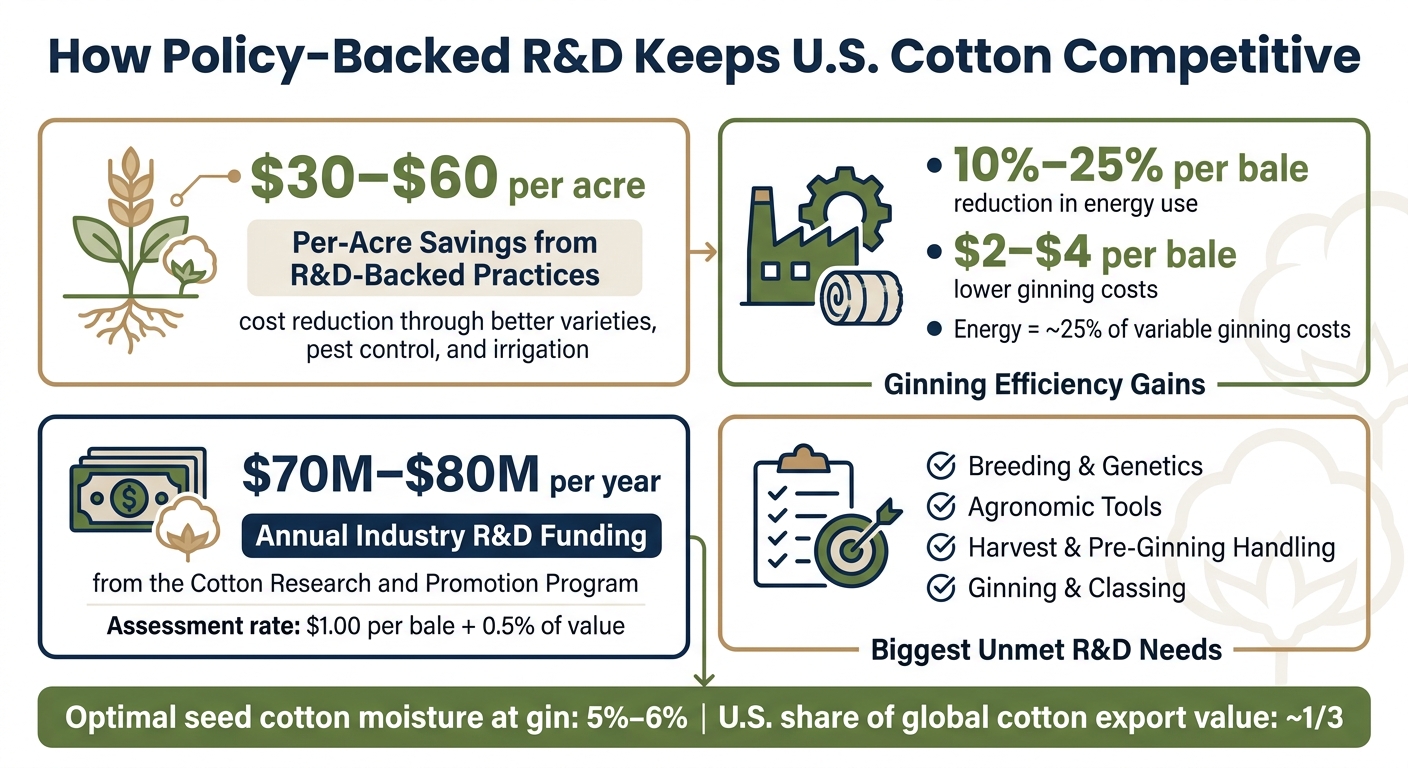
- Growers can cut costs by about $30–$60 per acre
- Gins can trim energy use by 10%–25% per bale
- Ginning cost cuts can reach about $2–$4 per bale
- Energy matters a lot at the gin. It makes up about 25% of variable ginning costs.
- Checkoff support helps, but it has limits. The Cotton Research and Promotion Program brings in about $70 million to $80 million per year.
What I take from this is simple: if policy support weakens, cotton gets more expensive to grow and process, quality becomes harder to protect, and market share gets harder to hold. Research, extension, and trade/infrastructure support work best when they move together.
| Area | What support does | Why it matters |
|---|---|---|
| Breeding | Funds drought, heat, and disease work | Helps yields and fiber hold up under stress |
| Agronomy | Improves irrigation, fertilizer, and pest decisions | Cuts per-acre costs |
| Harvest/ginning | Reduces contamination, moisture issues, and energy use | Protects bale value and lowers processing costs |
| Classing/market work | Improves testing and buyer confidence | Supports pricing and export sales |
If you want the core message in one line, it’s this: policy-backed R&D helps cotton stay cost-competitive, consistent, and easier to sell.
Cotton Industry R&D Policy Support: Key Stats & Cost Savings
'Great American Cotton Plan' rolled out by Trump admin., aims to rebuild cotton industry
sbb-itb-0e617ca
The Problem: Rising Competitive Pressure and Unmet R&D Needs in Cotton
U.S. cotton is under pressure from lower-cost synthetics and foreign suppliers that move faster. Cotton’s share of global fiber consumption has dropped hard, while polyester and other synthetics keep taking more of the market. The U.S. still makes up about one-third of global cotton export market value, but that standing won’t hold on its own. It depends on steady research that helps keep production costs in check and fiber quality high. Those pressures land differently across growers, gins, merchants, and mills, and they also point to the clearest R&D gaps.
Where the Biggest R&D Gaps Are
The biggest gaps show up in four areas that have a direct effect on competitiveness.
Breeding and genetics are still near the top of the list. Cotton breeding needs to produce drought- and heat-tolerant varieties that hold up under stress, not just under near-perfect conditions. That’s where many cost and yield gains are either made or lost.
Agronomic tools are another weak spot, especially for water-use efficiency, nutrient management, and precision pest control. Even small gains in irrigation scheduling or variable-rate fertilizer use can lower per-acre input costs in a crop with tight margins. Without research-based decision tools, growers are often making expensive calls with only limited data.
Harvest and pre-ginning handling doesn’t always get much attention, but it has a huge effect on value. Quality losses between the field and the gin - from contamination, moisture swings, or rough module handling - can hurt classing grades even when the crop itself is solid. USDA-ARS research shows that better pre-ginning practices help protect the fiber value built in the field. But those gains only matter if the cotton reaches the gin and warehouse in good shape.
On the ginning and classing side, both energy use and measurement accuracy still need work. Research has found cotton lines that separate fiber from seed more easily. That can mean faster processing, lower energy use, and less fiber damage. But moving that from research into broad use takes steady engineering work and extension support.
Why Private Investment Alone Falls Short
A new variety, test method, or energy protocol can help the whole industry. That sounds good in theory, but it creates a basic funding problem: no single firm gets enough of the payoff to justify covering the full cost alone. That’s why the industry set up the Cotton Research and Promotion Program to pool money for research and market development. Today, the program brings in about $70 million to $80 million per year through assessments of $1.00 per bale plus 0.5% of value. That’s meaningful support, but it still doesn’t cover the full range of R&D the industry needs.
Private funding also runs into a time problem. Germplasm improvement, fiber quality standardization, and gin efficiency studies can take 10 years or more before returns show up in a way that fits a company balance sheet. Most firms just don’t invest on that kind of timeline.
And a lot of the cotton research that matters most depends on shared systems that private companies are not likely to build on their own, including:
- land-grant university trial networks
- USDA-ARS labs
- regional extension systems that turn plot-level findings into field recommendations
That’s the core issue. If the industry wants to close these gaps, it needs policy-backed support for research, extension, and the infrastructure behind both.
The Solution: Policy Tools That Keep Cotton Innovation Moving
These gaps need policy support because cotton research takes time and spreads costs across the whole industry. Work in breeding, agronomy, gin efficiency, and market development often needs public backing to move from the lab into the field. And with thin margins, many producers just don’t have much room to put money back into cotton-focused R&D.
Federal Research Funding and Farm Bill Support
USDA-ARS and competitive grants help keep multi-year work moving in breeding, agronomy, and ginning - especially the kind of research no single company would pay for on its own. Farm Bill programs like ARC and PLC can help cushion losses, but they don’t solve the problem of weak market prices.
University Extension Partnerships and Field-Level Adoption
Research matters only when growers can use it. Land-grant universities and extension networks help turn research into field-ready practices by linking trial results to day-to-day choices on irrigation, pest control, and gin operations. That step is where the payoff from public research spending actually shows up.
Trade Assistance and Infrastructure Incentives
Trade assistance and infrastructure incentives can help manage export risk and cut logistics costs. In plain terms, those policy choices can lead to lower costs, better fiber, and stronger market performance.
How Policy-Supported R&D Affects Daily Operations and Market Position
Lower Production and Processing Costs
Policy-backed R&D helps trim costs while improving day-to-day work on the farm and at the gin. For growers, it cuts per-acre costs by about $30–$60, mostly through better varieties, more targeted pest control, and tighter irrigation practices. Those gains help narrow the cost gap with synthetics and lower-cost foreign suppliers.
For gin operators, energy is a big expense. It accounts for about 25% of total variable ginning costs, so even modest efficiency gains can make a dent fast. R&D-supported upgrades like motor speed controls, better airflow, and improved drying have reduced energy use by 10%–25% per bale. In practice, that can lower ginning costs by $2–$4 per bale while also reducing overdrying and moisture issues.
Better Yields, Stronger Fiber Quality, and More Reliable Classing Results
Lower costs help, but they matter more when lint quality holds up at the same time. Public research in genetics, agronomy, and ginning supports more stable yields and more consistent fiber. Stress-tolerant varieties, for example, help growers maintain yield under weather stress and pest pressure, which cuts some of the year-to-year volatility.
Moisture management is a big part of that. Seed cotton performs best in the gin at about 5%–6% moisture. Staying in that range helps reduce discounts, rework, and unpleasant surprises at classing. USDA classing gives every U.S. bale a standardized quality reading through instrument and manual classing, and buyers use that data when setting prices and writing contracts.
Stronger Market Development Across the Cotton Chain
When costs come down and quality data becomes more dependable, the market effect shows up pretty quickly. Reliable classing data strengthens the market position of U.S. cotton because mills trust the consistency of the quality signal. Market-development programs also help U.S. cotton compete with synthetics by supporting performance research and buyer outreach. That ties fiber quality data to actual purchasing decisions in key importing countries.
Conclusion: The R&D Investment Priorities That Matter Most for Cotton's Future
The big issue isn't whether cotton can improve. It can. The issue is whether policy will keep that work funded and make sure people can actually use it. The competitiveness of U.S. cotton depends on steady R&D, from seed genetics to market development, with public support that private money on its own usually won't cover.
USDA agencies, land-grant universities, and extension systems pay for and deliver breeding, agronomy, and ginning research that private firms often leave alone. And that matters for a simple reason: research doesn't change competitiveness just because it exists on paper. It matters when it reaches farms, gins, and mills.
These three policy levers work as a connected system. Research creates the tools. Extension helps people put those tools to work. Trade and infrastructure policy help the industry get the return from that work.
That support shows up in a few direct ways:
- Research grants can help cut costs and improve yields
- Extension funding helps turn lab work into on-farm results
- Trade promotion can expand market access
- Infrastructure incentives can support fiber quality and movement through the supply chain
For growers, that means using extension programs instead of letting good information sit on the shelf. For gin operators, it means going after modernization support when it's available. For cotton leaders, it means backing farm bill research titles, steady extension funding, and trade provisions that help U.S. cotton compete.
Policy-backed R&D keeps the sector moving. Private investment alone doesn't.
FAQs
Why can’t private funding cover cotton R&D alone?
Private investment plays a big role here, especially in seed genetics and proprietary tech. But money from private companies usually goes to research with a clear path to profit.
That leaves some big needs leaning on public funding, often through USDA grants and university partnerships. This includes work on long-term climate resilience, resource efficiency, and foundational genomic research.
In plain English: private dollars often help push products toward field use, while public dollars help support the base science and longer-horizon work. You need both. That mix helps move research from the lab into actual farming and helps support long-term competitiveness.
Which cotton R&D areas need the most policy support?
The U.S. cotton industry needs policy-backed R&D in a few key areas.
- Seed genetics to lift yields while using water, fertilizer, and pesticides more efficiently
- Ginning and processing technology to cut fiber damage, improve efficiency, and support higher-value cotton
- Sustainability research, including soil health, climate-smart farming, and financial tools
- Traceability systems that support domestic demand for U.S. fiber
This work matters across the whole cotton chain. Better seed can help growers get more from each acre. Smarter ginning and processing can protect fiber quality instead of wearing it down. Research on soil health and climate-smart farming can help farms stay productive while managing risk and costs. And traceability systems can give mills, brands, and buyers a clearer line back to U.S. fiber, which can help strengthen demand at home.
How does policy-backed R&D improve cotton competitiveness?
Policy-backed research and development helps cotton stay competitive in a pretty direct way: it can lift yields, improve fiber quality, and cut operating costs through innovation.
That support shows up in a few key places, including public research grants, university partnerships, R&D tax credits, Farm Bill provisions, and infrastructure support. Together, these efforts help develop resilient regional seed varieties, move new ideas from research plots into fields faster, and modernize ginning operations.
For U.S. growers, that matters. Better seed, faster field adoption, and updated gins can make the difference between thin margins and staying profitable in a market crowded with global suppliers.