If your cotton records live in paper files, spreadsheets, and separate apps, audits get messy fast. I’d fix that with one system that links field logs, module IDs, PBI bale IDs, and sales records from farm to shipment.
Here’s the short version:
- I need one record trail for growers, gins, and merchants
- I should track the same core data for Better Cotton, USDA Organic, Fairtrade, and the U.S. Cotton Trust Protocol
- I need to match my records to the right custody model:
- Mass balance = volume tracking
- Segregation = physical separation
- Identity-preserved = bale-by-bale source tracking
- I should store dates as MM/DD/YYYY, weights in lb, land in acres, and money in USD ($)
- In U.S. cotton, every bale gets a PBI barcode at the gin, and that ID should stay tied to the bale through storage and shipment
- Better Cotton also has hard deadlines: 30 days for ginners to enter purchases, lint production, and sales, and 60 days for other supply-chain entries or acknowledgments
A simple setup does most of the heavy lifting: field history + input logs + harvest records + gin intake + bale IDs + inventory + shipment records. When those records line up, I spend less time fixing gaps and more time getting through audits cleanly.
| Program | Main focus | Records I’d keep |
|---|---|---|
| Better Cotton | Water, pesticide use, soil, work conditions, farm records | Farm profile, input logs, training, volume records |
| USDA Organic | Prohibited input control, seed rules, separation | Organic plan, field history, input logs, buffers, separation records |
| Fairtrade | Worker rules, payments, premiums | Member files, premium records, wage logs, sales ledgers |
| U.S. Cotton Trust Protocol | GHG, water use, soil carbon, land use | Enrollment data, self-checks, Fieldprint data, practice logs, production volumes |
My main takeaway: one linked data system can support all four programs if I set up IDs, units, and transaction records the right way from the start.
TraceBale: Simplifying Textile Supply Chains | CottonConnect
sbb-itb-0e617ca
Standards, Traceability Models, and the Records They Require
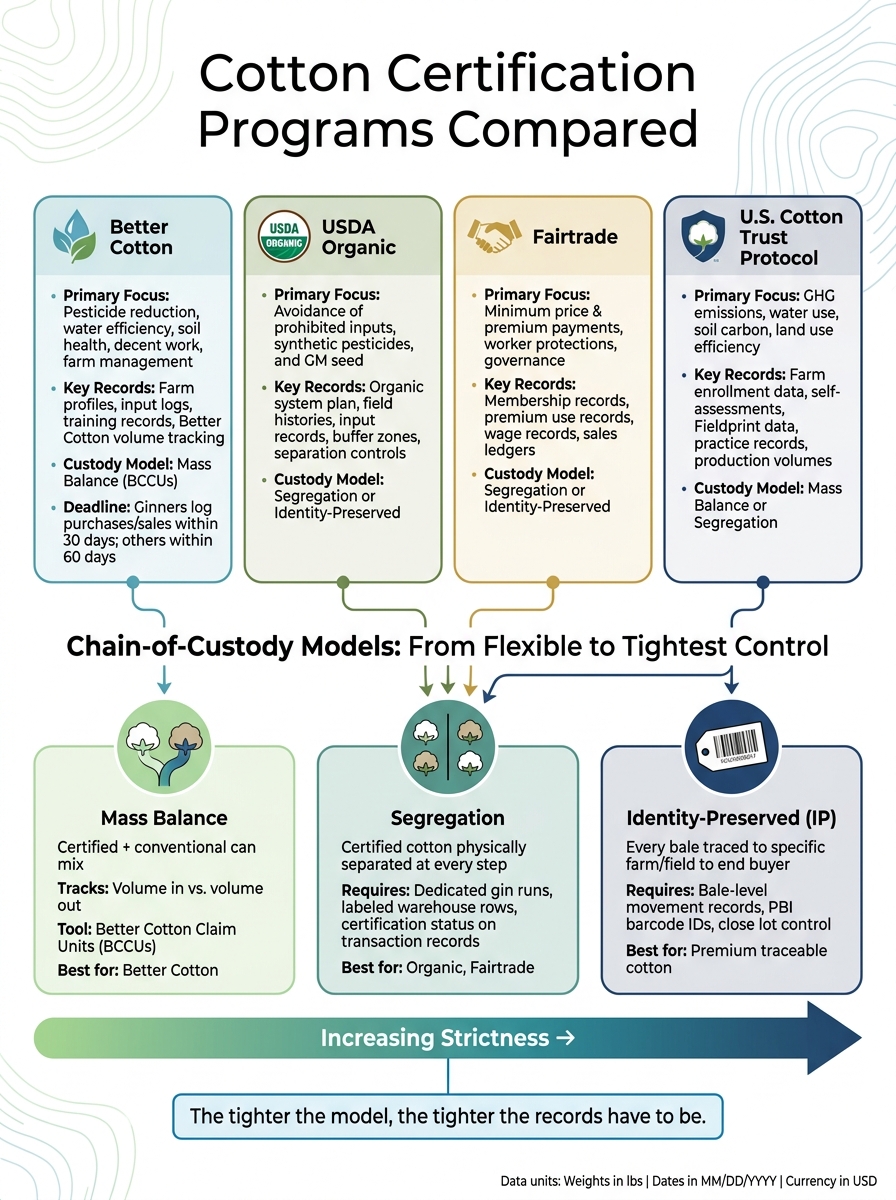
4 Cotton Certification Programs: Standards, Records & Traceability at a Glance
Better Cotton, Organic, Fairtrade, and U.S. Cotton Trust Protocol at a Glance
Each program has its own rules around sustainability. But the day-to-day reality is pretty simple: they all run on records tied to farms, fields, and transactions.
| Program | Primary Focus | Key Record Types |
|---|---|---|
| Better Cotton | Pesticide reduction, water efficiency, soil health, decent work, farm management | Farm profiles, input logs, training records, Better Cotton volume tracking |
| USDA Organic | Avoidance of prohibited inputs, most synthetic pesticides, and GM seed | Organic system plan, field histories, input records, buffer zones, separation controls for organic and conventional production |
| Fairtrade | Minimum price and premium payments, worker protections, governance | Membership records, premium use records, wage records, sales ledgers |
| U.S. Cotton Trust Protocol | Greenhouse gas emissions, water use, soil carbon, land use efficiency | Farm enrollment data, self-assessments, Fieldprint data, practice records, production volumes |
There’s a lot of overlap here, and that matters. If your data is set up well, one system can support more than one program instead of forcing you to rebuild the same paper trail again and again.
That only works, though, if the chain-of-custody model lines up with the program’s rules.
Mass Balance, Segregation, and Identity-Preserved Traceability Explained
The chain-of-custody model decides how tight your lot control and recordkeeping need to be.
Mass balance is the most flexible. It allows certified and conventional cotton to be mixed. Better Cotton uses claim units, or BCCUs, to match certified volume across each handoff. In plain terms, the main job is volume accounting: what came in, what went out, and whether the balances match.
Segregation is stricter. Certified cotton has to stay physically separate at every step. That can mean dedicated gin runs, labeled warehouse rows, and transaction records that clearly show certification status. Organic and Fairtrade-style chain-of-custody models usually depend on segregation or identity-preserved methods.
Identity-preserved (IP) is the tightest model of the three. Every bale stays tied to a specific farm or field all the way to the end buyer. That means close lot control, detailed bale movement records, and a system that can trace single bales through warehouses, merchants, and mills.
The tighter the model, the tighter the records have to be.
Once you know which model you’re working under, the next step is to lock down the same core data fields across the operation.
Core Data Fields Every Operation Should Capture
The smart move is to capture data once and use it across programs. That shared backbone cuts down on duplicate work and makes audits much less painful.
| Role | Core Data Fields |
|---|---|
| Grower | Farm ID, grower name and contact details, field IDs, GPS coordinates, acreage, soil type or management zones, crop rotation history (3+ years), seed variety/lot, fertilizer and pesticide logs (product, rate, date, field), irrigation source and volume, harvest date, module ID, weight |
| Gin | Gin ID, gin lot/run ID, module IDs received, truck/weight tickets, bale IDs (PBI barcodes), bale weights (lbs), classing data, certification status per lot or bale |
| Merchant | Warehouse ID, lot IDs, bale ID lists, contract ID, buyer ID, shipment ID, invoice ID, certificate numbers |
A few formatting rules are worth fixing early so you don’t run into headaches later. Dates should use MM/DD/YYYY. Weights should be in pounds, and acreage should be in acres.
The USDA’s National Cotton Database stores classing data by gin code and PBI bale number for the current crop year plus the previous four crop years. That gives you a built-in five-year traceability window, and your internal records should match that timeline.
Small naming and unit choices can make a big difference. If one file says “lbs” and another says “pounds,” or one team uses a different field name for the same item, the mess adds up fast. Standardized names and units help keep the same records ready for audits across programs.
Field-to-Bale Recordkeeping for Growers, Gins, and Merchants
Farm Logs for Field History, Inputs, and Harvest
Use the shared farm fields already set up to build each field-level log. Each farm log should begin with the farm ID, field IDs, GIS coordinates, acreage, and field history. That gives you the base record for everything that happens in that field.
Then log each input application as its own record. Include:
- Product name
- Application rate
- Application date
- Target field
- Applicator name
Those records matter during certification audits because they show exactly what was used, where it was used, and when.
Harvest records should connect the crop back to the field. Record the harvest date and module ID for each harvest entry. Just as important, keep the module ID matched to the gin intake record so the trail doesn't break once the crop leaves the farm.
Gin Traceability Records and Permanent Bale Identification
At the gin, intake records connect each module to its bale ID. The intake record should include the consignor, receipt date, module ID, and lot or run number. This is the first custody record at the gin, and it sets up the bale trail from that point forward.
PBI assigns each bale a single bale ID that must appear on gin records and bale tags. USDA classing data should match that same PBI number. The gin's internal records should point to those same PBI numbers as well, so the bale trail stays in one piece during an audit.
Merchant and Chain-of-Custody Transaction Records
After bales leave the gin, merchant records carry that same traceability trail forward. The key idea is simple: keep the same bale IDs attached to the cotton through storage and shipment.
Document every purchase with the bale IDs, gin lot number, and transaction date. Shipping records should show which PBI numbers moved in each shipment. Warehouse and inventory records should also keep bale locations up to date so received, stored, and shipped volumes can be reconciled cleanly.
For certified cotton, Better Cotton's Chain of Custody Standard requires ginners to log all purchases, lint production, and all sale transactions in the Better Cotton Platform within 30 calendar days of the transaction date. Other supply chain actors have 60 days from the shipment date to enter or acknowledge transactions. Stock reconciliation compares bales received, shipped, and on hand to confirm inventory balances during audits.
Once the field-to-bale trail is set, digital systems can record it once and use it again across audits and claims.
Digital Systems That Make Certification Easier
Farm, Gin, and Traceability Platforms Worth Knowing
Digital systems help keep field IDs, bale IDs, and shipment records connected as cotton moves through the supply chain. That matters because different chain-of-custody models need different levels of recordkeeping. Mass balance depends on volume reconciliation. Segregation and identity-preserved programs need bale-level movement records. In practice, the same core data, field, bale, and transaction records, can support Better Cotton, Organic, Fairtrade, and U.S. Cotton Trust Protocol requirements. The best setup handles that work without forcing duplicate entry across farms, gins, and merchants.
The Better Cotton Platform (BCP) records volumes, transactions, and supporting documents in site-level accounts with assigned data owners.
CottonConnect's TraceBale supports farm-to-mill traceability by linking bale IDs, stage-to-stage losses, handler records, and test results in one system.
Some platforms check traceability through digital records alone. Others go a step further and add a physical marker. FibreTrace adds proof of origin at the fiber stage, then uses scanners to verify the cotton at later processing stages.
Document Dashboards and Audit-Ready Reporting
A good document dashboard brings certificates, farm maps, lab results, field logs, gin reports, and chain-of-custody records into one workspace. The most useful dashboards sort those records by both document type and supply chain stage. That way, an auditor can move from a summary report straight to the supporting evidence instead of digging through folders.
Just storing files isn't enough. A dashboard should control the data too. Required fields stop incomplete records from being saved. Date and unit checks catch formatting mistakes before they turn into audit findings. Role-based access lets auditors view records without changing them, while limiting data entry to approved staff. Each upload or edit should create a time-stamped, read-only audit log that shows who made the change and when.
Exportable PDF or CSV reports with MM/DD/YYYY dates and USD amounts make life easier during audits. You can hand over what the auditor needs without fixing formats by hand at the last minute.
What to Check Before Adopting a System
Before you pick a system, line it up with how your farm and gin already work. A tool can look good in a demo and still become a headache if it adds one more layer of admin work.
| Capability | What to confirm |
|---|---|
| Farm-to-bale and gin integration | Can field records link to bale IDs and sync with gin software? |
| Multi-standard support | Does it handle Better Cotton, organic, Fairtrade, and U.S. Cotton Trust Protocol data fields? |
| Field staff usability | Is data entry simple enough for seasonal workers, with validation rules and offline access? |
| Report exports | Can it export volume summaries and chain-of-custody logs in CSV, XLSX, or PDF with MM/DD/YYYY dates and $ amounts? |
| Audit trails | Are edits logged with user IDs and timestamps that auditors can review? |
Platforms like BCP and TraceBale show what tailored traceability looks like in day-to-day use. The main thing is to choose a system that fits your farm and gin workflow, instead of creating a separate data-entry job just to keep certification records in order.
Building a Centralized Compliance Workflow and Next Steps
How to Connect Records Across Multiple Standards
Once your field, bale, and transaction records are set up, the next move is to connect them inside one compliance workflow.
The simplest way to do that is to use one ID structure across field, gin, and merchant records. That lets you reuse the same data across multiple standards instead of entering it again and again. Each harvest lot should link back to harvest date, equipment, field grouping, and certified volume. When that link is in place, one record can support BCP uploads, organic annexes, and Fairtrade reports.
At the gin and warehouse level, each bale should be tagged with its certification status and the custody model that applies. That gives merchants a clean way to reference bale IDs or lot IDs in contracts, invoices, and shipment records.
When bale IDs and custody status stay consistent from one step to the next, reconciliation can run from the same record set instead of being rebuilt for each program.
How Centralized Records Save Time and Cut Audit Risk
Shared IDs make volume reconciliation faster and cleaner. Better Cotton Claim Units (BCCUs) and organic lint volumes can be matched against production and inventory records automatically, which helps cut the risk of over-claiming or double-counting. You can also automate lot segregation checks by comparing storage locations with shipment records.
For U.S. operations, linked records make audit trails faster to pull and easier to verify. It also speeds up document storage, review, and exports. In plain English: when everything points back to the same record trail, audits get a lot less messy.
Using cottongins.org to Support Certified Cotton Operations
Store linked records in one system and create standard exports for Better Cotton, organic, Fairtrade, and U.S. Cotton Trust Protocol reporting.
FAQs
Which traceability model fits my cotton program?
The right traceability model comes down to your program needs, scale, and how much transparency you want.
Mass Balance tracks certified cotton by volume through documents, which means it can be mixed with conventional cotton along the way. Physical segregation or Hard Identity Preserved (HIP) keeps certified cotton separate through each stage of processing and gives you the higher level of traceability needed for stricter standards like GOTS or some branded labels.
How do I connect field records to bale IDs?
Use one steady data workflow that tracks cotton from harvest through ginning. Record module IDs before ginning, then assign each bale a 12-digit Permanent Bale Identification (PBI) tag during processing.
Store those links in one centralized database. Gin management software can automate the connection between producer data, production metrics, and each PBI number.
What should a cotton compliance system automate first?
First, automate how you collect and organize core farm data, like field inputs, harvest records, and bale identifiers. When these records are digitized, you start with a clean, dependable base for reporting and audits.
Automated logging for inputs like seeds and fertilizers can cut down on manual entry mistakes and lower audit risk. Once that data lives in one place, it can support compliance checks, volume reconciliation, and chain-of-custody tracking.