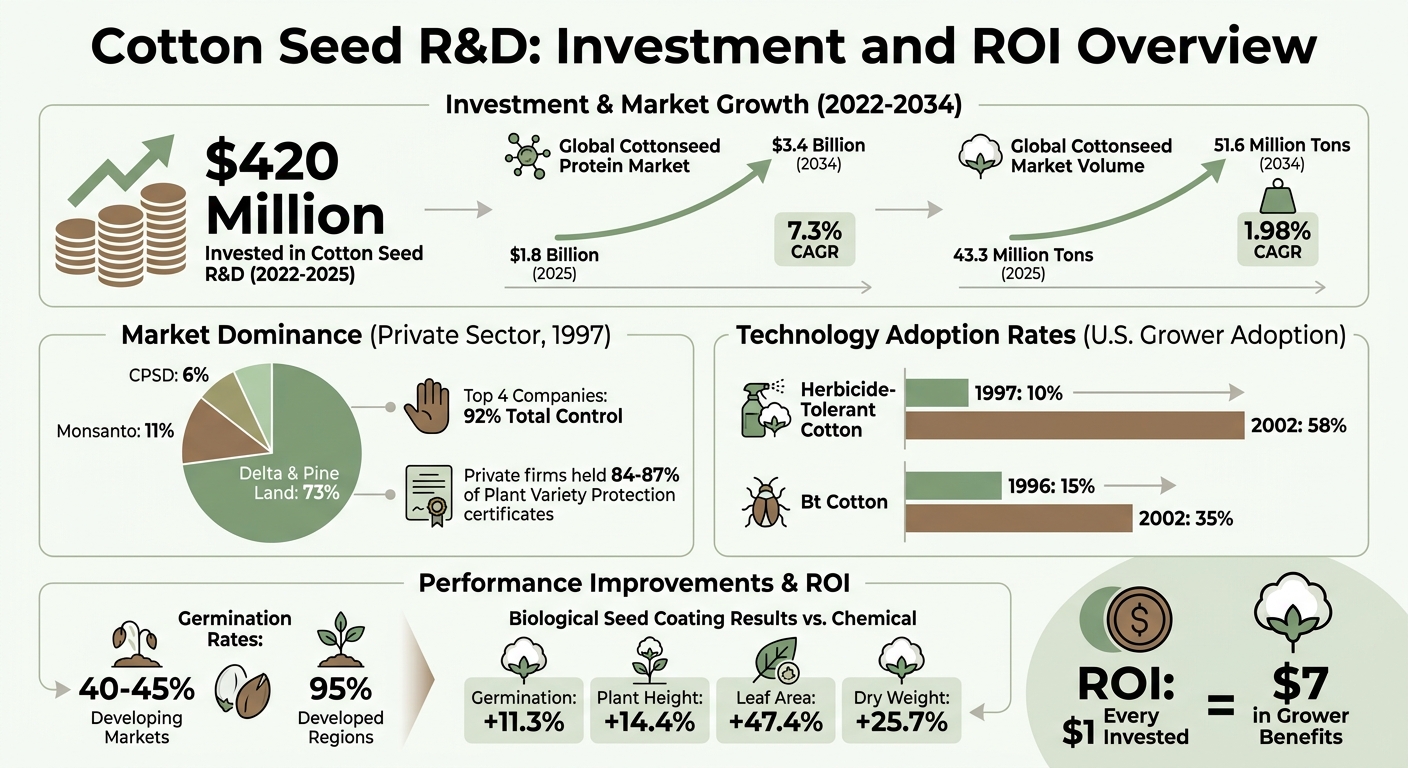
Cotton seed research is attracting significant investment, driven by rising demand for high-performance cotton, regulatory pressures for sustainability, and advancements in seed genetics. Between 2022 and 2025, over $420 million was invested in this sector, with the global cottonseed protein market projected to grow from $1.8 billion in 2025 to $3.4 billion by 2034 at a 7.3% CAGR. Key innovations include pest-resistant Bt cotton, gossypol-free seeds for food applications, and resource-efficient coatings and treatments. U.S. growers benefit from better yields, reduced costs, and new revenue streams like cottonseed for human nutrition and aquaculture. Genetic tools like gene editing and AI are further accelerating progress, ensuring profitability in a competitive global market.
Cotton Seed R&D Investment Returns and Market Growth Statistics 2022-2034
Why Investors Are Funding Cotton Seed R&D
Growing Global Demand for High-Performance Cotton
Cotton seeds serve a dual purpose, producing both fiber and oilseed, which makes them appealing to a wide range of investors. Consider this: the Indian textile market alone is worth $223 billion, and global cotton lint production is expected to hit 28.1 million tonnes by 2032.
But there’s a noticeable gap in performance. In developing markets, germination rates hover around 40–45%, while in developed regions, they reach approximately 95%. This gap highlights a significant opportunity to improve seed vigor, ensuring better crop establishment and creating room for market growth.
Sustainability and Environmental Requirements
Environmental concerns are another major driver behind innovation in cotton seed R&D. Investors are backing sustainable alternatives like plasma therapy, magnetic water treatments, and nanotechnology to minimize pollution while maintaining or enhancing seed performance.
Seed-applied coatings and priming techniques are also gaining attention. These methods deliver nutrients and protection right to the seed, cutting down on the need for large-scale fertilizers and pesticides. For example, biological seed coatings using growth-promoting rhizobacteria have demonstrated impressive results, increasing leaf area by 47.4% and dry weight by 25.7% compared to traditional chemical coatings. Meanwhile, older methods like acid delinting, known for its effectiveness in removing lint but also for generating hazardous waste, are being replaced by cleaner alternatives such as gas delinting.
Advances in Seed Genetics
Genetic research is playing a critical role in shaping the future of cotton seeds. Leading agricultural companies like Bayer AG, BASF SE, Corteva Agriscience, and Syngenta are expanding their genetic research capabilities, often through mergers and acquisitions. Between 2020 and 2024, the cottonseed market was expected to grow by $2.28 billion, with around 65% of that growth coming from the Asia-Pacific region.
These advancements are targeting the development of specialized seed varieties. Upland cottonseed is being tailored for broad applications, while Extra-Long-Staple (ELS) cottonseed caters to premium textile production. Additionally, research into protective coatings and treatments is addressing the challenge of seed deterioration during storage, a common problem given that cotton seeds contain about 20% oil. For instance, a simple hot water treatment at 96 °F for just 10 seconds has been shown to boost germination rates by up to 71% in varieties like Sayar-314. These genetic improvements not only enhance seed performance but also promise strong financial returns and opportunities for market expansion.
sbb-itb-0e617ca
ROI Case Studies: Financial Returns from Cotton Seed R&D
These examples show how investments in cotton seed R&D have translated advancements into measurable financial gains.
Case Study 1: Private Sector R&D Returns
Private sector efforts in cotton seed R&D have generated clear financial returns, especially for companies with intellectual property rights. From 1960 to 1996, private sector spending on crop variety research grew 14-fold. By 1997, private firms controlled 84% to 87% of Plant Variety Protection (PVP) certificates for cotton, granting them exclusive rights to market new seed varieties.
Delta & Pine Land is a standout example. In 1997, the company captured a 73% share of U.S. cotton seed sales through targeted R&D. Monsanto followed with 11%, and California Planting Seed Distributors (CPSD) held 6%. Together, the top four companies controlled 92% of the cotton seed market. These investments not only secured market dominance but also drove revenue growth, enabling the development of proprietary seed varieties that strengthened market competitiveness.
Case Study 2: Bt Cotton Cost Reduction and Yield Improvements
The financial impact of Bt cotton has varied depending on farm size and location. Monsanto’s Bollgard™ technology was designed to lower pesticide costs by embedding insect resistance directly into the seed. For example, in South Africa’s Makhathini Flats, adoption of Bt cotton reached 90% during the 2000-2001 season.
However, financial outcomes for small-scale farmers in the region were less promising. Research by Elfrieda Pschorn-Strauss and Biowatch South Africa (2000–2005) revealed that 80% of 2,390 farmers in Makhathini defaulted on production loans, collectively owing over $3 million - an average debt of $1,322 per farmer. Among a sample of 36 farmers, only 4 (11.1%) turned a profit, while the group collectively lost $83,348.
Rising seed costs and additional pest management expenses undercut the expected savings. In contrast, U.S. growers have generally seen clearer benefits from advanced seed technologies.
Case Study 3: U.S. Cotton Growers Using Advanced Seed Breeding
In the U.S., farmers have embraced genetically engineered cotton varieties, finding the returns sufficient to justify higher seed costs. Adoption of herbicide-tolerant (HT) cotton jumped from 10% in 1997 to 58% in 2002, while Bt cotton adoption rose from 15% in 1996 to 35% in 2002.
This rapid adoption occurred despite premium pricing, as growers experienced benefits like yield stability and reduced labor and chemical costs. By 1997, the U.S. commercial seed market had grown to $5.7 billion, making it the largest globally. Advances in seed genetics have driven yield increases of 2 to 4 times since the 1930s. These improvements have enabled U.S. cotton growers to meet stricter global quality standards while maintaining profitability through higher productivity and competitive market positioning.
Future Developments in Cotton Seed R&D
The next decade is set to transform cotton seed research, with new technologies helping growers tackle climate stress and limited resources. These advancements go beyond traditional methods, focusing on seeds that thrive under tough conditions while using fewer inputs.
Precision Breeding for Climate Challenges
Gene-editing tools like Cas12a are opening doors to cotton varieties that can endure drought, heat, and erratic weather. This technology has shown over 90% editing efficiency. Meanwhile, speed breeding is cutting down cotton growth cycles to just 71–85 days, allowing up to five generations per year. For example, in 2025, researchers used this method with the JND24-i3 elite line, combining genomics-assisted breeding with speed breeding to quickly integrate resilience and quality traits.
"The pace of breeding has long been out of step with the rhythm of environmental changes."
- Zhen Li, Hainan Institute of Biotechnology
The focus is shifting from targeting single genes to haplotype-based breeding, which leverages the combined effects of multiple genes to improve fiber quality and stress tolerance. Pangenomics, which uses multiple reference genomes, is helping researchers uncover genetic variations that enhance environmental adaptation - variations that were previously undetectable.
Resource-Efficient Seed Development
New seed technologies are cutting down on the need for water, fertilizers, and pesticides. For instance, polymer seed coatings infused with micronutrients have boosted cotton yields by 16% while using less product than traditional foliar or soil applications. Similarly, biological seed coatings with growth-promoting bacteria have shown impressive results: germination rates increased by 11.3%, plant height by 14.4%, and leaf area by 47.4% compared to chemical treatments.
These advancements are making a direct impact on growers' profitability. In developed regions, advanced seed treatments now achieve up to 95% germination rates, presenting both challenges and opportunities for U.S. growers to stay competitive.
"The application of micronutrients through seed coating is a more economically viable option which requires less dosage of agent and effectively improves the seedling growth."
- Journal of Cotton Research
Physical treatments like plasma therapies and protective coatings are also gaining traction. These methods help seeds endure the stress of ginning and delinting while reducing cleanup costs. Together, these innovations lay the groundwork for digital tools to refine seed development even further.
Digital Tools in Seed Development
Digital technologies are now taking cotton breeding to the next level. Artificial intelligence is speeding up the process. In October 2025, the agtech startup Avalo used machine learning to analyze the genomes of over 500 cotton varieties, including wild types from the 1920s. This approach allowed them to design fibers tailored to specific brand needs while helping farmers manage climate challenges.
"When we look at genetics for our seeds, we're talking to spinners, millers and brands about what is important in the fiber characteristics for them."
- Rebecca White, Chief Product Officer, Avalo
Another game-changing tool is the use of digital twins - virtual models that combine genomic, phenomic, and environmental data. These models simulate plant performance and optimize trait combinations before field trials. In May 2024, researchers developed a Bayesian model to analyze 256 recombinant inbred lines, achieving prediction accuracies of 0.46 to 0.62 for traits like lint percentage and seed oil content.
"Emerging digital agriculture tools, such as digital twins that combine genomic, phenomic, and environmental data layers, allow simulation of ideotype performance and optimisation of trait combinations in silico before field validation."
- MDPI Agronomy Journal
This shift from trial-and-error breeding to data-driven design is revolutionizing the industry. High-throughput phenotyping systems combined with genomic databases are making precision breeding more accessible, ensuring that breeders can deliver practical solutions to growers with greater efficiency and accuracy.
Benefits for U.S. Cotton Growers and Ginners
Increasing Profit Margins Through Better Yields
Advancements in cotton seed research are delivering real financial benefits for U.S. growers. In 2025, BASF expanded its FiberMax and Stoneville cotton seed lineup with six new varieties, bringing the total to 13. These seeds come equipped with Axant Flex herbicide tolerance and TwinLink Plus three-gene insect control, providing robust protection against pests and weeds to ensure stable yields. This combination helps growers reduce losses and maintain profitability.
Herbicide effectiveness is another critical factor. Liberty ULTRA herbicide, introduced in 2025, showed 20% better weed control compared to generic glufosinate. This enhanced performance directly supports higher yields. Additionally, BASF's "Real Results Yield Challenge" highlighted the effectiveness of fungicides like Veltyma, Revytek, and Revylok. In side-by-side trials, nearly 10% of regular fungicide users saw increased yields and better returns on investment, even under heavy disease pressure.
The financial return on R&D investment is substantial - every $1 spent on research, development, and extension translates into about $7 in benefits for cotton growers. With the U.S. projected to produce 13.92 million 480-pound bales of cotton in the 2025/2026 marketing year, representing 11% of global production, even small improvements in per-acre yields can lead to significant revenue gains across the industry. These gains also help growers meet the stringent quality demands of global markets.
Meeting Quality Standards for Global Markets
Beyond yield improvements, breakthroughs in seed genetics are unlocking new revenue opportunities. For instance, genetic research has enabled the silencing of the gossypol gene, transforming cottonseed from a byproduct into a viable food and feed source. The U.S. cotton industry is expected to plant one million acres of ultra-low-gossypol biotech cotton within the next six to ten years. This edible cottonseed is rich in protein (23%) and is free of trans fats and gluten, making it attractive for both human consumption and animal feed.
One promising application is in aquaculture. A pilot program at New Mexico State University is cultivating glandless cotton, which is processed into meal and combined with algae to replace traditional fish-based meal for shrimp feed. This provides a sustainable protein alternative, opening up a lucrative market for cotton growers while addressing the rising demand for sustainable food and feed sources. Diversifying in this way allows growers to capture premium prices and expand their market reach.
Using Industry Directories for Business Connections
R&D efforts are not just improving yields - they're also enhancing operational strategies. Industry directories like cottongins.org provide growers and ginners with access to valuable resources and partnerships. For example, BASF hosted five meetings in late 2025 and early 2026, bringing together 74 cotton farmers to review findings from over 200 Agronomic Performance Trials. These trials provided hands-on test-plot data, helping farmers make informed decisions about the 2026 FiberMax and Stoneville seed varieties.
These directories also help growers navigate challenges like rising input costs, which surged up to 22% due to trade volatility and tariffs. By connecting with regional trials and previewing new seed genetics, growers can reduce risks and adapt to market changes. The most successful operations are those that leverage real-time data and strategic networks to stay competitive in a shifting agricultural landscape.
Conclusion
Private investment in cotton seed research and development has reshaped the industry. Earlier studies highlight how intellectual property rights have driven market consolidation, strengthening the private sector's influence. Adoption rates over time have clearly reflected this shift.
Looking ahead, the global cottonseed market is expected to expand from 43.3 million tons in 2025 to 51.6 million tons by 2034, with a compound annual growth rate (CAGR) of 1.98%. Future advancements will likely focus on precision breeding techniques aimed at improving climate resilience and resource efficiency. Digital tools are set to play a critical role in accelerating genetic advancements, even as growers navigate rising input costs - such as the 22% increase seen in 2025, driven by trade tariffs.
These innovations have a direct impact on U.S. cotton growers, leading to better yields, higher quality crops, and increased profitability. For both growers and ginners, the benefits extend to improved profit margins, enhanced quality standards, and added value from byproducts like cottonseed oil and meal. The long-term success of the industry will depend on strong collaboration between public and private sectors. Public research continues to drive private biotech advancements, enabling faster adaptation to challenges and maximizing returns.
FAQs
Which cottonseed traits are likely to deliver the best ROI next?
Advancements in cottonseed breeding are paving the way for traits that promise a strong return on investment. By improving both the quality and quantity of cottonseed oil, these developments can significantly enhance yields and market value. This directly addresses industry needs for increased efficiency and profitability, making these innovations a win-win for growers and the market alike.
How can growers calculate if higher-priced seed will pay off on their farm?
To decide if spending more on higher-priced seed is a good move, growers need to weigh the costs against the potential revenue boost it could bring. Here's how to approach it:
- Estimate yield or quality improvements: Determine how much better the crop might perform with the new seed.
- Calculate potential revenue gains: Use current cotton prices to figure out how much extra income those improvements could generate.
- Subtract the additional seed cost per acre: Compare the extra expense to the potential revenue increase.
If the projected revenue outweighs the added cost, investing in the seed could be a smart decision.
What risks could reduce returns from biotech and gene-edited cottonseed?
Unpredictable factors could influence returns from biotech and gene-edited cottonseed. These might include unexpected market shifts, strict regulatory requirements, or challenges in gaining widespread acceptance, all of which could affect profitability.
Related Blog Posts
- Biotechnology Innovations in Cotton Farming for Enhanced Yields
- Advanced Cotton Crop Management: Digital Innovations and Sustainable Practices for Enhanced Yield
- Stacked Trait Cotton Seeds: The Smart Investment Doubling Yields and Cutting Pesticide Use
- Hybrid Cotton Seeds Advantages: Why Farmers Are Switching to Higher Yields