Better Cotton Initiative (BCI) certification is a structured process designed to help farmers adopt improved cotton farming practices and enable brands to meet transparency requirements. Here's what you need to know:
- For Farmers: Register as an individual or part of a group, complete training on sustainable practices, and pass third-party audits to market cotton as BCI-certified.
- For Brands: Join the BCI Platform, select a sourcing model (Mass Balance or Physical BCI Cotton), and adhere to traceability standards to use the BCI Cotton label.
- Certification Process: Includes registration, training, implementing standards, third-party audits, and maintaining compliance through data submission and renewals.
- Key Changes: Starting January 2025, third-party certification is mandatory. By 2028, all participants must transition to the new certification system.
The certification ensures traceability, aligns with regulatory demands, and supports responsible cotton production. Whether you're a farmer or a brand, following these steps prepares you for a more transparent and compliant supply chain.
BCI Certification Process: 5-Step Guide for Farmers and Brands
Better Cotton Initiative BCI Certification video
sbb-itb-0e617ca
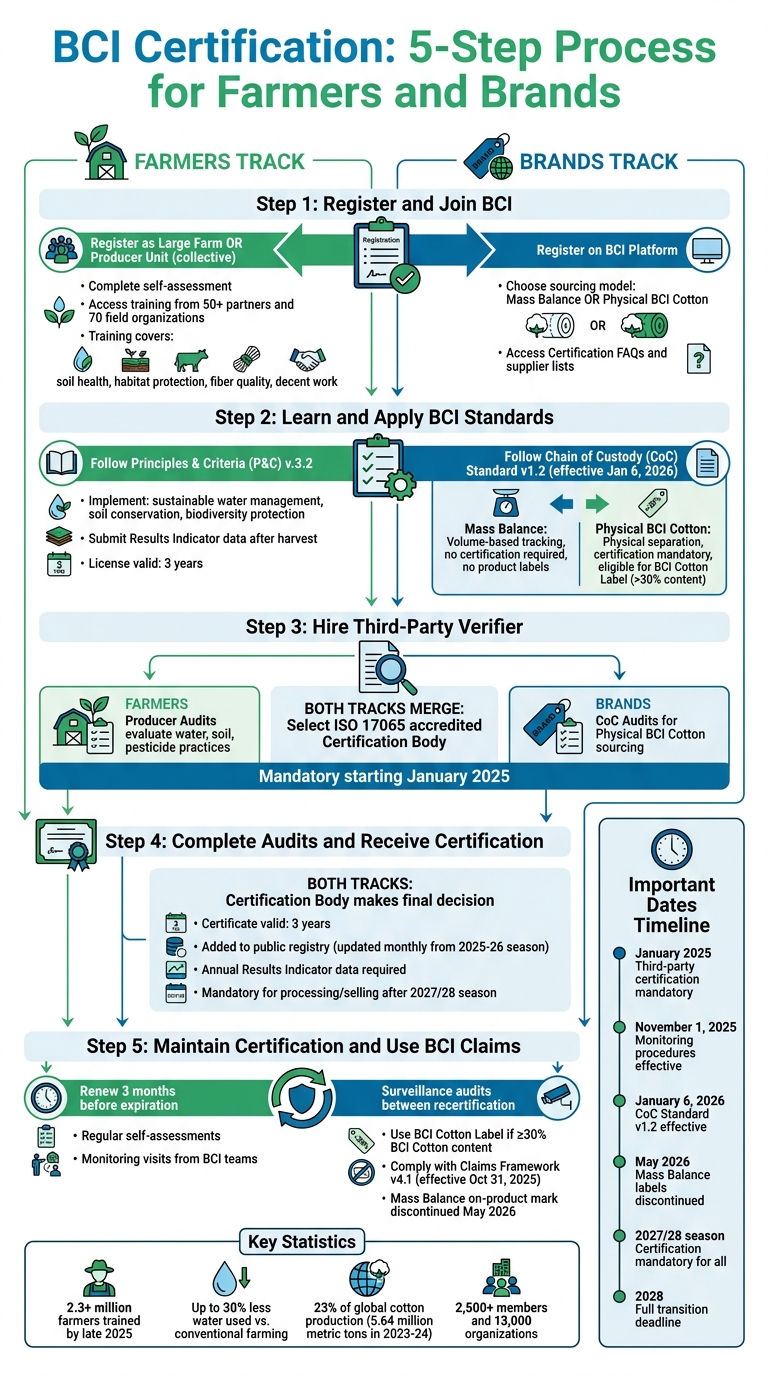
Step 1: Register and Join BCI
To get started, you'll need to pick your registration path: either become a full BCI Member or sign up for a BCI Platform Account. The BCI Platform acts as the main online hub where all supply chain participants handle their Better Cotton transactions. Below, you'll find step-by-step registration details for farmers and brands.
How Farmers Register for Membership
Farmers have two registration options: they can sign up as individual "Large Farms" or as part of a "Producer Unit" (a collective of farmers). After registering, farmers must complete a self-assessment to identify any areas where they may fall short of BCI's Principles and Criteria.
Once registered, farmers can tap into training opportunities provided by BCI's network of over 50 partners and nearly 70 field-level organizations that work directly with farming communities. These training programs focus on six key production areas: reducing pesticide use, improving water efficiency, enhancing soil health, protecting habitats, maintaining fiber quality, and promoting decent working conditions. By late 2025, BCI had already trained over 2.3 million farmers in sustainable farming methods. Many of these farmers have adopted efficient irrigation techniques, using up to 30% less water compared to conventional farming practices.
How Brands and Suppliers Register for Membership
Brands and retailers register on the BCI Platform to monitor the flow of BCI Cotton within their supply chains. Before registering, you'll need to decide on your sourcing model: Mass Balance (which only requires a platform account) or Physical BCI Cotton (which involves full third-party certification and allows use of the BCI Cotton Label).
After registration, brands gain access to various resources, including Certification FAQs, Key Terms and Definitions, General Certification Requirements, and Chain of Custody (CoC) Monitoring & Certification Requirements. Members also receive monthly updates and can consult the public supplier list to find certified partners based on country and CoC model.
Step 2: Learn and Apply BCI Standards
Once you've registered, the next step is to understand and implement the standards relevant to your role. Farmers need to follow the Principles and Criteria (P&C) v.3.2, while brands and suppliers must adhere to the Chain of Custody (CoC) Standard v1.2, which goes into effect on January 6, 2026. These standards work hand-in-hand to ensure a traceable journey for cotton, from the farm to the finished product.
Farm-Level Requirements and Practices
For farmers, compliance with the P&C v.3.2 is non-negotiable. Approval for BCI Cotton now requires passing a third-party audit. Starting January 2025, BCI transitioned to a full certification model, making adherence to standards mandatory rather than optional. This shift emphasizes continuous progress, moving from basic practices to more advanced sustainability measures.
Key environmental requirements include:
- Sustainable water management
- Soil conservation
- Biodiversity protection
Farmers must also follow strict guidelines on pesticide use, including an "Exceptional Use Process" for Highly Hazardous Pesticides (HHPs). If specific local conditions make it impossible to meet standard requirements, consult resources like the "BCI Active Derogation List" or "HHP Exceptional Use Decisions" for guidance.
After each harvest, farmers are required to submit Results Indicator data to measure the impact on both the environment and livelihoods. Missing this submission could lead to a license suspension for the next season. BCI licenses are valid for three years, provided annual requirements are met. The transition to the new certification system must be completed by 2028.
Chain of Custody (CoC) Requirements for Brands
After farm-level compliance, brands play a critical role in ensuring traceability by following the CoC Standard. This standard offers four different models to trace cotton and supports two types of BCI Cotton: Mass Balance and Physical BCI Cotton.
- Mass Balance: Tracks the volume of Better Cotton sourced and sold, but allows mixing with conventional cotton. It relies on administrative records rather than physical separation.
- Physical BCI Cotton: Maintains strict separation and documentation, ensuring the fiber's origin is traceable throughout the supply chain.
Here’s a quick comparison of the two models:
| Feature | Mass Balance | Physical BCI Cotton |
|---|---|---|
| Method | Volume-based; tracks BCI cotton volumes through documentation | Physical separation; fibers are kept distinct with full custodial records |
| Certification | Not required for sourcing or processing | Mandatory for all supply chain actors handling Physical BCI Cotton |
| Consumer Labeling | Not eligible for product-level labels | Eligible for BCI Cotton Label if >30% Physical BCI Cotton is used |
| Traceability | Tracks volumes administratively | Provides full traceability of fiber origin |
Step 3: Hire a Third-Party Verifier for Audits
Once you've implemented BCI standards, the next crucial step is to secure independent verification. This process sets BCI certification apart from self-reported claims because all certification decisions are handled by accredited third-party Certification Bodies. This ensures impartiality and aligns with evolving regulations like the EU Directive on Empowering Consumers for the Green Transition. Under this directive, only sustainability labels backed by third-party certification schemes can appear on products.
BCI-approved Certification Bodies meet ISO 17065 standards. The system combines third-party certification with first-party self-assessments and second-party monitoring by BCI country teams. This layered approach ensures reliability while maintaining practical scalability. As BCI explains:
"Appointing third parties to issue certification decisions brings impartiality and an additional layer of independence".
Farm Verification and Audit Process
Farmers are required to choose a Certification Body from BCI's official list to conduct Producer Audits. However, in some cases, BCI may take charge of selecting the Certification Body, so it's essential to consult with them before proceeding. During these audits, verifiers evaluate adherence to the Principles and Criteria (P&C) Indicators, focusing on key areas like water management, soil conservation, and pesticide use. Farms and farmer groups cannot market their cotton as BCI-certified until they successfully pass this third-party verification. Similarly, brands and suppliers must complete their own audit process to achieve Chain of Custody certification.
CoC Audits for Brands and Suppliers
For brands and suppliers, the audit process is tailored to meet Chain of Custody (CoC) standards. Independent Assessments are mandatory for Retailer, Brand, and Buyer members (excluding 'Very Small' members), while CoC Audits are required for any organization involved in sourcing or selling Physical BCI Cotton. Compliance must align with the BCI Chain of Custody Standard v1.2, which takes effect on January 6, 2026, as well as the Monitoring and Certification Procedures effective November 1, 2025. Brands can leverage the BCI Platform's supplier list and filters to find certified suppliers within their supply chain. Keep in mind, certification becomes mandatory for processing and selling BCI Cotton after the 2027/28 season.
Step 4: Complete Audits and Receive Certification
After your third-party audit wraps up, the Certification Body steps in to make the final certification decision. Starting in January 2025, only accredited third-party Certification Bodies handle these decisions. They carefully evaluate all conformity assessments based on the BCI Principles and Criteria for farmers or the Chain of Custody requirements for brands and suppliers. This step marks the formal beginning of the certification process.
If compliance is confirmed, the Certification Body issues a certificate that's valid for three years. This certification allows farmers to market their harvest under the Better Cotton label and gives brands the green light to source, process, and sell Physical Better Cotton. However, certification holders must submit annual Results Indicator data to maintain their status - failure to do so could lead to suspension.
Once certified, your organization will be added to a public registry of active certificate holders. Starting with the 2025–26 season, this registry will be updated monthly. This listing not only boosts transparency across the supply chain but also helps stakeholders verify compliance.
Keep in mind that the timeline for receiving your certificate can depend on factors like regional harvest schedules and how complete your data is. Planning ahead is crucial, especially since certification will become mandatory for processing and selling Physical Better Cotton after the 2027/28 season.
Step 5: Maintain Certification and Use BCI Claims
Renewal Requirements and Compliance Checks
A BCI certificate remains valid for three years, but it’s crucial to start the renewal process at least three months before it expires to ensure uninterrupted market access. Farmers are required to perform regular self-assessments and should anticipate monitoring visits from BCI Country Teams and Program Partners. Submitting results indicator data on time is critical - delays or failures can lead to an immediate suspension of your license.
For brands and suppliers, regular surveillance audits are conducted between recertification cycles. These audits are designed to confirm ongoing adherence to Chain of Custody standards. Additionally, maintaining detailed internal records of BCI Cotton volumes and segregation practices is a key part of staying compliant.
Staying certified not only guarantees compliance but also strengthens your position in the market.
How to Use the BCI Label for Marketing
If you’re sourcing cotton through segregated and traceable Chain of Custody models, your brand may qualify to feature the BCI Cotton label on products. To use the label, the product must contain at least 30% BCI Cotton, and 100% of its cotton content must meet BCI standards. The label should clearly state the percentage of BCI Cotton and include the official certification number, giving consumers a way to confirm the product’s certification.
All marketing efforts must comply with the BCI Claims Framework version 4.1, effective October 31, 2025. Additionally, BCI reviews consumer-facing materials to ensure accuracy. By May 2026, the mass balance on-product mark will no longer be allowed - only physically traceable BCI Cotton will qualify for labeling. As the Better Cotton Initiative emphasizes:
"Only sustainability labels which are based on third-party certification schemes can be used on products going forward".
To avoid issues, BCI actively monitors for non-compliant claims, such as unauthorized logo use, misleading sustainability claims, or non-members falsely advertising certification. Regularly confirming your suppliers’ certification status on the BCI Platform and including your certification number on product labels can help build trust with consumers.
Conclusion
BCI certification offers more than just a certificate - it's a gateway to valuable opportunities. For farmers, it provides access to global markets and equips them with training in sustainable practices that help maintain soil health. For brands, it ensures alignment with evolving regulations like California's 2026 lifecycle responsibility laws and the EU Directive on Empowering Consumers for the Green Transition. Plus, it builds consumer confidence through verified sustainability claims.
The certification process - spanning registration, training, and third-party audits - encourages ongoing improvement. It also connects participants to a network of over 2,500 members and 13,000 organizations. With BCI cotton now accounting for 23% of global production (5.64 million metric tons in 2023–24), the initiative is a powerful force in the industry. As the Better Cotton Initiative emphasizes:
"We see third-party certification as essential to bolstering the credibility of our work and amplifying the good work of cotton farmers globally".
Start your certification journey today. Certification is crucial for future market access, especially as brands must now source Physical Better Cotton to qualify for the BCI Cotton label - Mass Balance sourcing no longer supports consumer-facing claims.
Whether you're focused on improving your farm's sustainability or ensuring transparency in your supply chain, the steps are clear. Head to the BCI Platform, review the Principles and Criteria, and work with accredited third-party verifiers to take the first step toward sustainable cotton production.
FAQs
What does BCI certification cost?
The cost of obtaining BCI certification isn’t explicitly outlined in the provided information. Pricing can differ depending on various factors, such as location, the size of the operation, and the specific needs of farmers or brands. For precise information, it’s best to contact the Better Cotton Initiative or the appropriate certification organizations directly.
How long does BCI certification take?
The timeframe for achieving BCI certification can vary, but it generally takes several months. Factors like your organization's readiness and the scheduling of audits play a significant role. The process includes key steps such as registration, planning, conducting audits, and ongoing monitoring. For most organizations, certification is achievable within 6 to 12 months after meeting all the required standards. The exact duration depends on how efficiently these standards are implemented.
What happens if I fail a BCI audit?
If you don’t pass a Better Cotton Initiative (BCI) audit, you’ll need to tackle any non-conformities by creating and implementing corrective action plans. If these issues aren’t resolved within the given timeframe, your certification could be suspended or even withdrawn. The audit process evaluates these non-conformities and determines whether compliance has been achieved before deciding to reinstate or revoke your certification status.