If you can prove where a bale came from, who handled it, and where it ended up, you have a better shot at premium apparel programs.
I’d sum up the article like this: cotton traceability now affects market access, supplier selection, audit support, and product claims. The main driver is simple: brands want records that connect farm data, module IDs, bale IDs, USDA classing results, warehouse moves, merchant shipments, and mill use into one trackable chain.
Here’s the short version:
- Traceability starts on the farm with grower, field, variety, planting, and harvest records.
- The gin turns that into bale-level proof by linking module IDs, Permanent Bale Identification (PBI), and USDA classing data.
- Warehouses, merchants, and mills must keep the same bale record moving forward or the trail breaks.
- Systems like the U.S. Cotton Trust Protocol PCMS and TextileGenesis help connect bale records to finished goods.
- The business payoff is usually better buyer access, steadier demand, and stronger contract terms - not always a simple per-pound premium.
- Bad input data still breaks the system, even if blockchain or token-based records are added later.
A few facts stand out:
- PBI uses a 12-digit bale ID
- PCMS requires tracked shipments to be logged within 14 days
- TextileGenesis can follow materials across 300+ transformation steps
- By March 2023, PCMS had tracked 3 million+ kilograms of cotton and 11 million+ finished units
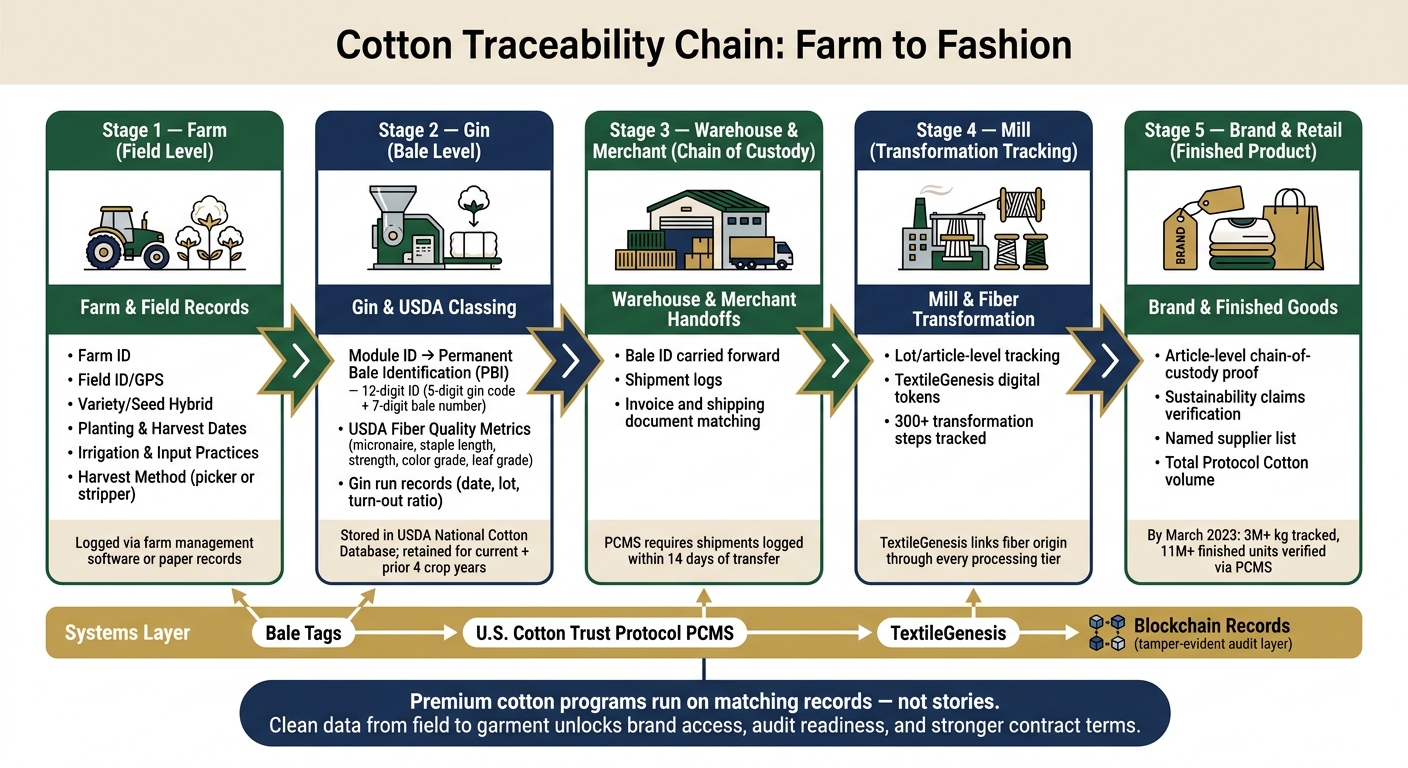
Cotton Traceability Chain: Farm to Fashion in 5 Key Stages
The Story Behind Origin ID: How Eurofins Built a Cotton Traceability Solution
sbb-itb-0e617ca
Quick Comparison
| System | Main Job | Data Level | What it helps with |
|---|---|---|---|
| Bale tags | Keep physical bale identity tied to farm/module records | Bale | Inventory control and source tracking |
| Gin + USDA classing data | Link origin to fiber quality | Bale | Grade-based selling and mill specs |
| Trust Protocol PCMS | Log chain-of-custody transactions | Farm to finished product | Brand program entry and claim support |
| TextileGenesis | Track material movement with digital records | Lot/article | Product-level tracking and audit trails |
| Blockchain records | Make transaction logs harder to alter | Transaction | Audit support, if source data is clean |
So if I were putting the whole article into one plain-English takeaway, it would be this: premium cotton programs don’t run on stories alone; they run on matching records from field to garment.
How Cotton Data Is Captured From the Field to the Gin
Traceability starts in the field.
Farm, Module, and Bale Data That Start the Traceability Record
A traceable bale starts with a pretty simple idea: know where it came from and what happened before it reached the gin.
That means the first record usually includes farm ID, field ID or GPS location, variety or seed hybrid, planting and harvest dates, irrigation and input practices, and harvest method - picker or stripper. Those details are tied to the grower’s name and operation so buyers can check origin and quality.
Some U.S. growers log this data in farm management software or electronic field records. Others still use paper logs and enter the information later when cotton is delivered to the gin. Different tools, same goal: keep the chain from field to bale intact.
Once cotton is harvested, each module gets its own ID through a printed tag or RFID tag. The gin then links that module ID to the grower, field, and harvest date. After ginning, the finished bales receive permanent bale numbers that keep the farm-to-bale connection in place.
Some gins also use RFID-enabled bale tags. These tags can be read as bales move through the press and into storage, which cuts manual entry and helps avoid the kind of small mistakes that can turn into big tracking problems later. Those intake records also need to line up with the bale’s USDA classing data.
USDA Classing and Gin Data Integration as the Core of Bale-Level Visibility
In the U.S., cotton uses Permanent Bale Identification, or PBI. It’s a 12-digit bale ID made up of 5 digits for the gin code and 7 digits for the bale number.
The USDA classing office scans that ID and attaches fiber quality results to the same record, including:
- micronaire
- staple length
- strength
- color grade
- leaf grade
That record is stored in USDA’s National Cotton Database, which gives downstream systems a way to audit the bale.
Gin management software then combines the USDA classing data with the gin’s own run records. That can include the gin date, lot or run number, turn-out ratio, press line, and any contamination or quality notes. Put together, this creates one bale record that shows both agronomic origin and fiber quality.
USDA keeps this data for the current crop year plus the prior four crop years, and access is limited to the bale owner or an authorized agent.
For this information to move cleanly into downstream systems, naming has to match. Grower codes, farm and field IDs, and variety names should be consistent across gin intake records and farm logs. If not, warehouse and merchant systems often need manual cleanup before they can use the data.
That’s why gins that export bale data in consistent EDI or other compatible digital formats are easier to bring into traceability programs like the U.S. Cotton Trust Protocol or TextileGenesis. Less reformatting means less friction, less manual work, and stronger downstream claims. The bale record created at the gin is the same record warehouse and merchant systems carry forward.
How cottongins.org Supports Gin Visibility and Industry Connections
Gins also need a simple way to show buyers what they can do.
cottongins.org is an online directory of U.S. cotton gins. It lists contact details, locations, and business information, which gives merchants, mills, and brands a direct way to find gin partners that fit their sourcing needs.
Gins can add a new listing or update an existing one to show current services, such as:
- bale-level data integration
- USDA classing participation
- sustainability program memberships
When those profiles stay current, buyers have an easier time finding traceability-ready gin partners, and merchants and mills can move faster when building a sourceable supply base.
How Digital Chain of Custody Works From Warehouse to Finished Garment
After the gin, traceability comes down to one thing: clean handoffs through warehouses, merchants, and mills. The bale record has to stay intact every time cotton changes hands.
Warehouse, Merchant, and Mill Records That Keep Cotton Traceable
A gin record on its own doesn't do much. Warehouses, merchants, and mills have to carry that same bale ID forward.
This is where traceability often falls apart. A receipt goes missing. A lot number doesn't match. Shipment paperwork is only partly filled out. Once that happens, mills can't show which cotton ended up in a finished style.
That's the record layer article-level systems rely on.
TextileGenesis and U.S. Cotton Trust Protocol PCMS in Article-Level Tracking
Two systems are used to connect bale-level data to finished garments: TextileGenesis and the U.S. Cotton Trust Protocol's Protocol Consumption Management Solution (PCMS).
TextileGenesis ties each shipment to a digital token and tracks article and lot movement across tiers 1 through 6 and more than 300 transformation steps. In April 2021, the Trust Protocol and TextileGenesis announced a collaboration to capture and verify article-level transactions across the complete supply chain.
PCMS logs tracked transactions within 14 days of shipment and attaches invoices and shipping documents. For brands and retailers, PCMS can show the name and location of each supplier involved in a tracked product, along with the total volume of U.S. Cotton and Protocol Cotton consumed. By March 2023, PCMS had tracked over 3 million kilograms of cotton and more than 11 million units of finished products.
Together, these systems create the proof layer behind premium sourcing claims at the garment level.
Some platforms also add blockchain to give auditors a clearer view across those transactions.
How Blockchain-Backed Chain of Custody Supports Audit Trails
Blockchain can make transaction logs tamper-evident and easier to audit, but it cannot correct bad source data.
Which Traceability Systems Deliver Measurable Business Value
Market Access, Brand Partnerships, and Sustainability Claims Verification
When bale-level data stays intact at each handoff, traceability stops being a back-office record and starts helping close deals.
The clearest payoff is market access through brand sourcing programs. The U.S. Cotton Trust Protocol gives brands verified sustainability data that supports sourcing claims and preferred-cotton programs. Its data supports sustainability claims with verified farm and fiber records.
Carhartt, for example, joined the Trust Protocol as part of its commitment to "responsibly sourced and preferred cotton." That kind of brand language needs proof. Verified chain-of-custody data, including named farms, bale IDs, and auditable handoffs, is what makes those claims defensible. For suppliers, joining a recognized program helps cut the risk of greenwashing allegations and keeps them ready for audits as U.S. and EU disclosure rules get tighter.
Market access gets you in the door. Verified origin and quality help win the business.
Price Premiums and Merchandising Gains for Growers, Gins, and Cotton Merchants
Traceability does not usually show up as a simple per-pound premium. In most cases, the payoff comes from preferred supplier status, steadier demand, and better contract terms. Merchants and cooperatives enrolled in the Trust Protocol can use program participation as a clear point of difference when negotiating with brand members.
The bigger merchandising gain is that the sale shifts from price-only to proof-based. If a merchant can show a mill or brand buyer a verified quality profile, a sustainability data set, and a digital chain-of-custody record, the conversation changes. It is no longer just about who is cheapest. Supima uses TextileGenesis to link each kilogram to a verified digital token, which strengthens premium branding and chain-of-custody proof. That kind of evidence can support higher average price points and marketing support that generic commodity cotton simply cannot reach.
Returns still depend on data quality, buyer demand, and how well the program is carried out.
Comparison Table: Bale Tags, Gin-Classing Integration, Trust Protocol, TextileGenesis, and Blockchain Records
Each system creates business value in a different way, but they all do the same basic job: they turn proof into leverage.
| System | Supply-Chain Stage | Data Granularity | Business Use | Value Delivered |
|---|---|---|---|---|
| Bale Tags | Field → Gin → Warehouse | Bale-level ID linked to module and field | Physical traceability and inventory control | Unique bale identity; foundation for downstream tracking and quality differentiation |
| Gin-Classing Integration | Gin → Classing Office → Merchant | Fiber quality metrics tied to bale ID | Grade-based marketing and origin-quality linkage | Verified quality positioning; supports targeted contracts and mill-specific specs |
| U.S. Cotton Trust Protocol | Farm → Merchant → Mill → Brand | Farm-level sustainability metrics; article-level chain-of-custody | Sustainability claims verification and brand sourcing qualification | Access to brand sourcing programs and responsible-cotton partnerships |
| TextileGenesis | Fiber Producer → Retail | Tokenized fiber units capturing origin, certifications, and transactions | Digital traceability and premium ingredient branding | Audit-ready chain of custody; prevents double-counting; supports product storytelling |
| Blockchain Records | Any stage requiring tamper-evident logs | Transaction-level audit trail linked to bale or token records | Audit support and fraud reduction | Tamper-resistant logs that increase buyer trust and support third-party audits |
Conclusion: Building a Farm-to-Fashion Traceability Strategy
Farm-to-fashion traceability isn't one piece of software or one checkpoint. It's a connected process that starts in the field and has to stay intact through every handoff across the warehouse, merchant, mill, and brand. Put simply, the same identifier and the same records need to carry through from field to finished garment. The businesses that get the most out of this are the ones that treat data capture as a business priority from day one.
Key Points for U.S. Cotton Businesses
Every bale needs a PBI linked to the grower and checked against USDA records before it moves into downstream systems.
Gins should export bale and classing data in formats that work across systems. Merchants should also log shipments in PCMS within 14 days, with matching invoices and shipping documents. When a brand or auditor asks for proof, those records make origin and sustainability claims much easier to stand behind.
The best business results tend to come from companies that make traceability part of normal day-to-day work. Platforms like TextileGenesis and the Trust Protocol PCMS have shown that they can work at scale, but their output depends on the quality and timing of the data going in.
A phased rollout is usually the clearest way forward. Start with Trust Protocol enrollment, accurate bale registration, and standard classing and shipment records. Then test article-level tracking on one product line before rolling it out more broadly. Start with bale registration, then move into classing, shipment records, and article-level tracking.
FAQs
How do I start a cotton traceability program?
Start by giving every inventory item its own ID. During harvest, attach RFID tags to round modules so you can record GPS coordinates, harvest dates, and farm locations. At the gin, give each bale a 12-digit Permanent Bale Identification (PBI) tag.
Next, bring all of that data into one digital platform so teams can track cotton in real time. Connect gin software with databases like the U.S. Cotton Trust Protocol, keep certified and non-certified cotton separate, and train staff to handle data entry and documentation correctly.
What data errors most often break traceability?
The most common breaks happen during manual data entry. A simple typo, swapped digits, or inconsistent formatting can create mismatches that chip away at data integrity.
Traceability can also break down when farm- or gin-level details are entered incorrectly, whether that happens through clerical error or fraud. On top of that, uneven data collection, limited digital know-how, and fiber identity loss during blending can make the original source hard to verify without strong physical and digital tracking.
Does traceability raise cotton prices or just improve buyer access?
Traceability does more than improve buyer access. It can also help gins and growers secure premium pricing by backing up claims with verified data on sustainability, ethical labor practices, and origin.
That kind of transparency can help cotton businesses stand out in a crowded global market. And for buyers who care about ethical sourcing, it can support higher prices.
Related Blog Posts
- Cotton Traceability: How Blockchain and Certifications Are Changing the Game
- Cotton Supply Chain Traceability: Tools, Standards, and Regulations
- Blockchain Cotton Traceability: From Farm to Fashion, Building Trust and Premium Prices
- Digital Cotton Supply Chain: Real-Time Tracking and Transparency That Brands Want