Herbicide resistance in cotton is a growing challenge that impacts yields, increases costs, and complicates weed management. Cotton requires at least 8 weed-free weeks after planting and 99% weed control for optimal production. Over-reliance on single herbicides has led to resistance in weeds like Palmer amaranth and Johnsongrass, causing significant economic and agricultural issues.
To combat resistance, Integrated Weed Management (IWM) combines chemical, mechanical, and biological methods. Key strategies include:
- Rotating at least six herbicide modes of action over two years.
- Tank-mixing multiple herbicides for better control.
- Using nonchemical tactics like cover crops and mechanical weeding.
- Adopting precision spraying technology to target weeds effectively.
New cotton varieties, such as XtendFlex and Axant Flex, offer resistance to multiple herbicides, providing more options for growers. Tools like GPS mapping and AI-powered sprayers further enhance weed control while reducing chemical use. Regional coordination among farms and gins is critical to prevent resistance spread and maintain cotton quality.
Key Weed Species and Resistance Mechanisms
Problem Weeds in Cotton Fields
Certain weed species pose a significant threat to cotton production, with Palmer amaranth and Johnsongrass leading the charge. Palmer amaranth (Amaranthus spp.) is particularly aggressive, producing massive amounts of seed and showing resistance to several herbicide classes. Meanwhile, Johnsongrass (Sorghum halepense) is a tough perennial grass that spreads through both seeds and underground rhizomes, making it notoriously hard to manage. Other weeds like field bindweed, kochia, barnyardgrass, and yellow nutsedge also compete fiercely with cotton, especially during its early growth stages.
| Common Name | Scientific Name | Type | Lifecycle |
|---|---|---|---|
| Palmer amaranth | Amaranthus spp. | Broadleaf | Summer Annual |
| Johnsongrass | Sorghum halepense | Grass | Creeping Perennial |
| Field bindweed | Convolvulus arvensis | Broadleaf | Creeping Perennial |
| Kochia | Kochia scoparia | Broadleaf | Summer Annual |
| Barnyardgrass | Echinochloa crus-galli | Grass | Summer Annual |
| Yellow nutsedge | Cyperus esculentus | Sedge | Creeping Perennial |
Beyond reducing yields, these weeds can harbor nematodes, rodents, and pathogens, amplifying the damage they cause. Gaining a clear understanding of these species helps in addressing their resistance mechanisms more effectively.
How Resistance Mechanisms Work
Herbicide resistance develops when repeated applications kill off susceptible plants, leaving naturally tolerant ones to dominate. Resistance generally falls into two categories:
- Target-site resistance: Genetic changes prevent the herbicide from binding to its intended target, rendering it ineffective.
- Non-target-site resistance: This involves a range of adaptations, such as enhanced metabolism, reduced absorption, or sequestration of the herbicide, which neutralizes its effects.
When a single weed species develops resistance to multiple herbicide classes via these non-target-site pathways, it leads to cross-resistance - a particularly tough challenge for cotton growers.
"Many herbicides... already have a history of use in cotton fields, indicating that some selection for resistance for any registered herbicide could already have occurred." - CottonInfo
Resistance can also spread between fields. Equipment carrying seeds or rhizome fragments, movement along fencerows and irrigation ditches, or even uncertified seeds can all contribute to this problem. Understanding how resistance works is crucial for creating integrated weed management strategies.
Spotting Herbicide Resistance in the Field
The first clue of resistance is often patchy escapes - clusters of weeds that survive herbicide treatment while most others die. If a specific weed species consistently survives, it’s a strong indication that resistance has taken hold.
Pay close attention to row ends and skip-row areas, as these are common hotspots for resistant survivors. Acting quickly is essential. Just one resistant plant left to mature can release thousands of seeds into the soil, creating ongoing problems for years. Early detection and management are key to preventing long-term issues.
sbb-itb-0e617ca
Strategies for Managing Herbicide Resistance
Building a Multi-Year Weed Management Plan
Tackling herbicide resistance is no longer a one-season challenge. It demands a multi-year strategy. According to the 2025–26 Herbicide Resistance Management Strategy (HRMS), an effective plan involves deploying at least six different methods or modes of action (MOA) over a two-year period to keep resistance under control.
For dryland cotton systems, here's how it breaks down: use three different control methods during fallow periods and another three while the crop is growing. Fallow periods are especially important since they help cut down weed populations before the next planting season. During these times, adopting a "zero tolerance" policy is critical. Even a single weed left standing can replenish the soil seed bank, undoing years of careful planning.
A well-rounded, long-term approach also enables effective herbicide rotation, minimizing the risk of resistance over time.
Rotating and Mixing Herbicide Modes of Action
When it comes to herbicide diversity, not all strategies are equally effective. Research indicates that tank-mixing multiple MOAs in a single application works better than simply rotating herbicides annually. For example, fields using an average of 2.5 MOAs per application were 83 times less likely to develop glyphosate-resistant waterhemp over a 4–6 year period compared to fields using only 1.5 MOAs per application, according to Aaron Hager from the University of Illinois Department of Crop Sciences.
To make this easier, herbicide labels now include MOA group numbers. This helps ensure you're not accidentally reusing the same mode of action under a different product name. Another effective strategy is layering soil-applied residual herbicides with post-emergence treatments, which reduces the chances of resistant weeds surviving and spreading.
"The only certainty we have is that if there are no weed seeds produced at the end of the growing season, there is no change in the frequency of any resistance mechanism." - Aaron Hager, Department of Crop Sciences, University of Illinois
Combining chemical approaches with nonchemical methods creates a more robust resistance management system.
Nonchemical Tactics for Resistance Management
Herbicides alone can't solve resistance issues. Nonchemical strategies like mechanical cultivation, cover crops, and crop competition play a crucial role in disrupting weed cycles without adding chemical pressure.
The HRMS emphasizes the importance of taking "additional actions" to target any weeds that survive herbicide applications. This could mean physically removing the weeds or using cultivation to stop them from setting seeds. When paired with diverse MOA use and strong fallow management, these nonchemical methods ensure that no weed is left behind to replenish the seed bank.
Cotton Weed Control with Dr. Stanley Culpepper
Innovations in Cotton Weed Control
Herbicide-Resistant Cotton Traits Compared: XtendFlex vs Axant Flex vs Liberty Link vs Roundup Ready Flex
Recent developments in cotton weed control are pushing the boundaries of integrated strategies, aiming to tackle herbicide resistance more effectively.
Herbicide-Resistant Cotton Traits
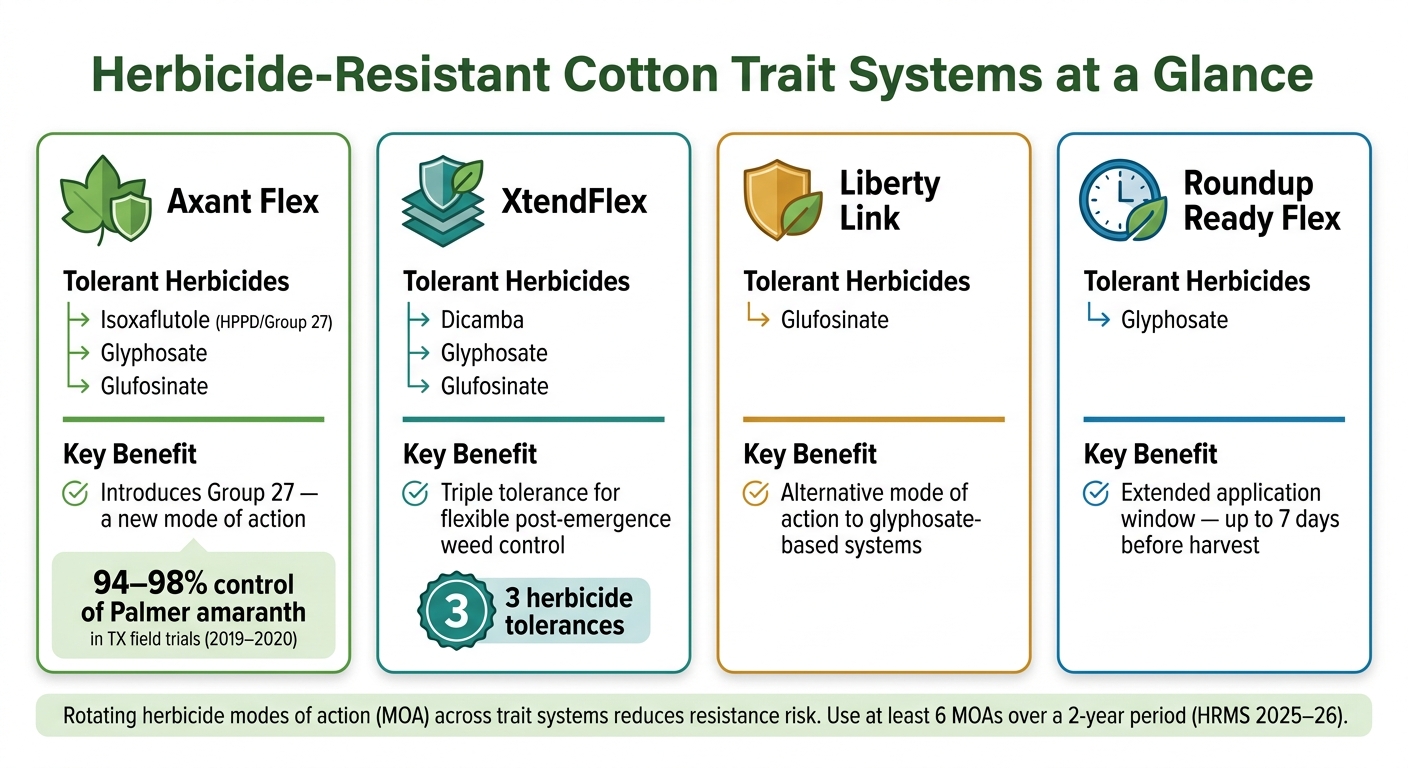
New cotton varieties now feature multiple herbicide tolerances, offering growers more options for weed management. For example, XtendFlex cotton is resistant to three herbicides - glyphosate, glufosinate, and dicamba - making it a versatile choice for post-emergence weed control.
Another recent advancement is Axant Flex technology, available in FiberMax and Stoneville varieties. This innovation introduces resistance to HPPD inhibitors (Group 27), particularly isoxaflutole. Field studies conducted in Texas from 2019 to 2020 demonstrated that preemergence isoxaflutole achieved 94%–98% control of Palmer amaranth without compromising lint yield or fiber quality. By comparison, traditional preemergence herbicides like prometryn provided roughly 89% control.
| Trait System | Tolerant Herbicides | Key Benefit |
|---|---|---|
| Axant Flex | Isoxaflutole (HPPD), Glyphosate, Glufosinate | Introduces Group 27 for a new mode of action |
| XtendFlex | Dicamba, Glyphosate, Glufosinate | Triple tolerance for flexible weed control |
| Liberty Link | Glufosinate | Offers an alternative mode of action |
| Roundup Ready Flex | Glyphosate | Extends application window until 7 days before harvest |
In addition to these traits, advancements in precision technology are reshaping how herbicides are applied.
Precision Tools and Digital Applications
Precision spraying technology is revolutionizing cotton weed control. Tools like John Deere's See & Spray Ultimate use real-time imaging and AI to detect and target weeds, applying herbicide only where necessary. This targeted approach has been shown to cut non-residual herbicide use by up to 77% with the See & Spray Select model. Similarly, retrofit systems such as the Greeneye system have achieved an average reduction of 87% in non-residual herbicide use.
"Precision spray technologies means using optical cameras and sensors to identify individual weeds or patches within fields and applying high rates of herbicide to prevent seed set." - Eric Koetz, Weed Management Technical Lead, CottonInfo
GPS mapping further enhances weed management by allowing growers to identify and monitor resistant weed patches, helping track their spread.
These digital tools are laying the groundwork for integrating biological and physical weed control measures into cotton farming.
Biological and Physical Weed Control Options
Nonchemical methods remain a cornerstone of integrated weed management. Traditional techniques like hand-weeding and mechanical cultivation are highly effective at removing weeds that survive chemical treatments, preventing resistance from spreading.
Emerging technologies are now complementing these methods. Autonomous platforms, such as the Solinftec Solix, are transforming mechanical weed control. This solar-powered robot continuously scans fields to identify and target weeds, reducing herbicide use by as much as 98% in some trials. Together, these tools strengthen integrated weed management systems, reducing reliance on chemicals while supporting sustainable resistance management in the long term.
Connecting Weed Management to Cotton Ginning
How Weed Control Affects Ginning Efficiency
Weed control on the field has a direct impact on how efficiently cotton is ginned. When weeds aren't properly managed, they contribute to excess plant debris, often referred to as "trash", entering the gin. This extra material slows down processing, wears out equipment faster, and lowers the quality of the lint. Cotton Incorporated emphasizes this point, stating, “Near perfect control is needed to avert difficulties with picking, excess trash in the harvested lint, and a recurring cycle of heavy weed seed fall, followed by emergence of high populations of weeds the next spring”.
To achieve top yields and ensure smooth ginning, growers need to maintain weed control levels of 99% or higher. Cotton also requires at least eight weeks of weed-free growth after planting to hit its full yield potential. Missing this critical period can lead to reduced yields and compromised lint quality, highlighting the importance of well-planned, regional weed management strategies.
Regional Coordination and Data Sharing
While field-level weed control is essential, coordinating efforts across a region can amplify results. Resistant weeds can spread quickly from one field to another via machinery, wind, or water, making collaboration between neighboring farms a necessity.
Programs like Area-wide Management (AWM) encourage growers, consultants, and gin operators to work together on weed control across entire regions. This approach helps track resistance patterns, share data, and respond collectively before a localized issue escalates into a widespread problem.
Farm hygiene is another critical piece of the puzzle. For example, the "Come Clean, Go Clean" protocol includes measures like cleaning cotton pickers before moving them between fields. This practice prevents resistant weed seeds from spreading to new areas. Regular monitoring for volunteer or ratoon cotton plants around fields also plays a key role in maintaining biosecurity.
A well-rounded weed management plan includes rotating at least six different herbicide modes of action or control methods over a two-year period. Regional coordination makes it easier to implement this kind of diverse strategy consistently across a larger area.
How cottongins.org Supports Cotton Producers
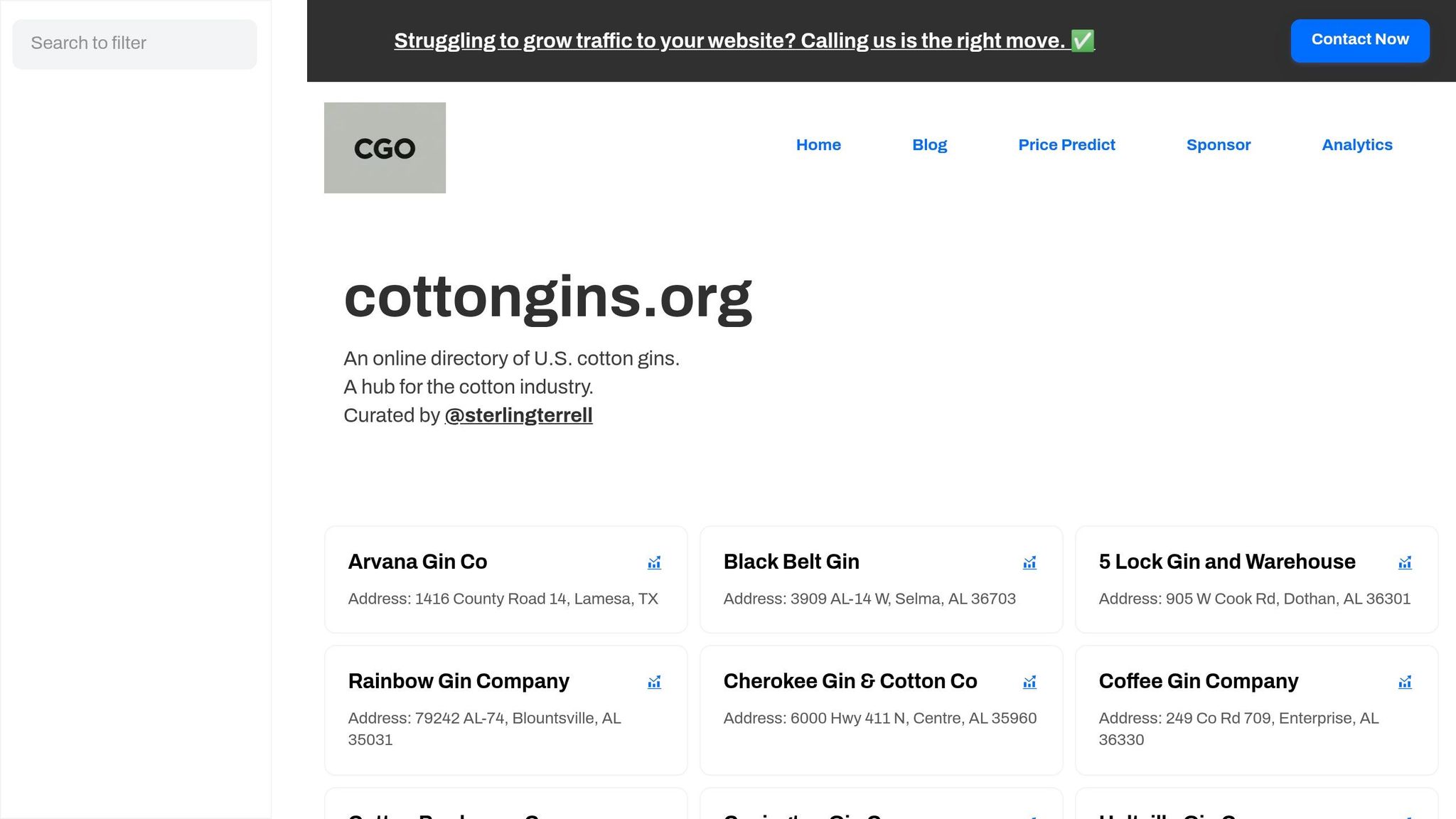
Strong weed management practices not only improve field conditions but also enhance ginning outcomes and regional collaboration. One way to strengthen these connections is by linking growers with their local gins, and cottongins.org makes this process simple. This online directory lists U.S. cotton gins by county and state, helping producers quickly locate facilities near them.
These connections aren't just logistical - they're strategic. Gins often have a clear view of trends in lint quality across their region, offering growers valuable insights into how weed pressure in the field is affecting ginning results. Regular communication between growers and gin operators allows for the sharing of observations, early identification of resistance issues, and alignment on best practices to tackle problems before they escalate.
For growers looking to build stronger local relationships, cottongins.org provides a practical starting point. By bridging field management and gin operations, this resource supports the kind of integrated approach needed for the long-term success of cotton production.
Conclusion and Key Takeaways
Summary of Key Strategies
Tackling herbicide resistance in cotton requires a multi-faceted approach that blends chemical solutions, practical field techniques, and an understanding of regional conditions.
At the heart of this effort is diversity. As CottonInfo emphasizes: "A sustainable system requires a high level of diversity and zero tolerance for survivors of herbicide sprays." This means rotating at least six different weed control methods or herbicide modes of action over a two-year period. On top of that, it’s crucial to eliminate any weeds that survive herbicide treatments to prevent the spread of resistant seeds across fields.
Advancements like XtendFlex® cotton, which tolerates glyphosate, glufosinate, and dicamba, and HPPD-resistant varieties that respond to isoxaflutole, offer growers more options for rotating chemistries. However, relying too heavily on any single herbicide - even innovative ones - can still lead to resistance problems.
By combining these tools with thoughtful management practices, cotton producers can take meaningful steps to address herbicide resistance.
Next Steps for Cotton Producers
To improve your weed management strategy, start by evaluating your current plan. If you’ve been using the same herbicide modes of action repeatedly, it’s time to switch things up. Incorporate post-application scouting to identify whether surviving weeds point to application issues or the early signs of resistance.
The Herbicide Resistance Management Strategy (HRMS) 2025-26 provides a clear guide for both irrigated and dryland operations, making it a valuable resource for aligning your approach with best practices. Additionally, connecting with local gin operators can provide valuable insights into lint quality and regional trends. For a simple way to build these connections, check out cottongins.org.
FAQs
How can I tell if a herbicide failure is resistance or an application problem?
After applying herbicide, it's important to scout the area to evaluate how weeds respond. If weeds persist even when the herbicide was applied with the correct timing, dosage, and method, resistance could be the issue. On the other hand, if weed survival is tied to mistakes like applying at the wrong time, using an incorrect dose, or unfavorable environmental conditions, it’s likely an application error. Confirming resistance typically involves testing or noticing the same weeds surviving year after year despite proper application practices.
What’s the simplest way to plan six herbicide modes of action over two years?
To effectively plan six herbicide modes of action over a two-year period, rotate three modes each year. Make sure to avoid using the same mode consecutively or excessively. During fallow and crop seasons, incorporate different modes and alternate them annually. This approach encourages diversity, minimizes the risk of resistance, and supports best practices for managing herbicide resistance.
Which precision spraying tools reduce herbicide use the most in cotton?
Precision spot spraying systems, equipped with real-time imaging and advanced sensors, have the potential to reduce herbicide use by as much as 90%. These cutting-edge tools play a crucial role in controlling weeds in cotton fields while significantly reducing herbicide application. By targeting only the areas that need treatment, they help maintain effective weed management and support environmentally conscious farming practices.