Most cotton claims fail when the record breaks. If you want better market access, cleaner audits, and a shot at premium pricing, the job is simple: tie each bale to a clear record from farm to garment.
Here’s the short version: I’d treat blockchain traceability as a record system for proof, not magic. It works best when every handoff is logged, bale IDs stay linked to warehouse and mill records, and claimed output never goes above verified input. That matters even more when fraud is common: reports cited in the article say 50% to 80% of cotton sold as organic may not be genuine, and one case involved about 20,000 metric tonnes of conventional cotton passed off as organic.
If I were explaining the article in plain English, these are the main points:
- The bale is the anchor. In U.S. cotton, the 12-digit Permanent Bale Identification (PBI) is the key link.
- Each step adds proof. Farm records, gin tickets, warehouse receipts, merchant transfers, mill batch logs, and brand claims all need to connect.
- Blockchain helps after entry. It does not fix false input, but it makes later edits much harder and leaves a time-stamped trail.
- Token systems help with volume control. They can stop the same cotton claim from being used more than once.
- QR codes and product passports help at retail. Shoppers see a simple version, while auditors review the full file.
- Business value comes from proof. The article ties traceability to audits, sourcing access, and better pricing for verified cotton programs.
- You do not need a full rebuild. A farm-gin-merchant-mill pilot with one defined cotton program is enough to start.
A few numbers stand out:
- Only 19% of fashion companies have full value-chain visibility
- 87% of consumers want brands to share supply-chain information
- Nearly 45% of major brands score just 0% to 1% on traceability in the Fashion Transparency Index section cited
- Mills using paper-only certificates may face 10% to 15% discounts when buyers cannot verify claims downstream
What I take from this is straightforward: traceability is less about tech and more about record discipline. If you can connect bale IDs, custody events, and mill use records into one clean chain, you give buyers something they can check instead of just trust.
That is the whole article in one idea: proof travels with the cotton, or the premium does not.
Blockchain tool to help farmers to become part of a sustainable cotton value chain
sbb-itb-0e617ca
Cotton traceability basics and the data behind it
In cotton, traceability comes down to a connected record trail that follows the fiber across harvest, ginning, storage, sale, shipment, and manufacturing. The trail starts at the bale level. That’s where the proof lives: who handled the bale, when they handled it, and what record backs that up.
Core records: bale IDs, gin tickets, certifications, and transaction logs
The main record is the Permanent Bale Identification (PBI) tag. It’s a 12-digit bale ID that includes a USDA gin code and bale number, printed in text and barcode form. USDA keeps bale-level classing data tied to each PBI for five crop years. So there are at least five years of bale-level identity and quality records available for checks.
A usable traceability record also pulls together a few other records tied to that bale or lot:
- Gin tickets with the intake date, bale weight in pounds, and tare weight
- Electronic warehouse receipts with storage location and lot references
- Ownership transfer records for each handoff
Certification records matter too. Organic, Better Cotton, and U.S. Cotton Trust Protocol records need to link to the exact bale or lot they cover. A general file sitting off to the side doesn’t do much good.
How immutable records reduce fraud and claim risk
Time-stamped transaction logs make it much harder to swap in uncertified cotton inside a premium supply chain, sell the same claim twice, or go back later and change an origin record. If a sustainability claim is going to stand up, the ledger needs to show a clean chain from the farm record to the gin ticket, PBI, warehouse receipt, merchant transfer, and mill intake. If one of those links is missing, that’s a red flag buyers and auditors can catch before the claim gets to the buyer.
Blockchain doesn’t promise that every data entry is honest. If someone enters false data at the gin, the ledger will still store that false data. But it does make after-the-fact changes much harder, and it leaves a clearer trail when disputes come up. Next, follow that record through each handoff from farm to garment.
Chain of custody from farm to garment: what each stage records
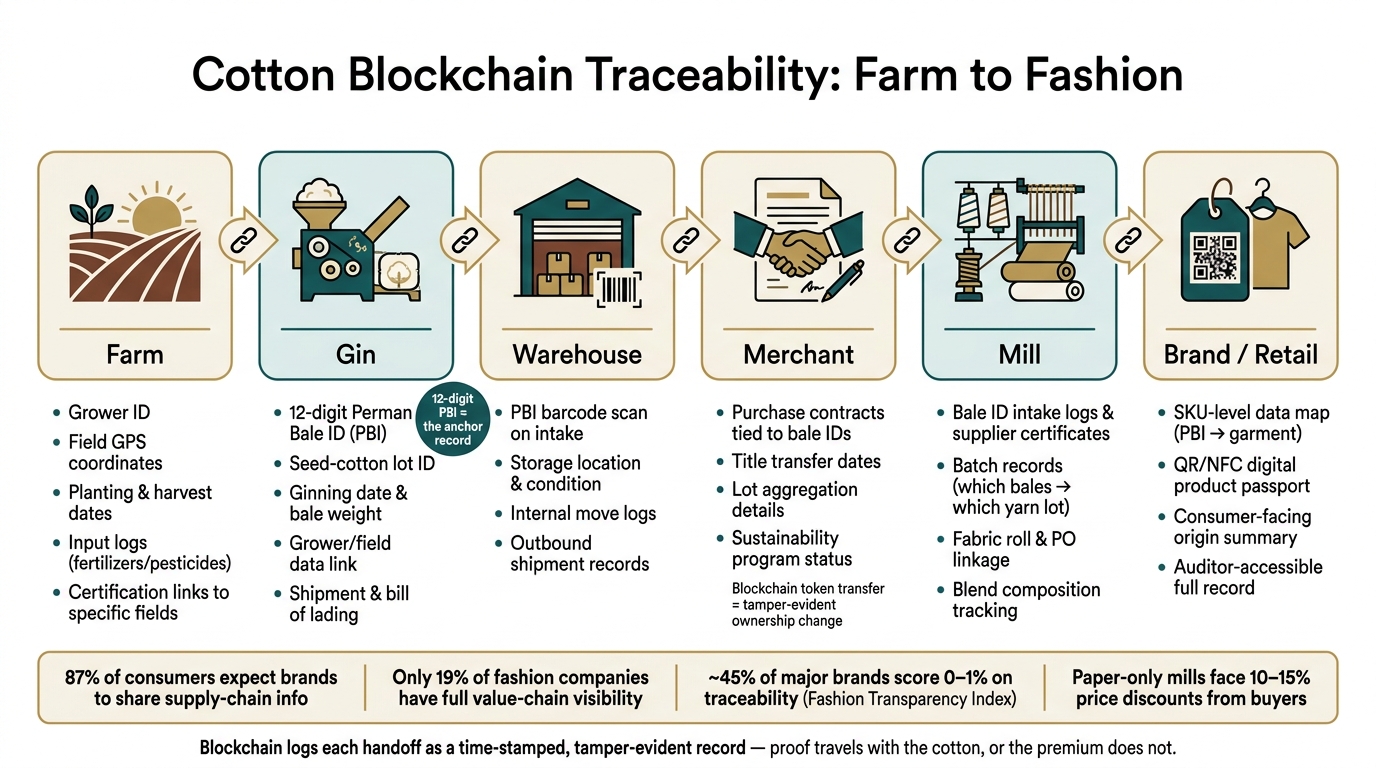
Cotton Blockchain Traceability: Farm to Fashion in 5 Steps
Every step in the cotton supply chain adds another record to the file. The PBI acts like the anchor point. Once that bale is identified, each handoff adds a new custody event and extends the trail.
Farm and gin: where traceability starts
At the farm level, the main records cover grower identity, field IDs, GPS coordinates, planting dates, harvest dates, and input logs for fertilizers and pesticides. Certified programs go a step further. They connect certificates to specific fields and harvest lots, not just to a grower’s general participation.
The gin is where that paper trail turns into something much more concrete. When seed cotton comes in, the gin records the incoming lot ID, the linked grower and field data, the ginning date, and bale weight in pounds. Each bale that leaves the press receives a 12-digit Permanent Bale Identification (PBI): a 5-digit gin code plus a 7-digit bale number.
In many gins, that first digital record is created right at the bale press and moves straight into the warehouse inventory system. When bales ship out, the gin also records transfer events. That includes the shipment ID, carrier, destination, and bill of lading number. Those details are attached to the bale record at that point, and that same record follows the bale into warehouse intake.
Warehouse, merchant, and mill: storage, sale, and processing records
When bales reach a licensed warehouse, staff scan PBI barcodes during intake and put-away. Warehouse records usually include the bale ID, receiving weight, storage location, condition checks, and the related bill of lading. Internal moves matter too. If a bale is relocated, placed on hold, or allocated, that action is logged. When it ships out, the outbound record includes the bale IDs, destination, carrier, and related commercial documents.
From there, ownership passes to the merchant. Merchants manage purchase contracts tied to specific bale IDs, title transfer dates, and lot aggregation details that still point back to the original bale IDs. If those bales carry a sustainability program label, that status stays attached as well.
On a blockchain ledger, ownership changes show up as token transfers from one holder to the next. That creates a trail that can be checked later. In plain English, it makes double-selling a certified lot much harder. It also makes it harder to slip uncertified bales into a premium shipment without leaving a clear hole in the record.
At the mill, the focus shifts from who owns the cotton to how it is physically used. Mill intake logs record bale IDs, arrival dates, and supplier certificates. Once bales move into opening and spinning, batching records show which bale IDs were used in each yarn lot. Those yarn lots then connect to fabric rolls and purchase orders, so the bale trail stays tied to the finished product.
If a mill blends cotton from more than one source, it records the batch composition. That might mean listing the share of certified or traceable bales versus conventional cotton. This keeps downstream claims in line with what actually went into production. Organic programs also track waste rate and waste destination to stop double-counting. Those processing records later support brand-level claims.
Brand and garment: product passports and consumer-facing proof
Brands connect upstream records - PBI IDs, certifications, mill lot IDs, and shipment references - to specific SKUs or production orders. That data map powers QR-code or NFC-based digital product passports placed on hangtags or care labels.
When someone scans the code, they don’t see the whole back-end system. They see a cleaned-up summary meant for shoppers: the cotton’s region or country of origin, program membership, a simple timeline of the journey, and verified sustainability or quality claims.
Access controls keep that split in place. Detailed records stay private, while shoppers see only approved summaries and auditors can review the full file. That setup lets brands show proof behind origin and sustainability claims without giving away sensitive commercial details.
Traceability systems and tools used in cotton programs
Those records need a system that can capture them, check them, and share them. That’s what turns bale data into proof a buyer can look at and trust. In cotton programs, the main setups are ledger entries, tokenized volume tracking, and QR-linked product passports.
Ledger models, digital tokens, and digital twins
A shared ledger model records each supply chain step as a time-stamped transaction tied to a specific product ID. In cotton, that usually means ginning, warehousing, sale, and shipment each create a dated record linked to a bale or lot ID. Gins, warehouses, merchants, mills, and brands each have identities on the network. Once a record is confirmed, it becomes tamper-evident.
In day-to-day work, gins and merchants usually log these events through gin software or warehouse systems connected by APIs. Auditors then review the full event history to check that the chain of custody stays intact from one step to the next.
Token-based digital twins deal with volume, not just movement history. TextileGenesis uses its Fibercoin™ model, which assigns one fibercoin per kilogram of sustainable fiber. At the grower or gin level, tokens are issued against checked volume, origin, certification, and classing data. As cotton moves from the gin to the merchant and then to the spinning mill, the tokens move between accounts to match those physical custody changes.
When that cotton becomes finished garments, brands or manufacturers retire the tokens. That step matters because it stops the same fiber from being claimed twice, and it keeps total claimed volume from going above the verified tokenized input. Supima also built Fibercoin into its licensing program, so every kilogram of Supima cotton is represented by a non-fungible digital token that can be physically and forensically verified from farm to retail shelf.
In practice, businesses use the platform or ERP connectors to transfer tokens, match them with inventory, and respond to audits. Auditors compare token histories with invoices and shipping records.
The right model depends on the claim being made:
- Event history: Ledger-based systems work best when the goal is to show exact movement history, timestamps, and locations.
- Volume control: Token systems are stronger when the goal is to match claimed output against checked input.
- Consumer proof: Many programs add a consumer-facing layer on top of ledger or token data.
A lot of cotton programs use both ledger and token layers together. One shows where the cotton went. The other shows how much can be claimed.
QR codes, transaction certificates, and bale-level workflows
QR codes are the bridge between a physical bale and its digital record. The American Cotton Shippers Association has recommended QR codes on bale tags to support traceability data flows. At the gin, a bale tag can include a bale ID and, in some cases, a gin ID, crop year, and module number.
When someone scans that code, it can update internal systems and post a custody event to the traceability platform. At the warehouse, the same kind of scan confirms receipt and storage location. Later, at the garment stage, a QR code on a hangtag can open a product passport that shows origin, program details, and the product’s journey.
Transaction certificates, or TCs, still play a big role, especially in certified programs such as organic or Better Cotton. Certification bodies issue TCs that list the seller, buyer, quantity, and program scope for a given transaction. Mills use them to check that incoming cotton belongs to the claimed program before putting it into higher-value orders.
During audits, companies can show TCs alongside ledger entries or token histories. U.S. businesses often use TCs to meet both certification rules and customer demands. In blockchain-based systems, TCs can also be digitized and attached to ledger entries or token transfers. The UNECE cotton blockchain pilot adds another check by requiring platforms to get authorization from the relevant standard-setting body, such as OEKO-TEX or Better Cotton, before validating a certification on-chain.
Comparison of main traceability mechanisms
Choose the mechanism based on what the buyer needs to check: custody, volume, or consumer-facing proof.
| Mechanism | Data Captured | Primary Users | Verification Method | Best-Fit Use Case |
|---|---|---|---|---|
| Ledger entries | Who, what, when, where for each movement and ownership change | Gins, warehouses, merchants, mills | Review on-chain history per bale or lot ID; confirm unbroken custody | Detailed compliance, multi-party programs, export shipments, regulated programs |
| Tokenized material units (digital twins) | Volume, origin, and certification attributes linked to specific quantities | Sourcing, sustainability, and certification teams | Reconcile token balances with physical inventory; confirm tokens retire only when material is consumed | Branded sustainability programs, premium origin claims, volume integrity across large portfolios |
| QR product passports | Origin, program information, journey highlights, and brand messaging | Brands, retailers, consumers | Consumers view the product passport directly; auditors cross-check against ledger or token data | Building trust, supporting premium pricing, differentiating products at retail |
| Bale-level ID systems | Bale ID, gin, farm, classing results, and weight | Gins, warehouses, merchants, classing offices | Scan tags and match bale IDs to internal and external records | Inventory management, quality selection for mills, foundation for other traceability tools |
Business value, setup steps, and key takeaways
How verified traceability supports trust and premium prices
Once the chain of custody is set up, the payoff shows up in three places: pricing, audit prep, and market access. Verified traceability helps protect premiums because buyers pay for proof, not just claims. The same bale-level record that shows origin also helps protect value at the mill and brand level. Mills that rely on paper-only certificates often face 10%–15% discounts from buyers who can't verify claims downstream. That's the core reason verified traceability matters for premium pricing.
Premiums for certified or origin-specific cotton, including organic, Better Cotton, and Pima, can range from a few percent above standard prices to more than double the fiber price in some value chains. But those premiums only hold up when the record holds up. Verified traceability is what gives those claims weight. And when large brands adopt these systems at scale, it sends a clear market signal: buyers will pay for traceable cotton.
The table below shows the main business upside for each supply-chain role.
| Supply Chain Role | Key Benefits |
|---|---|
| Grower | Access to sustainability programs and associated premiums; agronomic data feedback from digital platforms; better access to brand contracts |
| Gin | Streamlined documentation; fewer disputes on bale identity and quality; stronger relationships with merchants and brand programs that prioritize traceable gins |
| Merchant/Marketer | Stronger claim integrity; cleaner lot aggregation for premium programs; reduced blending errors and mislabeling risk |
| Mill | Full premium capture on certified cotton; avoidance of discount pressure from unverifiable claims; better audit readiness |
| Brand/Retailer | Auditable proof of origin and sustainability; better visibility into upstream suppliers; consumer-facing proof that supports premium pricing |
These gains matter even more now because buyers and regulators want proof instead of promises. Fashion Revolution's 2023 survey found that 87% of consumers expect brands to disclose supply-chain information, including factories and material origins. The EU's Ecodesign for Sustainable Products Regulation will require digital product passports with composition, origin, and sustainability data. For U.S. gins and merchants, getting set up early puts them ahead of where the market is headed.
Minimum setup for a workable cotton traceability program
You don't need to rebuild the whole operation to get started. A gin can begin with a defined group of growers in one sustainability program and trace only that volume.
A simple rollout usually includes five parts:
- Define scope and onboard partners: Decide which cotton qualifies, then bring farms, the gin, a merchant, and at least one mill into the platform.
- Assign bale IDs: Choose the ID format, such as barcode, QR code, or the current PBI tag, and apply it the same way at the gin. U.S. cotton already uses a 12-digit PBI number and standard barcode from gin to mill, and that can plug into blockchain or product passport systems.
- Capture gin-checkpoint records: Record the seed-cotton lot, ginning date, weight, quality, and certification status. This becomes the anchor record for each downstream claim.
- Record each handoff: As bales move to the warehouse, then to the merchant, then to the mill, each transfer gets dual confirmation before it posts to the ledger.
- Validate the chain: Run periodic audits, either internal or third-party, to confirm that each physical movement matches a digital transaction and that no volume has been double-counted or over-claimed.
The system only works if the data is clean. Total claimed volume downstream can't be more than verified input upstream. Every bale ID needs to be used once and only once. And required fields like origin, certification reference, and buyer need to be filled in before a transaction posts. Those platform rules are what keep the chain trustworthy.
Conclusion: from proof of origin to stronger market access
Traceability starts to matter when every transfer, from warehouse to merchant to mill, is recorded and checked. That record builds trust because anyone in the chain can verify the claim. It also cuts down on disputes and makes sourcing simpler when the proof stays with the cotton all the way to the finished garment.
Nearly 45% of major brands score just 0–1% in the traceability section of the Fashion Transparency Index 2023. That leaves a big gap between what the market wants and what many brands can prove. U.S. gins and merchants that build solid traceability records now are putting themselves in a stronger spot for contracts and programs that require proof. Start with bale IDs, gin records, and verified transfers. That's where the business case begins.
FAQs
How does blockchain trace cotton at the bale level?
At the ginning stage, each bale gets a Permanent Bale Identification (PBI) tag. That tag includes a one-of-a-kind 12-digit number and a barcode.
When the gin operator logs the PBI and the bale’s weight, the system stores that record on a secure, tamper-proof blockchain ledger.
Some systems also create a digital twin or token for the bale. That digital record can be checked against official databases to confirm it’s legit and help stop fraud.
What records are required to prove cotton claims?
Maintain a clear chain of custody across both digital and physical records. At the gin, log each module ID and assign a Permanent Bale Identification (PBI) number to every bale. That PBI should connect the bale to USDA classing data and official databases.
Keep records such as:
- phytosanitary certificates
- Certificates of Origin
- 10-digit HTS codes
- maintenance logs
- energy and water use
- training records
- daily process reports
- platform-based timestamps, location data, and transaction certificates
This paper trail matters. It ties each bale back to its source and gives you a clean record if a buyer, auditor, or regulator wants proof of where the cotton came from and how it moved through the system.
How can traceability help cotton earn premium prices?
Traceability can help cotton sell at higher prices because it gives verified proof about how the fiber was produced, where it came from, and whether it meets sustainability and labor standards. Those are the kinds of details global brands and shoppers care about more and more.
Tools such as blockchain, QR-code product passports, and permanent bale IDs make those claims easier to check. They can cut fraud and compliance risk, while also giving gins and marketers a clearer way to stand out, position their cotton differently, and tap into higher-value programs.