Brands now want proof, not broad claims. If you sell cotton, the main job is simple: keep one bale ID tied to farm data, gin records, shipment scans, and mill receipt, then share that record in a clean format buyers can check.
I’d sum up the article like this: cotton traceability breaks when bale IDs stop matching, records sit in paper files or spreadsheets, and updates come too late. The fix is a digital chain of custody built around Permanent Bale Identification (PBI), scan points at each handoff, and buyer-ready reports. That matters because 84% of respondents say customers want to know where cotton was grown, while about 80% of brand-sourced fibers still come from an unknown country of origin. And 86% of responding brands and retailers plan to require digital chain-of-custody records for organic cotton by 2027.
If I were explaining the whole piece in a few bullets, I’d say:
- The problem: bale identity gets lost between farm, gin, warehouse, shipper, and mill.
- What breaks tracking: paper logs, separate software, delayed updates, and missing scan data.
- What buyers want: bale-level proof tied to source, movement, and receipt.
- What fixes it: PBI, gin software, barcode/QR/RFID scans, shipment tracking, and shared records.
- What to share: a simple shipment summary first, then bale-level data through a secure portal or report.
- Why it matters: fewer claim disputes, easier audits, and a better shot at staying on buyer lists.
Here’s the core idea in one line: if every handoff keeps the same bale ID and records each scan, you can show where cotton came from and where it went.
The article then walks through where visibility fails, which digital tools help, and how gins, merchants, and suppliers can build a farm-to-mill record that brands can check.
The Story Behind Origin ID: How Eurofins Built a Cotton Traceability Solution
sbb-itb-0e617ca
The Core Problems Blocking Farm-to-Mill Visibility
The gap usually starts with a few predictable failures in the cotton chain. First, bale identity gets broken. Then records get messy or late. After that, claims become hard to prove.
How Bale Identity Gets Lost at Supply Chain Handoffs
When there isn't one shared bale ID that stays with the cotton from one handoff to the next, chain of custody falls apart. That happens from farm to gin, gin to warehouse, and warehouse to mill. Each business may rely on its own numbering system, paper shipping records, and software. Bit by bit, those gaps stack up.
At the farm-to-gin stage, modules or seed cotton may be logged only as batches, with little connection to specific fields or growers. Then the gin assigns new bale numbers. Unless someone manually matches those numbers back to farm data, that link is gone.
The same thing happens again downstream. From the gin to the warehouse, some operators still pass along paper shipping records. Warehouses may re-tag bales or enter them into separate inventory systems that don't keep the original gin ID. By the time cotton gets to a shipper, tracking often moves to the container or load level, not the individual bale. At the mill, blending can end traceability if the original bale ID isn't recorded.
The U.S. cotton industry already has Permanent Bale Identification (PBI), a 12-digit barcode assigned to each bale after ginning. So the issue isn't that there is no ID system. The issue is weak use of that system after the bale leaves the gin. It only works if every warehouse, shipper, and mill reads, records, and passes that ID forward.
Once that bale ID link is broken, every record after that depends on manual matching.
How Manual Records and Delayed Reporting Create Blind Spots
Paper logs and spreadsheets break down fast when bale status changes during transit. A gin might carefully write down the ginning date, bale weight, and classing results. But once that information is retyped into a spreadsheet, mistakes slip in: transposed bale numbers, overwritten cells, inconsistent naming. And there may be no automatic check to flag the error.
Delay makes the problem worse. When bales move between warehouse sites, manual systems don't update live. Status changes often depend on phone calls, emails, or file transfers that can take days or even weeks. If a brand asks where a specific lot is at that moment, there may be no clean answer.
When updates come late, brands lose live visibility into bale location and status.
What Happens When Claims Cannot Be Verified
When traceability is lost, verification problems follow. They're not separate issues. They're the business result of the same breakdown.
If bale IDs can't be tied back to a specific grower or field, a supplier may only be able to make a regional claim. If classing records aren't tied to the right bale IDs, quality disputes become messy and hard to settle. And if chain-of-custody records for certified cotton are incomplete, a brand may need to pull marketing claims or deal with an audit.
Fewer than 5 out of the top 100 brands could identify their fiber supplier at the farm or gin level. That doesn't just say something about brands. It shows how rarely suppliers can hand over that level of proof. For gins and merchants, the cost is direct: invoice disputes, lost preferred-supplier status, and lower-value sales.
Digital Tools That Enable Real-Time Cotton Tracking
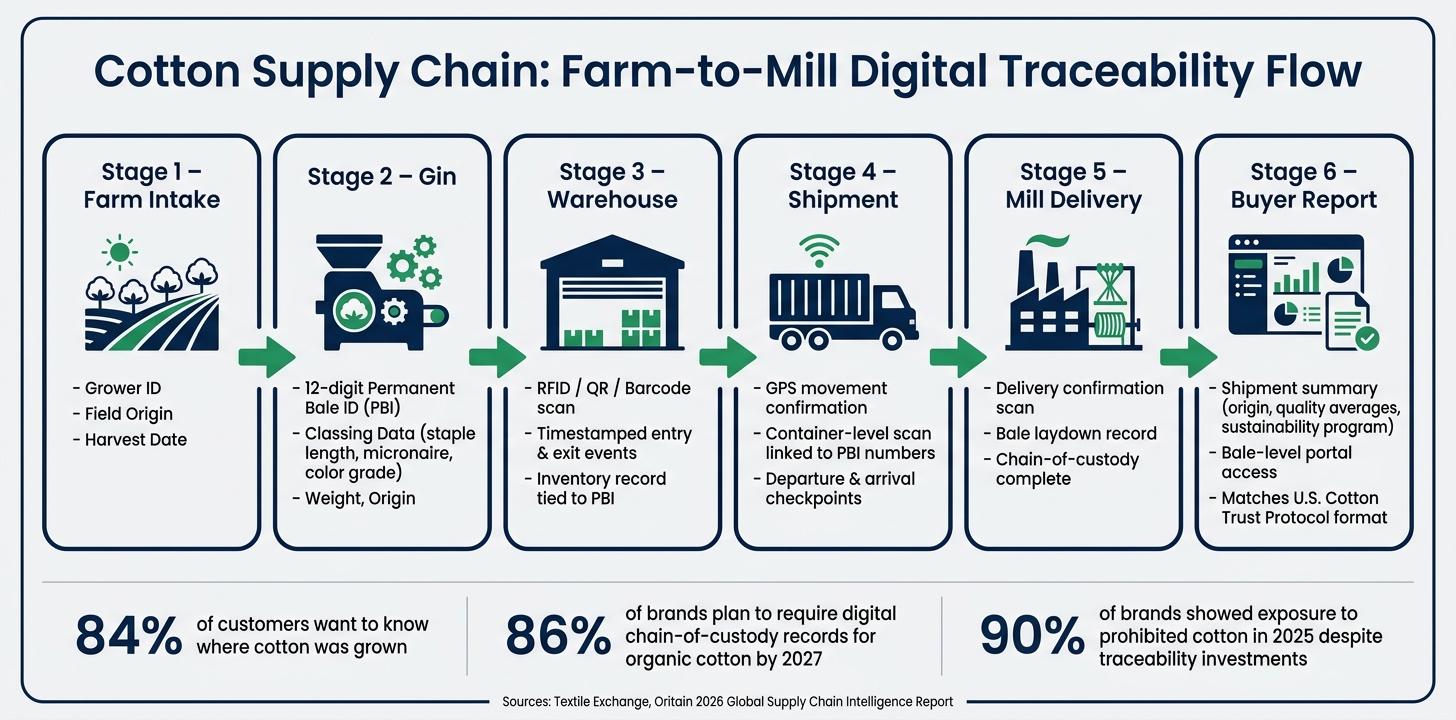
Cotton Supply Chain: Farm-to-Mill Digital Traceability Flow
Digital tools already close these gaps by tying bale identity, movement, and receipt into one shared record. It starts with the bale ID, because every scan after that depends on it.
Permanent Bale Identification and Gin Software as the Data Backbone
PBI gives each bale a permanent, unique ID. Gin software records that ID and connects it to classing, weight, origin, and shipment data. That shifts the bale from a paper trail to a digital record. Once the bale has a dependable ID, each downstream scan can stay tied to the same record.
RFID, QR Codes, and Barcodes for Warehouse and Mill Visibility
Once a bale leaves the gin, visibility comes down to steady scanning. RFID tags, QR codes, and barcodes create scan points at module intake, warehouse entry, outbound loading, receiving, and mill laydown. Each scan logs a timestamped event tied to the bale ID.
RFID works well for bulk scanning and doesn't need a direct line of sight, which helps in busy warehouse yards. QR codes and barcodes cost less to roll out and work well with standard mobile devices, so they're often a good fit for smaller operations. In plain terms, RFID, QR codes, and barcodes add timestamped scans at intake, loading, receiving, and laydown. But there's a catch: every scan needs to feed the same shared system tied to the bale ID.
GPS Logistics Tracking and Blockchain-Based Traceability Platforms
After the bale leaves the gin and warehouse, shipment data needs to stay connected to that same ID. GPS confirms shipment movement and arrival. When it's linked to a shipment record that lists specific PBI numbers, it adds a verified movement event to the chain of custody.
Blockchain platforms add a shared, auditable record across companies that's hard to alter. But they only help if the upstream bale data is accurate.
With the tracking tools in place, the next step is deciding which data to share with buyers.
How Gins, Merchants, and Suppliers Can Build a Transparent Supply Chain
Build a Connected Record from Farm Intake to Mill Delivery
Once bale IDs and scan points are set up, the next move is to tie them into one continuous record. The aim is simple: each bale should carry a digital trail that begins at the farm and stays with the cotton all the way to the mill.
That starts at intake. Capture the grower ID, field origin, and harvest date, then connect that information to the gin intake record before ginning. At the press, the PBI ties the bale to that upstream record. From there, USDA classing data adds staple length, micronaire, and color grade to the same bale ID through a digital data feed.
Then the back half of the trip needs to be tracked too. Warehouse scans, outbound loading, and mill delivery confirmation complete the record, so brands can see a clear chain of custody from a U.S. farm to the spinning floor.
Share the Right Data with Buyers and Brands Downstream
Once the record is in place, the next task is sharing the right amount of data with buyers. Too much raw data, too soon, can make things messy. A better route is a tiered setup.
Start with a high-level shipment summary that covers:
- origin region
- quality averages
- sustainability program participation
If a buyer wants more detail, make bale-level data available through a secure web portal or downloadable reports.
This saves time on both sides. Automated shipment notifications can go out at departure and arrival checkpoints, so brand teams don't have to keep asking for updates. Pre-shipment traceability briefs help too. Send them before the shipment moves, and many origin and processing questions get answered before they become back-and-forth emails.
It also helps to match report formats with recognized programs like the U.S. Cotton Trust Protocol. That way, brand teams can compare supplier data with third-party records instead of just taking claims at face value.
One common mistake is sending data dumps with no formatting or context. That usually creates confusion, not trust. Lead with a summary, then give people the option to dig deeper.
Use cottongins.org to Support Visibility and Industry Connections
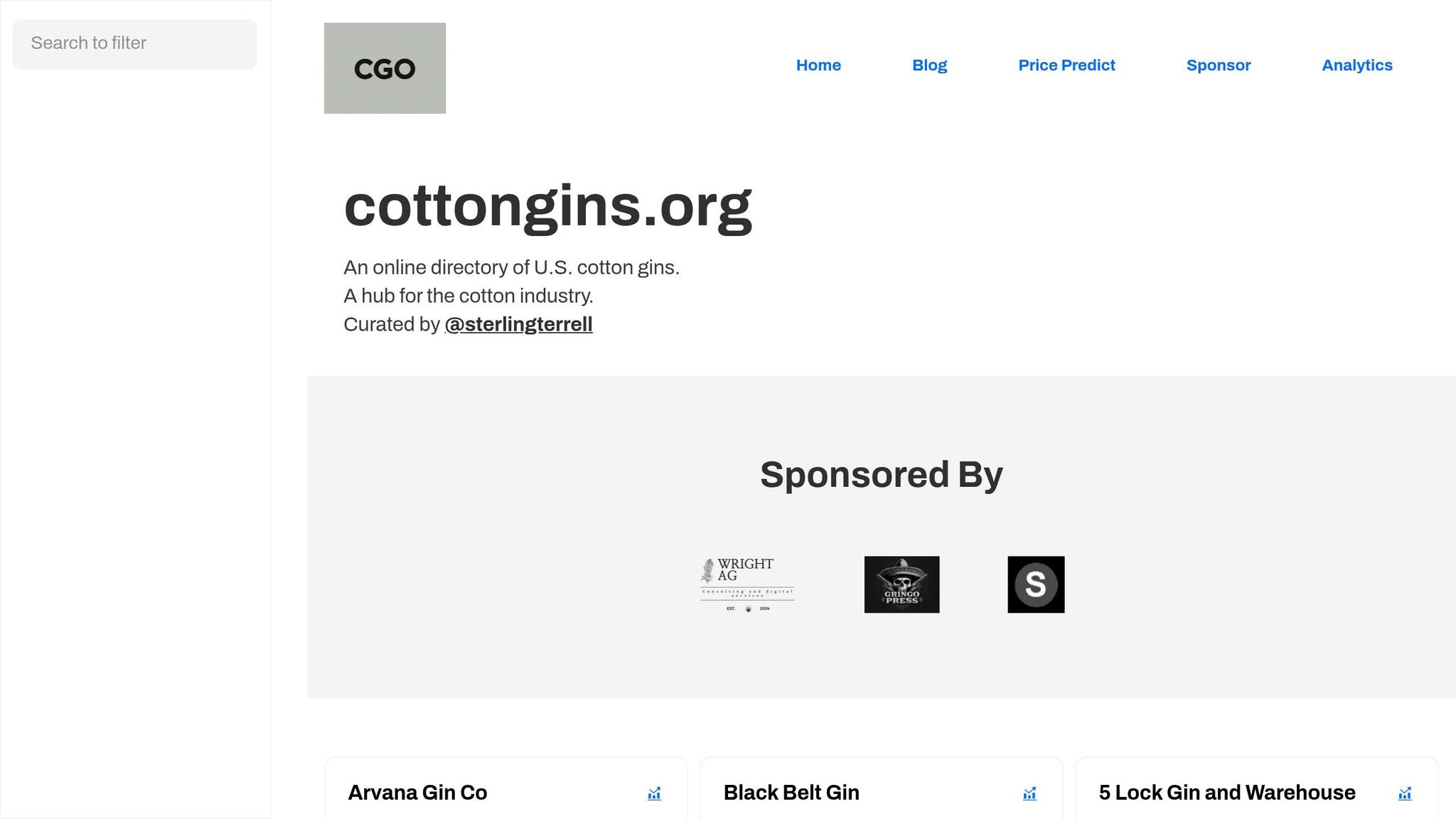
Visibility matters too. If buyers are looking for traceability-ready suppliers, they need an easy way to find them.
cottongins.org is a U.S. cotton gin directory that helps merchants, mills, and brand sourcing teams find gins by state and region, check capabilities, and spot partners ready for traceability reviews.
Use cottongins.org to show:
- traceability capabilities
- contact details
- region
That helps buyers find the right gin faster. It also makes supplier selection easier and claim checks more straightforward.
Conclusion: A More Transparent Cotton Supply Chain Is Easier to Market
Brands want cotton they can verify, and U.S. gins, merchants, and suppliers are now in a position to provide it. Digital tools help close the gaps that have long made cotton hard to track. They connect each step, from farm intake to mill delivery, into one auditable record. That means more than better visibility. It can also lead to easier sales, faster audits, and fewer disputes over claims.
That change is starting to shape sourcing decisions in a direct way. Brands now lean toward suppliers that can show clean, auditable records. A Textile Exchange survey found that 86% of responding brands and retailers plan to require digital chain-of-custody documentation for organic cotton by 2027, up from 34% in 2023. What used to be a nice-to-have is turning into a requirement.
The pressure is easy to understand. According to Oritain's 2026 Global Supply Chain Intelligence Report, 90% of brands analyzed showed exposure to prohibited cotton in 2025, despite existing traceability investments. A digital chain of custody that runs from farm intake through mill delivery gives brands proof they can use in an audit. For buyers, that kind of record is simpler to trust and simpler to source.
Being listed on cottongins.org can also make it easier for merchants, mills, and sourcing teams to find gins and suppliers with documented traceability capabilities. In a market where proof matters, documented visibility becomes a sales edge.
FAQs
How does PBI keep cotton traceable?
Permanent Bale Identification (PBI) keeps cotton traceable by giving each bale its own 12-digit ID: a 5-digit USDA gin code plus a 7-digit bale number.
That ID ties the physical bale to its digital USDA/FAS record, including fiber quality data. As PBI numbers are logged at the gin, they build a digital trail that people across the supply chain can use to check the bale’s identity, origin, and movement.
What data do brands want to see?
Brands want clear, checked data that proves where cotton came from, how it performed, and whether it was produced in the right way from the farm to final delivery.
The main data points include:
- Provenance and origin
- Sustainability metrics such as water use, energy use, soil conservation, and regenerative practices
- Quality metrics like fiber length, strength, and micronaire
- Chain-of-custody records, including processing times, warehouse locations, and manufacturing sites
How can smaller gins start digital tracking?
Smaller gins can start with the established Permanent Bale Identification (PBI) system. The 12-digit barcode gives each bale a clear link to fiber quality data.
Before processing begins, teams should record module IDs and make sure every bale gets a PBI tag. That step keeps the chain intact from module to finished bale.
Shifting from spreadsheets to a digital inventory system gives gins a stronger base for tracking. Barcode scanning is a reliable, cost-effective place to start. As the operation gets bigger, they can add RFID or traceability software later.