If you need to prove a cotton claim, paperwork alone is not enough. I’d sum it up this way: DNA testing checks the fiber itself, while bale records, invoices, and custody logs show where that fiber was supposed to go.
Here’s the short version:
-
There are two DNA approaches:
- Native cotton DNA shows what the cotton is, such as Pima vs. upland.
- Applied DNA markers show whether a tagged lot stayed in the supply chain.
-
DNA testing works best with records, not by itself.
A positive test can support a claim. A negative test does not always prove the cotton was never tagged. -
The process starts early:
field data, gin tagging, bale IDs, lot segregation, warehouse checks, mill intake tests, and finished-goods testing all matter. -
PCR and qPCR are the main lab tools.
They can detect very small amounts of a marker, and some systems return results in under 40 minutes. -
This matters because fraud is common.
One cited case found labeled Egyptian cotton products contained no Egyptian cotton at all. Other testing found over 80% of products claiming 100% Pima were not pure Pima, and 89% of items sold as pure Pima or Egyptian cotton contained cheaper upland cotton. -
For U.S. cotton, bale IDs still matter.
Each bale has a 12-digit Permanent Bale Identification number tied to USDA classing data, which helps connect lab results to the paper trail. -
Costs sit on top of ginning costs.
Base ginning runs about $36-$53 per bale, and DNA programs add marker, lab, equipment, setup, and labor costs.
How DNA technology is being used to confirm the source of cotton
sbb-itb-0e617ca
Quick comparison
| Method | What it checks | Best use | Main limit |
|---|---|---|---|
| Native DNA | Cotton type or variety | Fiber identity claims | Does not track a tagged lot through each handoff |
| Applied DNA markers | Presence of a tagged program lot | Origin and program verification across processing | Must be paired with records and sampling |
| Paper records | Transactions and custody steps | Day-to-day tracking | Cannot test the fiber itself |
| Digital batch tracking | Lot movement and data logs | Batch visibility across suppliers | Depends on correct data entry |
If I were setting up a cotton claim file, I’d start with bale IDs, lot control, and custody records, then use DNA testing only where the claim needs physical proof.
The Science Behind DNA Markers and Lab Testing
This section explains what the lab tests, how markers make it through production, and what the results can actually show.
Types of DNA Markers Used on Cotton
DNA markers used on cotton are synthetic DNA tags linked to a specific program or lot. They need to stay separate from the cotton plant’s own DNA and still be detectable at very low levels.
That’s what makes them useful in practice. A marker isn’t much help if it disappears halfway through production. It has to stay in place through downstream processing. One study found that DNA molecular tags were still identifiable on denim swatches even after stone and bleach washing.
Markers can be added at the gin or later during spinning and finishing.
How Cotton Samples Are Collected and Tested
Sampling starts early. Collect samples from multiple points in the bale or lot as soon as possible. Those samples can come from a bale, yarn, fabric, or finished garments.
In the lab, the process is pretty direct. Fibers are cut into small pieces and treated with chemical or enzymatic solutions that release the DNA from the fiber or finish. After that, purification steps remove dyes and finishing chemicals that could interfere with detection. The test looks for the applied marker, not the cotton plant’s native DNA or other background DNA.
Then the lab runs PCR (Polymerase Chain Reaction). PCR amplifies the target marker sequence millions of times, which lets the lab detect even a very small amount.
Most programs use qPCR (quantitative PCR), which tracks amplification in real time. That gives two things: a yes-or-no result on whether the marker is present, and a relative sense of how much marker is in the sample. That second part matters when a program needs to check whether a minimum content threshold has been met. In cotton traceability programs, qPCR systems can return results in under 40 minutes.
To cut down on false results, labs use duplicate tests along with positive and negative controls.
Those testing choices shape the whole program. The sampling plan affects test volume, turnaround time, and total cost.
What Test Results Can and Cannot Confirm
A positive result means the expected marker for a specific program was detected in that sample. That can support claims like organic cotton from a named region or recycled cotton from a tagged stream, but ONLY when the result is paired with bale IDs and custody records.
A negative result is less simple. It means the marker was not detected, not that the cotton was never tagged. Standards warn against making that leap. Inhibitors, degradation, poor storage, or gaps in sampling can all stop the marker from being detected.
So DNA testing works best as verification evidence, not as standalone proof. To stand up in a commercial or compliance setting, the lab result needs to sit alongside bale IDs, invoices, shipping records, and chain-of-custody logs. The lab confirms presence. The records confirm custody.
Step by Step: DNA Traceability from Farm to Finished Product
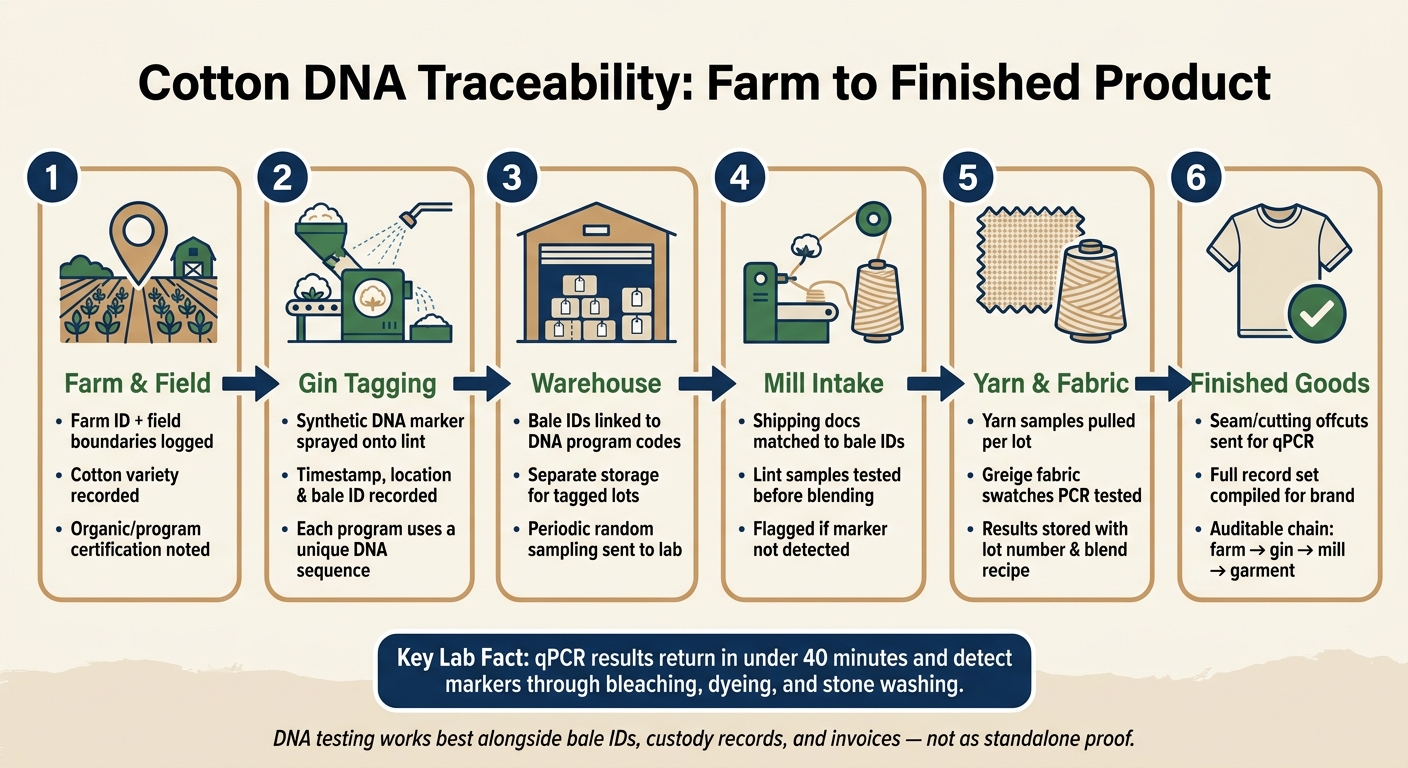
Cotton DNA Traceability: Farm to Finished Product Step-by-Step
Farm, Harvest, and Gin: Where Traceability Starts
Before any bale gets tagged, the field record has to be set up. That usually includes the farm ID, field or pivot ID, GPS boundaries, cotton variety, harvest date, and any program data tied to the crop, such as organic certification or water-use program details. This is the first link in the chain. It gives the fiber a documented origin before the marker is added.
In plain English, field data gives the DNA marker something to point back to. Without that record, the marker is just a marker.
In day-to-day use, traceability usually starts at the gin. That’s where providers apply synthetic DNA markers as a fine spray to lint during ginning or right after it, using a calibrated spray unit mounted on the lint line or placed just before the bale press. This stage makes sense for a simple reason: gins already work with bale numbers and bale press records. So this is where the physical tag and the digital chain of custody first meet.
At that moment, the system records the timestamp, location, program type, and bale ID together. Each program uses its own DNA sequence, and the gin can assign different codes by field, farm, or batch based on how much detail the program wants. At the gin, the DNA tag can also carry program, date, and location data.
Once the bale is tagged, the job changes. It’s no longer about proving where the cotton came from. It’s about keeping that lot intact as it moves.
Warehouse, Merchant, and Mill Controls
After ginning, every handoff matters. Once bales leave the gin, custody control becomes the main concern. That means warehouse receipts linked to bale IDs and DNA program codes, separate storage for tagged lots, and clear lot labels that show program, origin, and claim.
The main check at this stage is periodic sampling. Warehouses or merchants pull small lint samples from randomly chosen bales in a lot and send them to a DNA lab before big shipment or blending events. If the test comes back positive, it shows the tagged cotton is still in the lot. Controls meant to stop bale swaps help close the loop.
By the time cotton reaches the mill, the process gets tighter. Mills compare shipping documents and bale IDs with purchase orders, then take lint samples from a representative share of incoming bales for testing before any blending or spinning starts. The point is simple: Did the right cotton arrive? If the marker doesn’t show up at intake, the lot gets flagged before it moves into production.
Verification at Fabric, Garment, and Final Claim Stage
DNA markers are built to stay detectable through later processing steps. Mills take yarn samples from specific cones or bobbins in each lot, while weavers and knitters pull swatches from greige fabric rolls. Those samples go through PCR testing, and the results are stored with the matching lot number, blend recipe, and bale IDs.
At the finished fabric and garment stage, brands use the full set of test records to back up claims such as U.S.-grown, organic, premium Pima, or Egyptian cotton. Post-finishing fabric swatches and garment seam or cutting offcuts are sent in for PCR or qPCR testing to check for the expected marker. Programs like PimaCott and Haelixa-marked Egyptian cotton verify yarn, fabric, and finished goods this way.
A claim only holds up if the full chain holds up. A defensible claim file brings together records from every step:
- farm and gin records
- warehouse receipts and shipping records
- mill intake reports
- yarn and greige fabric test results
- final garment test reports tied to lot numbers and style numbers
That’s why final verification doesn’t rest on one fabric swatch. It depends on the full record set. This multi-stage documentation lets brands show auditors not only that a marker appears at the end, but that it was tracked and checked at each key point in the chain. Those records also spell out the staffing, sampling, and software the program needs.
Cost, Data, and Setup Requirements for U.S. Cotton Businesses
What Gins Need to Run a DNA Traceability Program
Once DNA testing confirms the fiber, the focus shifts to execution. A gin needs the right setup to run a traceability program cleanly and at scale.
That means putting a few core pieces in place: a designated application point at the gin, strict lot segregation, line-cleanout procedures to stop carryover, bale-to-lot labeling, and a digital log for each bale that records the timestamp, bale number, and marker code. Staff also need training on application, logging, exceptions, and release approval.
This part matters more than it may seem at first glance. If the process at the gin gets sloppy, the paper trail can fall apart fast.
Key Cost Drivers and Business Returns
Traditional ginning costs run about $36-$53 per bale, with roughly $30 per bale in fixed costs. DNA traceability sits on top of that, with separate costs for markers, testing, equipment, installation, and labor.
The return isn't just about getting a higher price per bale. Verified traceability can help support claims with more confidence, cut fraud risk, and open the door to premium programs such as PimaCott and HomeGrown.
After mapping the cost side, the next move is simple: find gins that are already in a position to handle traceable cotton.
Using cottongins.org to Support Traceable Cotton Programs
cottongins.org can help you find U.S. gins by region, check contact details, and spot facilities that may be able to take part in traceable cotton programs.
DNA Traceability vs. Paper Tracking: How to Choose
Comparison Table: DNA Testing, Paper Records, and Digital Batch Tracking
Once traceability controls are in place, the next step is simple: can paperwork alone support the claim?
A good rule is to use the lightest method that can defend the claim.
| Criteria | DNA Testing | Paper Records | Digital Batch Tracking |
|---|---|---|---|
| Physical proof | High - tests the physical fiber itself | None - relies on declarations | None - depends on data inputs |
| Fraud resistance | High - substitution is detectable | Low - documents can be falsified | Medium - better logs, but no physical check |
| Setup difficulty | Moderate to high | Low | Moderate |
| Scalability | Good once standardized | Easy but error-prone at volume | Strong, if stakeholders adopt it |
| Suitability for origin/sustainability claims | High | Low to medium | Medium to high when combined with controls |
The core choice isn't whether to track cotton. It's whether the claim needs physical proof.
Paper records work for day-to-day tracking. Digital batch systems give you better visibility across lots and handoffs. But only DNA tests the fiber itself. Records track the transaction; DNA checks the material.
Where DNA Adds the Most Value in Cotton
DNA makes the biggest difference when the stakes are high and paperwork can only go so far.
That usually means cases like:
- Premium origin claims, such as Pima, Egyptian, or region-specific cotton
- Recycled content claims, where greenwashing risk is a serious issue
- High-risk sourcing programs, where origin fraud or regulatory exposure is a concern
The numbers here are hard to ignore. Two Applied DNA Sciences investigations found that over 80% of products claiming 100% Pima cotton were not, and a separate test found 89% of items advertised as pure Pima or Egyptian cotton contained cheaper upland cotton instead. Applied DNA also reported that cotton from China's Xinjiang region was present in 19% of 822 cotton-containing products tested in 2023–2024, and among Xinjiang-positive samples labeled as single-origin, 57% were claimed to be U.S.-only cotton.
In other words, DNA tends to matter most in premium, high-risk, or multi-step supply chains where substitutions can slip through without showing up in the paperwork.
Conclusion: What to Put in Place First
Start with the basics: unique bale IDs, lot segregation, and clean chain-of-custody records. Then use DNA where a claim needs physical verification.
That keeps DNA focused on the claims that need proof, instead of treating every bale like a special case.
FAQs
How accurate is DNA cotton traceability?
DNA cotton traceability is highly accurate because it uses synthetic forensic markers to give cotton fibers a unique, verifiable fingerprint. In plain English, each batch can be tied back to its source with hard proof, not guesswork.
These markers hold up through bleaching, dyeing, and washing. That means the cotton can still be identified even after processing and blending, which is where many tracking methods start to fall apart.
When you pair this approach with digital traceability systems, you get much stronger proof of authenticity. It also helps cut down on fraud and mislabeling, while backing up sustainability claims with data that can be checked.
Can DNA testing verify blended cotton products?
Yes. DNA testing can verify cotton origin even after the cotton is blended with other fibers.
At the source, producers apply synthetic DNA markers to raw cotton. Those markers stay detectable even after steps like bleaching, dyeing, and washing.
Labs then use PCR testing on blended yarn, fabric, or finished garments to check for those markers. That gives brands and suppliers defensible evidence of origin.
When should a cotton business use DNA testing?
A cotton business should use DNA testing when it needs to verify where cotton fiber came from and confirm that it is what suppliers say it is, from the farm all the way to the finished product.
DNA markers act like a forensic fingerprint for cotton. And because that fingerprint can survive manufacturing, it gives businesses a way to check fiber origin with hard evidence, not just paperwork. That matters when a company wants to stop substitution, back up sustainability claims, fight fraud, meet transparency rules, and sell into premium markets with data it can defend.