Moving cottonseed via barges offers cost savings, high capacity, and reduced emissions but comes with challenges like weather disruptions and infrastructure issues. This method is ideal for long-distance, high-volume shipments, especially when proximity to waterways aligns with operational needs.
Key takeaways:
- Cost-Effective: Barges are cheaper for distances over 1,341 miles, moving one ton of cargo 647 miles per gallon of fuel.
- High Capacity: A single barge carries the load of 70 trucks or 15 railcars.
- Lower Emissions: Barges emit significantly less CO₂ compared to trucks and rail.
- Challenges: Weather delays, low water levels, aging infrastructure, and regulatory requirements can disrupt operations.
For cotton producers, evaluating shipment volume, proximity to waterways, and integrating other transport methods (like trucks or rail) for last-mile delivery can help mitigate risks and maximize efficiency.
Benefits of Cotton Barge Transport
Lower Costs and Better Efficiency
Barges offer a cost-effective solution thanks to their impressive fuel efficiency. To put it in perspective, a single barge can move one ton of cargo 647 miles on just one gallon of fuel. Compare that to trains, which manage 477 miles, and trucks, which only reach 145 miles per gallon. This efficiency leads to lower fuel surcharges and reduced operational expenses for long-haul shipments.
The economics of transport shift depending on distance. Trucks are ideal for shorter hauls under 459 miles, while rail becomes more economical for distances between 459 and 1,341 miles. For shipments exceeding 1,341 miles, barge transport emerges as the most cost-effective option. Additionally, using natural waterways helps cut down on infrastructure maintenance costs.
Handling Large Shipments
Barges shine when it comes to moving large volumes. Their capacity makes them perfect for high-volume cotton shipping. A single hopper barge can carry between 1,500 and 1,800 tons of cargo - equivalent to 58–70 truckloads or 15–18 railcars. A standard tow of 15 barges can handle the same amount as 1,050 trucks or 216 railcars pulled by six locomotives. This consolidation simplifies logistics, replacing hundreds of individual truck trips with a single barge shipment.
Reduced Environmental Impact
Barge transport isn’t just economical - it’s also a greener option. It produces just 15.6 tons of CO2 per million ton-miles, compared to 21.2 tons for rail and a staggering 154.2 tons for trucks. Trucks emit nearly 10 times more carbon than barges. For cotton producers aiming to achieve sustainability certifications or cut down on Scope 3 emissions, barge transport offers clear environmental advantages.
Another plus? Barges have a lower spill rate, averaging just 2.12 gallons per million ton-miles, compared to 6.04 gallons for trucks. This reduces the risk of environmental contamination during transport, making barges a safer and more eco-friendly choice for moving cotton.
sbb-itb-0e617ca
River Transportation: Shipping Goods using Barge Tows
Risks and Challenges of Barge Transport
Barge transport offers cost and capacity benefits, but it also comes with distinct operational risks that can disrupt efficiency and reliability.
Weather Delays and River Conditions
Seasonal weather conditions play a major role in barge transport, especially during critical shipping periods. For instance, droughts during the fall harvest have severely impacted operations on the Mississippi River. In September 2024, barge drafts were reduced from 12 feet to 9 feet due to low water levels, causing a 40% capacity loss per barge. This reduction translates to a loss of 600 tons of cargo per barge, with shippers still paying the same freight costs for a smaller load. The Memphis gauge hit -6 feet that month, prompting U.S. Coast Guard restrictions.
These low-water conditions are not new - 2022, 2023, and 2024 all saw critical river levels disrupt peak shipping seasons. For example, in October 2022, river levels at Memphis dropped to -10.79 feet, pushing St. Louis barge spot rates to an unprecedented $106 per ton, compared to the usual $20 per ton. This also caused a $3 per bushel discount for inland soybeans. Jon Davis, Chief Meteorologist at Everstream Analytics, highlighted the urgency of the situation:
"October is a critical month for barge transportation in the Mississippi River Basin... Both last year and in 2023, shipping was virtually halted along the Mississippi River and other tributaries due to low water levels".
Transit delays are another common issue during low-water conditions, with operators often reducing tow sizes from the standard 30–40 barges to 25 or fewer to navigate narrower channels. These delays, lasting 24 to 48 hours, can significantly disrupt supply chains. Winter adds further complications, as ice formation in the upper basin exacerbates low water levels.
Infrastructure Problems
Aging infrastructure, particularly the lock and dam systems, poses another significant challenge. These systems often act as bottlenecks, and high water levels can overwhelm them, forcing closures that strand barges for days. Considering that the Mississippi River system moves 400 million tons of goods annually - including 92% of U.S. agricultural exports - any disruption has widespread consequences.
Proactive maintenance, such as dredging, is essential to keep channels navigable. Without it, shallow waters lead to additional draft restrictions and reduced cargo capacity. Marty Hettel from American Commercial Barge Line underscored this point:
"We're at the stage right now we need to be in that proactive stage, and we need to bring these dredges up here and maintain the Lower Miss so we can move those farmers' commodities to market".
Permits and Compliance Requirements
Regulatory oversight adds another layer of complexity to barge transport. The U.S. Army Corps of Engineers oversees permits and waterway regulations, while the U.S. Coast Guard enforces safety and navigation rules. For instance, when river levels drop below specific thresholds, the Coast Guard imposes mandatory draft restrictions, such as the 9-foot draft requirement seen during the past two years.
Operators must stay informed of these regulations through regular updates, like the twice-weekly coordination calls between the barge industry and the U.S. Army Corps of Engineers via the Lower Mississippi River Committee. Each foot of reduced draft cuts cargo capacity by 200 tons, significantly driving up costs for commodities like cotton. These compliance requirements, while necessary for safety and efficiency, add to the operational challenges and costs of barge transport.
Comparing Costs: Barge vs. Truck vs. Rail
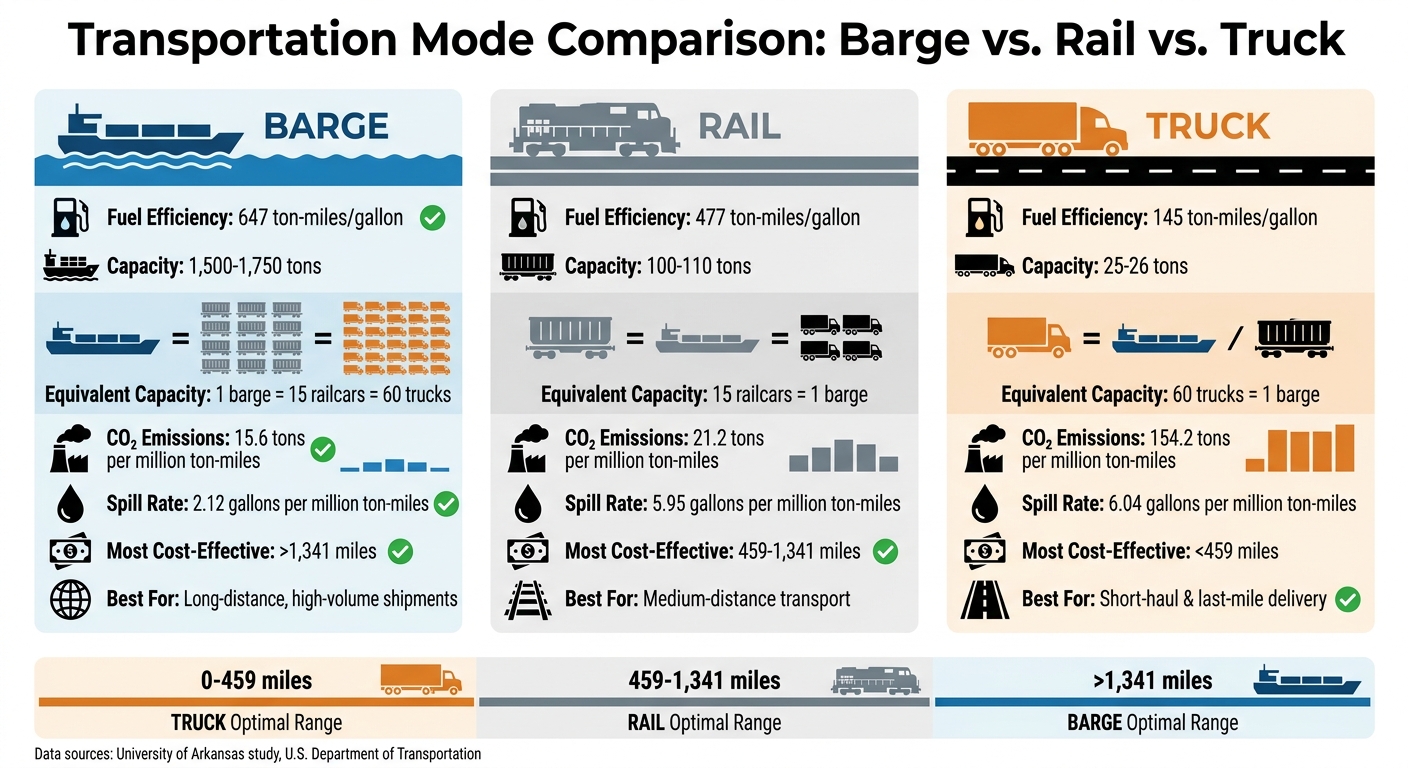
Barge vs Truck vs Rail Transport: Cost, Capacity & Emissions Comparison
Cost, Capacity, and Fuel Efficiency Data
When it comes to choosing the right transportation method, understanding cost, capacity, and fuel efficiency is critical. Each mode - barge, truck, and rail - has its sweet spot, depending on distance and shipment volume.
A study from the University of Arkansas provides clear guidelines: trucks are most cost-effective for distances under 459 miles, rail takes the lead between 459 and 1,341 miles, and barges become the best option for distances over 1,341 miles.
The Mississippi River system uses a distinct pricing model based on percent-of-tariff rates set back in 1976. These benchmark rates differ by region: $6.19 per ton in the Twin Cities, $3.99 per ton in St. Louis, and $3.14 per ton in the Cairo-Memphis area. To calculate actual costs, multiply the benchmark rate by the tariff percentage. For instance, a 300% tariff at St. Louis results in $11.97 per ton ($3.99 × 3.00). Additional charges, such as demurrage fees ranging from $400 to $650 per day after a 24–72 hour grace period, along with fleeting and cleaning fees, should also be considered.
Capacity Comparison
Capacity is another area where transportation modes differ significantly. A single 15-barge tow can carry the same load as 216 rail cars or 1,050 trucks. Even a single barge alone replaces 15 railcars or 60 trucks. In terms of tonnage, barges carry between 1,500 and 1,750 tons, while railcars handle 100–110 tons, and trucks manage just 25–26 tons per load. This makes barges the go-to choice for moving large volumes of goods.
Fuel Efficiency and Emissions
Fuel efficiency is another major factor. Barges excel in this category, moving one ton of cargo 647 miles on a single gallon of fuel. Rail comes in second at 477 miles per gallon, while trucks lag far behind at 145 miles. According to the U.S. Department of Transportation, waterway transport is more than twice as energy-efficient as rail and eight times as efficient as trucking. This efficiency not only cuts costs but also reduces environmental impact. Barges emit just 15.6 tons of CO₂ per million ton-miles, compared to 21.2 tons for rail and a whopping 154.2 tons for trucks.
| Feature | Barge | Rail | Truck |
|---|---|---|---|
| Fuel Efficiency (Ton-Miles/Gallon) | 647 | 477 | 145 |
| Capacity | 1,500–1,750 tons | 100–110 tons | 25–26 tons |
| Equivalent Unit Capacity | 1 Barge | 15 Railcars | 60 Trucks |
| CO₂ Emissions (Tons/Million Ton-Miles) | 15.6 | 21.2 | 154.2 |
| Most Cost-Effective Range | > 1,341 miles | 459–1,341 miles | < 459 miles |
| Spills (Gallons/Million Ton-Miles) | 2.12 | 5.95 | 6.04 |
These figures highlight why barge transport is the best option for long-distance, high-volume shipments, offering unmatched capacity and fuel efficiency with significantly lower emissions compared to other methods.
How to Reduce Risks in Cotton Barge Transport
Using Weather Data and River Forecasts
Staying ahead of potential disruptions is key when transporting cotton via barges, and real-time monitoring tools can make all the difference. For instance, platforms like BargeOS combine satellite and cellular barge tracking with NOAA weather updates and U.S. Army Corps of Engineers river condition reports. This setup ensures continuous visibility into operational conditions. Automated alerts keep you informed about lock statuses, river gauge levels, and weather-related disruptions, allowing for quick adjustments to shipping plans. Additionally, IoT sensors on barges track water temperature, flow, and levels in real time, while GPS tracking and RFID tags provide precise shipment updates - essential during extreme weather events like hurricanes. These tools are critical because weather-related incidents and navigation hazards remain leading causes of barge accidents.
For cotton producers, having sufficient storage is equally important. Partnering with sellers or gins that offer warehouse facilities can help ensure a steady supply, even when river conditions cause delays. This is particularly vital for handling whole cottonseed, which presents unique storage challenges. These steps work hand-in-hand with broader strategies to reduce transportation risks.
Combining Transport Methods
Using data-driven forecasts to anticipate risks is a smart move, but diversifying transportation methods adds another layer of reliability. For example, pairing short-haul trucking with barge transport can help offset reduced barge capacity during low water conditions. Early warning systems allow operators to adjust connected rail and truck operations before barge delays disrupt the supply chain.
Peak harvest seasons, when barge volumes can spike by 30–50% above yearly averages, present unique challenges. Pre-booking short-haul trucking capacity 3–4 months in advance can help avoid inflated spot-market rates. This also allows destination ports to better manage staffing for truck and rail transfers, ensuring smoother operations.
Insurance and Industry Support
Reducing risks isn’t just about logistics - it’s also about having the right financial safeguards in place. Marine cargo insurance protects your cotton from physical loss, damage, or theft. Protection and Indemnity (P&I) insurance covers third-party liability claims, while business interruption insurance can help recover income lost due to weather or infrastructure delays. Keeping digital records of each shipment can streamline claims processing, and conducting immediate visual inspections upon delivery is essential. Failing to report visible damage promptly could jeopardize your insurance rights.
Forward contracting on the Mississippi River system offers another layer of security, allowing you to lock in freight rates and manage price fluctuations. As Larry Johnson, Owner of Tactical Risk Advisors, puts it:
"The days of cheap freight and quick shipments are gone".
Deciding if Barge Transport Works for Your Operation
Checking Distance to Waterways
Start by figuring out if you're close enough to a navigable waterway to make barge transport worthwhile. You'll need to calculate the cost of moving cotton overland - whether by truck or rail - from your gin to the nearest river terminal. Overland transport costs, especially for the last mile, can quickly eat into the savings barge transport offers, particularly if you're located far from major rivers.
To simplify this process, cottongins.org offers a searchable directory of U.S. cotton gins, complete with detailed addresses. This tool makes it easier to identify facilities near major waterways, such as the Mississippi River system. By mapping out which gins are within a reasonable trucking distance of barge terminals, you can assess whether the location works for your operation. Proximity plays a big role here - barge transport only makes sense if the cost of getting cotton to the terminal doesn’t cancel out the savings from lower per-ton shipping costs.
Keep in mind that barge transport has its limitations. It’s slower and less flexible than trucking. This method works best when you’re not in a rush for delivery and can plan shipments around river conditions and lock schedules.
Once you’ve confirmed your proximity to a navigable waterway, the next step is to evaluate your shipment volume to ensure the economics of barge transport work in your favor.
Estimating Shipment Volume and Returns
After considering your location, it’s time to assess whether your shipment volume justifies using barge transport. A single barge can carry the same load as 70 trucks, so you’ll need a significant amount of cotton to make the logistics worthwhile. The Cotton Module Transport Calculator can help you balance hauling costs with your gin’s capacity. This tool uses percent utilization (%U) to demonstrate how larger shipment volumes can lower your per-bale costs by spreading out fixed expenses like staffing, taxes, and capital investments.
To use the calculator effectively, you’ll need these four data points:
- Your rated gin capacity (bales per hour)
- Average bales per module
- Estimated bales within various distance ranges
- Current fuel costs
The tool is most accurate for operations running at 70% utilization or higher. If your operation falls below this threshold, the projections become less reliable.
"The model can help a ginner evaluate scenarios to determine when traveling farther to retrieve bales may actually reduce per bale costs".
This insight is particularly useful if you’re considering sourcing cotton from farther distances to fill a barge. It ties back to the earlier discussion about how scale can enhance cost efficiency when comparing different transport methods.
Conclusion
Barge transport offers an efficient way to move large cotton shipments. To put it in perspective, a single 15-barge tow can carry the same load as 1,050 trucks or 216 rail cars. Plus, barges are incredibly fuel-efficient, moving one ton of cargo 647 miles on just one gallon of fuel. For shipments traveling beyond 1,341 miles, they provide the lowest cost per ton-mile, with spill rates as low as 2.3 gallons per million ton-miles.
However, these advantages come with challenges. Weather disruptions, aging infrastructure, and regulatory requirements demand careful planning. Using real-time weather forecasts can help predict restrictions and avoid delays. Pairing barge transport with trucks or rail for last-mile delivery ensures flexibility when river conditions unexpectedly change. This adaptability helps maintain the efficiency that makes barge transport so appealing.
Determining if barge transport fits your operation depends on factors like shipment volume and proximity to navigable waterways. For example, trucks are often the most cost-effective option for distances under 459 miles, while rail becomes more economical for 459 to 1,341 miles. Beyond that, barges take the lead as the most affordable option. Tools like those available on cottongins.org can help you assess your specific needs. Their searchable directory can locate cotton gins near major waterways, such as the Mississippi River system, and the Cotton Module Transport Calculator shows how larger shipment volumes can reduce per-bale costs. By leveraging these resources, you can make informed decisions based on your operation's unique requirements.
FAQs
What hidden costs can reduce barge savings?
Hidden expenses can eat into barge transportation savings, such as port duties, taxes, fuel surcharges, and currency fluctuations. On top of that, the cost of additional overland transportation to deliver goods to their final destination can quickly add up. It's crucial to consider all these elements when determining whether barge transport is truly cost-effective.
How do I plan for low-water or lock delays?
Keeping barge transport running smoothly during challenges like low water levels or lock delays requires careful planning. Start by closely tracking water levels and weather patterns - droughts or severe weather can quickly disrupt navigation.
It’s also smart to build flexible schedules and map out alternative routes ahead of time. This way, you’re ready to pivot if delays occur. Partnering with experienced logistics providers is another key move, as they can offer valuable insights and real-time updates on waterway conditions.
By staying informed and planning ahead, you can reduce disruptions and keep operations on track even when nature throws a curveball.
What shipment size makes barge transport worthwhile?
Barge transport proves to be a cost-effective option when shipment sizes meet or exceed the capacity of a single barge - roughly equal to 70 truckloads of bulk goods such as grain or cottonseed. This makes it a practical choice for handling large, high-volume shipments, providing an efficient and scalable solution for producers and supply chain managers.