If you need to prove where cotton came from in 2026, paperwork alone is not enough. In most cases, I’d sum it up like this: good gin records, bale-level IDs, lab checks, and shared data across suppliers are what make a cotton traceability program hold up.
Here’s the short version:
- The gin is the starting point. If bale IDs are not tied to farm and field records at the gin, later proof gets weak fast.
- DNA tagging and isotopes do different jobs. DNA tags show whether a marked lot stayed in the chain. Isotope tests check whether cotton is in line with a claimed growing area.
- HVI is not an origin test. It helps sort and grade cotton, but it does not show where cotton was grown.
- Barcodes and RFID keep bales linked to records. Barcodes are common and low-cost. RFID helps cut missed scans in larger flows.
- ERP data is the core record. If scans, lab results, and shipment records sit in different files, audits get harder.
- Blockchain records handoffs, not truth. It can log custody transfers, but it cannot fix bad data entered at the start.
- Cost depends on scope. A pilot often lands around $10,000 to $50,000 in year one. A larger rollout can move into the hundreds of thousands of dollars per year.
- Scale is already growing. Better Cotton said 23,000+ metric tons of Physical BCI Cotton had been traced, up from 90 metric tons in November 2024.
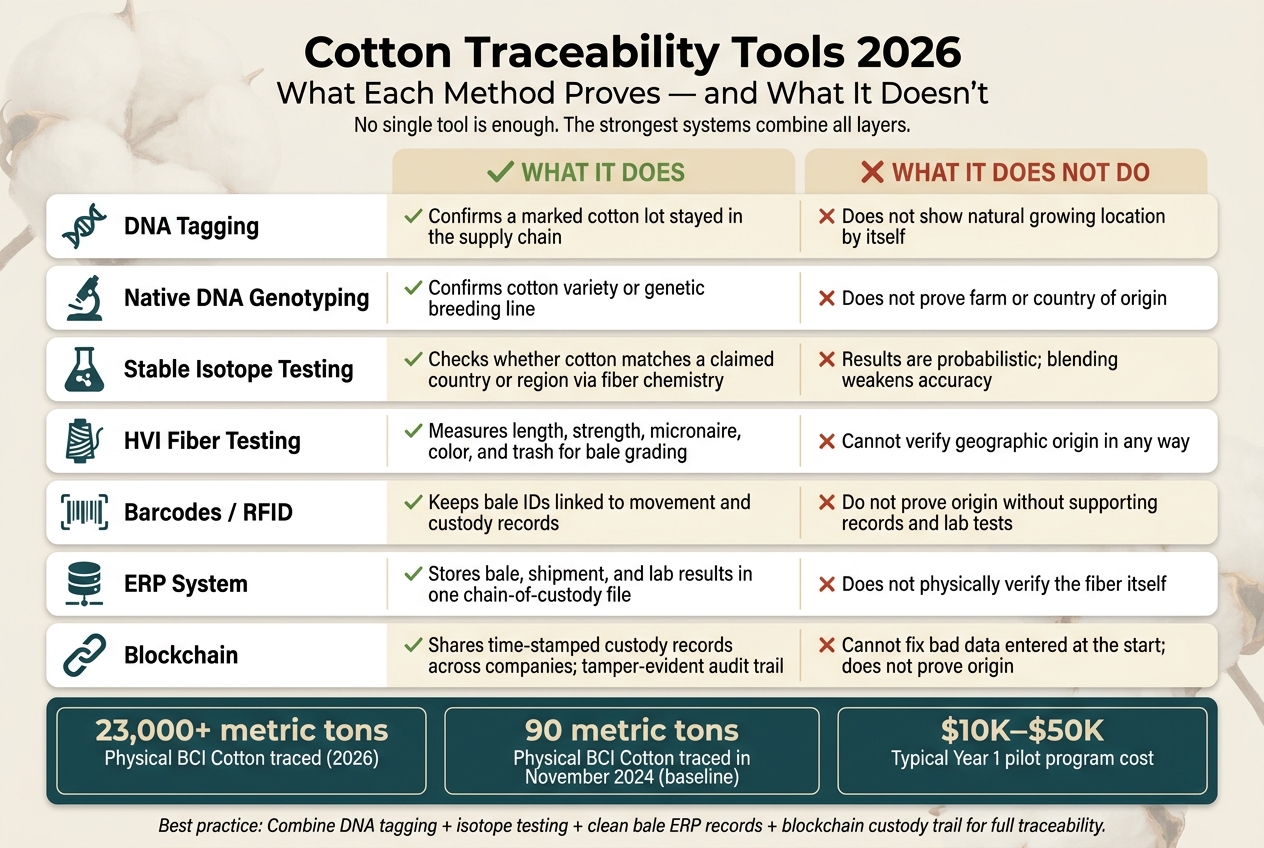
Cotton Traceability Tools 2026: What Each Method Proves (and What It Doesn't)
TEXPROCIL on Kasturi Cotton Bharat & Cotton Traceability at Bharat Tex 2026 | Fibre2Fashion
sbb-itb-0e617ca
Quick comparison
| Tool | What it does | What it does not do |
|---|---|---|
| DNA tagging | Confirms a marked cotton lot stayed in the chain | Does not show natural growing location by itself |
| Native DNA genotyping | Checks cotton variety or breeding line | Does not prove farm or country of origin |
| Stable isotope testing | Checks whether cotton is in line with a claimed country or region | Does not give perfect yes/no proof, and blending can blur results |
| HVI testing | Measures fiber quality traits like length and strength | Does not verify origin |
| Barcodes/RFID | Keep bale IDs linked to movement records | Do not prove origin without records and tests |
| ERP | Stores bale, shipment, and lab records in one chain-of-custody file | Does not verify physical fiber by itself |
| Blockchain | Shares time-stamped custody records across companies | Does not prove the starting data was correct |
So if I had to put the whole article into one plain sentence, it would be this: the best cotton traceability systems in 2026 combine physical testing with clean bale records and shared chain-of-custody data.
Lab-Based Origin and Content Verification
Lab tests back up the bale record created at the gin. Paperwork alone can't prove where cotton came from. Testing adds physical evidence.
The main tools here are synthetic DNA tagging, native DNA genotyping, stable isotope analysis, and HVI fiber testing. Each one answers a different question. At the gin, these tests either confirm bale identity or check whether the origin claim holds up.
DNA Marker Systems and Cotton Genotyping
Synthetic DNA tagging is a lot-marking tool. A lab-designed DNA code is applied directly to cotton lint, usually at the gin before baling. Later in the supply chain, labs can pull that tag from yarn, fabric, or finished garments with PCR testing and match it to the code on file for that program. If the result is positive, it shows that the tagged cotton made it into the final product.
That distinction matters. Synthetic tags show that a marked lot moved through the chain. Isotope testing does something else: it checks whether unmarked cotton lines up with its stated origin.
Native cotton DNA genotyping is about variety verification. It reads the plant's own DNA to confirm variety or breeding lineage, not where the cotton was grown. Applied DNA Sciences, for example, has used genotyping to identify biomarkers specific to Giza 94 Egyptian cotton, which helps support variety-authenticity claims. In practice, genotyping fits best in disputes or premium-variety checks, not day-to-day bale tracking.
| Synthetic DNA Tagging | Native Cotton DNA Genotyping | |
|---|---|---|
| Application point | Applied at the gin or finishing stage | No application; analyzes existing fiber DNA |
| Proof type | Confirms a marked lot passed through the supply chain | Confirms variety or genetic identity |
| Sampling needs | Lint, yarn, fabric, or garments; high detection sensitivity | Higher-quality DNA extraction; best on lint or yarn |
| Cost drivers | Marker material, application equipment, per-audit lab tests | Specialized lab analysis, reference library; used selectively |
| Typical users | Growers, gins, merchants, mills running branded origin programs | Brands, breeders, merchants verifying premium varieties or resolving IP disputes |
Isotopic and Fiber Testing for Origin Verification
Stable isotope testing uses chemical analysis. It measures natural isotope ratios, usually oxygen, hydrogen, and carbon, in cotton fiber and compares them with reference libraries built from cotton grown in known places. Climate and soil shape those ratios while the plant grows, so the isotopic fingerprint points to where the cotton was actually produced, not just what the documents claim.
This method usually works at the country or broad-region level. Eurofins tests many sample types, including fabric swatches, yarn cones, loose fiber, and finished articles. Results come back as consistent, inconsistent, or inconclusive. That's a key point. It isn't absolute proof. A result that's consistent with U.S. cotton can strengthen a compliance case, but it screens the claim rather than replacing chain-of-custody records.
Blending makes the picture messier. When cotton from different regions gets mixed during spinning, the isotopic signal starts to average out. That makes it harder to spot a small share of cotton from a higher-risk origin. Strict segregation and clean upstream records make those results easier to defend.
HVI testing plays a different role. It helps with bale grading and sorting, but it does not verify origin.
HVI measures length, strength, micronaire, color, and trash for bale grading. It does not prove where cotton came from. Think of it as a quality and sorting tool that supports traceability records, not a forensic origin test.
And there's a practical catch: lab results only help if the gin records bale IDs cleanly enough to tie the test back to the right bale.
| Stable Isotope Testing | HVI Fiber-Property Testing | |
|---|---|---|
| Geographic resolution | Country or broad-region level | None - not a geographic tool |
| Strengths | Tied to conditions during growth; works on lint, yarn, fabric, finished goods | Fast, standardized, bale-level; supports quality grading |
| Limits | Probabilistic results; weakened by blending; reference libraries need updates | Cannot establish origin |
| Compliance value | Screens origin claims when combined with documentation | Supports bale identity and quality records; not origin proof |
| Typical use cases | Checking whether cotton is consistent with a claimed country of origin | Bale classification, mill purchasing, quality anomaly detection |
Bale Identification, Gin Software, and Data Flow
Lab results only help if they tie back to a bale ID. That connection starts at the gin, where tags and software create the first record. This is the layer that turns a bale from a physical package into a checked, traceable record. After that, tags and scans keep the bale tied to that record as it moves through the system.
Barcodes, RFID, and Bale-Level Tracking at the Gin
In the U.S., bale identification starts with the Permanent Bale Identifier (PBI), a 12-digit code linked to the gin and bale number. The PBI appears on the physical tag attached to each bale and shows up in gin, warehouse, merchant, and mill records downstream. Bale numbers are not reused for at least five years, which matters when an auditor needs to trace a bale from an earlier crop year.
At the gin, the PBI tag is attached to the bale at the press. Scan points at warehouse intake and again before shipment loading update the bale’s status in the system. Each scan adds a timestamped record showing that the bale moved through the right steps in the right sequence. In a busy gin, those scan points help stop bales from different growers or programs from getting mixed together.
Modern harvesters can place RFID tags in the module wrap to record GPS, moisture, weight, and harvest area before the cotton even reaches the gin. Cotton Incorporated and USDA-ARS have demonstrated that the RFID tag on round modules can track cotton through the full ginning process without extra temporary tags. At the gin, fixed RFID readers at choke points, like warehouse doors and shipping lanes, can read multiple bales at once without line-of-sight. That speeds up inventory counts and cuts down on missed scans compared with manual barcode scanning. And that’s a big deal, because traceability can fall apart when one bale gets missed during a handoff.
Most U.S. gins begin with barcodes. RFID tends to make more sense for larger operations and premium programs, where a missed scan can cause expensive problems.
| Method | Data on tag | Read conditions | Integration level | Relative cost |
|---|---|---|---|---|
| Barcode (PBI label) | Bale ID; sometimes lot code | Line-of-sight required; affected by dust or damage | Easy; works with most ERP and USDA systems | Low |
| RFID tag | Bale ID, lot, and optional attributes | No line-of-sight; bulk reads; more resistant in dusty settings | High; supports automation and real-time inventory | Medium–high |
| ERP-only ID | Bale ID in ERP only; no physical tag | Depends entirely on paperwork and manual records | Basic; harder to audit on-site | Lowest upfront; higher error risk |
A scan by itself doesn’t do much. It only counts if the gin software saves it to the bale record.
ERP Integration and Chain-of-Custody Records
The gin’s ERP or operating software is where bale movement becomes a documented chain of custody. At a minimum, the record should include grower ID, field ID, module number, PBI, bale weight, ginning date, classing results, warehouse location, and shipment details. Program flags like DNA-marked lot, U.S. Cotton Trust Protocol participant, or organic should also sit at the bale level. That way, shipments can be built using only the bales that match a buyer’s spec.
When a merchant or mill receives a shipment, they need to connect any outside lab results - DNA verification, isotopic testing, or fiber analysis - back to specific bale IDs. That only works if the gin sent samples with bale IDs clearly listed on the lab submission form, and if the lab returns results using those same IDs. Mills then upload those results into their own ERP and mark the linked bales as verified for the right program. If a result doesn’t match, the system can flag or quarantine the affected lot before it moves any farther down the chain.
Gin data usually moves through CSV or XML exports, or through REST APIs for near-real-time transfer. Use one ERP record set, not a side spreadsheet, so auditors can review one chain-of-custody file per bale.
That record layer is what downstream labs and traceability systems depend on next.
Blockchain Platforms and Full-Chain Traceability Design
Once ERP records are clean and bale IDs stay consistent, the next step is sharing that data across companies in a way buyers and auditors can trust. That’s where blockchain-based chain-of-custody platforms come in. They don’t replace ERP. They sit on top of it as a shared ledger. That shared record gives separate companies one version of the same cotton flow to review.
What Blockchain Can Document and What It Cannot Prove
A blockchain platform records each custody transfer as a time-stamped, cryptographically signed transaction. It logs bale IDs, origin references, and linked certifications. Once entries are confirmed, they can’t be changed later without leaving a trace. That makes the ledger useful for audits that involve many parties.
But there’s a limit here. In cotton, blockchain can track movement and custody. It cannot prove origin by itself.
Eurofins guidance says blockchain needs to be tied to a physical, non-destructive identifier, such as a DNA marker or RFID bale tag, for the system to mean much. NIST makes the same point in broader supply chain terms: blockchain alone cannot ensure the veracity of a supply chain or stop bad origin data from being entered at the start. If a gin records the wrong farm ID, the ledger will keep that mistake perfectly.
Most current programs use a hybrid setup. Summary chain-of-custody events - shipment creation, lot receipt, processing steps, and certification attachments - are pushed to the blockchain as a shared audit trail.
Combining DNA, Isotopes, ERP, and Blockchain Into One System
The best setup depends on the program’s goal. Fashion for Good’s organic cotton pilot traced 75 metric tonnes of organic cotton from farm to finished garment using multiple physical tracers alongside the Bext360 blockchain platform. It showed how physical markers and a shared digital ledger can work together for end-to-end traceability when both layers are linked. The choice comes down to what you’re trying to do: meet compliance rules, support premium-origin claims, or stop substitution.
| Program Type | Primary Goal | Proof Strength | Operational Burden | Integration Needs | Likely Cost Categories |
|---|---|---|---|---|---|
| Compliance-focused | U.S. origin and forced-labor regulation compliance | Strong documentary proof; limited forensic verification | Moderate - digital records, sample-based audits | API links between gin/mill ERP and blockchain; document upload | Platform subscription; integration work; sample lab tests |
| Premium-origin | Single-region or grower-branded U.S. cotton claims | High - chain-of-custody plus periodic DNA/isotopic tests | Higher - segregation rules, regular sampling, lab coordination | ERP segregation rules; lab results linked to blockchain lot IDs | Platform/integration; segregation management; ongoing lab costs |
| Anti-substitution | Prevent mixing of non-compliant cotton into U.S.-origin lots | Highest - DNA tagging plus risk-based forensic audits at key points | Highest - tagging at gin, strict mill controls, risk-based testing | DNA tagging records in gin ERP; blockchain flags non-conforming results | Tagging program; testing at risk points; audit and penalty enforcement |
In a compliance-focused program, ERP stays the day-to-day system of record. API connections send key events to the blockchain, and occasional isotopic tests on selected lots are added as backup documentation. That gives you a shared audit trail for regulatory review without lab testing every shipment.
For anti-substitution programs, the setup gets tighter. DNA tagging at the gin is logged in ERP and mirrored on-chain when the bale is created. Mills then handle tagged cotton as its own production category, and those consumption events are also recorded on-chain. Risk-based DNA and isotopic audits at spinning mills check whether the fiber matches the digital record. If the test results don’t line up, the blockchain flags the gap for review. The deterrent doesn’t come from tagging alone. It comes from tagging paired with risk-based testing.
A practical rollout usually starts small - one program or one customer. Existing ERP data is mapped to the blockchain platform’s event schema, and forensic testing is saved for high-risk points. Those tradeoffs shape cost and rollout, which the next section covers.
Costs, Rollout Choices, and Key Takeaways
How Growers, Gins, Merchants, and Mills Should Choose a Starting Point
Once the system design is set, the next step is simpler than it sounds: decide where to begin and who pays for what. The best place to start is usually where your data is already the cleanest and easiest to control.
- Growers: focus on field data quality. That means farm identity, field blocks, varieties, planting dates, and harvest timing all need to live in a system that can export data to the gin.
- Gins: focus on bale identity and scan discipline. Every bale should be tagged, every scan should be logged, and every lot record should be exportable. Barcode labels cost fractions of a cent each. RFID tags cost about $0.10–$0.50 each at volume, and readers add hardware costs in the low thousands per unit.
- Merchants: focus on lot control and verification. Isotopic testing can help with higher-risk origin claims when paired with clean bale and lot records. DNA verification makes more sense for identity-preserved flows once the recordkeeping is already working.
- Mills: focus on ERP/MES intake and production mapping. In plain terms, link incoming bale IDs to yarn and fabric batches before layering in blockchain participation.
For most operations, a tightly scoped pilot lands in the $10,000–$50,000 range for the first year. That usually covers a limited set of farms, one or two gins, and one customer program.
A full commercial rollout is a different animal. Annual costs can move into the hundreds of thousands of dollars, with lab testing, IT integration, tagging, and independent audits all in the mix. Shared traceability platforms can cost $10,000–$30,000 per facility per year, and API integration can add another $20,000–$60,000, depending on complexity. One practical move is to use the gin map to create a narrower sourcing corridor, with fewer handoffs and tighter custody control.
Conclusion: The Strongest Systems Combine Tools
Cost matters, but only after the workflow makes sense. The strongest systems don’t lean on one tool and hope for the best. They match each tool to a specific claim.
Each tool answers a different question. DNA markers confirm tagged identity. Isotopic testing points to geographic origin through fiber chemistry. Bale tags and ERP keep the operating record in one piece. Blockchain adds a shared audit trail across companies. On its own, none of these is enough.
You can see that in programs that have already scaled physical traceability. Better Cotton reported that more than 23,000 metric tons of Physical BCI Cotton had been traced from cotton gins to retailers and brands, up from just 90 metric tons in November 2024. It also said that more than 2,500 supplier sites were enabled to trade Physical BCI cotton, with more than 2,000 already certified under its Chain of Custody Standard. That kind of growth came from combining transaction-level data, certified supplier onboarding, and physical traceability across the platform.
The best 2026 traceability programs are tied to a clear business goal, whether that’s compliance, premium-origin claims, or anti-substitution. They also start with clean bale and lot records that already exist inside the operation. Start narrow. Prove the data loop. Scale after audits and buyers confirm the system works.
FAQs
What is the best way to prove cotton origin?
The best approach is to pair a physical origin tracer with an auditable identity record at each handoff.
In practice, that means using PBI-linked bale and module IDs inside a traceability platform, then confirming the fiber through forensic testing such as DNA marker PCR or isotopic origin analysis. Those results should then be checked against USDA records.
Blockchain-style recordkeeping can help reduce tampering along the way. But it can't fix bad data if the first entry is wrong.
When should a gin use RFID instead of barcodes?
Use RFID when a gin needs automated, high-volume tracking at checkpoints like storage yards, weighbridges, or entry points.
Unlike barcodes, RFID doesn't need line-of-sight scanning. It can also read up to 40 tags at once, which makes traffic flow smoother in busy areas.
It tends to work better in dirt, moisture, or debris too, with read ranges of up to 150 meters. That means less manual data entry, fewer mistakes, and tighter inventory records.
How should a traceability pilot start?
Start with basic data collection at the source. Record module IDs before ginning. Then assign a Permanent Bale Identification (PBI) tag to each bale right after processing.
Next, move away from manual spreadsheets and into a digital inventory system. That gives you one place for records, cuts down on paperwork, and makes it easier to support downstream partners.