If you want bale-level traceability without changing how cotton already moves, QR codes are the simple fix. I’d sum it up like this: put the existing permanent bale ID into a QR code, link it to one digital bale record, and update that record at each handoff from gin to warehouse to mill.
In a U.S. cotton flow that moves about 12 million 480-lb bales each season, that matters fast. One scan can show origin, classing data, location, shipment status, and custody history. That means fewer load mistakes, less manual entry, and audit files that are much easier to check.
Here’s the article in plain English:
- QR codes do not replace bale IDs. They make the current ID easier to scan and connect to live records.
- Each bale needs one master record tied to the PBI, with origin, quality, location, and shipment data.
- Each scan adds a time-stamped trail showing who handled the bale, when, and where.
- The process starts at the gin, continues through warehouse inventory and shipping, and ends with buyer or mill receipt checks.
- A small pilot works best first: about 200 to 500 bales from one to three fields.
- The setup is simple: QR generator, durable tags, scanners, and a cloud database.
- Label cost is low, about $0.05 to $0.30 each.
- The payoff shows up in daily work: one cited result showed a 34% drop in manual-entry errors and up to 70% less time spent on compliance checks.
- Gin reference data matters too. A source like cottongins.org can help connect bale records to a named processing site.
The bottom line: I see QR tracking as a low-friction way to tighten cotton recordkeeping, shipment checks, and origin proof without adding much clutter to the work.
Quick Comparison
| Method | What it does well | Main limit |
|---|---|---|
| Paper logs | Simple to start | Hard to search, easy to mismatch |
| Barcode-only | Better scan control | Less data access at scan point |
| QR-based tracking | Links one scan to a live bale record and custody trail | Needs clean data and scan discipline |
If you’re reading this to figure out whether QR tracking is worth it, the short answer is yes - if you keep the record simple, use the current bale ID, and require scans at every handoff.
sbb-itb-0e617ca
What Data a QR-Coded Cotton Bale Should Carry
Core Records Linked to Each Bale or Lot
The QR code should point to one master bale record keyed to the PBI, so every handler sees the same bale history at each handoff. In plain English, the code isn’t the record itself. It links to the digital record.
Store these four data blocks in the linked record:
| Block | Key Fields |
|---|---|
| Origin and Identity | Bale ID (PBI), lot ID, grower name, field or region, variety, gin code, harvest date, processing date |
| Quality | Classing results and HVI readings (length, strength, length uniformity, micronaire, color, and trash) |
| Location/Status | Warehouse, physical position (aisle, bay, stack), status (receiving, available, reserved, staged for shipment, loaded, in transit, delivered) |
| Transaction History | Shipment ID, carrier, destination, bill of lading or loading reference, buyer and mill documents |
A smart way to start is simple: build the identity and quality records first. Then add location and transaction fields as day-to-day operations get tighter.
How Scan Events Build a Chain-of-Custody History
Each scan should write who scanned, when, and where to the bale record. Those scan events create a custody trail: ginning completion, warehouse receipt, location move, staging, load-out, mill receiving, and final acceptance. That’s what turns a static tag into live visibility.
This log is what makes QR tracking audit-ready. Instead of digging through paper tickets or bouncing between spreadsheets, a reviewer can open one record and see the full movement history in order. A warehouse receiver can check origin, classing data, and customer assignment at intake. A shipping clerk can confirm the lot, destination, and carrier before load-out. The mill can verify the shipment record and fiber specs on receipt.
One master record for identity data, paired with a clear update workflow for status and location, helps keep the record reliable from gin to mill. Update location and status at every handoff. That workflow sets up the scan steps from gin to warehouse to mill.
How QR Code Tracking Works From Gin to Warehouse to Mill
QR-Coded Bale Tags at the Gin
Once the master bale record is set up, the gin turns that data into a physical tag and a scan-based process. As each bale comes out of the press, the gin assigns a 12-digit PBI, prints a durable tag with the bale ID and QR code, and attaches it on the crown side between the designated straps.
Gin staff then scan the QR code to make sure it matches the bale number shown on the gin console and that the record has been sent to the system of record. When USDA classing results come back, the gin's software matches each file to the right bale using the shared PBI. That means staple length, micronaire, strength, color grade, and leaf data all become part of the QR-linked record.
That same PBI stays with the bale through storage and shipment.
Scan-Based Inventory and Shipment Control in Warehouses
At the warehouse, receiving crews scan each arriving bale and assign it a Locator ID that records its exact bay, row, and stack position. The scan sets the location and takes the place of paper tally sheets.
During inventory counts, operators walk the aisles and scan tags. If a bale is missing from its recorded position, or turns up in the wrong bay, row, or stack, the software flags it right away.
Outbound shipments follow the same pattern. Pickers use a digital pick list and scan each bale as it's pulled. If the scanned bale belongs to the wrong lot, customer, or quality profile, the system blocks confirmation and alerts a supervisor. Before the truck or rail car is sealed, staff do one final scan of all staged bales to confirm the full lot is there and matches the manifest.
Buyer and Mill Verification Before Use
Farther down the chain, that same scan history helps verify receipt and use. When bales arrive at a merchant warehouse or mill, staff scan each QR tag, and the system checks the incoming bale list against the electronic bill of lading and purchase contract.
Origin details like grower, region, and gin, along with the classing profile and shipment status, can be pulled up in seconds. Before laydown, mill teams scan individual bales to check micronaire, staple length, and strength. Then they build laydowns that meet yarn quality targets and reduce fiber variability.
For traceable programs, the scan record provides an auditable path from farm to mill and supports origin claims.
How to Set Up QR Tracking Without Overcomplicating Operations
Once the tag-and-scan flow is mapped out, the rollout can stay pretty simple.
Basic Tools and Setup Requirements
Start with what you already have: the bale ID, a QR generator, durable tags, handheld scanners, and a simple cloud database.
For tags, polyester laminate or vinyl labels are usually the practical fit for gin and warehouse settings. They tend to cost about $0.05 to $0.30 per label and can stand up to dust, moisture, and abrasion.
It also helps to set edit rights by role. Growers, gins, warehouses, and buyers should each see only the fields they need to do their job. That keeps the system cleaner and cuts down on avoidable errors.
A Simple Pilot for Growers, Gins, and Warehouses
Starting small makes sense. A pilot with 200 to 500 bales from one to three fields gives you enough information to test the workflow without putting the whole season on the line.
Use one shared record that includes:
- Grower ID
- Field
- Harvest date
- Gin ID
- Classing number
- Warehouse ID
- Buyer or lot info
Then check the pilot against current classing, gin, and warehouse records. If the QR record matches those logs from field to delivery, the pilot is doing its job.
A few problems can throw things off fast:
- Inconsistent bale IDs
- Weak tags
- Records stuffed with extra fields no one needs
Each bale should also include a verified gin reference so the pilot can connect processing data to a named location.
Using cottongins.org to Support Origin and Processing Visibility
Use the gin reference field to tie each bale to a processing point that can be checked.
Add a verified gin reference field to the bale record. The cottongins.org U.S. cotton gin directory includes standardized gin details such as name, location, and contact information. That information can be linked straight into QR bale records.
This gives merchants, brands, and auditors a processing point they can verify. A QR record that lists the grower, field, processing gin referenced through its cottongins.org listing, and processing date also makes grouping bales by gin much easier. That matters when you're looking at regional quality patterns or backing up marketing claims tied to certain growing areas.
Business Value: Fewer Mix-Ups, Faster Audits, and Stronger Cotton Claims
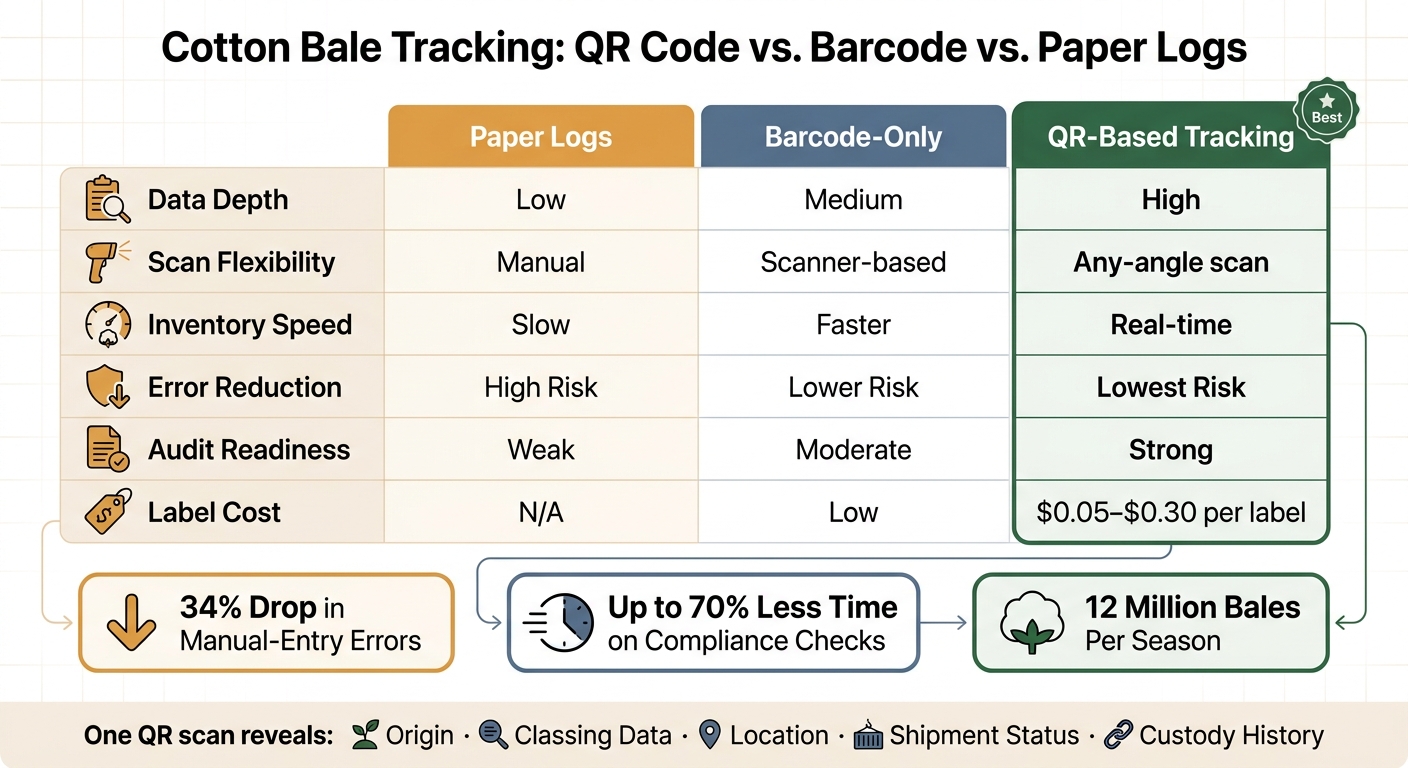
QR Code vs. Barcode vs. Paper: Cotton Bale Tracking Compared
Gains in Inventory Accuracy and Shipment Control
Once bale records go live, the payoff shows up fast in day-to-day work. Scan-based bale records cut miscounts, speed up cycle counts, and flag loading mistakes before a shipment leaves. Research on QR-based traceability found a 34% drop in manual-entry errors during shipping and inventory audits when scan-based capture replaced manual logging.
That matters most at the dock. With scan-to-verify loading, staff can confirm that every bale on a truck matches the buyer's order before it leaves the yard. It’s a simple check, but it stops the kind of mix-up that turns into phone calls, delays, and claim disputes later.
If a quality or contamination issue shows up at the mill, the QR record points back to the bale’s gin run, farm lot, and warehouse location. Instead of reviewing everything, the team can zero in on the exact scan events tied to that bale.
That same linked record also makes audits move much faster.
Audit Readiness and Stronger Documentation
Digital bale histories cut down on missing paperwork and make verification easier. Auditors can pull origin, classing, storage, and shipment records straight from the linked bale file, all tied to one bale ID. Research on QR-based traceability systems shows up to 70% less time spent on compliance verification compared to paper-based searches.
For identity-preserved cotton, that paper trail matters. QR records give timestamped proof that qualifying bales were identified, kept separate, and shipped to the correct buyer. When a brand or mill needs to support a marketing claim, those records give auditors something they can check fast.
QR Tracking vs. Paper Logs and Barcode-Only Workflows
The gap stands out when the workflows are placed side by side.
| Factor | Paper Logs | Barcode-Only | QR-Based Tracking |
|---|---|---|---|
| Data depth | Low | Medium | High |
| Scan flexibility | Manual | Scanner-based | Any-angle scan |
| Inventory speed | Slow | Faster | Real-time |
| Error reduction | High risk | Lower risk | Lowest risk |
| Audit readiness | Weak | Moderate | Strong |
QR codes add visibility without changing bale tags. That makes the upgrade fairly low-cost while improving accuracy, shipment checks, and recordkeeping. The cotton keeps moving through the same flow, but the team gets a much clearer view of what’s happening at each step.
FAQs
How do QR codes improve bale traceability?
QR codes make bale traceability a lot easier. Each bale gets a low-cost, scannable link to key supply chain data, such as farm origin, gin processing details, classing results, storage location, and shipment status.
That one scan helps tighten chain-of-custody records and makes quality checks easier to manage. It can also speed up audits, cut handling mix-ups, and give teams the paperwork they need to back up marketing claims and supply chain transparency.
What data should each cotton bale record include?
Each cotton bale record should center on the 12-digit Permanent Bale Identification (PBI) number. That number combines the 5-digit USDA gin code with the 7-digit bale number, so it works as the main reference point for the full record. It should also connect to core details like gin name, country of origin, and harvest year.
The record should also include USDA HVI quality results. That means fiber length, strength, uniformity, micronaire, color, and trash content. On top of that, include mass specifications, cotton variety, and any farm or certification data tied to the bale.
What does a simple QR tracking pilot look like?
A simple QR tracking pilot can tighten chain-of-custody by linking bale-level data directly to each physical asset.
Each bale gets a Permanent Bale Identification (PBI) tag with a 12-digit barcode. That code connects in a central database to the bale’s farm origin, gin processing details, HVI classing results, and current storage location.
From there, mobile scanners record the QR-coded tags at each checkpoint - from gin exit to warehouse storage to final shipment. The result is real-time visibility across the process, which speeds audits and cuts down on manual mistakes.