Integrated Pest Management (IPM) can help cotton farmers reduce pesticide costs by up to 50% while maintaining yields. The approach combines pest monitoring, targeted chemical use, and alternative control methods to avoid wasteful spraying. Key strategies include:
- Bt Cotton Varieties: Built-in pest resistance reduces pesticide use and boosts efficiency.
- Crop Rotation: Disrupts pest lifecycles and improves soil health.
- Field Scouting: Regular monitoring ensures sprays are applied only when needed.
- Biological Control: Natural predators like ladybugs and parasitic wasps manage pests.
- Seed Treatments: Early-season protection minimizes initial pest damage.
- Planting Date Optimization: Avoids peak pest seasons and enhances crop growth.
- Precision Application: GPS and drones target pest hotspots, reducing chemical use.
- Pheromone Mating Disruption: Prevents pest reproduction without harming beneficial insects.
- Mulching & Mechanical Weed Control: Suppresses weeds without relying on herbicides.
- AI-Powered Pest Detection: Real-time monitoring ensures precise, data-driven pest control.
Arizona's long-standing IPM program demonstrates the effectiveness of these methods, saving over $700 million and reducing pesticide use by 40 million pounds since 1996. Start small by testing one or two tactics, then expand based on results. This data-driven approach ensures smarter pest management, lower costs, and healthier fields.
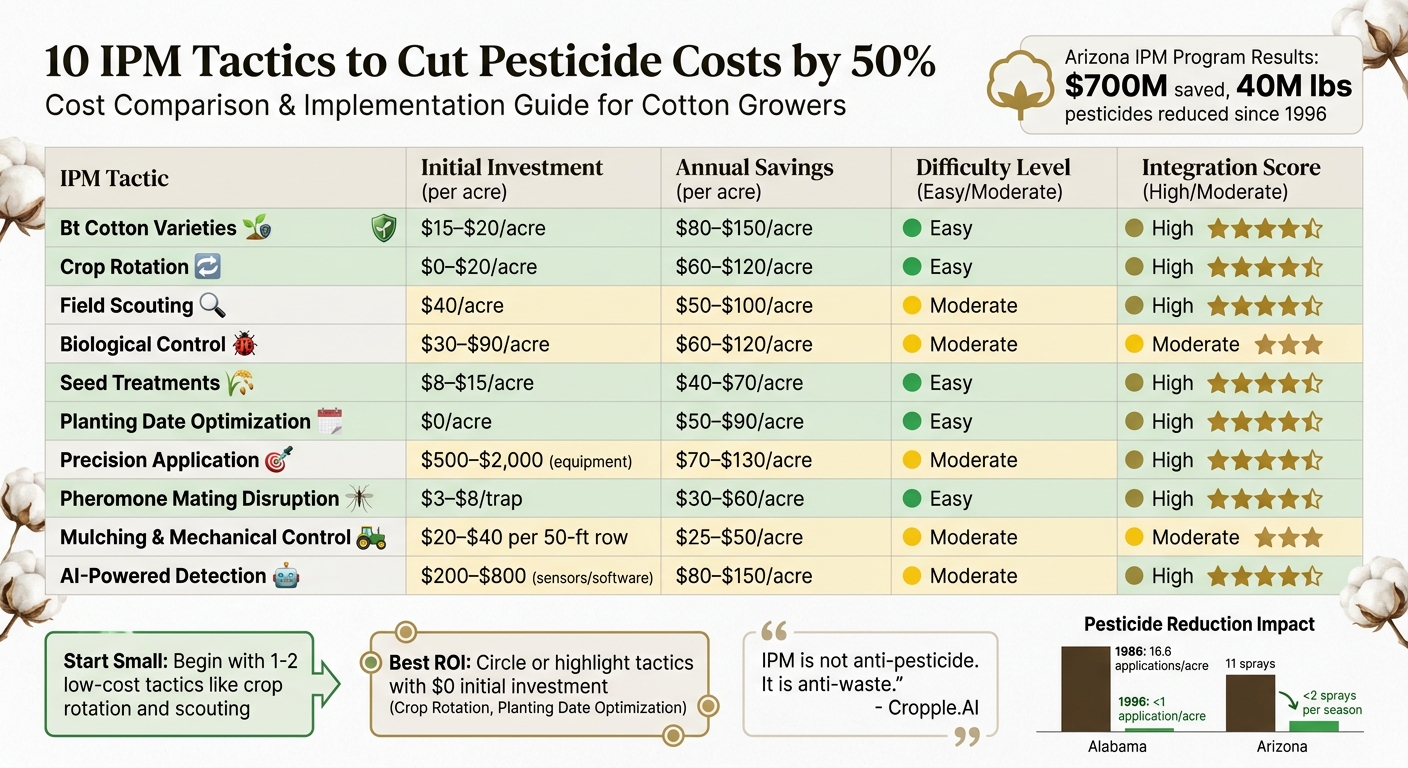
IPM Tactics for Cotton: Cost Comparison and ROI Analysis
Managing Pests and Crop Growth for Optimum Cotton Production in Arizona
sbb-itb-0e617ca
1. Bt Cotton Varieties and Host Plant Resistance
Bt cotton plants are engineered to produce proteins from the bacterium Bacillus thuringiensis, which are lethal to chewing pests but harmless to beneficial insects. This built-in pest control provides consistent protection throughout the growing season.
The introduction of this technology has reshaped the economics of cotton farming. For example, in the United States, the adoption of Bt cotton skyrocketed from 15% in 1997 to 85% by 2019. In Australia, Bt cotton has led to a 97% drop in insecticide use since its introduction in 1992, with farm income gains totaling $395 million since 2010 - averaging about $180 per hectare. Globally, between 1996 and 2008, Bt cotton helped reduce insecticide use by 141 million kilograms of active ingredients.
Cost Savings Potential
Pyramided Bt cotton varieties, which combine Cry1Ac and Cry2Ab proteins, offer broader pest protection and delay resistance development. Field trials have shown these varieties deliver 100% larval mortality against certain bollworm species. The Environmental Impact Quotient for cotton has dropped by 24.8% due to Bt technology. Additionally, reduced tractor passes have saved 125 million liters of fuel and cut 344 million kilograms of CO2 emissions. This makes Bt cotton not only cost-effective but also a natural fit with Integrated Pest Management (IPM) practices.
Compatibility with Other IPM Strategies
While Bt cotton targets chewing pests, it allows natural predators and parasites to manage secondary pests. However, growers still need to monitor and manage sucking pests like thrips, aphids, and whiteflies. To preserve the effectiveness of Bt technology, farmers are encouraged to plant "refuge" areas with non-Bt cotton or alternative crops like corn or soybeans. These refuges maintain a population of susceptible pests, slowing resistance development. This strategy works well alongside biological controls, such as sterile insect releases, which further suppress pest populations.
Environmental Impact
"Since the introduction of Bt cotton in Australia in 1992, there has been a 97% decrease in insecticide use." – Cotton Australia
The reduced need for chemical applications has significant environmental benefits. It minimizes chemical runoff, improving water quality and soil health, while also reducing carbon emissions from fewer tractor operations. Additionally, the selective toxicity of Bt proteins protects non-target wildlife and beneficial insects, fostering a healthier ecosystem that supports natural pest control.
2. Crop Rotation and Cover Crops
Switching cotton with non-host crops disrupts pest lifecycles, controlling nematodes, Verticillium wilt, and seedling diseases - all without relying on pesticides. Different crops bring unique benefits: legumes add nitrogen, cereals improve soil structure, and corn increases organic matter.
Back in 1986, cotton farmers in Alabama applied an average of 16.6 insecticide treatments per acre. But by 1996, after embracing Bt cotton and integrated strategies like crop rotation, that number fell to less than one application per acre.
Cost Savings Potential
This method not only improves soil health but also offers immediate financial benefits. By keeping pest populations below damaging levels, crop rotation reduces the need for expensive pesticide treatments. For instance, small grains, corn, and sorghum can help manage root-knot nematodes, Verticillium wilt, and seedling diseases like Rhizoctonia and Pythium. Legumes naturally enrich the soil with nitrogen, lowering fertilizer costs, while cover crops suppress weeds and retain soil moisture - potentially reducing herbicide expenses.
Compatibility with Other IPM Strategies
"Effective cultural and biological control strategies can, in some instances, effectively reduce the dependence on chemical control of pests." – National Cotton Council of America
Crop rotation complements biological controls by fostering healthier soil conditions that support beneficial predators and parasites.
Environmental Impact
Beyond economic benefits, these practices also contribute to environmental health. Cover crops help conserve soil moisture and control weeds, while crop rotation enhances soil structure and fertility. Together, they create a more sustainable farming system by minimizing reliance on chemical solutions.
When combined with other Integrated Pest Management (IPM) techniques, crop rotation becomes a key piece of a cost-effective and environmentally friendly pest control strategy.
3. Field Scouting and Pest Monitoring
Checking your fields every 3–4 days with tools like a sweep net or shake sheet is a smart way to avoid spraying pesticides on a fixed schedule. Instead, you can base pesticide use on whether pest populations exceed economic thresholds.
"Proper scouting is the backbone of an effective cotton insect management program. The goal of any scouting program should be to minimize insecticide use and insect control costs by avoiding unnecessary treatments and by timing required treatments properly." – Mississippi State University Extension
Field scouting works hand-in-hand with strategies like using Bt cotton and crop rotation. It ensures pest control decisions are based on real-time data. In Texas, for example, this threshold-based approach has led to a two-thirds drop in foliar insecticide use since 2000, while cotton yields have jumped by 50%. Farmers can also monitor crop maturity using metrics like NAWF (Nodes Above White Flower) and accumulated heat units. Once the crop reaches NAWF = 5 plus 350–400 heat units, treatments can be discontinued. This avoids unnecessary late-season applications for fruit that no longer contributes to yield.
Making these informed decisions can lead to major cost savings.
Cost Savings Potential
By switching to threshold-based scouting, farmers can cut pesticide applications by 30%–50% compared to calendar-based spraying. This translates to savings of $25–$50 per acre. Additionally, keeping an eye on beneficial insects like lady beetles and big-eyed bugs might allow farmers to delay or even skip treatments if natural predators are already managing pest populations.
Compatibility with Other IPM Strategies
Regular field scouting is the foundation for integrating multiple pest management tools. It complements biological control by tracking predator populations and supports resistance management and cultural practices by identifying the best times to stop spraying. Monitoring both pests and beneficial insects also helps avoid the use of broad-spectrum insecticides, which can lead to secondary pest outbreaks . This data-driven approach strengthens the overall goal of Integrated Pest Management (IPM): reducing pesticide use while protecting yields.
4. Biological Control and Natural Predators
In cotton fields, certain insects like lady beetles, lacewings, minute pirate bugs, and parasitic wasps play a crucial role in keeping pests such as aphids, spider mites, and caterpillars under control. These natural predators can consume up to 99% of eggs and early-stage larvae of pests like beet armyworm, cabbage looper, and cotton bollworm in fields with a healthy predator population. The challenge lies in conserving these beneficial insects, as broad-spectrum insecticides can harm them along with the pests.
"Biological control works when chemical controls are carefully selected so that key predator groups are conserved." – Peter C. Ellsworth, Department of Entomology & Cooperative Extension, University of Arizona
To protect these natural predators, selective insecticides - such as botanical, microbial, oil, or soap-based options - are recommended. These target pests while sparing beneficial insects. Before deciding to spray, growers can use the "beat bucket" method: shake three plants into a 2.5- or 5-gallon bucket and repeat this process 34 times (covering 102 plants in total) to estimate predator density. If populations of beneficial insects like big-eyed bugs, lacewings, or lady beetles are thriving, spraying may not be necessary. This targeted approach not only preserves natural enemies but also significantly reduces costs.
Cost Savings Potential
Arizona cotton growers have seen a dramatic drop in insecticide use - going from an average of 11 applications per season to fewer than two - by focusing on biological control. This shift reduces the chances of secondary pest outbreaks, which can be both damaging and expensive.
Compatibility with Other IPM Strategies
Biological control integrates seamlessly with other Integrated Pest Management (IPM) practices, enhancing overall pest control effectiveness. For instance, pairing biological control with Bt cotton and field scouting creates a robust pest management system. While Bt traits specifically target caterpillars, natural predators act as a backup, tackling survivors and non-target pests like aphids and whiteflies. Sampling predator populations at first bloom and again 2–3 weeks later provides essential data for managing pests during mid- and late-season, avoiding unnecessary chemical applications. This integrated approach has yielded impressive results in Texas, where foliar insecticide use has dropped by two-thirds, and yields have increased by 50% since 2000.
5. Seed Treatments for Early-Season Protection
Seed treatments play a key role in Integrated Pest Management (IPM) by providing early-season protection. These treatments coat seeds with insecticides, using just 4% of the rates needed for foliar applications and causing less than 1% soil impact. This approach shields seedlings from pests like thrips, which can slow down plant development.
In the Southern Plains, imidacloprid dominates seed treatments because of its lower solubility (0.61 g/L compared to 4.1 g/L for thiamethoxam) and reliable performance under varying moisture conditions. Farmers near wheat fields often face greater thrips pressure due to migrating pests. Additionally, the rise in conservation tillage and cover crop practices has led to wireworms becoming a notable early-season threat. Fields using no-till methods or cover crops should confirm their seed treatments are specifically labeled to manage wireworms.
Cost Savings Potential
Seed treatments can help growers avoid one or two labor-intensive foliar insecticide applications during the season. However, while these treatments effectively suppress early pests, they can also reduce predator populations by 43%–75%. This makes it crucial to monitor for secondary pests like spider mites.
Compatibility with Other IPM Strategies
Applied at low rates below ground, seed treatments are less disruptive to beneficial insects compared to broad-spectrum foliar sprays. This creates an environment where natural predators can establish themselves more quickly. When combined with Bt cotton varieties and regular field scouting, seed treatments form a layered defense system. They protect seedlings early on while supporting the natural predator populations needed for pest control later in the season. This layered approach ensures a smooth transition to other IPM tactics as the growing season advances.
6. Planting Date Optimization and Cultural Practices
Timing your planting dates carefully can help you sidestep peak pest populations. By planting early-maturing crops, you shorten the window of vulnerability, allowing crops to grow past their most susceptible stages before pests reach their peak activity. This approach fits naturally with other farming practices, creating a stronger overall strategy against pests.
For example, in the Southern Plains, planting later can reduce issues with Onion thrips and Western flower thrips, which tend to migrate from maturing wheat crops. However, it’s critical to coordinate planting dates with other farming methods to encourage rapid seedling growth. Slower-growing plants remain exposed to pests and diseases for longer, often leading to increased reliance on chemical treatments.
Weed management also plays a big role here. Removing weeds eliminates pest habitats, improving integrated pest management (IPM) results. Similarly, clearing wheat and sorghum residue can limit overwintering thrips populations that thrive in crop debris.
Cost Savings Potential
Optimizing planting dates is both cost-effective and eco-friendly. It doesn’t require extra expenses - just thoughtful planning. When paired with other cultural practices, this strategy has been shown to cut down on pesticide use significantly.
Compatibility with Other IPM Strategies
Planting date optimization works hand-in-hand with other IPM methods like biological controls and field scouting. By reducing early pest exposure, it enhances the effectiveness of Bt cotton and scouting efforts. Plus, well-timed planting creates an environment where natural pest suppressors - like predators, parasites, and diseases - can thrive. For instance, early crops with proper timing and nutrient management allow beneficial insects to establish themselves before pests become a major threat.
That said, weekly scouting is still a must. Even with optimized cultural practices, regular monitoring from emergence to cutout ensures pests don’t exceed economic thresholds.
"Cultural practices can impact natural predators, parasites and diseases, which play an important role in the biological control of many cotton pests." - National Cotton Council of America
7. Precision Application and GPS Mapping
Precision application takes field scouting data to the next level, using tools like GPS mapping and variable rate application (VRA) to fine-tune pesticide use. Instead of treating an entire field, you can zero in on specific hotspots where pests have exceeded economic thresholds. Tools such as NDVI maps, generated by satellites or drones, help identify stressed zones, ensuring that chemicals are applied only where they're needed.
GPS mapping ensures accurate coverage, eliminating overlaps and missed spots. Calibrated sprayers further enhance efficiency by controlling droplet size and output, which maximizes chemical effectiveness while minimizing drift. When paired with scouting data, these tools create a digital pest map that can guide future treatments.
"Integrated Pest Management is not anti-pesticide. It is anti-waste." - Cropple.AI
Cost Savings Potential
Precision tools can reduce pesticide use by as much as 30%–50%, aligning with economic thresholds. For growers, this translates to significant savings, with reduced chemical inputs saving an average of $60 to $120 per acre. Beyond the financial benefits, these tools also lower environmental risks, continuing the cost-efficient trend seen in other IPM approaches.
Compatibility with Other IPM Strategies
One of the strengths of precision application is how well it integrates with biological controls. By focusing treatments on pest-infested areas, you leave much of the field untreated, creating safe zones for beneficial insects like ladybugs and parasitic wasps to thrive. This approach maintains natural pest suppression across the field while still targeting problem areas. Additionally, AI systems can confirm when treatments are necessary, ensuring that decisions are data-driven and aligned with broader IPM goals.
Environmental Impact
Precision application supports IPM's commitment to reducing chemical waste and safeguarding beneficial species. By targeting only problem areas, this method minimizes risks to pollinator habitats and other sensitive ecosystems. Broad-spectrum applications are avoided, protecting bees and other organisms that can be harmed by even trace amounts of chemicals - studies show neonicotinoids can impact bees at just 10 ppb. Precision mapping also reduces drift and runoff, ensuring pesticides stay where they're needed and out of surrounding environments.
8. Pheromone Mating Disruption
Pheromone mating disruption works by releasing synthetic versions of female pheromones, which confuse male pests and prevent them from locating mates. This breaks the reproductive cycle without relying on toxic chemicals. It's proven particularly effective against pests like the pink bollworm in cotton, where it has become a go-to method. By stopping pests from reproducing, this technique can cut pest populations by over 90%. It also complements other Integrated Pest Management (IPM) tools, reducing the need for broad-spectrum insecticides.
What makes this approach stand out is its precision. Unlike broad-spectrum insecticides that can harm a wide range of insects, pheromone disruption targets only the specific pest. This means beneficial insects - like ladybugs, lacewings, and parasitic wasps - are left unharmed to continue their role in naturally managing other pest populations. As part of a broader IPM strategy, pheromone disruption has helped Arizona growers significantly reduce pesticide applications and lower overall costs.
"Mating disruption saturates the air with pheromone to prevent males from finding females, reducing reproduction by 90% or more." - Cropple.AI
These benefits not only improve pest control but also lead to substantial cost savings.
Cost Savings Potential
Using pheromone mating disruption as part of an IPM program can save growers about $25 to $50 per acre in chemical inputs. The key savings come from avoiding unnecessary sprays. By using pheromone traps to monitor pest activity, growers can move away from rigid, calendar-based spraying schedules. Instead, they rely on data to reduce pesticide applications by 30% to 50%, cutting costs while maintaining - or even boosting - yields.
Ease of Implementation
Beyond the cost benefits, implementing this tactic is straightforward. Pheromone traps serve a dual purpose: they monitor pest activity and act as a mass trapping method. Setting up traps early in the season helps establish a baseline for pest levels. To achieve the best results, growers should coordinate pheromone disruption across a larger area instead of focusing on individual fields since pests like bollworms are highly mobile. When combined with other IPM strategies, such as planting Bt cotton varieties, this approach creates multiple layers of protection that keep pest populations below economic thresholds.
Compatibility with Other IPM Strategies
Pheromone disruption integrates seamlessly with other IPM methods. It preserves beneficial insect populations by specifically targeting pests, which reduces the need for broad chemical applications. Beneficial insects, like those that control aphids (reducing them by 70% to 90%), continue to thrive, while the pheromones focus solely on pests like bollworms. This makes pheromone disruption an excellent foundation for an IPM program, enabling growers to combine monitoring data, field scouting, and precision tools for smarter, threshold-based pest management.
Environmental Impact
Because pheromone disruption targets specific pests, it avoids harming pollinators, natural predators, and other beneficial organisms. It eliminates concerns about pesticide drift, runoff, or residue. By protecting natural enemy populations, this method helps maintain ecological balance in the field while delivering effective pest control. As one of the cleanest IPM tactics available, its environmental benefits extend well beyond individual farms, contributing to a healthier ecosystem overall.
9. Mulching and Mechanical Weed Control
Mechanical cultivation stands out as a highly effective, non-chemical method for managing weeds. By physically disrupting or burying weed seedlings, this approach reduces the need for herbicides and slows the development of herbicide-resistant weeds. Timing is critical - weed seedlings are most vulnerable when they are small, typically around 1 to 2 inches in diameter. Cultivating at this stage ensures weeds don’t sap soil moisture or compete with cotton during the crucial first 6 to 8 weeks after planting.
"Cotton grows slowly in the spring and can be shaded out easily by weeds. If weeds begin to overpower the seedling cotton, drastic reductions in yield can result." – National Cotton Council of America
Mulching also plays a key role by allowing cotton to establish before aggressive weeds like nutsedge take hold. Strategic planting helps too - placing cottonseed deep in moist soil while leaving weed seeds in drier upper layers discourages weed germination. Once the cotton canopy develops and shades the ground, it naturally suppresses late-season weeds.
Cost Savings Potential
While mechanical cultivation involves labor and fuel costs, it reduces the need for repeated herbicide applications. This is especially helpful for managing herbicide-resistant weeds, as timely hand weeding (hoeing) can prevent weeds from producing seeds. Deep plowing is another option, burying nutsedge tubers beyond their germination depth, though it may take about three years for these tubers to decay. By cutting down on chemical use, growers can avoid the rising costs of newer herbicide formulations while still maintaining effective weed control.
Ease of Implementation
Modern farming tools make mechanical weed control easier and more precise. Advanced guidance systems for planters and cultivators allow close, in-row cultivation without harming cotton plants. The choice of equipment matters - sweeps and bed knives are great for tackling nutsedge and perennial grasses, while rolling cultivators work best for smaller, younger weeds. Layby cultivation, performed 5 to 10 days after irrigation as the crop canopy closes, buries weed seedlings in the drill row, providing another layer of protection without resorting to late-season herbicides. Scheduling cultivation during dry soil conditions is key to avoiding compaction.
Compatibility with Other IPM Strategies
Mechanical weed control complements Integrated Pest Management (IPM) by preserving beneficial predators and reducing the selection pressure caused by chemical herbicides. This approach strengthens the long-term sustainability of IPM practices .
Environmental Impact
By eliminating herbicides, mechanical cultivation reduces risks of chemical contamination in ecosystems and potential health concerns. It supports soil health, protects water quality, and preserves beneficial insect populations, all while promoting biodiversity in cotton fields. Although it requires more hands-on effort compared to herbicide spraying, the environmental benefits contribute to healthier and more balanced agricultural systems. This method works in harmony with the precision and biological strategies discussed earlier, reinforcing a well-rounded IPM approach.
10. AI-Powered Pest Detection Systems
AI-powered pest detection systems are transforming how farmers manage crop threats. With automated sensors and field photo analysis, these tools can identify pest species and track their populations in real time. This means pesticides are only applied when pest numbers exceed the economic threshold - the point where the cost of crop damage outweighs the cost of treatment. By eliminating guesswork, these systems ensure precise and necessary interventions, aligning with other Integrated Pest Management (IPM) strategies discussed earlier.
In September 2025, Georgia Southern University collaborated with the City of Millen and FarmSense to pilot the FlightSensor system in eight large cotton fields in Jenkins County, Georgia. Using infrared technology, the sensors identified pests like stink bugs and bollworms by analyzing their unique wingbeats. Farmers accessed real-time data through satellite-linked dashboards, allowing them to address outbreaks early. Researchers Debra Lam and Atin Adhikari led the project, aiming to reduce pesticide residues while helping farmers target pest hotspots.
"AI tools can help farmers pinpoint exactly where pest outbreaks are likely – before they happen. That means they can treat only the areas that need it, saving time, labor and pesticide costs." - Debra Lam, Founding Director of the Partnership for Inclusive Innovation
Cost Savings Potential
AI-powered pest detection can reduce pesticide use by 30% to 50%. Additionally, these systems help preserve beneficial insects like ladybugs and parasitic wasps, which can naturally control aphid populations by 70% to 90% without chemical intervention. By maintaining digital records of pest activity and treatment results, farmers can refine their strategies over time, creating a foundation for consistent, long-term savings.
Ease of Implementation
Farmers can start small by replacing one scheduled pesticide application with an AI-based decision in a single field or for a specific pest. Mobile AI tools can supplement traditional weekly scouting, ensuring pest species are correctly identified before treatment. A hybrid approach - combining AI sensors with tools like the Georgia Cotton Insect Advisor app - can further enhance detection accuracy. However, training in digital literacy is crucial for interpreting AI dashboards and predictive models, enabling farmers to monitor fields remotely and collaborate effectively with extension agents.
Compatibility with Other IPM Strategies
AI detection integrates seamlessly with existing IPM methods. For instance, it helps identify when natural predators are already controlling pest populations, reducing unnecessary pesticide applications that could harm these beneficial insects. It also supports precision application techniques by pinpointing specific areas needing treatment, avoiding blanket spraying across entire fields. This targeted approach complements other strategies like crop rotation, resistant crop varieties, and pheromone disruption.
Environmental Impact
By cutting down on pesticide use, AI systems significantly reduce chemical residues in soil and air, ensuring better protection for pollinators. They also help combat the growing issue of insecticide resistance, which affects over 600 known pest species. Shifting from broad-spectrum pesticides to selective, low-toxicity options like Bt or neem further supports natural predators and enhances biodiversity in cotton fields. This creates healthier, more balanced agricultural ecosystems.
Cost Comparison and Implementation Guide
This guide breaks down IPM strategies into practical, cost-conscious steps for cotton growers. By focusing on real-world data, it helps you make informed decisions tailored to your farm's unique needs and budget.
When choosing IPM tactics, consider your farm's size, financial constraints, and current practices. The table below outlines the initial costs, annual savings, difficulty level, and compatibility of each strategy. These figures are based on data from cotton farms across the United States, with costs presented per acre.
| IPM Tactic | Initial Investment | Annual Savings | Difficulty | Integration |
|---|---|---|---|---|
| Bt Cotton Varieties | $15–$20/acre (seed premium) | $80–$150/acre (fewer sprays) | Easy | High - pairs well with selective insecticides to protect beneficial insects |
| Crop Rotation | $0–$20/acre | $60–$120/acre (soil pest prevention) | Easy | High - naturally fits seasonal planting cycles |
| Field Scouting | $40/acre (labor) | $50–$100/acre (avoids unnecessary sprays) | Moderate | High - crucial for timing biological or chemical controls |
| Biological Control | $30–$90/acre (insect releases) | $60–$120/acre (aphid and mite suppression) | Moderate | Moderate - requires habitat strips and selective chemistry |
| Seed Treatments | $8–$15/acre | $40–$70/acre (early-season protection) | Easy | High - works alongside scouting to reduce early sprays |
| Planting Date Optimization | $0 (timing adjustment) | $50–$90/acre (avoids peak pest pressure) | Easy | High - boosts predator activity and plant vigor |
| Precision Application | $500–$2,000 (GPS equipment) | $70–$130/acre (targeted spraying) | Moderate | High - uses scouting data and AI for zone-specific treatment |
| Pheromone Mating Disruption | $3–$8/trap | $30–$60/acre (monitoring and interference) | Easy | High - "set-and-forget" tool that complements scouting |
| Mulching & Mechanical Control | $20–$40 per 50-foot row | $25–$50/acre (weed suppression) | Moderate | Moderate - labor-intensive but chemical-free |
| AI-Powered Detection | $200–$800 (sensors/software) | $80–$150/acre (30–50% pesticide reduction) | Moderate | High - integrates with precision spraying and economic thresholds |
Arizona's long-standing IPM program highlights the benefits of combining these strategies. By using Bt cotton, selective insecticides, and biological controls, growers cut insecticide use from 11 sprays per season to fewer than two. Since 1996, this approach has saved over $700 million and prevented the application of more than 40 million pounds of insecticides.
Start small by testing one or two methods on a single field before committing to larger-scale integration. Low-cost, high-impact options like crop rotation and field scouting are excellent starting points. As your budget allows, you can explore advanced tools like precision application and AI-powered detection.
"One of the most costly pesticide applications a producer can make is one that doesn't work." - National Cotton Council of America
To avoid waste, treat pests only when the cost of damage exceeds the cost of treatment. Timing, product selection, and proper spray coverage are key to preventing expensive mistakes. Regularly review your treatment triggers to ensure efficiency and reduce unnecessary expenses.
Conclusion
Reducing pesticide expenses by half takes a mix of strategies, and Arizona's 30-year Integrated Pest Management (IPM) program shows how it can be done. By cutting spray applications from 11 per season to less than two, they saved over $700 million and kept 40 million pounds of insecticides out of their fields.
"Integrated Pest Management is not anti-pesticide. It is anti-waste." - Cropple.AI
Start small with cost-effective practices like crop rotation or scouting on a trial field. Once you see the savings, you can expand your IPM toolbox with tactics such as pheromone traps, precision spraying, or AI-powered pest detection. Keep track of your results - monitor savings and pest levels to understand what works best. This layered approach not only trims costs but also ensures the long-term health of your fields.
For region-specific advice, reach out to your local extension office. They often provide helpful resources like newsletters, guides (e.g., the "Cotton Insect ID Guide"), and phone support to keep you informed about current pest pressures.
Knowing when not to spray is just as important as knowing when to act. Treat pests only when the cost of damage outweighs the cost of treatment. This strategy safeguards your budget, protects beneficial insects, and keeps your fields thriving for the future. With data-driven decisions, every spray becomes a smart investment - benefiting both your bottom line and the environment.
FAQs
Which IPM tactics should I try first on a tight budget?
Start with budget-friendly Integrated Pest Management (IPM) tactics like pest monitoring and field practices. Regularly inspect your fields to keep tabs on pest populations and see if they hit economic thresholds. On top of that, try cultural methods like adjusting planting schedules, rotating crops, or destroying stalks to tackle pests without overspending. These approaches are affordable and lay the groundwork for more precise measures down the road.
How do I know when a pest has reached the economic threshold?
Regularly monitoring pest populations and comparing them to research-based thresholds specific to cotton pests can help you determine if intervention is needed. Scouting your fields allows you to catch problems early, ensuring that control measures are applied only when it makes financial sense. These thresholds act as a guide, helping you decide when action is necessary to avoid major crop damage while keeping costs under control.
Will Bt cotton and seed treatments harm beneficial insects on my farm?
Bt cotton and seed treatments offer a way to manage pests effectively while keeping beneficial insects safe - if they're used correctly. Missteps in application, however, can harm these helpful species. To reduce potential risks, stick to the recommended guidelines and keep a close eye on how treatments are applied.