Key Takeaways
-
What is ESG Reporting?
- It's about disclosing how businesses impact the environment, society, and governance.
- For cotton, it includes water use, pesticide application, labor conditions, and supply chain transparency.
-
Why It Matters:
- Regulations like the U.S. Uyghur Forced Labor Prevention Act (UFLPA) and EU Corporate Sustainability Reporting Directive (CSRD) are now mandatory.
- Non-compliance risks shipment detentions, market access loss, and reputational damage.
-
Key Regulations:
- CSRD (EU): Applies to large companies; requires audited sustainability reports by 2025.
- UFLPA (USA): Prohibits goods linked to forced labor, especially from Xinjiang.
- California CCAA (USA): Mandatory greenhouse gas emissions reporting by 2026.
-
How to Comply:
- Use digital tools like TraceBale for supply chain traceability.
- Adopt frameworks like the U.S. Cotton Trust Protocol or Regenerative Cotton Standard.
- Conduct ESG risk assessments and ensure third-party audits for verified data.
-
Best Practices:
- Implement sustainable farming techniques like regenerative agriculture or organic methods.
- Ensure ethical labor practices through Human Rights Due Diligence (HRDD).
- Use data-driven tools to measure and report progress, avoiding greenwashing risks.
Why This Matters Now
The cotton industry faces increasing pressure for transparency and accountability. With stricter regulations and rising consumer awareness, businesses must prioritize ESG compliance to remain competitive and credible.
ESG Reporting Standards and Frameworks for Cotton
Cotton ESG Reporting Frameworks Comparison Guide
Required Reporting Standards
In the U.S., there isn't a single federal ESG framework. Instead, businesses face a mix of state and federal regulations. For publicly traded cotton companies, the SEC requires disclosure of "material" ESG risks - such as climate change, workforce management, and cybersecurity - that could influence financial performance. Additionally, large-scale cotton gins or processing plants emitting 25,000 metric tons or more of greenhouse gases annually must report to the EPA under the Greenhouse Gas Reporting Rule.
"Currently, no comprehensive federal or state framework exists that regulates ESG; instead, a patchwork of federal and state laws and practices govern ESG activities."
- Amy Antoniolli, Jane Montgomery, and Sarah A. W. Fitts, Contributors, ArentFox Schiff LLP
Cotton businesses marketing products as "sustainably sourced" or "biodegradable" must comply with FTC Green Guides to avoid misleading claims. An EU report has flagged that many environmental claims lack proper verification, highlighting the importance of accurate data. Furthermore, U.S. cotton producers working with large EU companies must meet CSRD compliance requirements, even if they aren't directly governed by EU regulations.
Where mandatory regulations fall short, voluntary frameworks step in to provide more specific guidance and metrics.
Voluntary Certifications and Standards
Voluntary standards go beyond regulatory requirements, offering cotton businesses detailed tools to measure and improve their sustainability practices. For example:
- The Regenerative Cotton Standard (RCS) supports data collection on soil health, carbon capture, and farmer well-being.
- The U.S. Cotton Trust Protocol emphasizes sustainable farming methods and gathers field-level environmental data.
These frameworks often rely on Chain of Custody models like Hard Identity Preserved (HIP) to ensure traceability from the farm to the final product.
Voluntary certifications also help businesses meet regulatory expectations with precise, actionable data. For instance, the CSRD's double materiality reporting requires businesses to evaluate both how sustainability issues affect their operations and how their activities impact society. Voluntary frameworks provide the metrics needed to meet these dual requirements, promoting transparency and moving away from vague "sustainability storytelling".
Comparing Standards and Certifications
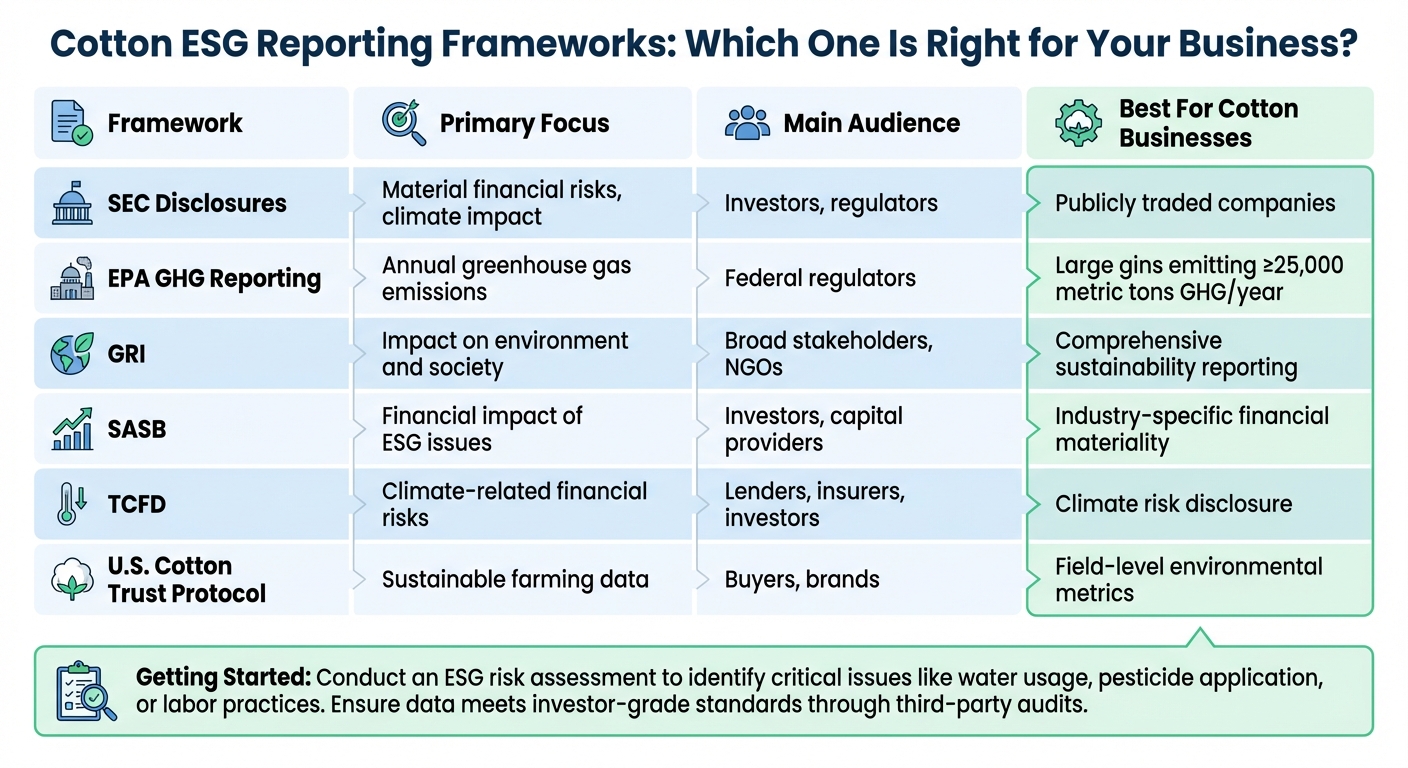
Each ESG framework has a unique focus, and the best fit depends on your business's goals, stakeholders, and regulatory obligations. Here's a quick breakdown:
| Framework | Primary Focus | Main Audience | Best For Cotton Businesses |
|---|---|---|---|
| SEC Disclosures | Material financial risks, climate impact | Investors, regulators | Publicly traded companies |
| EPA GHG Reporting | Annual greenhouse gas emissions | Federal regulators | Large gins emitting ≥25,000 metric tons GHG/year |
| GRI | Impact on environment and society | Broad stakeholders, NGOs | Comprehensive sustainability reporting |
| SASB | Financial impact of ESG issues | Investors, capital providers | Industry-specific financial materiality |
| TCFD | Climate-related financial risks | Lenders, insurers, investors | Climate risk disclosure |
| U.S. Cotton Trust Protocol | Sustainable farming data | Buyers, brands | Field-level environmental metrics |
To get started, conduct an ESG risk assessment to identify critical issues like water usage, pesticide application, or labor practices. Ensure your data meets "investor-grade" standards by using third-party audits to verify disclosures and avoid accusations of greenwashing.
sbb-itb-0e617ca
Traceability and Documentation in the Cotton Supply Chain
Building a Traceable Cotton Supply Chain
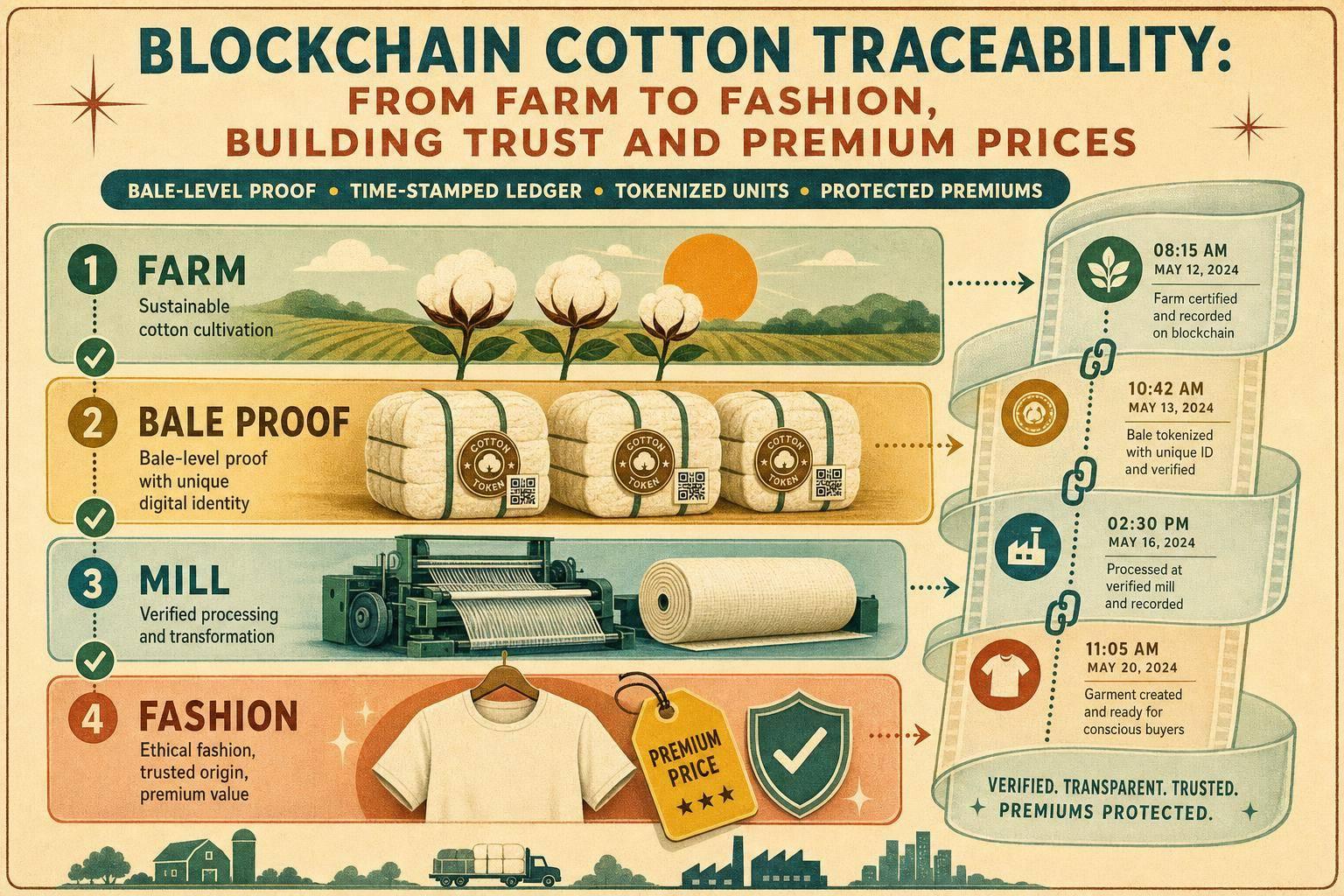
Traceability starts right at the farm, ensuring cotton is monitored through every step of its journey. Digital tools like TraceBale play a key role by tracking cotton bales from the field to the gin. These systems work in tandem with frameworks such as the REEL Cotton Code of Conduct, ensuring data collection is both accurate and transparent. For gins, initiatives like Responsible Business for Gins focus on maintaining chain-of-custody records and promoting ethical practices during processing. Regular Life Cycle Assessments (LCA) provide measurable environmental insights, helping companies meet the stringent documentation standards now required by ESG regulations. Together, these measures create a solid foundation for accurate ESG reporting.
Required Documentation for ESG Reporting
Today’s ESG reporting demands comprehensive chain-of-custody records to confirm the origin and handling of products at every stage. For example, under California's SB 253, companies must report their Scope 1 and Scope 2 emissions by August 10, 2026. Human rights compliance is equally critical. The UFLPA requires documented proof that supply chains are free from forced labor, while the EU's Forced Labor Regulation, taking effect in December 2027, will require certified audits to back verification efforts.
"Businesses... will need to set up the tools and due diligence measures necessary to meaningfully identify, assess, and address forced labor and other human rights risks in their supply chains with the same rigor as Foreign Corrupt Practices Act (FCPA) compliance."
- Maram T. Salaheldin, Author, Clark Hill PLC
Additionally, contracts with sub-tier suppliers must include enforceable ESG standards. Companies must also document monitoring and evaluation (M&E) data for practices like pesticide and fertilizer use to meet environmental reporting standards.
How Traceability Builds Market Trust
Thorough documentation, paired with robust traceability, strengthens market confidence by addressing regulatory requirements and backing sustainability claims. Transparent supply chains not only meet these demands but also reduce risks of greenwashing accusations. For instance, the EU’s sustainability claims legislation and corporate due diligence standards require that all environmental and social claims are supported by verified data.
Beyond compliance, traceability opens doors to premium markets, where buyers increasingly prioritize documentation of regenerative farming practices, such as those outlined by the REEL Regenerative Standard. Participation in regional stakeholder roundtables - whether in Türkiye, China, or Egypt - helps align traceability efforts with local farming methods while meeting global buyer expectations. As sustainability reporting transitions from optional to mandatory, investing in traceability systems is no longer just a good idea - it’s a necessity for staying ahead of evolving regulations.
Best Practices for Sustainable Cotton Farming and Ethical Labor
Sustainable Farming Techniques
Cotton farming has a big environmental impact. For instance, producing just one t-shirt requires 157 gallons of water, and cotton crops account for nearly 5% of global pesticide use, even though they only cover 2.4% of cultivated land. However, there are proven strategies to lessen this burden while meeting environmental, social, and governance (ESG) standards.
Regenerative agriculture focuses on restoring soil health by using methods that align with the Regenerative Cotton Standard. These practices help build ecosystems that are better equipped to handle climate change. On the other hand, organic farming eliminates synthetic pesticides, avoids GMO seeds, and relies on crop rotation to naturally improve soil quality. This method also drastically reduces water usage, cutting it down to just 10% of what conventional cotton farming requires. For those not ready to fully transition to organic methods, the Better Cotton Initiative's Integrated Pest Management (IPM) provides a practical alternative. By minimizing pesticide use while still protecting crops, it offers a balanced approach.
Water management is another key focus. Tools like the Local Water Tool and Aqua Gauge help farmers assess water-related risks and improve irrigation efficiency under the Better Cotton Principles and Criteria. Additionally, avoiding monoculture - planting the same crop repeatedly - can protect soil nutrients and prevent long-term degradation. These sustainable practices are not just theoretical. For example, the U.S. cotton industry has already achieved a 25% reduction in greenhouse gas emissions since 1980, showing that real progress is achievable. However, environmental sustainability is only one piece of the puzzle; ethical labor practices are equally important for meeting ESG goals.
Ethical Labor Practices
Achieving ESG compliance also requires a strong commitment to human rights throughout the supply chain. A formal Human Rights Due Diligence (HRDD) framework is essential for identifying, preventing, and addressing labor risks at every stage of production. For cotton gin operations, adopting a Code of Conduct for gins helps ensure ethical practices during the initial stages of processing.
Laws such as the Uyghur Forced Labor Prevention Act (UFLPA) and the EU Corporate Sustainability Due Diligence Directive (CSDDD) now mandate traceability, requiring companies to provide documented evidence of fair labor practices. This includes addressing critical issues like gender-based violence and ensuring fair treatment for all workers. Regular audits and enforceable supplier agreements are essential for maintaining compliance and supporting accurate ESG reporting. These actions not only meet regulatory requirements but also help build trust with consumers and stakeholders.
Measuring and Reporting Sustainability Results
Effective ESG reporting depends on tracking and documenting measurable outcomes. Frameworks like the US Cotton Trust Protocol and the Global Organic Textile Standard (GOTS) provide clear guidelines for reporting key metrics such as water usage, greenhouse gas emissions, and pesticide application rates. These data points offer concrete proof of progress.
Advanced tools like GIS mapping, satellite imagery, and GPS technology can verify sourcing claims and monitor environmental impacts. Emerging scientific methods like isotopic testing and "Origin Fingerprints" go a step further, providing precise authentication of a cotton's geographic origin. These techniques replace unreliable paper trails with hard evidence, ensuring transparency for regulators and buyers alike.
"Sustainable cotton farming is important because cotton production impacts freshwater resources in terms of water quantity through irrigation... and water quality through the application of agrochemicals."
How to Implement ESG Reporting: Tools and Strategies
Digital Tools for ESG Reporting
Digital tools can simplify ESG reporting by automating processes and cutting down on manual work. For example, TraceBale, created by CottonConnect, uses a bottom-up approach to collect data, tracking cotton from farm groups to finished goods. Impressively, the platform has registered over 580,000 farmers and mapped cotton volumes equivalent to 1.77 billion T-shirts. A participant in the REEL Sustainable Cotton Programme shared:
"TraceBale is mapping the journey of our raw material from farms to fabric through various stakeholders, making it completely transparent"
For operations in the U.S., the U.S. Cotton Trust Protocol provides field-level sustainability tracking, offering traceability for individual articles across six environmental metrics. Since 2015, growers in the program have achieved an 89% reduction in soil erosion, while energy use intensity has remained 28% below the 2015 baseline. As the U.S. Cotton Trust Protocol explains:
"The Trust Protocol is the first cotton fiber program to offer article-level traceability, enabling our members to follow the journey of U.S. Cotton and Protocol Cotton to finished product"
Integrated ESG platforms take things further by centralizing sustainability data and automating reporting for frameworks like CSRD and ESRS. These platforms can link with existing ERP systems, use AI for document extraction, identify gaps in compliance, and even draft narrative disclosures. This level of automation can reduce manual reporting efforts by as much as 60% to 80%. Additionally, hybrid traceability - combining digital tracking with physical DNA markers - helps verify raw material origins and back up sustainability claims.
Once digital tools are in place, implementing a phased compliance plan ensures these systems deliver ongoing value.
Creating a Phased ESG Compliance Plan
A well-organized compliance plan is essential for effective ESG reporting. By breaking the process into manageable phases, businesses can ensure steady progress. Here’s a typical phased approach:
| Implementation Phase | Key Activities | Timeline |
|---|---|---|
| Needs Assessment | Define scope, regulatory requirements, and stakeholder expectations | 2–4 weeks |
| Data Inventory | Map data sources, identify gaps, and plan integrations | 3–6 weeks |
| Pilot Implementation | Configure the platform for a subset of entities and test workflows | 6–10 weeks |
| Full Rollout | Extend to all entities, train users, and establish governance | 8–12 weeks |
| Continuous Improvement | Refine processes, expand scope, and optimize automation | Ongoing |
Start with a double materiality assessment, which examines ESG topics from two angles: the impact your business has on the environment and society, and how ESG risks could affect your financial performance. For smaller cotton businesses, simpler standards like the Voluntary SME Standard (VSME) can help meet customer demands without the complexity of enterprise-level reporting. It’s also important to stay ahead of regulatory deadlines - CSRD requirements began in 2024 and will expand through 2026, while Better Cotton Initiative participants must phase out mass balance on-product marks by May 2026.
Communicating ESG Efforts to Stakeholders
After implementing digital tools and a structured compliance plan, transparent communication becomes key to building trust with stakeholders. Providing clear, detailed updates not only satisfies auditors and regulators but also demonstrates accountability. Tools like real-time dashboards can go beyond annual reports, allowing stakeholders to track progress continuously and address ESG risks proactively.
Engaging suppliers early is also crucial. Choose platforms that offer training and collaborative spaces to ensure high-quality data collection and build trust across the supply chain. When sharing results, focus on specific, measurable achievements - like exact reductions in water usage or documented improvements in soil health - rather than vague promises. With 72% of consumers indicating they’re willing to pay more for products with sustainable packaging, effectively communicating your ESG successes can even provide a competitive edge in the market.
Conclusion and Key Takeaways
Summary of ESG Compliance Priorities
Cotton businesses are navigating a complex web of ESG (Environmental, Social, and Governance) requirements, but certain priorities remain central across the industry. Labor rights are at the forefront, emphasizing the elimination of forced labor, child labor, and trafficking. Companies must also ensure fair wages, safe workplaces, and the right to unionize. On the environmental side, responsible practices include regulating pesticide use, safeguarding air and water quality, and encouraging biodiversity through sustainable farming techniques.
Supply chain traceability has become essential rather than optional. Over 85% of industry professionals now view transparency in the supply chain as a top priority. Achieving this requires complete visibility - from the cotton fields to the final product - using digital solutions and advanced methods like isotopic testing to confirm origin claims. Third-party audits further support sustainability claims, enhancing credibility and market confidence.
Final Recommendations for Cotton Businesses
These ESG priorities call for immediate, strategic action to ensure compliance and long-term sustainability. With regulations tightening and enforcement of laws like the UFLPA becoming more rigorous, delaying action could leave businesses struggling to keep up.
To stay ahead, cotton businesses should embrace digital tools and align with established ESG frameworks. Programs like the U.S. Cotton Trust Protocol offer access to verified sustainability metrics. Digital tracking systems can improve inventory management while boosting transparency, which strengthens consumer trust. Finally, businesses must commit to ongoing improvements to meet the ever-changing sustainability standards year after year.
FAQs
Do U.S. cotton gins have to follow the EU CSRD?
U.S. cotton gins aren’t directly obligated to follow the EU CSRD. However, evolving EU sustainability policies and forthcoming textile industry regulations could influence their operations, especially regarding transparency, traceability, and reporting standards. By keeping up with these changes, U.S. cotton gins can better align with global expectations and stay competitive in the market.
What documents prove cotton is UFLPA-compliant?
Documents that support UFLPA compliance for cotton include the U.S. Cotton Trust Protocol Standard-Setting Procedure and the Chain of Custody Requirements. These documents detail the required standards and management systems to ensure proper traceability and adherence to compliance guidelines.
Which ESG metrics should we track first for cotton?
Tracking key environmental metrics is a crucial step for improving cotton production practices. Focus on areas like:
- Water use efficiency: Assess how effectively water resources are being utilized.
- Soil health: Monitor factors like nutrient levels and organic matter to ensure long-term productivity.
- Greenhouse gas emissions: Measure emissions to identify opportunities for reduction.
- Land use efficiency: Evaluate how land is being managed to maximize output responsibly.
These metrics align with industry guidelines and provide a clear framework for measuring progress in making cotton farming more environmentally friendly.