If you want blockchain to work in cotton, start small: one gin, one workflow, one season, and a short list of data fields. The article’s main point is simple: blockchain helps most when it ties bale IDs, farm records, shipment events, and contract records into one shared log that each party can check.
Here’s the short version of what matters:
- Start with one use case: bale traceability, contract records, claim tracking, or farm-to-textile tracing
- Use the gin as the anchor point: that’s where field records connect to the bale’s PBI
- Keep current systems in place: blockchain should sit on top of gin software, ERP tools, scanners, and document storage
- Store only key records on-chain: bale IDs, timestamps, status changes, and hashes for files
- Run a pilot for 6–12 months: long enough to cover harvest, ginning, shipping, and at least one audit or claim check
- Track hard numbers from day one: documentation turnaround, dispute count, resolution time, audit prep hours, and traceability completion rate
- Expect pilot costs of about $25,000 to $75,000: with platform, integration, hardware, and staff time driving the spend
- Fix data quality before scaling: if bale IDs and farm records don’t match across systems, the project will stall
A few numbers from the article stand out:
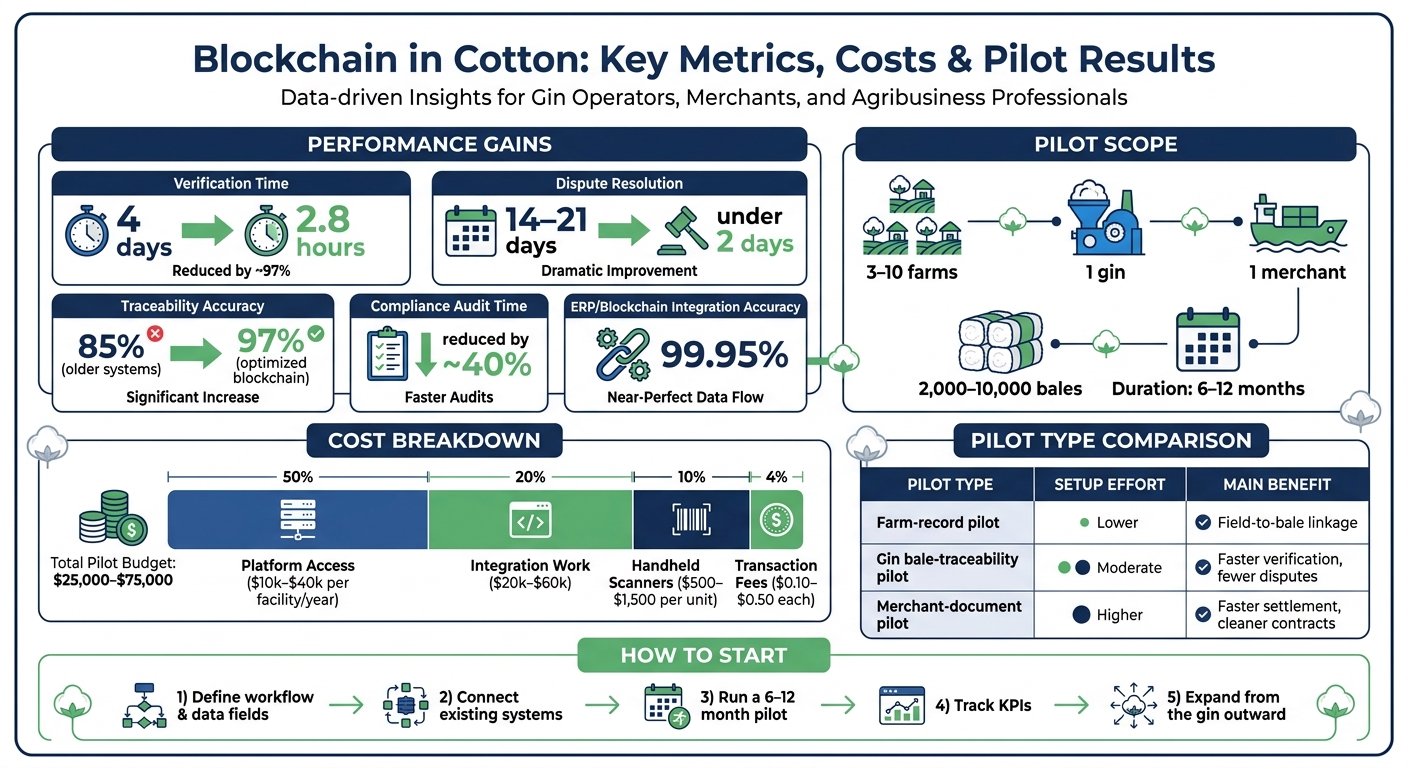
- One ERP/blockchain study reported 99.95% accuracy
- Verification time dropped from 4 days to 2.8 hours
- Some textile systems cut audit time by about 40%
- Dispute resolution fell from 14–21 days to under 2 days
- Pilot scope often lands around 3–10 farms, 1 gin, 1 merchant, and 2,000–10,000 bales
Blockchain in Cotton: Key Metrics, Costs & Pilot Results
Quick comparison
| Starting point | Best fit | Main goal | What I’d measure first |
|---|---|---|---|
| Farm-record pilot | Farms with digital field logs already in place | Link field data to bale history | Complete bale histories, entry error rate |
| Gin bale-traceability pilot | Gins with clean bale ID records | Cut lookup time and bale disputes | Verification time, dispute count |
| Merchant-document pilot | Merchants dealing with contract version issues | Clean up settlement and record checks | Settlement time, record retrieval time |
My takeaway: this isn’t about putting every cotton record on a blockchain. It’s about using a shared ledger in a few spots where mismatched records cost time, money, and trust. The rest of the article shows where to begin, what data to include, what it may cost, and what early pilots have already shown.
sbb-itb-0e617ca
Cotton Blockchain Use Cases That Solve Real Problems
Farm and Gin Records: Connecting Field Data to Bale IDs
A good place to start is with records that already exist but often lose trust once they move from one party to another. In cotton, that means tying farm data to the bale's Permanent Bale Identification (PBI) at gin intake, so buyers can check origin through one shared record.
Growers can log planting dates, field GPS coordinates, variety names, fertilizer and pesticide applications, irrigation records, and labor practices in a farm management app. At the gin, intake and classing records connect to that same PBI. Sustainability certifications and related records can also attach to the bale record. QR codes or RFID tags can then link the physical bale to its digital file, which lets downstream partners scan one identifier and pull up the shared history.
The U.S. Cotton Trust Protocol's PCMS records each bale's unique PBI and gin weight, then issues digital tokens tied to verified fiber after checking bale data against USDA master lists. Once that bale data is anchored, the same ledger can also carry contract and settlement records downstream.
Merchant Contracts and Settlement Records
A lot of cotton trade disputes come down to one basic problem: different parties are working from different contract versions. Blockchain can fix that by recording agreed terms like quality specs, shipment windows, Incoterms, and payment conditions, while logging each amendment as a new version instead of wiping out the old one.
Shipment milestones can live on that same shared record too, including warehouse release, truck loading, vessel departure, and delivery confirmation. Bills of lading, weight tickets, and inspection reports can be linked to those events. From there, the record can keep moving downstream into fiber, fabric, and finished goods.
Textile Traceability and Sustainability Claims
When bale-level records continue into yarn, fabric, and finished goods, blockchain becomes much more useful for brands and retailers. This is where the idea stops sounding abstract and starts showing up in product claims, sourcing checks, and audit trails.
The Fashion for Good Organic Cotton Traceability Pilot traced about 165,000 pounds of organic cotton from Indian farms to finished garments at retail using tracer technologies and the Bext360 blockchain platform. The pilot selected about 15,400 pounds of seed cotton from 13 farms and digitized the purchase and custody data over a five-day on-site period. Credibility came from physical markers and certification documents that kept the record aligned through spinning, weaving, and cut-and-sew.
That is the control point. Digital records have to match physical product movement. Otherwise, the ledger looks neat on screen but falls apart in practice.
The UNECE cotton blockchain pilot traced products from field to retail across 23 countries and tested sustainability claims covering origin, fiber content, chemical use, and social and environmental aspects. Both pilots show the same thing: blockchain can serve as the documentation backbone, but it works best when every handoff lines up with the physical bale.
How to Put Blockchain to Work in a Cotton Business
Step 1: Define the Workflow, Partners, and Data Fields
Before you touch any software, choose one process and stay focused. For most cotton businesses, the best place to start is the gin-to-buyer traceability workflow. The paperwork is already there, and the path is fairly straight. That makes it much easier to test than trying to roll out something across the whole business at once.
Start by mapping the process on paper. Write down each step, who enters the data, when they enter it, and which documents back it up. Then look for the spots where things tend to go sideways: bale IDs typed again from gin software into merchant systems, farm IDs that don’t match, or contract terms buried in email threads. That’s where blockchain can help. Build the data model around those problem spots instead of trying to track everything under the sun.
A practical pilot usually includes 3–10 farms, one gin, one merchant, and one or two mills or brands. In volume terms, that means about 2,000–10,000 bales linked to a buyer contract or a sustainability program. That’s enough volume to test the setup under normal business conditions, but still small enough to fix issues without throwing the whole season off track.
Step 2: Connect the System to Existing Operations
Once the workflow and data fields are set, connect only the systems that already create those records. The blockchain layer should sit on top of your gin, ERP, and warehouse systems, not replace them. If your gin management or ERP platform has API support, it can send bale IDs, weights, and quality data to the blockchain app as records are created or updated. If APIs aren’t available, scheduled CSV or XML exports can do the job during a pilot.
Barcode or RFID scanners at the gin and warehouse can also feed scan events straight into the blockchain app. That includes events like bale shipped or bale received. The upside is simple: less manual entry and fewer chances for someone to mistype a record.
One ERP and blockchain integration study found traceability from gin to buyer across an average of 8 supply-chain nodes with 99.95% accuracy. It also showed bale or shipment verification time dropping from 4 days to 2.8 hours.
For storage, keep the core transaction data on-chain:
- bale IDs
- farm IDs
- timestamps
- status changes
Keep documents, contracts, and sensitive files off-chain in your current repositories. On the ledger, store only a cryptographic hash plus basic metadata like document type, date, and parties. That approach keeps the system lean, protects private business data, and lets people keep working in tools they already know.
Access rules matter just as much as system connections. Gin operators need full read-write access to bale and shipment records. Merchants need access to contract and logistics data. Mills and brands often need read-only access to traceability records and sustainability claims. Auditors should get time-limited or project-based read access tied to the records they need for review. Set those rules early. If you don’t, data-visibility arguments tend to show up later, usually at the worst possible time.
Step 3: Run a Pilot, Measure Results, and Expand Carefully
Once the data flow is working, run the pilot long enough to cover a full season. In practice, that means one full production and marketing cycle, ideally 6–12 months. You want to capture planting, harvest, ginning, contracting, shipping, and at least one audit or claim review. If you start before planting, you can collect field-level data from day one. If you start at the gin, that can still work, but you’ll likely spend more time cleaning up data and linking farm records after the fact.
To see whether the pilot is doing its job, track a small set of KPIs from the start. Without a baseline, it’s hard to tell if things got better or just busier.
| KPI | How to measure it |
|---|---|
| Documentation turnaround time | Hours or days from a key event, such as ginning or shipment, to a complete digital record being available to partners |
| Audit preparation hours | Staff time spent locating records and reconciling discrepancies before and after the pilot |
| Dispute frequency and resolution time | Number of quality, shipment, or documentation disputes per season or per 1,000 bales, and the time from dispute creation to closure |
| Traceability completion rate | Percentage of pilot bales with a complete chain of records from farm to buyer |
| Contract value tied to traceability or sustainability proof | Total U.S. dollar value of contracts that require documented traceability or sustainability proof |
Only expand if the pilot leads to faster documentation, fewer disputes, and steady partner use. If data quality is shaky or people aren’t using the system the way they should, fix that first. A smart way to grow is to use the gin as the anchor point, then add more farms, buyers, and downstream partners over time.
Costs, Risks, and Success Metrics for U.S. Cotton Operations
Budget, Risks, and Common Failure Points
A small to mid-sized cotton operation should expect to spend about $25,000 to $75,000 to run a pilot. The main driver is scope: how much system connection is needed, and how many partners have to take part. That budget usually covers platform access, integration work, hardware, and staff time.
Most traceability platforms charge $10,000 to $40,000 per facility per year, plus transaction fees of $0.10 to $0.50. On top of that, linking a blockchain platform with gin software, ERP, or merchant systems often adds $20,000 to $60,000 in integration work. Handheld scanners usually cost about $500 to $1,500 per unit. Costs tend to climb fast once traceability extends beyond the gin to merchants, mills, and brands.
When you compare vendors, ask for costs broken out into configuration, custom development, and ongoing support. That makes it much easier to connect each line item to savings you can track, like less manual data entry, faster settlement cycles, and fewer disputes over the next 12 to 24 months.
Clear ownership matters too. Each participant - the farm, gin, and merchant - should have one person in charge of data entry and corrections. Keep the SOPs simple, and train staff to scan as part of normal weighing and classing work.
Projects usually bog down for a few familiar reasons:
- Partners don't want to share data
- System connections are weak
- The pilot tries to do too much at once
If bale IDs don't already match between your gin software and merchant records, fix that before launch.
How to Compare Pilot Scope Options
Start with the workflow you can measure first. That's usually the safest way in. The table below helps small and mid-sized cotton businesses pick a starting point with less risk.
| Pilot Type | Setup Effort | Partner Complexity | Main Benefit | What to Measure |
|---|---|---|---|---|
| Farm-record pilot | Lower - works best when digital field records already exist | Low - primarily the farm and gin | Better field-to-bale linkage and more complete traceability data | Traceability accuracy; data entry error rate; percentage of bales with complete histories |
| Gin bale-traceability pilot | Moderate - usually needs gin software integration or structured exports | Medium - gin plus a few downstream partners | Faster bale verification and fewer bale-ID disputes | Verification time per shipment; dispute frequency; information retrieval time |
| Merchant-document pilot | More process-heavy - workflows must be mapped first | Medium - merchant and counterparties | Faster settlement and cleaner contract records | Invoice settlement time; contract dispute count; time to retrieve records |
Results from agri-food and textile pilots give a useful point of reference. Traceability accuracy has moved from about 85% in older systems to as high as 97% in optimized blockchain designs. Information retrieval has also dropped from hours or days to seconds.
Textile traceability systems have reported about a 40% drop in compliance audit time. They also cut dispute resolution from 14–21 days to under 2 days by using immutable transaction records.
If you can't measure traceability accuracy, dispute frequency, settlement time, and audit preparation time today, proving pilot value later will be tough. Those metrics should shape the size of the pilot before you compare results against live traceability cases. The next section shows how these numbers play out in actual cotton and textile pilots.
Success Stories and Next Steps
What Cotton and Textile Traceability Pilots Have Already Shown
These pilots show what implementation looks like when it moves from theory into day-to-day work.
The UNECE cotton and leather pilot tested eight cotton use cases across 13 countries, tracing eight cotton products and five leather products.
Some of these efforts are already running at commercial scale. In the 2023–24 season, CottonConnect's TraceBale platform traced 193,468 metric tons of lint, linking farm data to mills through APIs. Better Cotton's traceability solution says that more than 50% of BCI cotton volumes entering global supply chains are now traceable. It also reports that more than 23,000 metric tons of Physical BCI Cotton have been traced from gins to retailer and brand members across 15 countries.
One of the clearest farmer-level examples comes from the +Cotton project in Peru, a joint effort by FAO, UNECE, the Costach Cooperative, and Creditex. The pilot works with 5,200 farming families and has already traced 10 tons of sustainable cotton. It uses DNA markers along with blockchain records to verify fiber and link small producers to global value chains.
For U.S. gin operators, the takeaway is pretty plain: get farm data and bale identity right first.
The pattern across these pilots is straightforward. Start at the gin, keep source data clean, and track each handoff.
Conclusion: Start Small, Fix Data Quality, and Build from the Gin Out
The pilots that worked well kept the workflow narrow, the source data clean, and ownership clear. UNECE's work also shows that multi-party projects need a tight scope and clear governance.
For U.S. cotton operations, that points to a simple next move: start with one workflow, one gin, and one result you can measure. The gin is the natural place to begin. It's where field records meet bale identity, and where downstream partners start depending on your data.
Focus first on gin partners that already use consistent bale IDs and shared data fields. Then track a small set of outcomes:
- Documentation speed
- Dispute reduction
- Complete bale histories
Expand only when bale IDs, farm records, and shipment data line up across systems.
FAQs
How do I choose the best blockchain pilot to start with?
Start with your main goal, such as farm-to-product visibility, organic certification verification, or better supply chain transparency. That gives you a clear filter from day one. From there, look at what you need for certification, tech integration, and how deep your traceability needs to go.
Then choose a solution that supports core traceability standards like the U.S. Cotton Trust Protocol. It also helps if the platform offers live demos, uses standardized data models, and has a mobile-friendly interface so teams can enter data accurately in the field or on the go.
What data should stay off-chain in a cotton traceability system?
Keep large files and sensitive proprietary information off-chain. That helps protect privacy and keeps the system from getting bogged down.
Blockchain works best as a secure, tamper-proof ledger for things like transactions, asset movements, and certifications.
For large documents, such as high-resolution images, long audit reports, or raw secondary datasets, use secure off-chain databases or cloud storage. Then place only a cryptographic hash on-chain.
That way, you can verify the records without overloading the ledger or exposing sensitive information.
What must be fixed before scaling beyond one gin?
Before you scale past a single gin, deal with supply-chain fragmentation and clean up your data. Start by mapping the cotton journey with unique identifiers and one digital platform that connects growers, ginners, merchants, and spinners. That shift replaces paper records and scattered spreadsheets with one shared system.
You’ll also need standard data formats, clear segregation rules, and volume reconciliation protocols. Just as important, train staff to enter data correctly and consistently. The system is only as reliable as the data entered.