If you need cotton traceability in 2026, the short answer is this: pick TextileGenesis for deep farm-to-product tracking, TrusTrace for supplier records and reporting, ChainPoint for Better Cotton transaction logging, and Better Cotton Traceability Tools for companies working inside the Better Cotton system.
I’d narrow the choice using five checks:
- Bale-level tracking
- Farm-to-gin-to-mill data flow
- Certification support
- Compliance reporting
- Connection to current systems
This matters because U.S. cotton runs at huge volume: about 13–14 million 480-pound bales a year across about 8 million acres. And for many importers, UFLPA pressure means proof is no longer optional.
Here’s the simple breakdown:
- TextileGenesis goes deepest on chain-of-custody detail and product-level tracing.
- TrusTrace is strongest when you need supplier files, purchase records, and audit trails in one place.
- ChainPoint fits Better Cotton and other program-based workflows.
- Better Cotton Traceability Tools work best if you need Better Cotton claims, volume tracking, and CoC rules.
TraceBale: Simplifying Textile Supply Chains | CottonConnect
sbb-itb-0e617ca
Quick Comparison
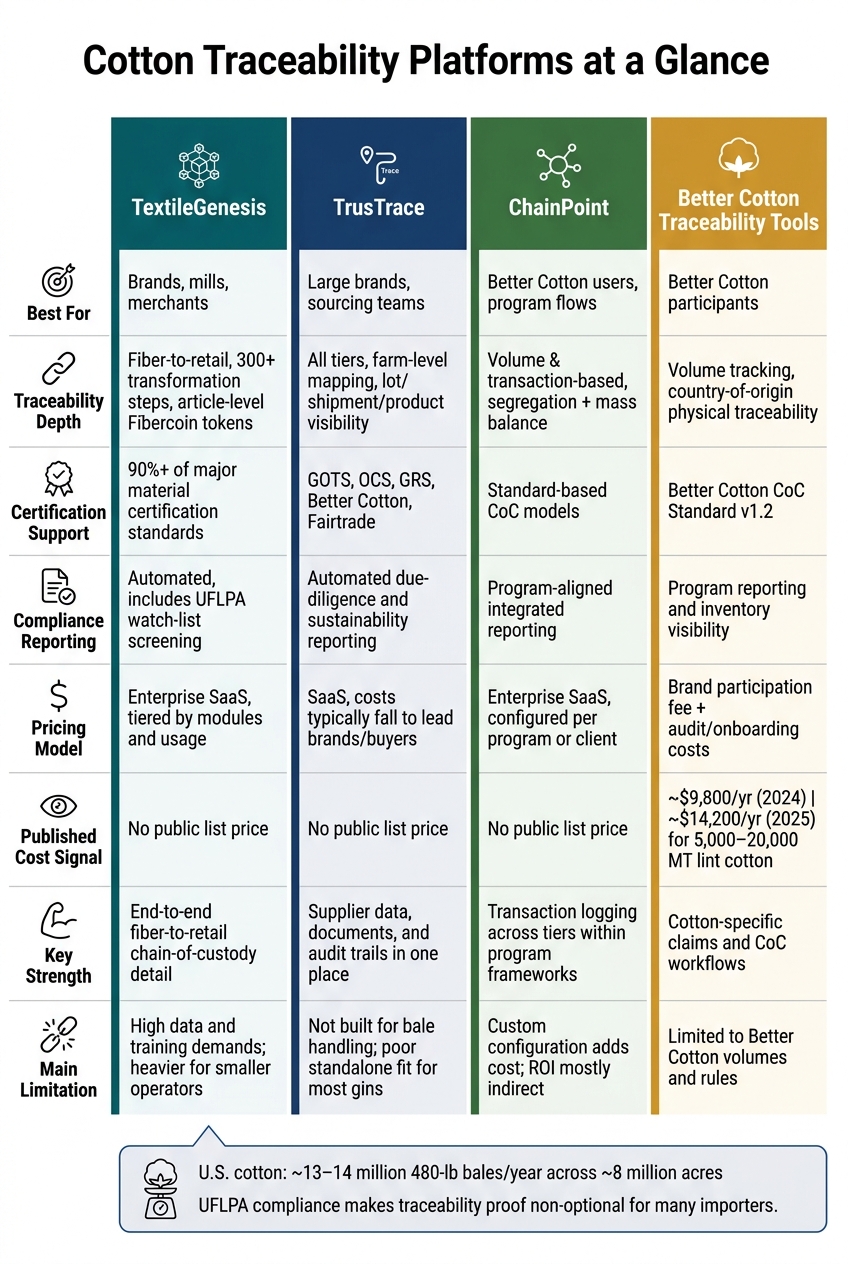
Cotton Traceability Platforms Compared: Features, Costs & ROI 2026
| Platform | Best For | Main Strength | Main Limit |
|---|---|---|---|
| TextileGenesis | Brands, mills, merchants | End-to-end fiber-to-retail tracing | More setup work and staff time |
| TrusTrace | Large brands, sourcing teams | Supplier data, documents, and reporting | Not built for bale handling |
| ChainPoint | Better Cotton users, program flows | Transaction logging across tiers | Less depth at bale level |
| Better Cotton Traceability Tools | Better Cotton participants | Cotton-specific claims and CoC workflows | Limited to Better Cotton rules and volumes |
Cost is rarely just software. I’d look at license fees, onboarding, training, support, internal labor, and volume-based charges. For example, published Better Cotton brand fees were about $9,800/year in 2024 and about $14,200/year in 2025 for 5,000 to 20,000 metric tons of lint cotton.
ROI usually comes from three places:
- Less manual document work
- Fewer audit and reconciliation hours
- Lower buyer and import risk
If you want the plain-English takeaway: the best platform is the one that fits your buyer demands, data maturity, and supply-chain setup without adding more work than your team can handle.
1. TextileGenesis
TextileGenesis has the deepest farm-to-retail setup of the four platforms. It uses Fibercoins to link physical fiber volumes with digital tokens, so cotton can be tracked from the farm all the way to retail.
Traceability Depth
The platform tracks cotton from bale ID through the finished product. At the farm and gin stage, it records bale IDs, bale weights, ginning dates, and program or certificate IDs. Farther down the chain, spinners and mills log incoming bale IDs, output lot IDs, and mass-balance data. Brands can then pull near-real-time traceability reports tied to specific cotton lots.
That depth isn't small-scale. TextileGenesis is used by 8,000+ supply-chain roles across 70+ countries, with 800 million+ units traced.
Certification Support
For brands dealing with buyer certification demands, TextileGenesis supports 90%+ of major material certification standards. That means brands and suppliers can manage many schemes in one place instead of bouncing between systems. It also digitizes transaction certificates and connects them to shipments, which cuts paper handling and manual matching work.
OEKO-TEX® chose TextileGenesis to address fraud prevention in organic cotton supply chains.
Cost Structure
TextileGenesis is sold as a SaaS platform with brand-level subscriptions and usage-based pricing. Suppliers like gins, merchants, and mills are usually brought in through the lead brand's network, often with low or no direct license fee.
For smaller U.S. gins, the main cost isn't usually software alone. It's the staff time, process shifts, and initial data uploads needed to get set up. A common path starts with Excel or SFTP uploads, then moves to APIs as volume grows.
That setup makes TextileGenesis a strong fit for brands that need end-to-end traceability. But if someone wants a light, low-touch tool, this may feel like more system than they need.
ROI
For U.S. gins and importers, the payoff is practical, not just about checking a compliance box. ROI comes from less documentation labor and lower UFLPA scrutiny risk. When certificates and shipment data are digitized, teams spend fewer hours building document packs and reconciling spreadsheets.
There’s also a sales angle. Better inventory visibility and stronger buyer access can help gins, mills, and brands keep customers that require verified cotton traceability.
2. TrusTrace
Where fiber-token systems focus on product movement, TrusTrace is more about data and document control across tiers. It’s an enterprise SaaS platform that tracks cotton and other materials from raw fiber to finished product. Its main edge is multi-tier traceability built around documents, not bale-handling on the ground. The company says it has 112,000+ verified suppliers and facilities, 5 million+ purchase orders, and 30 million+ annual transactions.
That makes TrusTrace a strong fit when buyers need auditable supplier records more than bale-level operational tracking.
Traceability Depth
TrusTrace supports both forward and backward traceability. A brand can start with a finished garment and trace back to the cotton source, or follow certified fiber forward through spinners, mills, and manufacturing partners. It also gives teams better inventory visibility by linking purchase orders, receipts, and production status to the same material record.
ASOS uses TrusTrace to trace materials down to raw materials and farm level (Tier 5). In cotton supply chains, that means purchase orders, invoices, transaction certificates, and material flow records can sit in one auditable trail instead of being scattered across spreadsheets and email threads.
There’s one clear limit here: TrusTrace does not manage bale-handling operations. If a gin or merchant needs bale identity, lot aggregation, or split/merge handling, they may need another tool or an upstream system that already stores bale-level data.
Certification Support
TrusTrace centralizes certificates, audits, and transaction records tied to suppliers, purchase orders, and production steps for fiber certification programs such as GOTS, OCS, GRS, Better Cotton, and Fairtrade.
Why does that matter? Because buyer proof requests now go beyond simple declarations. They often call for auditable chain-of-custody records. Keeping those files in one structured system can cut audit prep time and make buyer requests much easier to handle.
Cost Structure
TrusTrace is sold as enterprise SaaS, and there’s no public list price. Cost usually depends on factors like implementation scope, supplier count, transaction volume, integration complexity, and which modules are included. Buyers should also ask about:
- Subscription fees
- Onboarding
- Integration
- Data migration
- Support tiers
- Optional services
Centralized records and automation can lower total cost of ownership compared with spreadsheets and manual workflows. For cotton organizations, the smarter comparison is a vendor quote plus ROI review, not just the sticker price.
ROI
ROI tends to be strongest when TrusTrace is built into existing ERP, procurement, or manufacturing workflows instead of used only as a reporting layer. For brands, merchants, mills, and gins, the payoff often shows up in less audit prep, faster reconciliation, and fewer manual follow-ups.
A few KPIs can help put numbers behind that return:
- Verified-origin share
- Certified-versus-non-certified mix
- Audit hours saved
Next, ChainPoint shifts the focus from multi-tier document control to first-mile transaction logging.
3. ChainPoint
ChainPoint is a cloud-based traceability platform that tracks product, process, and supplier data from raw material to finished product. In cotton, its main use case is the Better Cotton Platform, which runs on ChainPoint.
Traceability Depth
In cotton supply chains, ChainPoint’s main job is transaction logging through the Better Cotton Platform. Suppliers record transactions at the ginner, spinner, fabric mill, and cut-and-sew stages.
That gives brands a clearer view of origin, handlers, and traceable volume. Today, the platform can trace physical Better Cotton back to its country of origin, while farm-level visibility remains the long-term target. So if the goal is solid chain-of-custody records, ChainPoint fits well. If the goal is bale-level plant tracking, that’s not where it’s strongest.
Certification Support
ChainPoint supports both mass balance and segregation chain-of-custody models, and organizations can shift between them as their supply chains develop. For U.S. gins, merchants, and mills, that creates a path from mass balance to physical segregation.
It also keeps certification data, audit results, and transaction records in one place. That matters because scattered records slow teams down fast.
Cost Structure
ChainPoint does not publish a public price list. In most cases, costs come through Better Cotton membership fees or enterprise subscriptions.
Pricing usually depends on a few things:
- Supply-chain tier count
- Transaction volume
- Integration needs
Those factors shape what a company ends up paying.
ROI
ChainPoint is used by over 70,000 companies globally and is trusted by major brands such as H&M, Adidas, and IKEA through Better Cotton. For U.S. gins and merchants, the return tends to show up in simpler audit prep, faster reconciliation, and more buyer confidence when traceability is part of the deal.
The data can also help with ESG reporting and sourcing decisions. The next platform shifts away from Better Cotton-focused workflows and into broader traceability and supplier-data control.
4. Better Cotton Traceability Tools
Better Cotton’s traceability tools bring together the BCI Platform, the CoC Standard, third-party certification, and claim rules in one connected system. This section looks at the Better Cotton rules and certification layer that sits on top of the platform itself. Today, more than 13,000 ginners, traders, spinners, mills, manufacturers, and brands use the system.
Traceability Depth
The BCI Platform tracks both Mass Balance and Physical Better Cotton from bale to finished product. As cotton moves through the chain, ginners, traders, spinners, mills, and brands log transactions in the system.
Right now, physical traceability reaches back to the country of origin. Better Cotton has said that farm-level traceability is a longer-term goal. The CoC Standard lays out the rules for physical traceability, including segregation and controlled blending.
For U.S. gins and merchants, the right model depends on two things: how complex the supply chain is and how much assurance buyers want.
That said, traceability on paper isn’t enough. The chain also has to prove it through certification.
Certification Support
If an organization wants to source Physical Better Cotton and make traceable claims, it must be certified against the CoC Standard v1.2. Third-party auditors handle independent assessments. They compare BCI Platform records with physical inventory and shipping documents to check that the records line up.
Retailers and brands that want to use Better Cotton on product labels also need to pay a one-time Traceability Activation Fee and follow the claim rules that apply to them.
Cost Structure
Costs land in three main areas:
- Platform participation
- Certification and audit fees
- Internal process investment
Better Cotton shares its fee categories, but it does not publish full public pricing.
In plain terms, the spend makes sense only if the system cuts audit time and helps companies get in front of buyers they might not reach otherwise.
ROI
The return comes from faster audits, clearer inventory visibility, and stronger buyer acceptance. Better Cotton says traceability is active in 15 countries. The program also reported that more than 3 million metric tonnes of lint were available for uptake in 2025.
For brands, that means a recognized framework they can point to in sourcing disclosures and ESG reporting.
The table below compares Better Cotton’s costs, traceability depth, and ROI against the other platforms.
Features, Costs, and ROI: Side-by-Side Tables
These tables make it easier to compare fit, cost, and ROI across supply-chain roles. First comes traceability depth. Then you can look at compliance needs and integration fit side by side.
Feature Comparison
| Feature | TextileGenesis | TrusTrace | ChainPoint | Better Cotton Traceability Tools |
|---|---|---|---|---|
| Traceability depth | Fiber-to-retail; tiers 1–5; 300+ transformation steps. | All tiers; supplier data collection supports farm-level mapping. | Configurable; depth depends on program setup and which participants are onboarded. | Better Cotton volume tracking; physical traceability is expanding beyond mass balance. |
| Tracking granularity | Article-level tracking through Fibercoin tokens. | Lot, shipment, and product-level visibility. | Volume and transaction-based; supports segregation and mass balance models. | Transactional volume tracking within the Better Cotton Platform. |
| Certification support | Integrates with more than 90% of major material certification standards. | Compliance data management and due-diligence workflows. | Supports standard-based initiatives and chain-of-custody models. | Supports verified Better Cotton volumes and program reporting. |
| Compliance reporting | Automated risk and compliance management, including UFLPA-related watch-list screening. | Automated sustainability and due-diligence reporting. | Integrated reporting aligned with program rules. | Program reporting and inventory visibility. |
| Integration fit | API and SFTP integrations; connects with certification databases and sector initiatives. | Centralized data hub that connects to PLM, ERP, and sustainability tools. | Configurable APIs; underpins the Better Cotton Platform. | Built on ChainPoint and used across ginners, traders, spinners, mills, and brands. |
Cost Comparison
Public pricing is limited, so this table focuses on the cost signals that have been published. In most cases, total cost depends less on a sticker price and more on volume, onboarding, and integration work.
| Cost Factor | TextileGenesis | TrusTrace | ChainPoint | Better Cotton Traceability Tools |
|---|---|---|---|---|
| Pricing model | Enterprise SaaS; tiered by modules and usage. | SaaS; costs typically fall to lead brands or buyers. | Enterprise SaaS; configured per program or client. | Brand participation fee plus audit and onboarding costs. |
| Key cost drivers | Number of users, transaction volume, risk/compliance modules, integrations. | Number of tiers mapped, integrations, SKU volume. | Configuration complexity, number of onboarded entities, integrations. | Annual lint-cotton volume tier, onboarding scope, internal process change. |
| Training & onboarding | Structured onboarding; domain-specific training for fiber, yarn, and fabric suppliers. | Scalable onboarding; standardized workflows reduce training time. | Program-led onboarding guidance for ginners, traders, and mills. | Sector-level onboarding; stakeholders learn transaction logging and inventory interpretation. |
Published Better Cotton brand fees were about $9,800/year in 2024 and about $14,200/year in 2025 for 5,000 to 20,000 metric tons of lint cotton.
ROI by Stakeholder Group
ROI shifts depending on who is using the system. A gin, a merchant, a mill, a grower, and a brand are not buying the same result. Some want tighter process control. Others want cleaner reporting or less time spent reconciling records.
| Stakeholder | TextileGenesis | TrusTrace | ChainPoint | Better Cotton Traceability Tools |
|---|---|---|---|---|
| Gins | Cuts bale-document handling and speeds shipment reconciliation. | Moderate fit; primarily brand- and supplier-facing. | Supports transaction logging for ginners within program frameworks. | Direct gin participation supports process control and data management. |
| Growers | Carries farm and bale data into verified fiber records. | Supports farm-level mapping and multi-tier visibility. | Indirect; depends on program configuration. | Indirect today, with more granular traceability developing over time. |
| Merchants | Reduces lot reconciliation and transaction follow-up. | Centralized data hub reduces reconciliation across tiers. | Strong fit for mass balance and segregation models. | Improves volume alignment and inventory visibility. |
| Mills | Links production records to traceable inputs and outputs. | Links production records to traceable inputs and outputs. | Integrated reporting for spinners and mills within programs. | Supports transaction logging, inventory visibility, and sourcing decisions. |
| Brands | Speeds audit prep, claims support, and sustainability reporting. | Automated due-diligence and sustainability reporting, reducing non-compliance risk. | Enables program-level reporting and buyer reporting. | Supports responsible sourcing claims and buyer reporting. |
The pros and cons below help show where each platform tends to fit best in day-to-day use.
Pros and Cons by Platform
The table below turns the earlier feature and cost comparison into a quick fit check. It helps you see where each platform makes sense, and where it can feel like too much.
| Platform | Best Fit | Key Strengths | Main Limitations |
|---|---|---|---|
| TextileGenesis | Mills, merchants, brands, and certification-driven programs | Article-level Fibercoins traceability; integrates with more than 90% of major material certification standards; covers nearly 300 transformation steps; includes risk and compliance screening, including UFLPA entity watch lists | High data and training demands make it heavier for smaller operators. |
| TrusTrace | Large retail brands and global manufacturers | Free supplier portal lowers onboarding friction; supports over 22 languages; AI-enhanced due diligence and sustainability reporting; strong ERP and PLM integration | Enterprise pricing and complex rollout make it a poor standalone fit for most gins. |
| ChainPoint | Program-driven initiatives such as Better Cotton; merchants and mills working inside certification schemes | Supports segregation and mass balance models; configurable workflows; powers the Better Cotton Platform for ginners, traders, mills, and brands | Best as a program platform; custom configuration adds cost, and ROI is mostly indirect. |
| Better Cotton Traceability Tools | Gins, spinners, mills, and brands participating in Better Cotton | Built specifically for cotton; logs transactions from ginning through to brands and retailers; now supports country-of-origin traceability | Limited to Better Cotton volumes and rules; farm-level physical traceability is still developing. |
A simple pattern shows up here. TextileGenesis goes deeper on chain-of-custody detail, but that depth comes with more work. TrusTrace is better suited to big brand environments where supplier onboarding, reporting, and system connections matter a lot. ChainPoint fits best when a company operates inside a set program framework, especially Better Cotton. And Better Cotton Traceability Tools make the most sense for users who want a cotton-specific setup tied directly to the Better Cotton system.
So the trade-off isn't just features. It's about how much traceability detail you need, how much process change your team can handle, and whether you need an open platform or one built around a specific program.
Conclusion
The comparison points to one clear takeaway: traceability pays off when it fits your workflow, not when it simply has more features. There isn’t one platform that comes out on top for every use case.
Your choice should come down to buyer requirements, certification scope, data maturity, and integration needs. ROI tends to be strongest when a platform cuts manual documentation, reduces audit work, supports regulatory-ready data, and protects buyer access. The best option is the one that removes friction while still meeting buyer and compliance demands.
FAQs
How do I choose the right traceability platform for my role?
Start with a needs assessment. Define your scope, regulatory requirements, stakeholder expectations, operational scale, and budget. Then pick a platform that matches your main goals, whether that’s article-level tracking, certification support, or automated inventory management.
For gin operators, put the spotlight on integration with existing gin software, automated scale-ticket data, and real-time bale tracking. For merchants and brands, focus on end-to-end transparency, certification support, and API-based data exchange. It also helps to check fit with your technical setup and the people who’ll use the system day to day.
What internal data do I need before implementation?
Before you roll out a traceability platform, get your records in one place. That step helps keep your data clean and consistent from the start.
Pull together field-level details such as farm locations, harvest dates, seed varieties, GPS coordinates, and current inventory records. That includes sales, purchase orders, transfers, and physical counts.
You’ll also want your production and quality data ready. Gather bale weights, moisture readings, ginning rates, and fiber quality tied to PBI tags.
On top of that, collect your compliance records, including environmental permits, fire safety records, and official classification reports.
How long does it usually take to see ROI?
You can often see measurable ROI within the first year.
Full implementation usually takes 18 to 32 weeks. That span usually covers assessment, data mapping, pilot testing, and integration. Even so, day-to-day gains can show up sooner.
Some facilities report a 10% drop in waste and a 15% lift in production in year one. Over time, better visibility can cut documentation work by up to 80% and support price premiums for sustainable practices.