Yes - on the right cotton acres, VRT can pay for itself in one season. I’m seeing the same pattern across the article: seed savings of about $20 per acre, nitrogen profit gains of about $9 to $14 per acre, lime savings near $18 per acre in one case, and a 17% cut in PGR product cost when rates matched field zones.
If I boil it down, the article says one thing: VRT pays fastest when a field has clear soil and yield variation, clean data, and equipment that can change rates on the go. The first places to look are seed, nitrogen, lime, and then PGR. And if I’m farming fewer acres, custom application may make more sense than buying all the hardware up front.
Here’s the plain-English version:
- Seed: one case cut seeding by 8,000 seeds per acre and saved about $20/acre
- Nitrogen: studies showed 20% to 50% less N use with no lint loss in cited cases
- Lime: zone-based lime cut total use and saved about $18/acre in one field example
- PGR: plant-height-based rates cut product cost by 17%
- Best fit: fields with repeat yield swings, pH changes, and soil texture shifts
- Payback math: stack savings across passes, then subtract mapping, software, and service costs
A short way to think about it: if your field changes a lot from one zone to another, flat-rate inputs can leave money on the table. This article shows where that money can come back in year one.
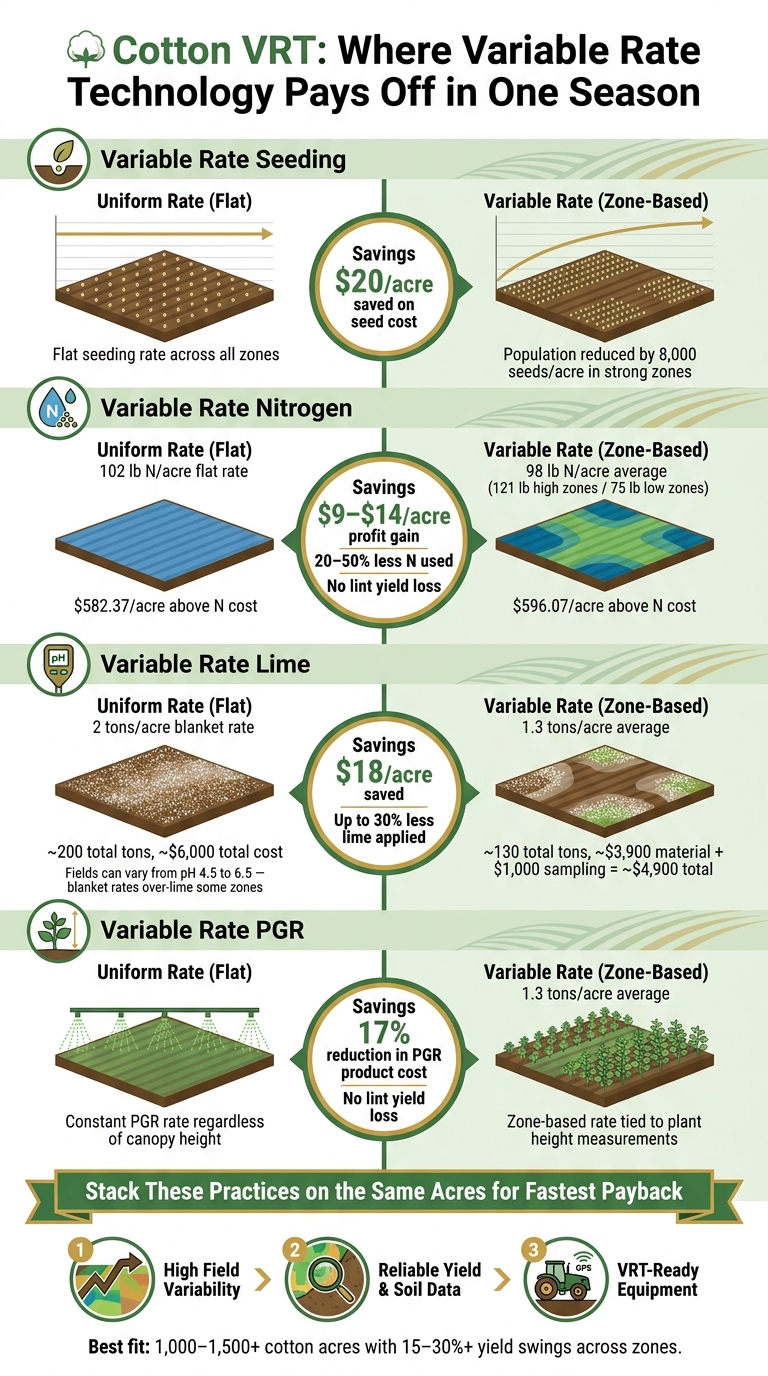
Cotton VRT Savings by Input: Uniform vs. Variable Rate Application
The Data and Equipment Behind Cotton VRT
VRT pays in cotton when your field data are good enough to cut the right input in the right spot. That work starts before the planter or spreader enters the field. And those zones only pay off when your equipment can turn them into live rate changes as it moves.
Yield Maps, Soil Zones, and Prescription Maps
The base of any cotton VRT program is multiple data layers. One source alone won't tell you much. But when you stack yield maps, soil samples, electrical conductivity (EC) readings, and field imagery, you get a much clearer view of where a field produces well and where it falls short.
Yield maps from monitor-equipped cotton pickers or strippers are usually the first layer. They need cleanup first. That means removing headlands, stoppages, and outliers, then checking the results against gin summaries. One year of yield data can point you in the wrong direction if weather throws things off. Data from several seasons give you a steadier read on each zone.
Soil sampling helps explain the why behind those yield patterns. Grid sampling gives pH, phosphorus, potassium, organic matter, and CEC at a fine enough scale to build lime and fertilizer prescriptions that mean something. Zone sampling can cut down the number of samples. In that setup, you define zones first using yield maps or EC data, then pull samples inside each zone.
EC or texture mapping adds another layer by showing where sandier soils and heavier soils sit in the field. That matters for seeding rates, nitrogen timing, and irrigation needs. Lighter soils hold less water and lose nutrients faster through leaching. Satellite or drone imagery, whether NDVI or bare-soil, fills in more of the story by showing in-season stand gaps, stress patterns, or vigor differences that soil tests alone can miss.
Once those layers are lined up in GIS or farm management software, an agronomist can draw management zones and assign target rates for each pass, including lime, base fertilizer, nitrogen, seeding, or PGR. Those layers then become a prescription map for each management zone. That file is what tells the planter, sprayer, or pivot how to change rates in the field.
Planters, Applicators, and Controllers That Apply Variable Rates
The fastest payback often comes from equipment that's already crossing every acre. But a prescription map only helps if the machine can read it and react with accuracy. That takes GPS-enabled rate controllers tied to hardware that can change rates on the go, such as electric or hydraulic drives on planters, servo or hydraulic valves on spreaders and sprayers, and variable-rate irrigation (VRI) controllers on center pivots.
For cotton seeding, precision planters with electric row-unit drives can load the prescription through USB or cloud transfer and then shift population from zone to zone. Fertilizer spreaders and sidedress applicators work much the same way. The controller reads GPS position, matches that position to the prescription, and adjusts belt speed, spinner output, or injection rate as needed.
A lot of these systems run through ISOBUS-compatible monitors that manage GPS guidance, mapping, and rate control in one screen. Sprayers used for PGR or foliar nutrients can switch rates by zone. VRI-enabled pivots take a prescription file that sets water depth by sector, then apply that depth as the pivot moves through the field.
The main thing is simple: the prescription file has to load the right way in the controller. If the file fails to load, or the GPS signal drifts, the applied rate no longer matches the prescription.
sbb-itb-0e617ca
Case Studies: Where Cotton VRT Pays Off in One Season
Once the data layers and controllers are set up, the quickest cotton VRT payback usually shows up in seed, nitrogen, and lime.
Variable Rate Seeding and Nitrogen That Cut Input Costs Quickly
The fastest cotton VRT payback usually comes from matching seed and nitrogen to field zones.
One field case showed that variable-rate seeding lowered planting population by about 8,000 seeds per acre and saved about $20 per acre on seed, while keeping yield intact. A separate multi-year cotton study found that zone-based prescriptions returned about $14 per acre more than the best flat rate in one year.
Nitrogen tells a similar story. Trials at the Clemson Edisto Research & Education Center in South Carolina showed 30% cuts in total N use in 2007–2008 and up to 50% in 2009, with no lint yield loss. In another field case, the prescription applied 121 lb N/acre on higher-yielding zones and 75 lb N/acre on lower-yielding zones. That averaged 98 lb N/acre versus 102 lb N/acre with a uniform rate. The variable-rate treatment produced 996 lb/acre lint and $596.07/acre above N cost, which was $13.70/acre higher than the uniform program.
Across the cited cases, variable-rate nitrogen cut N use by about 20% to 50% and improved profit by roughly $9 to $14 per acre, without reducing lint yield.
When you can trim input cost without giving up yield, lime is usually the next place to look.
Variable Rate Lime and pH Management That Prevent Over-Application
Lime is one of the clearest first-year VRT wins in cotton. Grid or zone soil sampling often shows that one field can range from pH 4.5 to 6.5, so a blanket 2 tons/acre rate may hit some areas too hard and miss others.
Applying lime only where pH is low can cut total lime program cost - material, freight, and spreading - by up to 30% compared with a blanket pass. In one documented 24-acre example, uniform liming would have needed about 48 tons at $30/ton, while VR liming used about 32 tons. Even after precision sampling and data costs, the farm still saved about $18 per acre in year one.
| Metric | Uniform Application | Variable Rate (Zoned) |
|---|---|---|
| Rate applied | 2 tons/acre | Avg. 1.3 tons/acre |
| Total tons | 200 tons | 130 tons |
| Material + spreading cost | ~$6,000 | ~$3,900 |
| Precision sampling cost | - | ~$1,000 |
| First-year field savings | - | ~$1,100 |
The cost piece matters, but so does the agronomy. Correcting pH only where it’s needed helps protect nutrient availability in zones already close to cotton’s 6.0–6.5 target. Over-liming those areas can create nutrient-availability issues without fixing anything. Site-specific pH management can also improve early vigor and boll set in low-pH zones.
Once soil chemistry is in better shape, canopy height often becomes the next field-by-field issue to manage.
Variable Rate PGR Applications That Improve Uniformity and Cut Waste
If crop vigor still varies after seed, N, and lime are matched to zones, PGR is often the next fast-payback VRT tool. Research published in the Journal of Cotton Science in 2023 tested zonal, plant-height-based PGR application at Sheely Farms in California against a constant rate. The study found a 17% reduction in PGR product cost with no negative effect on lint yield. In highly variable fields, it also reduced plant height variability and increased total lint yield and profitability.
That makes variable-rate PGR a practical same-season VRT move for fields that don’t grow evenly.
How to Judge Whether VRT Will Pay on Your Cotton Acres
Best Fit: Acres, Field Variability, and Number of Passes
The case studies show where cotton VRT can cut costs. This section is about when those savings are big enough to pay for the system.
VRT tends to pay back fastest when fixed costs are spread across enough acres, with enough field variation, and across several passes. On many U.S. cotton farms, 1,000–1,500 cotton acres is often the range where a one-season payback starts to look realistic. The reason is simple: monitor, controller, and software costs get spread over more acres.
Field spread matters just as much as farm size. If you have yield swings of 15–30% or more across zones, or clear shifts in soil texture, pH, or rooting depth, a prescription has something to work with. If your yield maps look flat and your soil tests show little change, the numbers get tighter. The best fit is a field where repeat yield data and soil data show that one zone has been getting too much input while another has been coming up short.
The biggest lever is stacking multiple VRT passes on the same acres. More passes on the same ground mean seeding, fertility, and PGR savings can add up much faster.
A Simple ROI Worksheet for Cotton VRT
Use a simple four-step ROI check. Only count the costs and gains that fit your farm.
- Estimate per-acre net benefit for each practice you'll actually run. Use conservative per-acre gains only for the practices you plan to use.
- Sum only the practices you'll implement to get total per-acre benefit.
- Multiply by total cotton acres to get gross annual benefit. At $33/acre across 1,200 acres, that's $39,600.
- Subtract annualized VRT costs: monitor and controller depreciation, software and mapping subscriptions, and agronomy or prescription-writing fees of about $4–$8/acre. If the year-one net return covers hardware, setup, and service costs, the system pays back in one season.
Use the worksheet below to check whether your acres, field spread, and service costs support a one-season payback.
| VRT Practice | Typical Source of Return | Required Data | Required Equipment |
|---|---|---|---|
| Variable-rate seeding | Seed savings on strong zones; better stands on weak zones | 2–3 years of yield maps; zone soil samples; stand history | VRT-capable planter; rate controller; mapping software |
| Variable-rate nitrogen | Reduced N on low-response zones; yield lift where N was limiting | Yield maps; soil OM and CEC; N response history | VRT-sidedress applicator; controller; mapping software |
| Variable-rate lime | Lower lime use where pH is already correct; yield gains where pH was limiting | Grid or zone pH and buffer pH; yield maps if available | Variable-rate spreader, owned or custom; pH mapping and recommendation engine |
| Variable-rate PGR | Less product on low-vigor zones; tighter height on high-vigor zones | Canopy vigor mapping; yield maps | Sprayer with rate control; mapping software; scouting tools |
For farms under about 500–700 cotton acres, buying your own hardware may not make sense in year one. A custom applicator with a VRT-equipped spreader or sprayer can let smaller operations use variable-rate lime, nutrient, or PGR programs without the upfront equipment bill. In that setup, the grower pays a per-acre service fee. That can still work if per-acre savings are higher than the fee.
The next step is figuring out which VRT move on your farm is most likely to pay first.
Conclusion: The Cotton VRT Moves Most Likely to Pay First
The fastest one-season wins in cotton VRT usually come down to three things: high field variability, reliable data, and the right equipment already in place. Variable-rate seeding, nitrogen, lime, PGR, and irrigation can all pay back fast, but the best fit depends on the farm.
A good starting point is the input that shifts the most dollars per acre. Variable-rate seeding and nitrogen often pay first because they hit the biggest repeat costs. If you already have several years of cleaned yield maps that show repeatable low-yield zones, and seed or nitrogen is a big part of your budget, those are strong signs to start there.
Lime and PGR can also make sense, especially in fields with uneven pH history or big swings in plant vigor. Zonal PGR management can cut product use and help keep canopy height tighter without giving up yield. That kind of uniformity matters for more than product savings.
When you run these practices on the same acres, the savings can stack up. Pairing seeding, fertility, and PGR on the same ground can speed payback because one system trims costs across several passes.
How Cotton Gins and Regional Planning Connect to VRT Results
That same consistency can help with harvest timing, hauling, and gin planning. More even maturity also helps harvest flow and gin scheduling. Use cottongins.org to find nearby gin locations, check service areas, and estimate haul distance from each field.
FAQs
How do I know if my cotton fields have enough variability for VRT to pay?
Review 2–3 seasons of layered yield maps to see if the same parts of the field keep performing in different ways. When that pattern shows up year after year, it’s a strong sign that VRT may be worth the cost.
Then check those patterns against grid or zone soil sampling for pH, organic matter, and nutrient levels, or use EM conductivity surveys. When both the yield maps and soil data point to clear management zones, VRT can often improve yields by 10–15% and cut inputs by 15–25%.
What data do I need before I start using VRT in cotton?
Start with a solid data base. Use grid soil sampling - ideally every 2.5 acres - or run EM conductivity surveys. Put your attention on pH, organic matter, CEC, and nutrient levels.
Then add multi-year yield maps, NDVI, and irrigation or moisture records. That gives you what you need to build 3–5 management zones for prescription maps.
To make those maps work in the field, calibrate your equipment with RTK GPS. And don’t just trust the screen - ground-truth the prescriptions so applications stay accurate and cost-effective.
Should smaller cotton farms use custom VRT services instead of buying equipment?
It depends on the size of the farm and the budget. For farms under 100 to 200 acres, upfront retrofit costs of $5,000 to $20,000 can be tough to justify. In that case, custom VRT services are often the more practical choice.
For larger operations, owning the equipment can pay for itself within one to two years. A smart way to start is small, then check ROI before putting more money into a bigger rollout.