Transporting cotton efficiently requires a provider that excels in reliability, scalability, cost-efficiency, and industry expertise. Cotton logistics is challenging due to long distances, seasonal peaks, and the need for specialized handling. This guide breaks down the leading providers - Louis Dreyfus Company (LDC), Olam Agri, Delta Logistics, and AmerTrans Logistics - based on these critical factors.
Key Takeaways:
- LDC: Strong global network, advanced logistics systems, and sustainability initiatives. Ideal for large-scale international shipments.
- Olam Agri: Focuses on integrated supply chains, sustainability, and traceability. Great for managing regional shifts and export compliance.
- Delta Logistics: USDA-certified storage with a regional focus, ensuring strict quality standards for U.S. exports.
- AmerTrans Logistics: Vendor-neutral, tech-driven solutions tailored for flexibility and cost savings.
Quick Comparison:
| Provider | Reliability | Scalability | Cost-Efficiency | Industry Expertise |
|---|---|---|---|---|
| LDC | Owns assets, 24/7 delivery | Expanding global capacity | Cuts truck miles via rail | Global analytics, trading |
| Olam Agri | Integrated supply chain | Scales regional operations | Hedging tools for pricing | Traceability, sustainability |
| Delta Logistics | USDA-certified storage | Regional focus | Reduces port delays | U.S. export compliance |
| AmerTrans | Vendor-neutral, tech-driven | Flexible, multimodal options | Cost control via tech | End-to-end transparency |
Choosing the right partner depends on your needs - whether it's global reach, regional expertise, or cost-effective solutions.
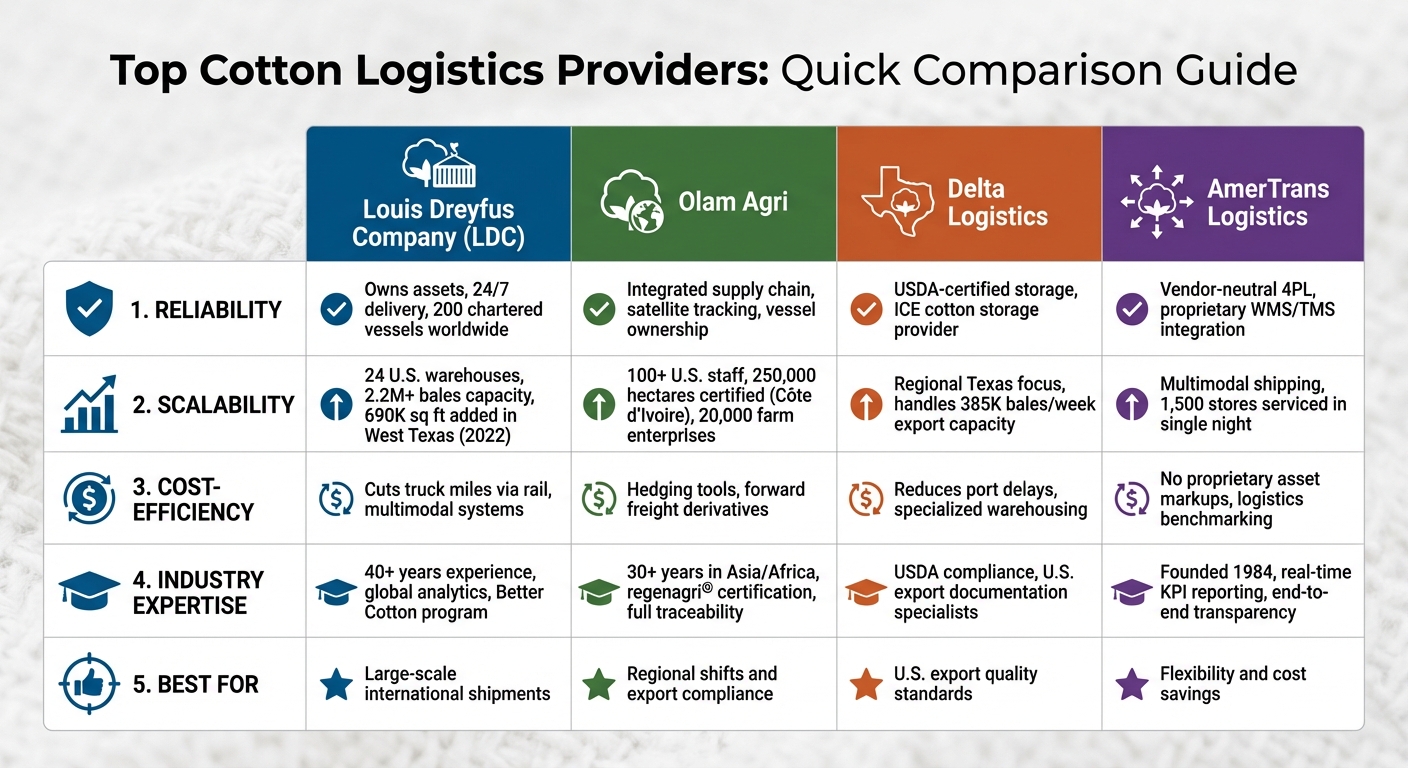
Cotton Logistics Providers Comparison: Key Features and Capabilities
1. Louis Dreyfus Company (LDC)
Louis Dreyfus Company (LDC) has over four decades of experience in the global cotton trade. It operates 24 warehouses across the United States, collectively holding more than 2.2 million bales of cotton.
Reliability
LDC’s dependability stems from owning and managing its physical assets rather than relying on third-party contractors. The company operates two container-loading facilities in West Texas and offers a 24/7 just-in-time delivery program through its international trading offices. This ensures cotton reaches spinning mills precisely when needed. Additionally, LDC maintains a fleet of around 200 chartered vessels worldwide for efficient global transport. As Joe Nicosia, Head of Cotton at LDC, notes:
"LDC's presence in all key origination markets allowed us to continue providing customers with global solutions, navigating supply constraints to meet their needs".
Scalability
In 2022, LDC significantly increased its logistics capacity. The company added 690,000 square feet of space in West Texas and another 350,000 square feet in Savannah, Georgia, to handle rising export volumes through the Port of Savannah. It also executed a record-breaking shipment from Australia, transporting 130,000 bales of cotton to Türkiye in a single voyage. With a global origination network spanning regions like the United States, Brazil, Australia, Africa, India, Pakistan, and China, LDC can adapt to regional supply challenges by sourcing cotton from alternative locations.
Industry Expertise
LDC’s capabilities extend far beyond logistics. As Michael Symonanis, Director of Strategic Network at LDC, puts it:
"Logistics is a strategic conversation".
The company’s research and risk management teams keep a close eye on supply and demand trends, helping customers navigate unpredictable markets. Its integrated approach covers every step - from farm-gate transportation to international shipping - leveraging multimodal systems that include rail, river, and road networks. LDC also brings sustainability to the forefront through its involvement in initiatives like the Better Cotton program and the US Cotton Trust Protocol.
These strengths highlight LDC’s position as a leader in the industry, setting a high bar for other providers.
sbb-itb-0e617ca
2. Olam Agri
Olam Agri blends efficient logistics with sustainable approaches to tackle the challenges of cotton's supply chain. With over 30 years of experience in Asia and Africa, the company has built a strong presence in the cotton logistics industry. Its extensive network includes offices, warehouses, and ginning facilities in key cotton-producing regions like the USA, Australia, Brazil, India, and Africa. In the United States alone, Olam Agri employs over 100 staff across major regions - Southeast, Mid-South, Southwest, and Far West - handling everything from origination and trading to logistics, ginning, and warehousing.
Reliability
Olam Agri’s reputation for dependability comes from its integrated approach to managing the cotton supply chain. By owning and operating ginning facilities and warehouses, the company maintains control over vital processes. Its freight team operates from seven global locations, managing a diverse fleet of vessels equipped with satellite tracking and data analytics to address challenges like port congestion quickly.
As noted by Olam Agri Freight Management:
"We use long-term time charters as well as making selective investments in vessel ownership to better manage the handling and risk associated with the shipments." - Olam Agri Freight Management
This level of operational control ensures reliable shipments and allows the company to scale rapidly during harvest surges.
Scalability
With a global presence, Olam Agri is well-positioned to adapt to regional production shifts. When harvest volumes increase in one area, its integrated ginning infrastructure can ramp up processing capacity directly at the source. The company also uses forward freight agreement derivatives to hedge physical trades, securing optimal pricing in volatile markets.
Olam Agri’s commitment to regenerative agriculture further highlights its scalable operations. In Côte d'Ivoire, it achieved regenagri® certification for all its directly sourced cotton, spanning over 250,000 hectares of land and involving 20,000 farm enterprises. Similarly, in the U.S., it has certified 15,000 hectares of farmland and three ginning facilities producing 20,000 metric tons of cotton. Ashok Hegde, CEO of Fibre, Agri-Industrials & Ag Services at Olam Agri, emphasizes:
"We'll be able to provide our customers access to sustainably sourced cotton that is fully traceable from production to shipment. By embracing regenerative agriculture, we aim to restore and enhance soil health, reduce greenhouse gas (GHG) emissions and sequester more carbon." - Ashok Hegde, CEO, Fibre, Agri-Industrials & Ag Services at Olam Agri
This ability to scale sustainably strengthens Olam Agri’s position in the market.
Industry Expertise
As one of the leading suppliers to the U.S. domestic textiles market, which consumes around 2 million bales of cotton annually, Olam Agri brings significant industry expertise. The company goes beyond transportation by offering end-to-end traceability through collaborations with organizations like Regenagri and the U.S. Cotton Trust Protocol. Its use of data analytics not only supports shipment tracking but also uncovers opportunities and helps customers overcome supply chain challenges. In Australia, its operations are managed by its subsidiary, Queensland Cotton, a well-regarded name in marketing, ginning, classing, and logistics.
3. Delta Logistics
Delta Logistics has established itself as a trusted name in USDA-approved cotton storage. Located in Dallas, Texas, the company is a certified Intercontinental Exchange (ICE) cotton storage provider, ensuring its facilities meet the stringent requirements for storing cotton tied to exchange-traded contracts. Its strategic Dallas hub connects directly to key cotton production regions and major transit routes in Texas.
Reliability
Delta Logistics' reputation for reliability is rooted in its strict adherence to federal standards. Operating a USDA-approved facility means following rigorous guidelines for handling and preserving cotton bales. This certification also involves specialized knowledge in managing USDA and ICE storage documentation. For cotton producers and traders, this level of compliance ensures their cotton meets the exacting standards required for contracts, preserving both quality and trust.
Scalability
The scale of U.S. cotton exports highlights the importance of facilities like Delta Logistics. In the 2021/2022 season, meeting the annual export goal of 15.5 million bales required shipping around 385,000 bales weekly. Buddy Allen, President and CEO of the American Cotton Shippers Association, described the challenge:
"We've got to ship 385,000 bales each week from now until the end of the marketing year to hit the 15.5 million bale mark".
Adding to the pressure, trucking costs surged by nearly 40%, and the industry faced a shortage of approximately 80,000 drivers nationwide. With about 60% of U.S. cotton exports passing through California ports, specialized warehousing like Delta Logistics becomes essential during port delays or scheduling disruptions. As Allen put it:
"The supply chain challenge is real, and we're not executing well".
Delta Logistics’ ability to provide flexibility and capacity makes it a crucial part of the cotton supply chain, bridging gaps and ensuring smoother transitions for other market players.
4. AmerTrans Logistics
AmerTrans Logistics operates with a vendor-neutral 4PL model, leveraging decades of expertise since its founding in 1984. Headquartered in Texas - a state that produces between 4 and 6 billion bales of cotton annually - AmerTrans is strategically located in the heart of the U.S. cotton industry.
Reliability
AmerTrans builds its reputation for reliability on a vendor-neutral approach and advanced technology. By avoiding ties to specific vendors, they can select the best partners for each client's unique requirements. This flexibility has been vital for high-stakes shipments, with major names like the Cotton Bowl and Goodyear trusting AmerTrans for precise, time-sensitive deliveries.
In late 2020, the company introduced a proprietary Warehouse Management System, seamlessly integrated with its Transportation Management System and cloud portal. This innovation provides real-time tracking and key performance indicator (KPI) reporting, enhancing shipment transparency. As Steve G., a client, remarked:
"The communication, verification and safety of the shipments stood out to CKE".
Scalability
AmerTrans offers scalable solutions tailored to individual client needs, avoiding rigid service packages. Their services include full truckload, less-than-truckload, expedited shipping, and final mile delivery, all designed to adapt as clients grow. Highlighting their flexible approach, AmerTrans explains:
"We will scale with you and only offer you what you need. We will work with the best vendor for the job, rather than trying to push you onto specific solutions".
Their ability to handle large-scale operations was showcased during a Victoria's Secret brand launch, where they successfully completed shipments for 1,500 stores in a single night. Additionally, their use of multimodal shipping ensures efficiency and cost savings.
Cost-Efficiency
AmerTrans focuses on cost-efficiency by avoiding proprietary asset markups. By coordinating multiple transportation modes - truck, rail, sea, and air - they optimize shipping routes based on cost and performance. Their integrated technology platform further supports cost control through logistics benchmarking and performance monitoring. As the company puts it:
"Your supply chain is now much more than just a cost, it is actually an asset to your business".
Strengths and Weaknesses
A comparative analysis of the providers discussed above reveals the unique strengths and challenges each brings to the table, offering insights into how they differentiate themselves in the cotton supply chain.
Global providers like LDC and Olam Agri stand out for their extensive international networks, enabling them to offer robust risk management and financing solutions. These capabilities are especially valuable for smaller operations that may lack such resources. However, their broad, global focus can sometimes miss the nuances of U.S.-specific regional needs.
Regional cooperatives, such as Delta Logistics and PCCA, excel in cost savings through specialized infrastructure. For instance, PCCA’s Altus rail project has significantly streamlined logistics by eliminating over 88,000 truck miles and transporting 20,000 bales directly to West Coast ports. While this infrastructure delivers strong regional advantages, its focus on areas like Texas, Oklahoma, Kansas, and New Mexico limits its broader geographic applicability.
AmerTrans Logistics takes a vendor-neutral 4PL approach, prioritizing operational flexibility and cost-efficiency. On the other hand, specialized freight forwarders like Coppersmith leverage decades of experience - spanning over 50 years in raw cotton exports - to navigate complex regulatory requirements, including fumigation and country-of-origin certifications. This highlights the importance of expertise in compliance for certain segments of the supply chain.
Another key player, Buske Logistics, offers a different model. With over 100 years of industry experience, they combine flexible warehouse and labor systems to efficiently handle seasonal demand surges in cotton transportation. This adaptability ensures they remain a reliable partner during peak periods.
In summary, global merchants provide scale and financial tools, regional cooperatives focus on cost optimization through targeted infrastructure, 4PL providers emphasize flexibility, and specialized freight forwarders bring expertise in regulatory compliance. The choice of provider ultimately depends on the specific needs and challenges of the supply chain.
| Provider Type | Reliability | Scalability | Cost-Efficiency | Industry Expertise |
|---|---|---|---|---|
| Global Merchant (e.g., LDC, Olam) | High: Proprietary warehouses, global network | High: Present in every major producing/consuming region | High: Integrated risk management, funding solutions | High: Global analytics, trading expertise |
| Regional Cooperative (e.g., Delta, PCCA) | High: Precise inventory management, origin facilities | Moderate: Regional focus limits geographic reach | High: Rail projects reduce truck miles, costs | High: Specialized in origin-to-port logistics |
| Specialized 3PL (e.g., Buske Logistics) | High: Real-time SKU tracking, WMS | High: Flexible space, labor models for seasonal demand | High: Cube optimization, consolidated freight | High: Over a century of industry experience |
| Freight Forwarder (e.g., Coppersmith) | High: 50-year history, established carrier relationships | Moderate: Focused on U.S. export logistics | Moderate: Specialized documentation involves additional service fees | High: Expertise in fumigation, export certificates |
Conclusion
When deciding on a cotton logistics provider, it's essential to weigh the specific needs of your operation against the strengths of each option. The right choice will depend on factors like export destinations, budget priorities, and compliance requirements.
For businesses focusing on Asian exports, prioritize providers with direct rail routes to U.S. West Coast ports. These routes bypass intermediate stops, saving both time and money. If cost is a primary concern, rail infrastructure often delivers better value for large shipments. Just as important, ensure your provider is well-versed in export compliance, including fumigation protocols and country-of-origin certifications. Customs delays can quickly erase any cost savings, making documentation expertise a must.
Technology is another critical element in modern cotton logistics. Providers offering real-time container tracking systems can improve accountability and provide the transparency needed for efficient inventory management. As Jay Cowart, Vice President of Warehouse Operations at PCCA, explained:
"The vision for the new train software system was to increase accountability and streamline operational flow".
Each provider has unique strengths, so focus on what aligns best with your goals. Consider the four key criteria - reliability, scalability, cost-efficiency, and industry expertise - when making your decision. Evaluate their global reach, regional capabilities, and compliance knowledge to find a partner that supports your long-term objectives.
FAQs
How do I pick the right cotton logistics provider for my business?
To select the best cotton logistics provider, prioritize reliability, expertise in the industry, scalability, and cost-effectiveness. Look into their track record with cotton transportation, their warehousing capabilities, and how well they handle regulatory requirements. It's also important that they provide features like real-time tracking, secure storage solutions, and contingency plans to handle unexpected disruptions such as weather issues or port delays. A provider with a solid history, modern technology, and the ability to adapt can streamline your supply chain while ensuring your cotton remains in top condition.
What certifications should cotton warehouses and shippers have?
Cotton warehouses and shippers should prioritize obtaining certifications that highlight their commitment to quality and adherence to industry standards. For instance, ISO 9001 focuses on quality management systems, while ISO 14001 addresses environmental management practices. Additionally, the GOTS (Global Organic Textile Standard) certification ensures eco-friendly processing, and USDA Organic certification verifies compliance with organic farming standards. Another important credential is phytosanitary certification, which guarantees shipments are free from pests and diseases. These certifications not only reflect a dedication to high standards but also align with sustainability and regulatory requirements.
Which shipping mode is best for cotton - truck, rail, or container?
The best way to ship cotton depends on factors like distance, costs, and logistical requirements. Rail works well for long-distance transportation, offering lower costs and a smaller carbon footprint. For shorter trips, such as moving cotton from farms to gins, trucks are a more flexible option. When it comes to international shipping, containers offer protection for the cotton but need to be carefully managed to prevent delays and extra expenses. Each method has its place in keeping the supply chain running smoothly.