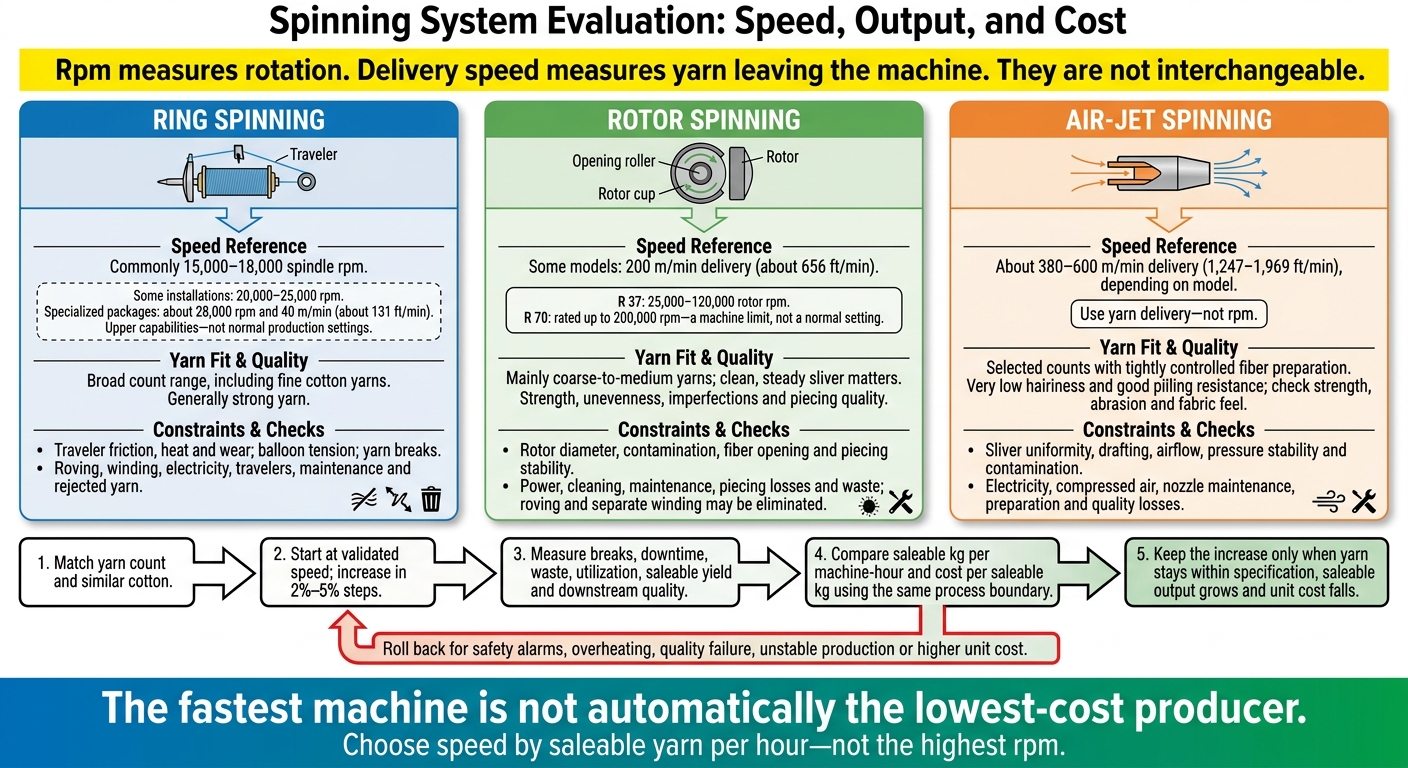
I’d choose spinning speed by saleable yarn per hour - not the highest rpm. Test increases in 2%–5% steps, and keep them only when yarn quality stays within spec and cost per saleable pound falls.
Ring, rotor, and air-jet spinning have different speed limits. Rpm measures rotation; delivery speed measures how fast yarn leaves the machine. They aren’t interchangeable.
Quick Comparison
| System | Speed reference | Cotton and yarn fit | Quality and cost checks |
|---|---|---|---|
| Ring | Commonly 15,000–18,000 spindle rpm | Broad count range, including fine cotton yarns | Strong yarn; traveler heat, wear, breaks, and winding costs limit output |
| Rotor | Some models deliver 200 m/min, about 656 ft/min | Mainly coarse-to-medium yarns; clean, steady sliver matters | Check strength, piecing, cleaning, power, and waste |
| Air-jet | About 380–600 m/min, or 1,247–1,969 ft/min, depending on model | Selected counts with tightly controlled fiber preparation | Low hairiness; check strength, fabric feel, and compressed-air costs |
My rule: compare the same yarn count and similar cotton, then include breaks, downtime, waste, energy, and downstream results. <u>A faster setting pays only when it produces more accepted yarn at a lower unit cost.</u>
Cotton Spinning Speeds: Ring vs Rotor vs Air-Jet
1. Ring Spinning
Operating Speeds and Limits
The spindle rotates the yarn package while the traveler adds twist and controls winding. Cotton ring frames commonly run at 15,000–18,000 rpm, with some installations reaching 20,000–25,000 rpm. Specialized packages can reach about 28,000 rpm and 40 meters per minute (about 131 feet per minute). These are upper capabilities, not normal production settings.
Ring-traveler friction sets the main speed limit. It generates heat and wear, while higher balloon tension increases the risk of yarn breaks. Ring diameter also matters: a smaller ring lowers traveler surface speed at the same spindle rpm. Choose traveler weight based on yarn count, twist, and balloon geometry - not rpm alone.
Cotton and Yarn Requirements
Ring spinning handles a broad count range, including fine cotton yarns. Longer, stronger, more uniform fibers better withstand drafting and spinning tension. Short fibers, trash, and neps leave less room to adjust operating settings.
Fine counts such as 40s–60s Ne often need lower rpm, lighter travelers, and tighter tension control than 20s Ne. Yarn quality is usually the first place these fiber limits show up.
Yarn Quality
Higher speeds can increase hairiness, imperfections, and strength variation when traveler wear or tension becomes unstable. Track mass variation, defects, strength, hairiness, winding efficiency, and downstream breaks. Passing a lab test doesn’t guarantee that a setting will work well in production.
Saleable Output and Costs
Test speed increases in 500-rpm steps across multiple doffing cycles. The ring-spinning speed ceiling provides a benchmark for rotor spinning, which uses a different twist system to run faster. Keep the higher setting only when the added saleable yarn outweighs the extra breaks, energy use, traveler wear, maintenance, and waste.
sbb-itb-0e617ca
2. Rotor Spinning
Operating Speeds and Limits
Rotor rpm is not output speed. Delivery in m/min is. Compared with ring spinning, rotor spinning offers much higher delivery speeds but less flexibility in yarn fineness. Rieter’s R 37 lists 25,000–120,000 rotor rpm. The R 70 is rated for up to 200,000 rpm, but that’s a machine limit - not a normal setting. The 33-XT-BD rotor specification lists up to 125,000 rpm and 200 m/min delivery, or about 656 ft/min.
Smaller rotors generally support higher rpm. Larger rotors hold more fiber mass for coarse yarns but usually run slower. Actual delivery depends on yarn count, twist, rotor diameter, fiber feed, piecing settings, and acceptable yarn quality. What matters is whether higher rotor rpm produces more saleable yarn per hour.
Cotton and Yarn Requirements
Rotor spinning works best at coarse and medium counts when cotton quality supports steady output. The R 37 lists Ne 2–40. Keep the bale mix and draw-frame sliver quality consistent. Monitor trash, neps, moisture, rotor cleanliness, and opening-roller condition.
Too much opening damages fibers; too little leaves them poorly separated. Short-fiber content also affects the settings needed to meet evenness, strength, and hairiness requirements.
Yarn Quality
A 2019 study on 20 Ne, 100% cotton yarn found that about 80,000 rotor rpm gave the best tenacity, twist, and unevenness, while about 75,000 rpm gave the best elongation.
The best speed depended on the quality target - not the highest available rpm.
Saleable Output and Costs
Test the current, intermediate, and higher settings while keeping count, twist, raw material, and cleaning conditions constant. Record delivery speed, breaks per 1,000 rotor hours, piecing success and cycle time, rotor-cleaning frequency, and doffing delays.
A fast restart helps only if the piecing meets strength and visible defect requirements. Compare saleable kilograms per machine-hour and cost per saleable kilogram, including power, waste, maintenance, and rejects - not nominal delivery alone.
Air-jet spinning takes delivery speed higher still, but requires tighter control of cotton quality.
3. Air-Jet Spinning
Operating Speeds and Limits
Air-jet (vortex) spinning uses an air vortex to wrap fibers around a central core, creating smooth yarn with very low hairiness. Speed is measured by yarn delivery, not rpm. Faster delivery pays off only when the yarn meets quality specs - and that depends on uniform sliver quality.
Cotton and Yarn Requirements
Use Ne 15/1 to Ne 60/1. Keep the sliver even and the fibers parallel. Auto-leveling draw frames and two or three draw passages help improve consistency. For Ne 40/1 and finer yarns, test whether combing reduces short fibers and neps.
Yarn Quality
Air-jet yarn has very low hairiness and good pilling resistance, but it feels harsher than ring-spun yarn. It works well for certain medium-count knit and woven fabrics, plus technical textiles where smoothness and pilling resistance matter.
Saleable Output and Costs
Air-jet spinning is often cost-efficient only when yarn quality stays within spec. Use the fastest setting that still meets end-use requirements. The next section compares that speed with ring and rotor spinning in terms of output, quality, and cost.
Yarn Manufacturing: Rotor Spinning
Comparing Speed, Cotton Requirements, Yarn Quality, and Costs
The machine-by-machine overview comes down to one comparison: usable output matters more than headline speed. Compare speed, cotton requirements, yarn quality, and cost on that basis.
Operating Speeds and Limits
Keep three speed figures separate: advertised maximum, stable operating speed, and validated mill speed.
| System | Speed measure and reference range | Practical limits |
|---|---|---|
| Ring | Typically 15,000–22,000 spindle rpm; some compact systems reach about 25,000 rpm. Delivery depends on spindle rpm and twist level. | Traveler friction and heat, balloon control, yarn tension, and drafting stability. |
| Rotor | Report rotor rpm and delivery separately. Delivery can reach several hundred meters per minute, depending on the model and yarn. | Rotor diameter and groove, opening roller, fiber transport, contamination, vibration, and piecing stability. |
| Air-jet | Delivery is roughly 380–600 m/min, depending on the model. | Drafting, nozzle airflow, pressure stability, fiber wrapping, and contamination. |
Cotton and Yarn Requirements
Speed matters only when the fiber meets the system’s requirements.
| System | Count suitability | Cotton, preparation, and twist checks |
|---|---|---|
| Ring | Offers the broadest count flexibility, including very fine yarns. | Check length, strength, uniformity, micronaire, maturity, short fibers, and roving consistency. More twist reduces delivery at fixed rpm. |
| Rotor | Best below Ne 20/1; usually weak above about Ne 40/1. | Control trash, neps, fiber transport, and sliver variation. Tolerance for short fibers does not remove the need for cleaning. |
| Air-jet | Selected MVS applications perform well around Ne 40/1–60/1. | Check cotton approval, short-fiber limits, preparation requirements, and wrapping stability. |
Yarn Quality
| System | Quality trade-off | Downstream acceptance checks |
|---|---|---|
| Ring | Generally strong and suitable for many uses; higher speeds can increase hairiness and tension variation. | Strength, elongation, abrasion resistance, winding performance, and loom or knitting stops. |
| Rotor | Yarn structure, strength, and fabric hand differ from ring yarn. | Unevenness, imperfections, piecing quality, fabric appearance, and customer strength limits. |
| Air-jet | Tenacity is generally lower than equivalent ring yarn. | Strength distribution, abrasion, splice performance, and results after dyeing and finishing. |
Once quality stays within specification, compare cost per saleable kilogram.
Saleable Output and Costs
Higher delivery pays off only if saleable kilograms increase after breaks, waste, and downtime.
| System | Costs to include | Operating controls |
|---|---|---|
| Ring | Roving, winding, labor, electricity, travelers, maintenance, and rejected yarn. | Track traveler wear, doffing time, temperature, and humidity. |
| Rotor | Electricity, opening-roller and rotor maintenance, cleaning, piecing losses, and waste. Roving and separate winding may be eliminated. | Track rotor contamination, piecing reliability, temperature, and humidity. |
| Air-jet | Electricity plus compressed air, nozzle maintenance, preparation, and quality losses. | Track air pressure, dryness, leaks, nozzle condition, temperature, and humidity. |
Use the same process boundary for every system when calculating cost per saleable kilogram, including climate control and auxiliary inputs. Approximately 50%–65% relative humidity is a common cotton-spinning reference range - not a universal setpoint. Log temperature and humidity by shift, and follow the process requirements.
[ \text{Saleable kg} = \frac{\text{delivery (m/min)} \times \text{positions} \times \text{scheduled hours} \times 60 \times \text{utilization} \times \text{yarn linear density (tex)}}{1{,}000{,}000} \times \text{saleable yield} ]
Utilization is the share of scheduled time spent producing at planned delivery, after stoppages. Saleable yield is the accepted share of produced yarn after winding, inspection, and release. Count stoppages in utilization and rejects in yield - do not count either loss twice.
A worked example should rank systems by saleable output, not rpm alone.
Speed-Increase Decision
| Trial result | Recommended decision |
|---|---|
| Output increases and quality stays within specification | Adopt the higher speed. If breaks increase moderately, adjust twist, drafting, humidity, or cleaning first. |
| Efficiency falls enough to offset the theoretical delivery gain | Return to the previous speed or test a smaller increase. |
| Waste, neps, hairiness, strength variation, or downstream defects exceed limits | Reject the higher speed unless process changes restore quality. |
| Energy, compressed-air, maintenance, or labor cost per saleable kilogram exceeds the business target | Use the lower speed or redesign the process. |
| Repeated stoppages, overheating, unsafe conditions, or unstable piecing occur | Roll back immediately and investigate the limiting mechanism. |
Trial Plan
Start at the validated speed and increase it in 2%–5% steps, keeping count, twist, raw material, and preparation constant. Run each condition long enough to include startup, doffing, cleaning, and normal operator activity. Where possible, test across multiple shifts and representative machine sections.
To check whether higher speed increases usable output, record:
- Machine model, spindle or rotor rpm, yarn delivery, and twist.
- Breaks per 1,000 position-hours, utilization, downtime, and doffing or piecing losses.
- Gross production, waste, saleable yield, and kilograms per scheduled shift.
- Electricity, compressed-air consumption, maintenance, component wear, and cost per saleable kilogram.
Set rollback triggers before testing: quality failure, increasing breaks, lower utilization, safety alarms, excess waste, or higher cost per saleable kilogram.
Pros and Cons of Each Spinning System
Compare each system’s speed gains against yarn quality and operating costs.
| System | Production advantages | High-speed limits and disadvantages | Best-fit applications |
|---|---|---|---|
| Ring | Handles a broad range of yarn counts, including fine counts. Produces strong yarn with good fabric appearance. | Traveler heat and wear limit speed. Roving and separate winding add handling steps. | Fine yarns, premium apparel, and products with strict strength or appearance requirements. |
| Rotor | Delivers high output without roving or separate winding. | Fiber opening and separation, rotor cleanliness, and piecing can limit production. Lower yarn tenacity can reduce fabric strength. | Coarse- and medium-count yarns for denim, towels, workwear, and utility fabrics. |
| Air-jet | Offers very high delivery rates, direct sliver feed, and typically low hairiness. | Preparation and fiber control must stay stable. Compressed-air costs, plus strength and abrasion performance that vary by application, can offset faster delivery. | High-volume knits and woven fabrics that benefit from clean surfaces and reduced pilling. |
Practical traveler velocity is near 50 m/s (about 164 ft/s). Before increasing spindle rpm, optimize traveler weight, ring condition, and balloon size.
Rotor yarn tenacity can be 10%–30% lower than comparable ring yarn. Test fabric tear strength and piecing strength before pushing speed.
Low hairiness can improve pilling resistance, but lower tenacity or a stiffer hand can rule out some uses. Include compressor power, leaks, drying, and filtration when calculating costs.
The final comparison ranks these systems by usable output, not headline speed.
Conclusion: Choose Speed by Usable Output
Choose performance, not headline speed, based on usable output and cost. Spindle rpm, rotor rpm, and delivery speed measure different things. Use ring spinning for demanding fine yarns and rotor spinning for cost-efficient coarse-to-medium yarns. Choose air-jet only when its yarn properties fit the order - not just because it runs fastest.
Test speed using the same yarn count and similar cotton. Compare settings by first-quality output per hour, breaks, waste, power use, and downtime. Then check downstream performance.
The right setting gives you the lowest cost per saleable pound or kilogram. Increase speed only while saleable output grows and the yarn stays within spec.
FAQs
How can I compare output at different yarn counts?
Compare production at the same yarn count (Ne) and similar quality requirements, while accounting for each spinning method’s limits. Rotor spinning produces more yarn at coarse counts. Ring spinning delivers more uniform, stronger yarn at fine counts.
Track rotor delivery speed and mass produced per hour, ring spindle speed (RPM), and ends-down per 1,000 spindle hours. Finer yarns need slower speeds and more maintenance to limit breakage.
How long should I run a speed trial?
Run the trial long enough to see how mechanical condition and humidity affect breakage while keeping other conditions stable.
For rotor spinning, log rotor RPM against yarn breaks each week to spot trends such as lapping. For fine-count ring spinning (Ne 60+), factor in traveler changes every 10 to 12 days.
Compare the trial results with standard productivity and yarn-quality metrics.
How can I pinpoint the cause of speed-related yarn breaks?
Track ends-down per 1,000 spindle or rotor hours. Check for patterns across shifts, fiber batches, machine components, and speed adjustments.
For ring spinning, check traveler weight, ring and traveler wear, roving consistency, humidity, and temperature. For rotor spinning, inspect opening rollers and ducts.
Monitor motor loads and spindle vibration for signs of misalignment or bearing wear. Compare spikes in yarn breaks with speed changes to assess the machine’s limits.