If I can’t link a bale back to a farm and forward to a shipment, I have a compliance problem.
That’s the whole issue in plain English. For U.S. cotton businesses, traceability now means keeping one clear record from field → load → gin intake → bale → warehouse → sale. If one handoff is missing, buyer claims, program volumes, and origin records can fail.
Here’s the short version of what matters most:
- I need one ID chain that stays tied to the cotton from harvest through shipment.
- I need the right records at each step, including farm data, gin tickets, bale tags, warehouse moves, invoices, and shipping papers.
- I need physical separation at the farm-to-gin stage when origin claims must stay intact.
- I need digital tools that fit the job: ERP for business records, bale tracking for bale movement, and chain-of-custody platforms for program transactions.
- I need audit-ready files stored in a searchable system, with records often kept for 2 full cotton seasons or up to 5 years, depending on the program or buyer need.
- I need to test the process before an audit, not during one.
A few hard facts stand out:
- Better Cotton tracks lint through Better Cotton Claim Units (BCCUs).
- Auditors often trace shipments backward from outbound documents to intake and farm records.
- QR labels cost less up front, while RFID can cut scan time in high-volume yards.
- Missing links can lead to shipment delays, rejected buyer claims, or customs questions.
Cotton from Field to Fabric with Full Traceability
sbb-itb-0e617ca
Quick comparison
| Area | What I need to prove | Main records |
|---|---|---|
| Farm | Where cotton came from | Field ID, grower ID, harvest date, variety |
| Transport | What load moved and where | Load number, pickup point, weight, delivery ticket |
| Gin | Which loads became which bales | Intake ticket, press log, bale ID, classing data |
| Warehouse | Where each bale went | Storage location, move history, ship date |
| Merchant/Mill | What was bought, sold, and claimed | Contracts, bale lists, invoices, transaction records |
| Compliance | That all records match | Volume checks, certificates, audit files |
My takeaway: the goal isn’t a fancy system. It’s a clear, consistent, testable one that shows origin, movement, and program claims without gaps.
Farm-to-gin traceability requirements
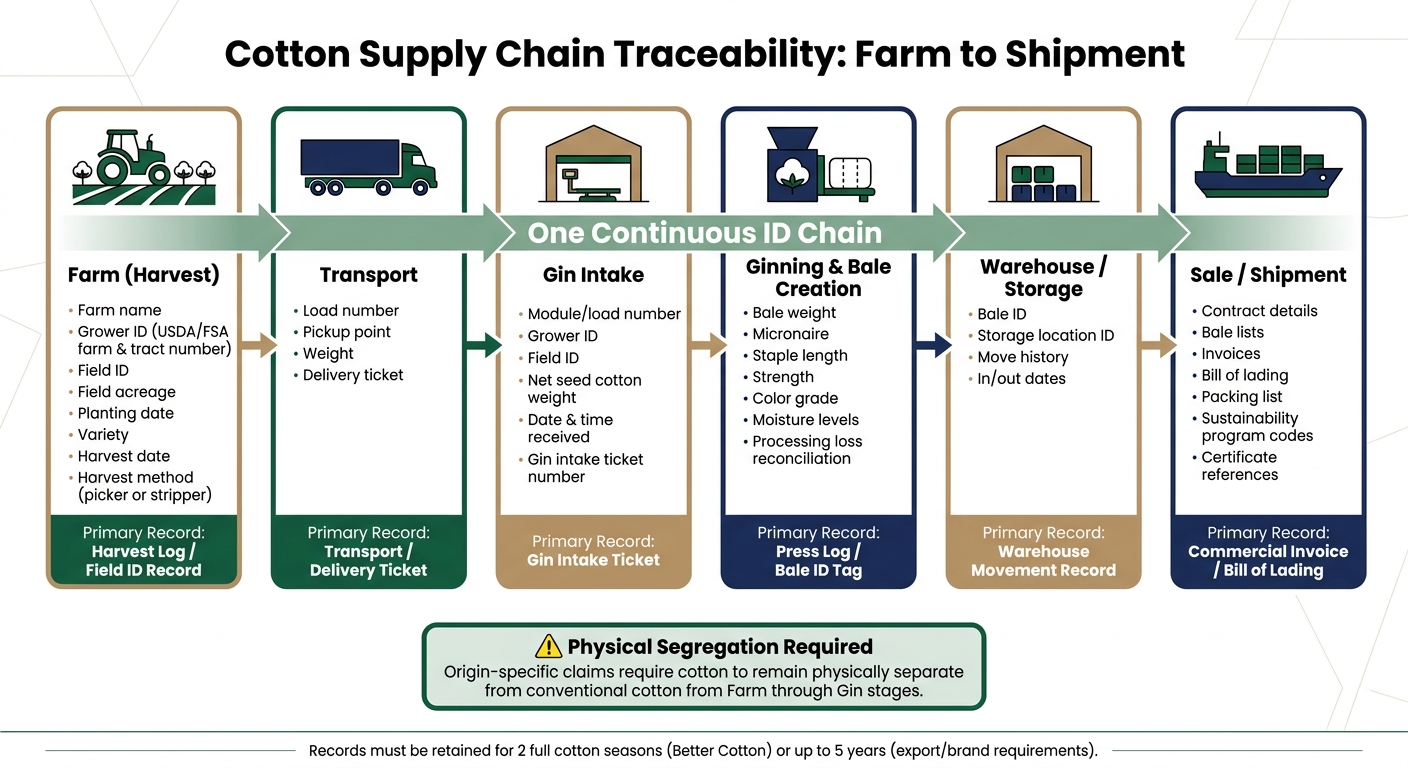
Cotton Supply Chain Traceability: Farm to Shipment Step-by-Step
Once you've identified the cotton, the next job is simple in theory and hard in practice: keep every handoff tied to the same record.
Core data to capture at harvest, intake, ginning, and bale creation
Start at harvest. Each harvest should be logged against a field ID or lot ID that stays with the cotton through transport, gin intake, and bale creation. That record should include:
- Farm name
- Grower identifier, such as a USDA/FSA farm and tract number or an internal grower code
- Field acreage
- Planting date
- Variety
- Harvest date
- Harvest method, either picker or stripper
This is the paper trail buyers and auditors use to confirm where the cotton came from.
At gin intake, create a gin intake ticket that repeats and checks the key upstream details. That includes the module or load number, grower ID, field ID, net seed cotton weight, and the date and time received. The ticket should also assign a gin intake ticket number.
During ginning, processing records need to connect each intake ticket to the bale numbers produced. For each bale, record bale weight, classing data, and moisture levels. Classing data includes micronaire, staple length, strength, and color grade.
You also need a reconciliation step. Compare seed cotton received against lint, seed, motes, and expected processing loss. If the numbers don't line up, that gap should trigger a review.
Physical segregation, identity preservation, and transfer records
Once the data is in place, handling control takes over.
If the cotton must keep an origin-specific claim, it needs to stay physically separate from conventional cotton. That usually means scheduling runs by status, cleaning equipment between lots, and storing qualifying bales in dedicated, labeled areas. If segregation breaks down, origin claims can fall apart in an audit.
Warehouse movement records should track bale identifiers, storage location IDs, and in/out dates for any movement inside storage. Those records should be backed up by SOPs, signage, and training records.
Mass balance belongs farther down the chain. At the farm-to-gin stage, physical segregation is required.
Minimum documentation to prove origin and chain of custody
Once handling is under control, the next question is whether every record leads back to the same bale.
The backbone of an auditable chain of custody is continuity of identifiers. Each bale should be traceable across harvest logs, transport tickets, gin intake, processing records, bale tagging, warehouse moves, shipping papers, and first-sale records.
Better Cotton's CoC Standard also says ginners should retain records such as farmer and producer lists, purchase slips or pay slips, gate entry passes, weighbridge slips, procurement and arrival registers, heap registers, bale and pressing registers, processing records including turnout ratios, and transport documents.
Keep digital copies for the full retention period in a searchable system indexed by bale reference, gin intake ticket number, grower ID, and field ID. That kind of setup makes life easier for merchants and mills that need to check suppliers fast and keep shipments moving. A cloud-backed, indexed system is much easier to audit than a stack of paper files.
The next section covers the digital tools that make record capture and retrieval workable at each stage.
Digital systems that make cotton traceability work
Good records fall apart fast if the systems behind them are messy. The last section covered what to record. This one is about the tools that collect, store, and connect that data across the supply chain.
The simplest way to think about it: use the right system for the right task. Use ERP for commercial records, bale tracking for yard movement, and chain-of-custody platforms for transactions between companies.
ERP platforms, bale tracking software, and chain-of-custody records
Use the ERP as your commercial and compliance record. Keep farm IDs, grower profiles, gin IDs, certification IDs, and product codes in master data. Track each bale or lot by ginning date, bale number, weight, grade, origin, certification status, and warehouse location.
When a sales order is released, the ERP should pull the correct bale IDs and certification references into the packing list and bill of lading automatically. No one should have to key that in by hand. That’s where errors creep in.
Bale tracking software manages bale-level movement inside the gin and warehouse. It assigns a unique bale ID at the press, often matched to USDA or national bale numbering schemes. It can also connect straight to scales and classing systems, which means weight, micronaire, staple length, and color grade can flow into the record without manual entry.
It also follows movement inside the site, from press to drying, wrapping, yard, and storage. So if someone asks where a specific bale is, you’re not guessing.
Use one bale ID standard across both systems. Let the bale tracking system send creation and quality data to the ERP. Then let the ERP send back order allocations for picking and loading.
Chain-of-custody systems record each transaction between trading partners and reconcile certified cotton bought and sold. The Better Cotton Platform (BCP) and Textile Exchange's eTrackit handle this digitally. Each kilogram of Better Cotton lint becomes one Better Cotton Claim Unit (BCCU) tracked through the chain to prevent over-claiming. These systems can run on their own or connect with an ERP through data exports and transaction certificates.
QR codes and RFID tags for bale-level tracking
A digital ID doesn’t help much if the bale itself can’t be scanned. That’s why each bale needs a physical tag at the press, usually a QR code label or RFID tag, linked to its digital record.
That record can include the origin farm and field, gin, date, weight, classing data, and certification status. Scan the bale at receipt, movement, and loading so you can confirm the right bale is tied to the right order.
QR codes are cheaper and simpler. RFID is faster in high-volume yards, but it needs careful reader placement and staff training. Dust, moisture, UV, and rough handling can interfere with reads.
Traceability tools compared by use case
The best option depends on volume, budget, and how much of the chain you need to verify.
| Tool | Key strengths | Main limitations | Best fit |
|---|---|---|---|
| ERP platforms | Integrated inventory, contracts, invoicing, and document control; clear audit trails | Can lack bale-level operational detail without extensions; complex and costly to implement | Gins and mills needing integrated financial and operational control; merchants managing multi-origin inventory |
| Bale tracking software | Bale-level location and status; integrates with scales and classing systems; built for cotton workflows | Typically focused on operational detail, not commercial or compliance reporting | Gins and warehouses handling high bale volumes; operations needing granular yard management |
| QR code labels | Low cost; easy to print and apply at the gin; scannable with standard mobile devices | Vulnerable to dirt, moisture, and physical damage; requires line-of-sight scanning | Entry-level bale identification; smaller gins or merchants starting traceability programs |
| RFID tags | Faster scanning; no line-of-sight required; supports automated reads at bridges and dock doors | Higher tag and infrastructure cost; interference risk in dense metal environments | High-throughput gins and warehouses; large bale yards; operations where labor savings justify investment |
| Chain-of-custody platforms | Cross-organization transaction records; volume reconciliation; supports certification claims and audit documentation | Requires participation from trading partners; data quality depends on upstream inputs | Merchants and mills managing certified cotton programs; any business needing to issue or receive transaction certificates |
Compliance frameworks and documentation standards
Use the strictest buyer requirements as the starting point for your data fields, document templates, and record-retention rules. That way, one setup can work across multiple buyers instead of forcing your team to juggle separate systems. This section covers which records each framework expects. It does not explain how traceability itself works.
Better Cotton and Textile Exchange data expectations
Better Cotton requires separate handling through the gin, BCP transaction entries farther downstream, and support files such as invoices, shipping papers, and tax receipts. Records must be kept for at least two full cotton seasons.
CCS and OCS call for scope certificates, linked input and output records, transaction certificates, and volume reconciliation. At a minimum, store:
- Certificate number
- Issuer
- Validity dates
- Standard name
- Buyer and seller details
Your system should also produce volume reconciliation reports that show outputs do not exceed inputs.
Brand requirements, export records, and audit readiness
Buyers often ask for approved-supplier lists, country- or region-of-origin declarations, purchase contracts that name preferred cotton types, and shipping records such as bills of lading, packing lists, commercial invoices, and bale lists tied to specific purchase orders and sustainability program codes.
For U.S. cotton exports, farm-to-gin records matter a lot. Records that show farm IDs, state and county, gin location, and bale IDs help support origin declarations and lower the chance of customs delays when origin restrictions apply.
Auditors usually work backward. They trace outbound shipments to intake records, check volume reconciliation, and confirm that licenses and certificates are current. So your indexing method can't be sloppy. Use the same keys across your ERP or document management system - PO number, customer name, shipment date, and sustainability program code - so your team can pull a full document chain in minutes, not hours.
Keep records for at least five years in English, or include a certified translation.
Framework requirements compared across the supply chain
Map each document to the stage that creates it, then assign clear ownership for storage and retrieval. If no one owns the file, it tends to vanish right when an auditor asks for it.
| Framework | Supply chain stage | Key data required | Segregation or volume tracking | Responsible participants |
|---|---|---|---|---|
| Better Cotton | Farm → Gin | Farmer/producer organization ID, Better Cotton license number, farm location, harvest-season lint volumes, incoming seed cotton volumes by source | Physical segregation required | Growers, farmer organizations, gins |
| Better Cotton | Gin → Mill | Gin ID, BCCU volumes, BCP transaction records, commercial invoices, shipping documents | Mass-balance tracking | Gins, merchants, spinners, mills |
| Textile Exchange (CCS/OCS) | Gin → Brand | Scope certificate number, lot/bale IDs, TC details, volume reconciliation records | Batch segregation or controlled blending | Gins, merchants, spinners, mills |
| Brand / retailer programs | Farm → Brand | Approved-supplier records, origin declarations, purchase contracts, bale lists, sustainability program codes, certificate copies | Origin traceability required; physical segregation varies by program | All supply chain participants |
| Export / customs | Gin → Export | Commercial invoice, packing list, bill of lading, certificate of origin, bale IDs, farm/state-of-origin records, sanctions screening | Origin documentation required | Gins, merchants, exporters |
On-product sustainability claims can only be made if chain of custody is in place up to the brand level. That means every link in the chain - not just the mill or merchant closest to the brand - has to keep its paperwork straight.
With these requirements defined, the next step is mapping them into a rollout plan and test routine.
How to set up a traceability system and lower compliance risk
Step-by-step rollout from process mapping to audit testing
The goal here is a basic traceability workflow, not a fully automated setup.
A good starting point is simple: use the records defined in the compliance section as your rollout blueprint. That keeps the work grounded in what you’ll need to show later, instead of building a system that looks neat on paper but falls apart during review.
Start by mapping every handoff. Track each point where cotton changes hands or changes form: farm to gin intake, gin to bale storage, and bale storage to outbound shipment. At each step, note who owns the task and which record gets created.
Next, define the data fields you must collect before you spend money on software. Agree on the minimum set for each stage: supplier name and code, farm or farmer code, bale or lot ID, quantity, date, location, transport details, and any certificate or program reference.
Then assign a unique identifier at intake. In most cases, that means giving each bale or lot its own ID at gin intake or bale formation and using that same ID on physical labels and in system records. If the label says one thing and the spreadsheet says another, that’s where trouble starts.
From there, connect intake, inventory, and outbound records. The same identifier should tie together scale tickets, classing sheets, inventory counts, and bills of lading. One linked record is much easier to check than a pile of separate spreadsheets.
It also helps to digitize the backup paperwork. Scan or upload purchase slips, farmer receipts, transport records, and certificates into a searchable system linked to each bale or lot. When someone asks for proof, you don’t want staff digging through file cabinets or old email threads.
Training matters too. Give people clear ownership instead of vague shared responsibility:
- Gin or warehouse managers handle intake accuracy
- Operations staff keep movement records up to date
- A compliance lead checks completeness and fixes gaps
Before a buyer review or certification audit, run a mock traceability audit. Pick one bale and trace it backward to the farm record and forward to the final shipment document. Then test the messy cases too: partial shipments, mixed lots, or missing signatures. Those edge cases are often where real audit issues show up.
Using directories and business records to support supplier verification
Once the workflow is working, make sure the business identity behind it lines up.
Traceability documents show what happened to the cotton. Business identity records show who your company is. Buyers and auditors usually want both.
Keep your legal name, facility address, contact details, and operating status current everywhere your business appears. That includes contracts, certificates, internal records, and any outside system where a buyer may check your details. If those records don’t match, even small differences can slow down shipment checks or supplier onboarding.
Conclusion: Key records, tools, and next steps
You don’t need a perfect system at launch. You need a consistent, documented, and testable process that links farm records to bale IDs and downstream claims in a way people can follow and verify.
That means collecting origin and handoff data at each stage, using one identifier across intake and shipment records, storing backup documents so they can be pulled fast, and matching your record fields to buyer requirements and any framework that applies. Then test the full chain before an audit or buyer request lands on your desk, not after.
Better traceability can lower compliance risk, support sustainability claims, and help with market access. Companies that start early will be in a stronger position as documentation rules get tighter.
FAQs
How do I start traceability without overbuilding the system?
Start with the systems you already use. Put your existing Permanent Bale Identification (PBI) process at the center, then connect your current software through API or SFTP so the workflow still feels familiar instead of forcing a full reset.
Keep the first phase simple. Record module IDs before processing, then create digital records for each bale with PBI numbers and weights. From there, add physical verification or Chain of Custody models if needed, and test more advanced tools before you spend money on them.
What usually breaks the cotton ID chain in an audit?
The cotton ID chain usually breaks for a pretty simple reason: something goes wrong with the data, paperwork, or physical handling.
In practice, that often means inaccurate data entry at the farm or gin, unrecorded returns, damaged bales, shipment mistakes, or weight differences caused by moisture.
The chain can also fail when certified and non-certified cotton aren’t kept strictly separate. And older manual ID methods, like spray paint or paper tags, can weaken the chain of custody and make mix-ups more likely.
When should I use QR labels instead of RFID tags?
Use QR labels when you need human-readable, audit-friendly identification that’s simple to scan and easy to match with chain-of-custody documents, bale records, or lot tracking paperwork.
RFID works better when you want automatic, near real-time data capture from tags embedded in modules or wrapping. But for simpler traceability workflows tied closely to paperwork, it’s often more than you need.