97% of cotton in the U.S. is genetically modified, leaving organic cotton farmers struggling to find pure, non-GMO seeds. This article explores how non-GM cotton seed development is reshaping the textile industry by meeting consumer demand for traceable, organic materials. Key advancements include:
- Non-GMO Seed Programs: Initiatives like Candiani Denim's Blue Seed and India’s "Seeding the Green Future" project are producing high-quality, non-GMO cotton varieties.
- Organic Certification Standards: Standards like GOTS require non-GMO seeds for organic certification, ensuring purity across the supply chain.
- Participatory Breeding: Farmers and scientists collaborate to develop cotton varieties tailored to local conditions, improving yields by over 21% in some cases.
- Seed Purity Measures: Techniques like marker-assisted breeding and morphological identification prevent GMO contamination.
- Economic Benefits: Non-GMO seeds reduce input costs and increase farmer incomes by 2–21%.
- Performance Highlights: Non-GMO varieties like RVJK-SGF-1 and Bukhara-9/1-I deliver competitive yields, fiber quality, and pest resistance.
These efforts are creating a reliable supply of organic seeds while addressing challenges like GMO contamination and climate resilience. Non-GMO seeds are proving to be a viable, high-quality option for organic cotton farmers and premium textile markets.
GOTS Talks - Organic Cotton Grown in Mexico
sbb-itb-0e617ca
Non-GMO Breeding Methods for Organic Cotton
Developing high-performing non-GMO cotton seeds involves breeding techniques that stay within natural genetic limits. Unlike genetic modification, these methods rely on traditional plant breeding, enhanced by modern scientific tools, to create varieties suited for organic farming. This approach emphasizes collaboration and precision in breeding.
Participatory Breeding Programs
Participatory Plant Breeding (PPB) has revolutionized the way organic cotton varieties are developed. Instead of limiting research to controlled environments, PPB brings farmers and scientists together to test and select varieties directly in the field. This hands-on collaboration ensures that the resulting cotton thrives under organic farming conditions.
One standout example is the "Seeding the Green Future" (SGF) project. Spearheaded by Dr. Amritbir Riar and involving Monika Messmer from FiBL Switzerland, the initiative teamed up with RVSKVV University and organizations like Pratibha Syntex and Chetna Organic. Over a decade, they developed and tested cotton varieties across multiple locations in India, addressing both the practical needs of farmers and the quality demands of the textile industry.
"The innovative model of collaboration is an example of the amalgamation of formal and farmer-managed seed system. It has the potential to scale up decentralised cotton breeding initiatives resulting in non-GM cotton varieties that meet the fibre quality requirements of the textile industry."
– Tanay Joshi, SGF Project Coordinator at FiBL
This decentralized breeding approach also acts as a safeguard against GM contamination. By incorporating native Desi cotton (Gossypium arboreum) alongside American upland varieties, breeders create a genetic barrier. Desi cotton’s unique chromosome count makes cross-pollination with GM hybrids extremely rare. Additionally, its distinct leaf shapes allow farmers to visually identify and remove any potential GM contaminants.
Modern analytical techniques complement these field strategies, ensuring the purity and performance of the seeds.
Marker-Assisted Breeding and Morphological Identification
To maintain seed purity, breeders use marker-assisted selection and morphological identification. By selecting varieties with distinct physical traits - such as unique leaf shapes or fiber colors like silver-white-shiny - it becomes easier for farmers to distinguish non-GM plants from possible contaminants. This approach reinforces genetic barriers and allows for the quick removal of unwanted plants before cross-pollination occurs.
"To avoid GM contamination, using the native, more robust Desi cotton varieties was an important strategy. These species have morphologically distinct leaf shapes compared to the GM-hybrids and different chromosome numbers making cross-pollination extremely rare."
– Monika Messmer, Deputy Leader of the Department of Crop Sciences at FiBL Switzerland
When developing these varieties, breeders focus on more than just high yields. They also prioritize fiber quality, pest resistance, and adaptability to local conditions. This balanced approach ensures that non-GM cotton varieties meet the profitability needs of farmers while satisfying the textile industry’s strict quality standards. By 2022, the SGF project had successfully developed 12 non-GM cotton varieties tailored for organic farming.
Together, these breeding methods pave the way for non-GMO cotton varieties designed to meet the demands of premium markets.
Maintaining Seed Purity and Preventing GMO Contamination
Ensuring the purity of non-GMO cotton seeds requires strict protocols throughout their production and distribution. With around 97% of U.S. cotton and 75% of global cotton being genetically modified, organic seed producers face an ongoing challenge to avoid contamination, especially in areas where GM and organic cotton are grown close together.
Production Standards for Non-GMO Cotton Seeds
Preventing contamination begins with selecting species that naturally resist crossbreeding with GM varieties. For example, Native Desi cotton (Gossypium arboreum) has a different chromosome number than GM American upland cotton, making accidental hybridization highly unlikely. Additionally, its distinct leaf shapes allow farmers and inspectors to spot and remove any GM plants easily. During breeding and cultivation, producers conduct on-site testing to catch contamination early, ensuring the seeds meet rigorous organic certification standards and maintain the integrity of the supply chain.
Testing and Certification Requirements
After production, certification processes play a critical role in safeguarding seed purity. Chain of custody certification ensures that non-GMO status is verified at every step, from the field to the final product. The Global Organic Textile Standard (GOTS) requires products to contain at least 95% organic fibers and bans GMOs at all stages. Unlike the Organic Content Standard (OCS), which focuses solely on fiber percentage, GOTS reviews the entire production process, including social and chemical criteria.
In 2022, the Organic Cotton Accelerator (OCA) established long-term partnerships with four seed producers - MARI Organics India, Paras Genetech, Parshv Genetics India, and Partech Seeds - to boost the production of high-quality organic, non-GMO cottonseed. These producers receive feedback through OCA's Seed Trial Network, which collects performance data from hundreds of trials across varying organic farming conditions. This collaborative effort not only helps maintain seed quality but also strengthens the reliability of the supply chain.
The Organic Seed Performance Database, launched around 2023, adds another layer of support by providing farmers with verified trial data to help them choose the best non-GMO seeds for their needs. Additionally, state seed committees play a vital role by officially approving and notifying new non-GMO varieties, ensuring their legal availability and use by organic farmers.
Performance Characteristics of Non-GMO Cotton Varieties
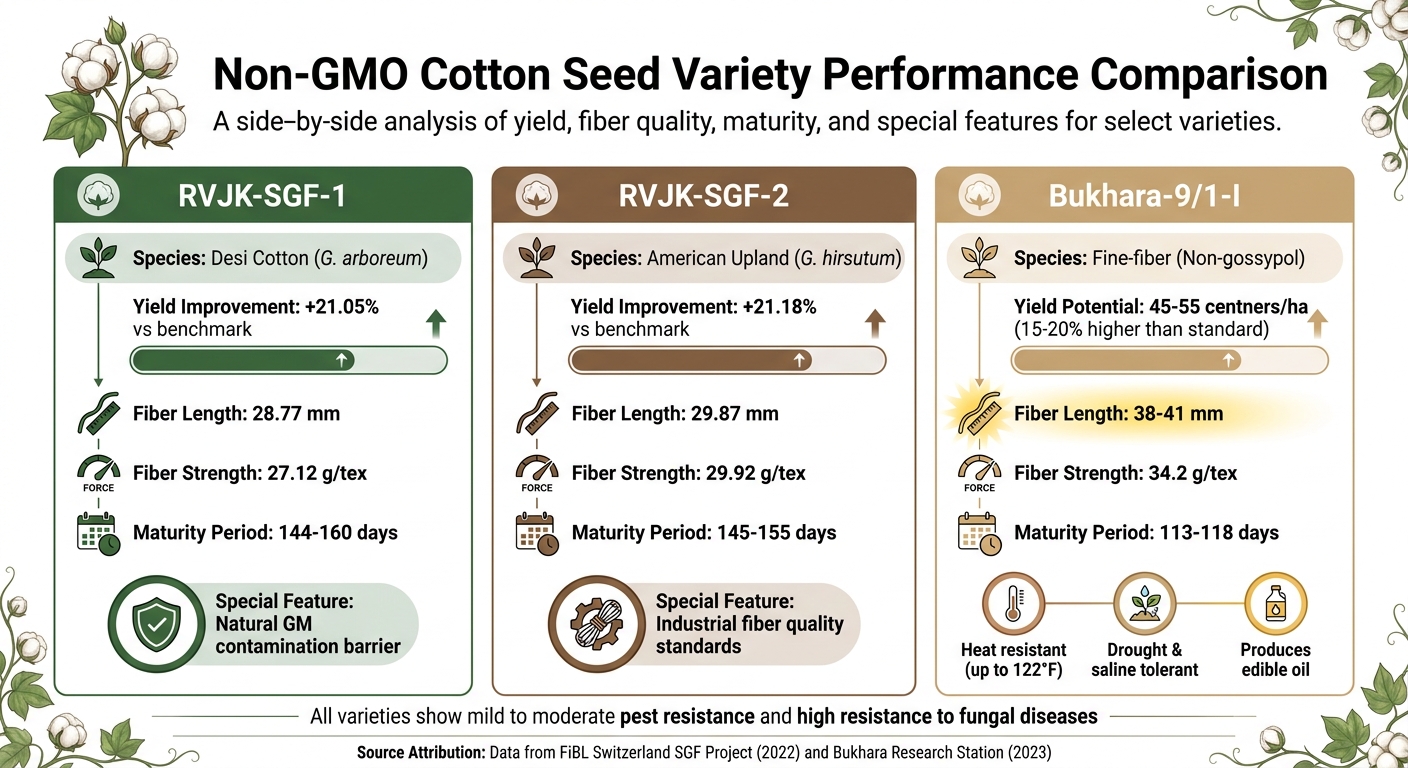
Non-GMO Cotton Seed Variety Performance Comparison
Fiber Quality and Growing Advantages
Modern non-GMO cotton varieties are designed to meet premium market demands, offering competitive or superior performance compared to conventional options. These advancements include improvements in yield, fiber strength, pest resistance, maturation time, and adaptability to environmental challenges, making them highly suitable for organic markets.
In September 2022, the Madhya Pradesh State Seed Sub Committee introduced two groundbreaking varieties under the "Seeding the Green Future" project. RVJK-SGF-1 (Desi cotton) outperformed benchmark varieties by 21.05% in yield, while RVJK-SGF-2 (American upland cotton) achieved a 21.18% yield improvement. Their fiber lengths - 28.77 mm and 29.87 mm respectively - and fiber strengths of 27.12 g/tex and 29.92 g/tex meet industrial fiber quality standards.
"These varieties enhance agrobiodiversity, improve smallholder livelihoods, and offer reliable choices between Desi and American upland cotton without compromising productivity, profitability, or quality." – Amritbir Riar, Project Leader, FiBL Switzerland
In August 2023, Uzbekistan's Bukhara Research Station unveiled Bukhara-9/1-I, a fine-fiber, gossypol-free variety. It delivers yields of 45–55 centners/ha, which is 15–20% higher than standard varieties. The fiber measures 38–41 mm in length with a strength of 34.2 g/tex. This variety matures in just 113–118 days, reducing late-season pest risks while maintaining high-quality fiber. Additionally, it thrives in extreme heat (up to 122°F), drought, and saline soils, making it ideal for challenging environments.
The absence of gossypol in Bukhara-9/1-I allows for the production of organic edible oil and high-protein flour through cold pressing. Beyond fiber quality and yield, non-GMO varieties show mild to moderate resistance to pests like pink bollworm and sucking pests, and high resistance to fungal diseases such as Fusarium and Verticillium wilt.
Non-GMO Seed Variety Comparison
The table below highlights the performance characteristics of these key non-GMO cotton varieties.
| Variety | Species/Type | Yield Potential | Fiber Length | Fiber Strength | Maturity (Days) |
|---|---|---|---|---|---|
| RVJK-SGF-1 | Desi (G. arboreum) | +21.05% vs benchmark | 28.77 mm | 27.12 g/tex | 144–160 |
| RVJK-SGF-2 | American (G. hirsutum) | +21.18% vs benchmark | 29.87 mm | 29.92 g/tex | 145–155 |
| Bukhara-9/1-I | Fine-fiber (Non-gossypol) | 45–55 c/ha | 38–41 mm | 34.2 g/tex | 113–118 |
This comparison highlights the advantages of shorter maturity periods combined with excellent fiber characteristics, making these non-GMO varieties strong contenders for organic farming systems. The RVJK varieties provide flexibility for growers to choose between Desi and American upland species based on their specific conditions and market needs. Meanwhile, Bukhara-9/1-I offers a premium choice for producers aiming at high-end textile markets and value-added seed products.
Creating Reliable Seed Supply Systems
Regional Seed Production Programs
Decentralized seed programs focus on developing varieties tailored to local soil, climate, and water conditions. This approach ensures farmers receive seeds that are suited to their specific environments, moving away from centralized corporate seed models.
A notable achievement in this area came in September 2022 with the release of RVJK-SGF-1 and RVJK-SGF-2 by the State Seed Sub Committee of Madhya Pradesh. These varieties were the result of a 10-year participatory breeding program led by FiBL Switzerland and its partners. Farmers were directly involved in selecting these varieties, which have since been successfully incorporated into regional programs. These efforts show that decentralized breeding can produce seeds that not only meet local needs but also achieve industrial fiber quality standards.
The SGF project also introduced an Organic Seed Performance Database, built from data collected over 300 trials across research stations and farmers' fields during a 4-year period. This tool helps farm partners and procurement teams identify which varieties perform best in specific regions. By testing seeds under real organic farming conditions instead of conventional high-input systems, these programs ensure the seeds are well-suited for low-input, regenerative agriculture. This regional approach complements earlier efforts in non-GM breeding by efficiently bringing locally adapted seeds to market.
Improving Farmer Access to Certified Seeds
While regional programs have made strides, smallholder farmers often face significant challenges in accessing certified organic seeds. Limited distribution networks and high costs are major barriers. To address this, formal partnerships between seed producers and organic cotton organizations have been established to ensure a steady supply of high-quality seeds.
In 2022, the Organic Cotton Accelerator (OCA) took a significant step by forming long-term agreements with four Indian seed producers - MARI Organics India, Paras Genetech, Parshv Genetics India, and Partech Seeds. These partnerships aim to scale up the production of organic cottonseed. A key part of this initiative is the creation of a Seed Trial Network, which provides seed producers with detailed feedback from farm groups. Farmers share insights on germination rates, pest resistance, and yields, enabling seed companies to refine their offerings based on real-world performance.
Direct relationships between brands and farmers have also proven effective. Since 2017, brands participating in the OCA Farm Programme, such as Patagonia and BESTSELLER, have partnered directly with farmers. These brands commit to purchasing organic cotton at premium prices and provide financial support early in the growing season. This model has helped participating farmers earn between 2% and 21% more annually compared to conventional farming, making certified organic seeds a more viable investment.
"The response must not be to retreat from organic cotton, but to invest more in supporting farmers to help them make the often-difficult conversion to organic on the ground." – Bart Vollaard, Executive Director, Organic Cotton Accelerator
Maintaining genetic purity is another critical aspect of certified organic production. Native Desi cotton (Gossypium arboreum) varieties naturally resist GM cross-pollination due to their unique chromosome structure and distinct leaf shapes. Additionally, multi-stage testing - at the seed, farm, and gin levels - ensures that organic integrity standards are upheld throughout the supply chain.
Conclusion
Main Points
Non-GMO advancements are reshaping the development of organic cotton seeds. Participatory breeding programs, such as those that produced RVJK-SGF-1 and RVJK-SGF-2 in September 2022, have demonstrated impressive results, with yields approximately 21% higher than standard benchmarks while still meeting industrial fiber quality requirements. These collaborative efforts, spearheaded by organizations like FiBL Switzerland, highlight how decentralized breeding can meet both agricultural and textile industry needs.
Maintaining seed purity remains critical for preserving organic certification. Native Desi cotton (Gossypium arboreum) serves as a natural barrier against GMO contamination. Additionally, strategic partnerships have improved access to certified seeds for smallholder farmers through Seed Trial Networks, which provide valuable performance feedback.
Non-GMO seeds offer significant economic benefits, reducing input costs and increasing farmer incomes by 2–21%. Innovations like non-gossypol cotton also present new opportunities by cutting processing costs by 45%.
These milestones lay the groundwork for future advancements aimed at improving resilience and expanding market opportunities.
Future Directions
The next phase of non-GMO cotton development will focus on tackling emerging challenges, particularly those related to climate resilience. By leveraging genetic diversity, the sector aims to expand the use of indigenous species that are naturally resistant to drought and local pests, creating a more climate-adapted cotton industry. The Organic Seed Performance Database, which compiles data from over 300 trials conducted over four years, provides a solid base for region-specific seed selection.
"The innovative model of collaboration is an example of the amalgamation of formal and farmer-managed seed system. It has the potential to scale up decentralised cotton breeding initiatives resulting in non-GM cotton varieties that meet the fibre quality requirements of the textile industry."
– Tanay Joshi, SGF Project Coordinator, FiBL
Expanding beyond India into regions like Pakistan will bring locally adapted organic seeds to a broader range of farmers. Another exciting trend is the development of multi-purpose cotton varieties that can meet textile fiber demands while also serving food or medical applications, offering farmers additional income streams. With premium brands increasingly prioritizing seed-to-shelf traceability, non-GMO innovations position organic cotton as a sustainable and transparent option that aligns with environmental objectives while improving farmer livelihoods.
FAQs
How can organic growers verify cottonseed is truly non-GMO?
Organic growers can make sure their cottonseed is non-GMO by purchasing from certified organic seed producers. These producers adhere to strict standards that ban genetic modification. It's also important to verify that the seeds are handled under protocols designed to prevent any GMO contamination. Moreover, organic breeding programs often use distinct morphological markers, which help maintain the purity of the seeds and simplify the verification process for growers.
What’s the fastest way to reduce GMO contamination risk on-farm?
The fastest way to reduce the risk of GMO contamination on your farm is to plant non-GMO cotton seeds that are developed through organic breeding or controlled pollination. Along with this, implement strict measures for sourcing seeds and maintaining isolation to prevent cross-contamination. These practices not only protect your crops but also ensure they meet organic certification requirements.
Where can farmers in the U.S. find certified non-GMO organic cottonseed?
Farmers in the U.S. now have access to certified non-GMO organic cottonseed through the Cottonseed Marketplace. This platform links buyers with reliable suppliers, simplifying the process of sourcing organic cottonseed.
Meanwhile, organic cotton varieties developed under organic conditions in India could influence future options in the U.S. These new varieties may align well with sustainable farming goals, providing exciting opportunities for growers looking to adopt eco-friendly practices.