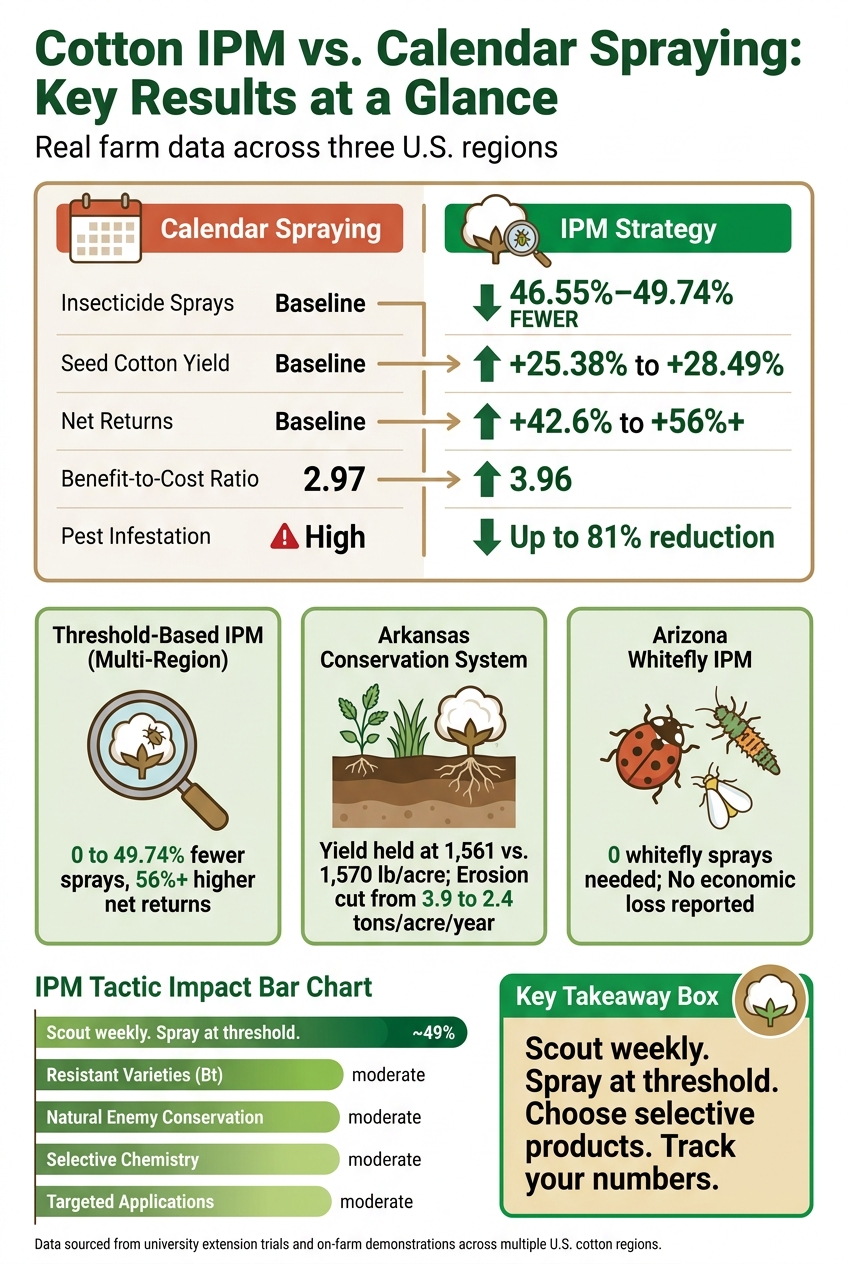
Cotton IPM helped growers spray less, spend less, and keep yields strong. In the cases covered here, insecticide use fell by 46.55% to 49.74%, net returns climbed by 42.6% to more than 56%, and one Arizona whitefly program got through the season with 0 sprays and no reported economic loss.
If you grow cotton, the message is simple:
- I would scout every week
- I would spray only at the economic threshold
- I would use selective products when a spray is needed
- I would track yield, spray cost, and return per acre
- I would look at field conditions, not the calendar
Here’s the short version of what stood out:
- Threshold-based IPM cut spray counts and improved returns
- Seed cotton yield increased by 25.38% to 28.49% in the spray-timing trials
- Benefit-to-cost ratio reached 3.96, compared with 2.97 under calendar spraying
- In Arkansas, lint yield stayed almost flat at 1,561 vs. 1,570 lb/acre, while soil erosion dropped from 3.9 to 2.4 tons/acre/year
- In Arizona, predator counts were strong enough that growers needed no whitefly sprays
| Case | Main change | Result |
|---|---|---|
| Threshold-based cotton IPM | Weekly scouting and threshold sprays | 46.55% to 49.74% fewer sprays; 42.6% to 56%+ higher net returns |
| Arkansas conservation cotton | Cover crops and reduced tillage | Yield held steady; 38% less erosion |
| Arizona whitefly IPM | Predator-based spray decisions | 0 whitefly sprays; no reported economic loss |
My takeaway: when I base pest control on scouting instead of fixed spray dates, I give myself a better shot at cutting costs without giving up production.
Cotton IPM vs. Calendar Spraying: Key Results at a Glance
Scouting for Cotton Insect Pests
sbb-itb-0e617ca
The IPM Practices Behind Lower Costs and Better Returns
Cotton IPM lowers spray use and trims costs by matching control to actual pest pressure. The playbook is pretty simple: scout fields every week, treat at the economic threshold, protect beneficial insects, and focus on problem spots instead of blanket-spraying whole fields. The goal isn't to spray less just for the sake of it. It's to cut input costs without giving up yield.
Where do the biggest savings come from? First, from scouting and threshold-based decisions. After that, product choice and spray timing make a big difference too.
Scouting and Economic Thresholds That Stop Unneeded Sprays
The biggest change is moving away from a calendar spray schedule and toward a need-based approach. Instead of spraying on set dates, growers treat only when pest counts hit the economic threshold, which is the point where control starts to pay.
That takes weekly scouting with sweep nets, plus square and boll counts. In plain terms, you're checking what's happening in the field before spending money on a spray pass. That one shift alone can keep a lot of unneeded applications off the books.
The table below shows which IPM tactics tend to cut sprays the most.
Selective Products, Natural Enemies, and Resistant Varieties
Selective products, Bt cotton, and natural-enemy conservation help keep pest pressure down without setting off flare-ups caused by wiping out beneficial insects. That's a big deal in cotton. A broad spray can knock pests back for a moment, then leave the field open for another pest problem right after.
Comparison Table: Which IPM Tactics Save the Most
| IPM Tactic | Typical Effect on Sprays | Impact on Pesticide Costs | Key Management Risk |
|---|---|---|---|
| Scouting & Thresholds | Reduces sprays by about 46.55% to 49.74% | Big drop from fewer field passes | Delayed scouting can miss pest surges |
| Resistant Varieties (Bt) | Lowers early-season bollworm pressure | Cuts need for lepidopteran-specific sprays | Resistance development over time |
| Natural Enemy Conservation | Reduces secondary pest flare-ups | Lower cost by leaning on biological control | Requires ability to identify beneficial insects |
| Selective Chemistry | Fewer total applications needed | Higher unit cost, lower seasonal spend | Limited availability of specific products |
| Targeted Applications | Treats only infested areas | Cuts treated acres and total product volume | Requires accurate field mapping and scouting data |
The next case studies show how these tactics changed spray counts, costs, and net return on real farms.
Case Study 1: Threshold-Based Decisions Cut Spray Costs in Cotton
The table above shows the pattern. This case brings it into the field.
In threshold-based IPM trials, growers used scouting and economic thresholds instead of spraying by the calendar. That shift led to fewer sprays and better profit.
Before IPM: Calendar Sprays, Higher Costs, and Lower Spray Selectivity
With calendar-spray practice, pest control relied on routine chemical applications. That meant more input costs and less selective spraying.
After IPM: Fewer Applications, Higher Yields, and Better Net Return
Once growers moved to IPM, insecticide applications dropped by 46.55% to 49.74%, seed cotton yield went up by 25.38% to 28.49%, and net returns increased by 42.6% to more than 56% compared with calendar-spray practice.
The economics improved too. Benefit-to-cost ratios reached 3.96 in IPM fields, versus 2.97 in traditional fields. In one trial, pest infestations fell by as much as 81%, while beneficial insects increased.
That’s the kind of result growers pay attention to: less spraying, more cotton, and better margins.
Before-and-After Metrics Table
| Metric | Calendar-Spray Practice | IPM Strategy | Result |
|---|---|---|---|
| Insecticide sprays | Calendar-based | 46.55%–49.74% fewer sprays | Lower input use |
| Seed cotton yield | Baseline | +25.38%–28.49% | Yield gain |
| Net returns | Baseline | +42.6% to more than 56% | Higher profit |
| Benefit-to-cost ratio | Up to 2.97 | Up to 3.96 | Better efficiency |
| Pest infestation | High | Up to 81% reduction | Stronger control |
The same pattern shows up in commercial cotton fields. Growers who use thresholds, conserve beneficial insects, and rely on spot treatment can cut costs without giving up yield.
Case Studies 2 and 3: Mid-South Beneficial Conservation and Western Precision Targeting
The same IPM logic showed up in two other regions too. But the tactics looked different on the ground. That’s the point: the principle stayed the same, while the field moves changed by region.
Mid-South Case: Cover Crops and Reduced Tillage Held Yield Steady
At the Judd Hill Foundation farm in the Mississippi Delta, a conservation-IPM system built around cover crops and reduced tillage kept lint yield basically flat while cutting erosion and helping soil moisture stay more even. Researchers from Arkansas State University, USDA-ARS, and the University of Arkansas ran a two-season field trial that compared standard management with the conservation system.
Here’s the big takeaway: yield held steady, erosion dropped, and soil moisture was more stable.
| Metric | Conventional System | Conservation/IPM System |
|---|---|---|
| Lint yield | 1,570 lb/acre | 1,561 lb/acre |
| Soil erosion | 3.9 tons/acre/year | 2.4 tons/acre/year |
| Soil moisture | Less consistent | Steadier |
That yield gap is tiny. Meanwhile, the soil side of the ledger moved in the right direction. For growers, that matters. If a system can hold output while easing erosion pressure, it’s doing more than just looking good on paper.
The western case takes the same idea and applies it in a different way. Instead of changing tillage and cover, it leans on predator counts to decide if a spray is needed in the first place.
Arizona Case: Predator-Based Thresholds Cut Whitefly Sprays
University of Arizona commercial on-farm whitefly demonstrations used predator-based thresholds and got through the season with no whitefly sprays and no reported economic loss.
| Metric | Conventional Practice | IPM (Predator-Based Thresholds) |
|---|---|---|
| Whitefly sprays | Standard sprays | 0 sprays needed |
| Economic loss | Baseline | None reported |
That’s a pretty clear result. The goal wasn’t to spray less just for the sake of it. The goal was to spray only when the field called for it. In these demonstrations, predator pressure did enough work that the spray pass never penciled out.
Put the two cases side by side, and the playbook is pretty simple: scout, use thresholds, and treat only the acres that need it. Those results lead straight into the field steps producers can use this season.
What These Results Mean for Cotton Producers and Gins
These case studies show a clear pattern: scouting and thresholds pay off. Across the examples, growers used scouting, thresholds, and selective controls to protect yield while cutting back on sprays. Conservation systems also kept yield steady while reducing erosion.
The data supports that, but the bigger takeaway is about day-to-day choices in the field. Fewer unnecessary sprays can mean lower input risk and more predictable margins. And that leads to a practical next move: use the same approach to guide field decisions this season.
For gins, higher returns and steadier production can support a more reliable grower base.
Steps Producers Can Act on This Season
Scout weekly, treat at threshold, and choose the most selective product that fits the pest. Keep field-by-field records on pest pressure, applications, and costs. Then, at harvest, compare those numbers with lint yield and net return.
That gives you the clearest read on whether your IPM program is helping the bottom line.
How cottongins.org Fits the Regional Cotton Network
For regional coordination, producers can also use cottongins.org to find nearby gins and stay connected to the regional cotton network.
FAQs
How do I set economic thresholds in my fields?
Set economic thresholds by scouting fields on a regular schedule, tracking pest numbers, and comparing what you find with established action levels.
For example, in Bt cotton, bollworm treatment may be justified at 20% egg lay. In other cases, thresholds are based on pest counts per plant or per leaf, or damage levels such as 6% damaged squares or bolls with larvae present. The goal is simple: spray only when the cost of control is lower than the yield loss you're likely to face.
What should I track to measure IPM profitability?
Track pest control costs, pesticide use, yield, and fiber quality. Then compare shifts in input costs, especially pesticide applications, against yield results to see the net economic return.
It also helps to watch pest infestation levels and beneficial insect populations over time. That gives you a clearer picture of whether your IPM program is cutting costs while keeping crop performance steady or pushing it higher.
When do selective sprays make more sense than broad-spectrum products?
Selective sprays make the most sense when pest numbers stay below economic thresholds or when you need to hit one pest, not everything in the field.
They also help protect beneficial insects and cut back on unneeded pesticide use when compared with broad-spectrum products.