Cotton consolidation centers simplify storage and shipping for the cotton industry by centralizing operations. These hubs store, sort, and prepare cotton for transport, reducing costs and improving efficiency. Key benefits include:
- Lower Costs: Shared facilities cut storage and transportation expenses.
- Improved Shipping: Combining smaller shipments into larger ones saves time and money.
- Better Coordination: Real-time inventory and shipping data enhance supply chain management.
For example, the Plains Cotton Cooperative Association (PCCA) in Oklahoma eliminated 80,000 trucking miles annually by integrating rail connections, enabling direct exports to Asia. These centers protect cotton quality, reduce trucking needs, and increase profitability for farmers and distributors alike.
Benefits of Using Cotton Consolidation Centers
Lower Storage Expenses
Cotton consolidation centers help cut storage costs by allowing multiple producers and ginners to share a single facility. This shared approach, known as multi-client warehousing, means you only pay for the space and services you actually need. Plus, by combining smaller shipments from the same region into larger, full truckloads, the per-unit cost of both handling and storage decreases. Modern inventory systems also provide real-time stock visibility, enabling producers to better time their shipments and avoid unnecessary long-term storage fees. These efficiencies contribute to smoother and more cost-effective shipping operations.
Simplified Shipping Operations
Shipping becomes much easier with consolidation centers, as they eliminate the hassle of managing numerous small shipments. Instead, smaller loads are combined into full-capacity deliveries, cutting transportation costs and reducing lead times. A great example of this is the Cotton On Group's Avalon Distribution Centre in Victoria, Australia. In 2020, the facility introduced a second Vanderlande TRAYSORTER system, a project completed three weeks ahead of schedule under the guidance of General Manager Andy Sanderson. This upgrade allowed the center to handle peak volumes more quickly and accurately, serving over 1,400 stores across 20 countries.
"With the Vanderlande solution, we have been able to dramatically reduce the time between picking items through to delivery, as well as improve picking accuracy."
– Andy Sanderson, General Manager, Cotton On Group Distribution
By improving shipping efficiency, consolidation centers not only save money but also strengthen communication across the supply chain.
Better Supply Chain Coordination
Consolidation centers also act as a hub for better coordination between producers, ginners, and distributors. With shared, real-time data on inventory, shipping schedules, and delivery timelines, everyone involved can work together more effectively. This reduces missed deadlines and improves planning for international shipments. Many centers are strategically located near gin facilities, which helps lower costs by shortening transportation distances. They also integrate with intermodal rail systems, cutting down on redundant trucking routes. Having access to real-time data further enhances route optimization and helps manage disruptions.
"Data Transparency and Export Efficiency are Non-Negotiable: Accurate and timely information... are fundamental for mitigating risks, optimizing routes, and ensuring the timely global delivery of cotton."
– Louis Dreyfus Company
sbb-itb-0e617ca
How to Operate Cotton Consolidation Centers
Tools for Managing Cotton Inventory
Managing cotton inventory effectively starts with utilizing advanced tracking technologies. Tools like RFID help with remote bale tracking, while NIR Spectroscopy ensures fiber purity. Optical sorting systems play a key role in maintaining consistent batch categorization, keeping quality standards high.
The PBI system is essential for standardizing bale packaging and tracking, which helps safeguard quality throughout the process. Additionally, warehouse reporting systems improve shipment monitoring and ensure compliance with shipping standards. For centers handling textile scraps or factory offcuts, SaaS platforms are excellent for optimizing inventory flow across the supply chain. Before implementing any tracking system, cotton must undergo a thorough cleaning process to remove contaminants like dirt and oils. It's also critical to monitor bale moisture levels to maintain lint quality during storage.
Improving Shipping and Transportation
Once inventory control is optimized, the next step is improving daily shipping operations. For facilities managing 501–1,500 orders per day, it’s best to use 2–4 loading bays with an additional 20% buffer space to avoid bottlenecks. Consolidate packages by destination pallet to simplify operations. Using zone-batch picking - grouping 15–30 orders at a time - can reduce handling time by up to 20%.
Dedicated staging lanes for carriers and strict loading checklists ensure accuracy. These checklists should verify SKU details, apply outbound labels, and batch shipments by carrier. This approach keeps trucks on schedule and minimizes errors. Consolidating shipments into daily windows can cut carrier costs by 28–35%, while optimizing pick sequencing boosts truck load utilization by 10–18%. For added efficiency, connect your Transportation Management System (TMS) to carriers via EDI or API, which eliminates manual errors and speeds up decision-making.
Adding Consolidation Centers to Current Operations
Start small by running a three-month pilot program on a single lane or a limited selection of SKUs. This allows you to measure metrics like cost per unit and lead time without disrupting your entire workflow. Systems like OMS and WMS should be integrated with event-driven updates every 1–5 minutes, and daily cycle counts on 10% of SKUs can help maintain 99.5% stock accuracy.
Set clear consolidation thresholds tailored to your operations. For instance, you might wait up to 12 hours to consolidate low-value orders or only trigger shipments when weekly volumes surpass specific cubic meter targets. Regularly track performance metrics like cost per package, average wait time before consolidation, and trucks loaded per shift. Before fully rolling out the program, negotiate favorable terms with carriers, such as fixed minimum-volume rates and capped accessorial fees (typically $20–$35 per consolidated shipment). These strategies ensure your consolidation center functions as an efficient extension of your existing supply chain.
Cotton Consolidation Center Success Stories
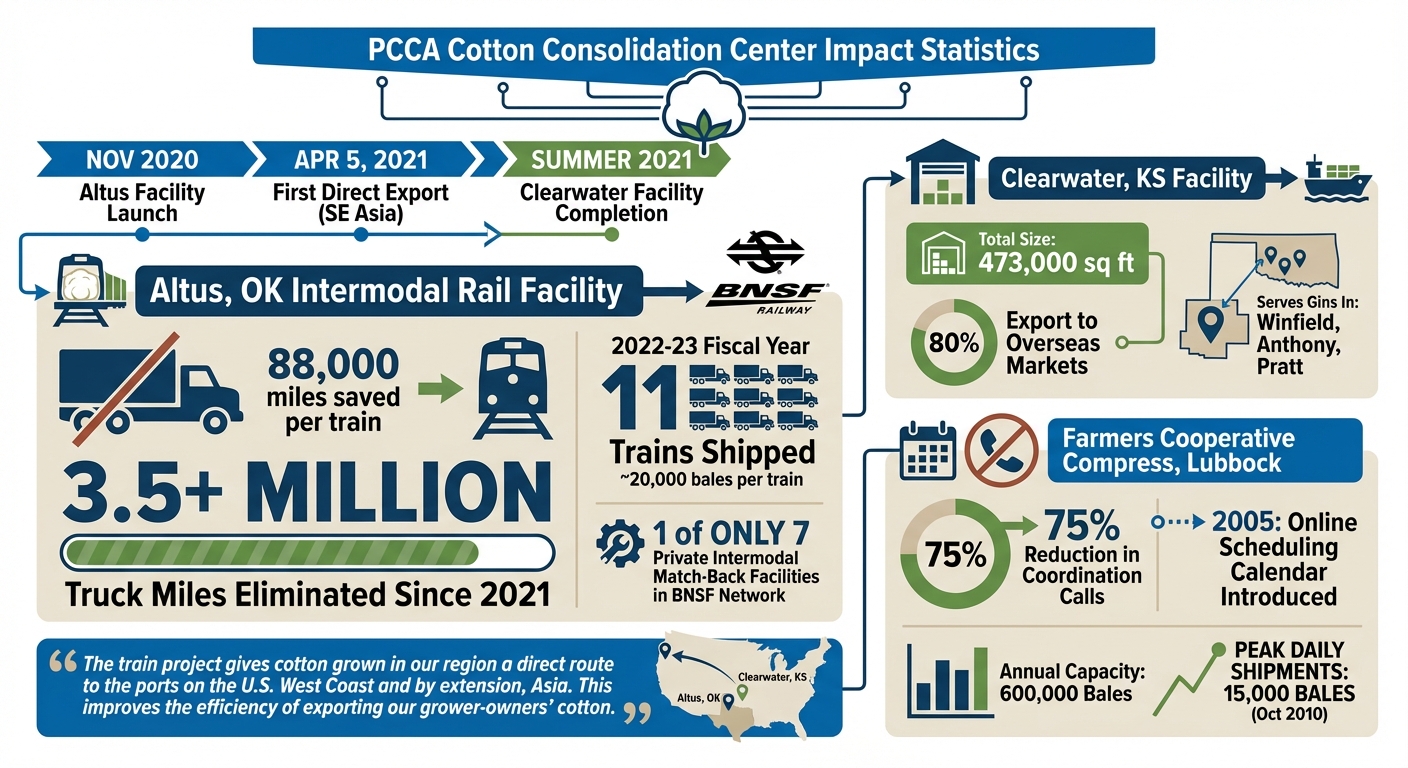
PCCA Cotton Consolidation Center Impact: Reducing Truck Miles and Improving Efficiency
Example: A Regional Cotton Consolidation Hub
Real-life examples show how consolidation centers can transform storage and shipping operations, making them more efficient and cost-effective.
Take the Plains Cotton Cooperative Association (PCCA), for instance. In November 2020, they launched a private intermodal rail facility in Altus, Oklahoma, under the leadership of Jay Cowart, Vice President of Warehouse Operations. This facility became one of just seven private intermodal match-back facilities in the BNSF Railway network. By April 5, 2021, PCCA shipped its first direct export to Southeast Asia, showcasing the cost-saving and efficiency benefits such centers bring.
One of the standout achievements? Loading trains directly at the warehouse eliminated the need to truck cotton to Dallas/Fort Worth, cutting 88,000 truck miles per train. Since its inception, the facility has removed over 3.5 million truck miles from the supply chain. During the 2022–23 fiscal year alone, PCCA shipped 11 trains, each carrying around 20,000 bales.
"The train project gives cotton grown in our region a direct route to the ports on the U.S. West Coast and by extension, Asia. This improves the efficiency of exporting our grower-owners' cotton."
Another success story is PCCA's Clearwater, Kansas facility, completed in the summer of 2021. Spanning 473,000 square feet, this regional hub consolidates cotton from gins in Winfield, Anthony, and Pratt for global distribution. Its strategic location helps reduce one of the most expensive parts of the supply chain - freight costs from gin to warehouse - with 80% of the cotton destined for overseas markets.
What Works: Lessons From Successful Centers
The success of these centers isn’t just about location - it’s about strategy.
One key factor is direct rail integration at the warehouse. By bypassing intermediate trucking, facilities achieve measurable improvements, including millions of truck miles saved. Additionally, custom tracking software ensures accountability and smooth operations throughout the loading process.
Another winning approach is resource consolidation. Combining warehouses allows for better use of labor, equipment, and capital.
The Farmers Cooperative Compress in Lubbock provides a great example of how technology can enhance efficiency. In 2005, they introduced an online scheduling calendar, which, according to Mike Nettles, Vice President of Operations, reduced coordination phone calls by 75%. This tool enabled the facility to handle 600,000 bales and ship 15,000 bales per day during peak periods in October 2010.
These examples clearly demonstrate how strategic consolidation not only trims costs but also streamlines the entire supply chain.
Conclusion: Improving Efficiency With Cotton Consolidation Centers
Cotton consolidation centers are reshaping how storage and shipping work for producers, ginners, and distributors. Take PCCA's hub in Altus, Oklahoma, for example - it has cut over 3.5 million truck miles from the supply chain since 2021, while also saving 88,000 road miles per train. These numbers translate into tangible cost savings and reduced environmental impact.
Built near gins, these centers eliminate the most expensive freight leg by integrating directly with rail systems, significantly reducing the need for trucking. Plus, indoor storage helps maintain fiber quality, which means higher payouts for your cotton. By centralizing labor, equipment, and capital, these facilities streamline operations and boost overall efficiency.
"The marketplace continually gives us feedback that cotton is more valuable to them if they can get it shipped timely. So that's our goal. If that allows our growers to get a better price, then that's where we can add the most value at the end of the day."
– Jay Cowart, Vice President of Warehousing, Plains Cotton Cooperative Association
The financial perks go beyond just cutting costs. When producers own these facilities, they can keep profits from storage and shipping services that would otherwise go to outside companies. Some cooperative centers even provide growers with steady annual dividends, offering a layer of long-term financial security. Altogether, these benefits combine to redefine supply chain efficiency.
Consolidation centers aren't just about cutting expenses - they're a game-changer that can turn your supply chain into a competitive edge.
FAQs
When does a cotton consolidation center make financial sense?
A cotton consolidation center becomes a smart financial move when its advantages - like streamlined logistics, lower costs, and better supply chain management - outweigh the upfront expenses. This is particularly relevant in regions where transportation costs are steep, ports face congestion, or handling large cotton volumes can lead to cost efficiencies.
How do consolidation centers protect bale quality in storage?
Consolidation centers play a key role in protecting bale quality by keeping storage conditions just right. They maintain humidity levels between 55% and 65% and ensure temperatures stay below 60°F. This careful control prevents problems like damage, contamination, or excess moisture, keeping the cotton in top-notch condition while in storage.
What systems need to integrate with a consolidation center?
To keep things running smoothly, a cotton consolidation center needs to bring together some essential systems. Tools like inventory management software, IoT sensors, and tracking technologies (like RFID and GIS) play a big role. These systems help monitor storage conditions, keep tabs on inventory, and fine-tune logistics processes.
A transportation management system (TMS) is another must-have. It ensures the efficient coordination of cotton shipments. On top of that, compliance systems are crucial for meeting USDA requirements and simplifying export documentation. When combined, these tools provide better visibility across the supply chain and help minimize mistakes.