Organic cotton fraud is a record problem. When paper files, PDFs, and email chains don’t stay linked to the cotton itself, bad data can move through the supply chain as if it were clean.
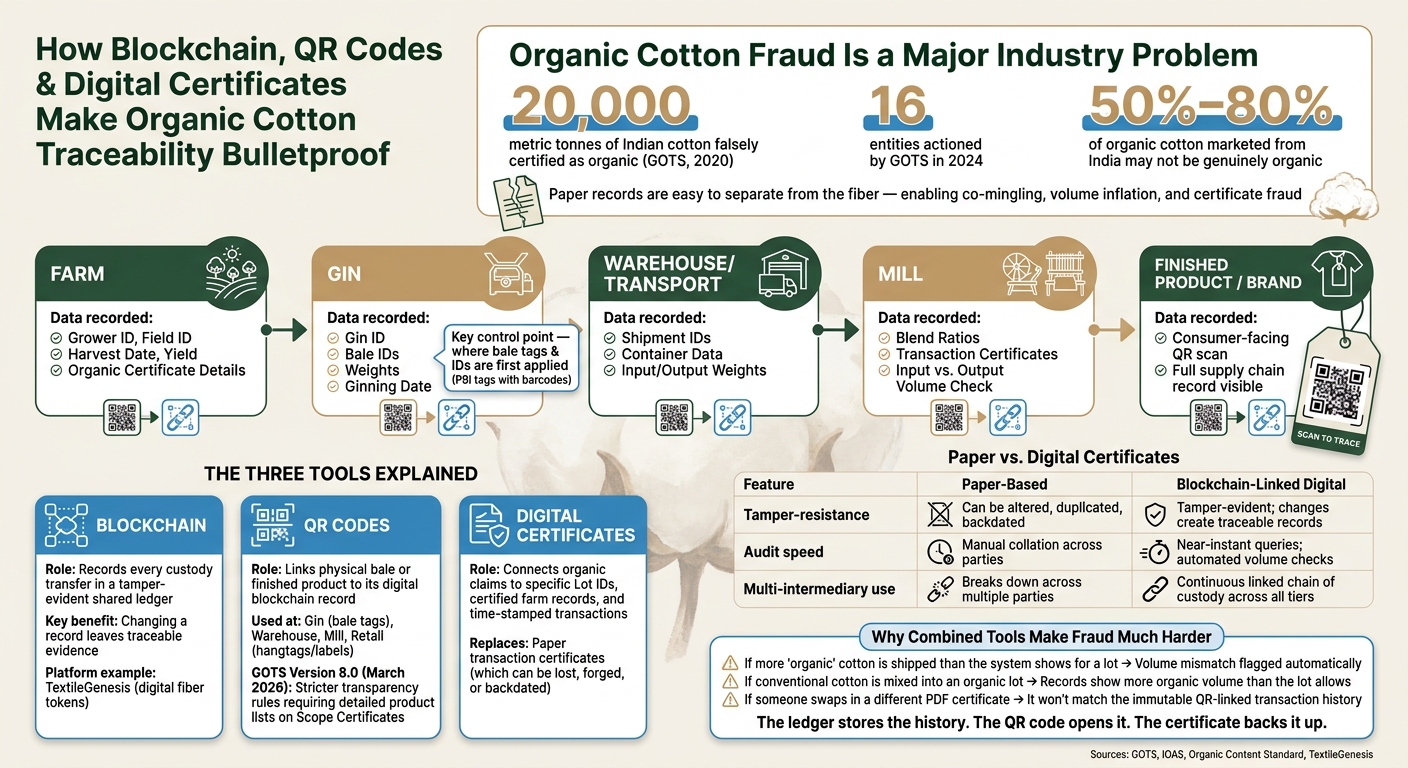
Here’s the short version: blockchain creates a tamper-evident chain of custody, QR codes tie that record to the bale or product, and digital certificates help auditors check lot IDs, dates, and volumes in one place. That matters when groups like GOTS have flagged 20,000 metric tons of falsely certified organic cotton and took action against 16 entities in 2024.
If I had to sum up the article in a few points, it would be this:
- The main weak spot is the handoff from farm to gin to mill
- Paper records are easy to split from the fiber
- Volume mismatches often point to blending or false claims
- Blockchain logs each transfer with time-stamped records
- QR bale tags connect physical cotton to digital records
- Digital certificates cut fraud risk by linking each claim to a lot history
- Buyers and auditors now want transaction-level proof, not loose paperwork
A simple way to think about it: the ledger stores the history, the QR code opens it, and the certificate backs it up.
| Tool | What it does | Main use |
|---|---|---|
| Blockchain | Records custody changes in a shared ledger | Tracks chain of custody |
| QR codes | Links a bale or product to its digital record | Checks identity at each handoff |
| Digital certificates | Connects claims to lot IDs and volumes | Supports audits and claim checks |
So if you grow, gin, spin, mill, source, or buy organic cotton, the core idea is simple: keep the bale, the record, and the certificate tied together from start to finish.
Organic Cotton Traceability: How Blockchain, QR Codes & Digital Certificates Work Together
The Traceability Problems Organic Cotton Businesses Face
Fraud, Blending, and Mislabeling in High-Value Fiber
Organic cotton sells at a premium, and that price gap gives bad actors a clear motive to cheat. The most common play is co-mingling: conventional cotton gets mixed into organic lots at storage yards, on trucks, or inside gin facilities, and then the whole batch is sold as certified organic. There’s no clear physical marker that separates one from the other, so the deception sits in the records, not the fiber itself.
That’s part of what makes this so hard. On paper, everything can look fine. In practice, the cotton may not match the claim.
Investigators and people inside the trade have estimated that 50% to 80% of organic cotton marketed from India may not be genuinely organic because of substitution and inflated volume across the supply chain. Parts of the market have been described as paper certificates traded without physical verification, where each deal works more like a certificate swap than a checked link to actual bales. Downstream, fiber content claims are often misstated, even when mills think they’re buying certified inputs.
For U.S. businesses, the fallout can be brutal: certificate withdrawals, rejected shipments, and reputational damage that doesn’t fade fast.
The trouble often begins at the first physical handoff, when the paper trail and the cotton stop lining up.
Why Farm-to-Gin-to-Mill Handoffs Are the Hardest Part
Farm-to-gin-to-mill handoffs are where traceability tends to break. Each lot needs to carry a full set of details, including bale IDs, lot numbers, seed cotton and lint weights, ginning dates, source farm IDs, and the related scope and transaction certificate numbers. If any of that is missing, entered wrong, or not tied to the physical bale, auditors can’t confirm that the bale matches the claimed certified origin.
The gin is the key control point. This is the stage where seed cotton becomes bales, and where bale tags and IDs first get applied. U.S. cotton already uses Permanent Bale Identification (PBI) tags with barcodes at the gin, which gives the industry a solid technical base. But tying those tags to organic certification data and full digital chain-of-custody systems is still a work in progress for many operations.
A lot of audit trouble comes down to volume reconciliation. If the total organic lint recorded at gins and sold downstream is more than certified farms could have produced, that points to substitution or inflated volume, even when the individual certificates look clean at first glance.
That kind of mismatch is exactly what digital chain-of-custody records are meant to catch.
What Buyers and Auditors Now Expect
As scrutiny grows, buyers and auditors want transaction-level proof, not just a certification claim. Brands and retailers are asking for lot-level records that show the organic cotton in a given purchase order traces back to verified bales from certified farms, with no unexplained jumps in volume along the way.
And they don’t want those records buried in inboxes as scattered PDFs. They want them fast, organized, and easy to pull up.
Auditors are tightening their checks too. Chain-of-custody rules can call for assessors to review at least 10 to 15 transactions across seed cotton purchase, lint production, and lint sale, while also checking turnout ratios, physical inventory, and related documentation against each other. Organic Content Standard procedures also require auditors of gins to have training in organic cotton farm certification and processes. For U.S. gins and mills, a failed audit can lead to downgrades, corrective actions, or decertification.
sbb-itb-0e617ca
Bharat Tex Connect | “Evolving Traceability in Global Cotton” | Eva Benavidez Clayton | IFBEC
How Blockchain Builds a Tamper-Resistant Chain of Custody
Blockchain logs each custody transfer in a shared ledger that’s hard to change without anyone noticing. Once a record is added, changing the chain of custody without leaving evidence becomes much harder.
What Gets Recorded at Each Step
Every handoff in the farm-to-gin-to-mill chain creates a checkpoint on the ledger.
At the farm, the record can include grower ID, field ID, harvest date, yield, and organic certificate details. At the gin, it can include gin ID, bale IDs, weights, and the ginning date. Farther down the chain, records can include shipment IDs, container data, input and output weights, blend ratios, and transaction certificates.
Put simply, each bale ends up with a traceable custody trail. But there’s a catch: the records only matter if the bale can still be matched to a physical tag.
Platforms Used for Textile Traceability
TextileGenesis tracks fiber using digital tokens that move with each certified transfer, which helps keep claimed organic volume from going past verified supply. If the input volume doesn’t back up the claim, automated rules can stop a lot from being labeled fully organic.
That matters for a simple reason. If a system lets more “organic” output appear than verified input, the whole record starts to fall apart.
Direct Value for Growers, Gins, and Mills
For growers, gins, and mills, the biggest upside is faster reconciliation. One ledger can take the place of scattered certificates, emails, and spreadsheets.
And if an organic claim gets questioned, a verifiable, unbroken chain of custody from a specific farm to a finished product puts a business in a much stronger position with buyers that want proof of sourcing.
The ledger stores the history. QR codes make that history visible on the bale, carton, or finished product. That link is what QR codes show clearly at the gin and farther down the chain.
How QR Codes Link Physical Cotton to Digital Records
Blockchain keeps the custody record. QR codes connect that record to the actual bale, carton, or hangtag.
That connection matters most at the gin. This is the first point where physical cotton bales need to stay tied to their digital records without mix-ups.
QR Bale Tags at the Gin and Through the Supply Chain
At the gin, a QR bale tag can link to the bale’s unique ID and blockchain record. From there, that same link can stay attached to the lot as it moves through the warehouse and on to the mill.
A simple way to think about it: the blockchain holds the history, and the QR tag acts like the door into that history.
Use bale-tag QR codes for checks at the gin, warehouse, and mill. Then use product QR codes on finished goods for buyer and consumer scans.
Those scans matter because the next proof step is making sure each tag matches the right certificate and lot record.
Consumer-Facing QR Scans on Finished Goods
The same traceability record can also appear on a hangtag or sewn-in label. Buyers and consumers can scan the code to view the digital supply chain record.
GOTS Version 8.0, scheduled for March 2026, will add stricter transparency rules, including detailed product lists on Scope Certificates.
That means gin staff can confirm bale identity, auditors can review batch history, and shoppers can scan the finished product. Once the QR code shows the record, the next step is checking whether that record is valid.
Certification Verification, Fraud Prevention, and Next Steps
Replacing Paper Certificates With Digital, Audit-Ready Records
Once a QR scan opens a bale or product record, the next step is simple: check whether the certificate behind it is legit.
That’s where paper records often fall apart. Paper transaction certificates can be lost, forged, backdated, or separated from the cotton they’re supposed to track. In 2020, GOTS confirmed that 20,000 tonnes of Indian cotton - about one-sixth of the country’s organic cotton output that year - had been falsely certified as organic. GOTS and its accreditation body IOAS also found fake raw cotton transaction certificates during surveillance audits.
Digital certificates linked to a blockchain record fix the most obvious weak spots. Each certificate connects to a specific lot ID, a certified farm record, and a time-stamped transaction. That gives auditors a direct way to compare shipped volume with certified volume, without piecing together stacks of paperwork.
| Feature | Paper-Based Certificates | Blockchain-Linked Digital Certificates |
|---|---|---|
| Tamper-resistance | Can be altered, duplicated, or backdated without detection | Tamper-evident; any change creates a traceable record |
| Audit speed | Manual collation and cross-checking across parties | Near-instant queries; automated volume checks |
| Works across multiple intermediaries | Breaks down with multiple intermediaries | Continuous, linked chain of custody across all tiers |
These records also make life easier for certifiers and buyers. Instead of waiting for scanned documents to arrive, they can review the data directly.
How Combined Tools Cut Fraud Risk
This kind of verification matters because the main safeguard isn’t just one tool. It’s the fact that every document and every scan has to line up with the same lot history.
Fraud becomes much harder when lot IDs, QR scans, and digital certificates all point to the same transaction trail. If someone tries to ship more “organic” cotton than the system shows for a given lot, the mismatch is flagged right away. If conventional cotton gets mixed into an organic lot, the records would show more organic volume than the lot allows. And because certificates are tied to specific lot IDs and QR codes, swapping in a different PDF doesn’t fix the mismatch with the immutable transaction history.
Conclusion: Key Points for U.S. Cotton Businesses
Organic cotton traceability breaks down when records are scattered across email inboxes, spreadsheets, and filing cabinets. Blockchain gives each lot one tamper-resistant history from the farm to the gin, mill, and finished product. QR tags link physical bales and finished goods to that record at each handoff. Digital certificates back up the organic claim behind every scan.
For growers, gins, mills, merchants, and brands, that means faster audits, fewer disputes, and stronger proof of organic origin.
FAQs
How does blockchain stop cotton records from being changed?
Blockchain makes cotton records hard to alter because it stores each step on a secure, decentralized digital ledger. Once an entry is recorded, it’s effectively tamper-proof. In plain English, that means no one can quietly go back and rewrite the record later.
Access is permissions-based, and the data is captured in a standard format. So the people involved can check what was logged at that moment, instead of arguing over a file that may have been edited after the fact. Smart contracts add another layer here. They can run automatic cross-checks when new entries come in, rather than changing older records.
What happens if a QR bale tag is missing or scanned incorrectly?
If a QR bale tag is missing or scanned the wrong way, the physical link to the digital record is lost. And once that happens, traceability gaps can show up fast. It can also trigger nonconformance issues because the chain of custody is no longer clear.
To stay compliant and audit-ready, facilities need to confirm the mismatch through internal checks before moving ahead with processing or certification. That can mean cross-checking batch logs or using physical markers like DNA tags to verify the product’s identity and origin.
How do digital certificates help catch volume mismatches?
Digital certificates help catch volume mismatches by requiring Transaction Certificates for every transfer of certified organic cotton. Each certificate lists the exact volume involved.
From there, facilities reconcile those volumes so auditors can check that the amount coming in matches the amount going out. If the numbers don’t line up, certificate records and audits flag those irregularities before certification decisions are finalized.