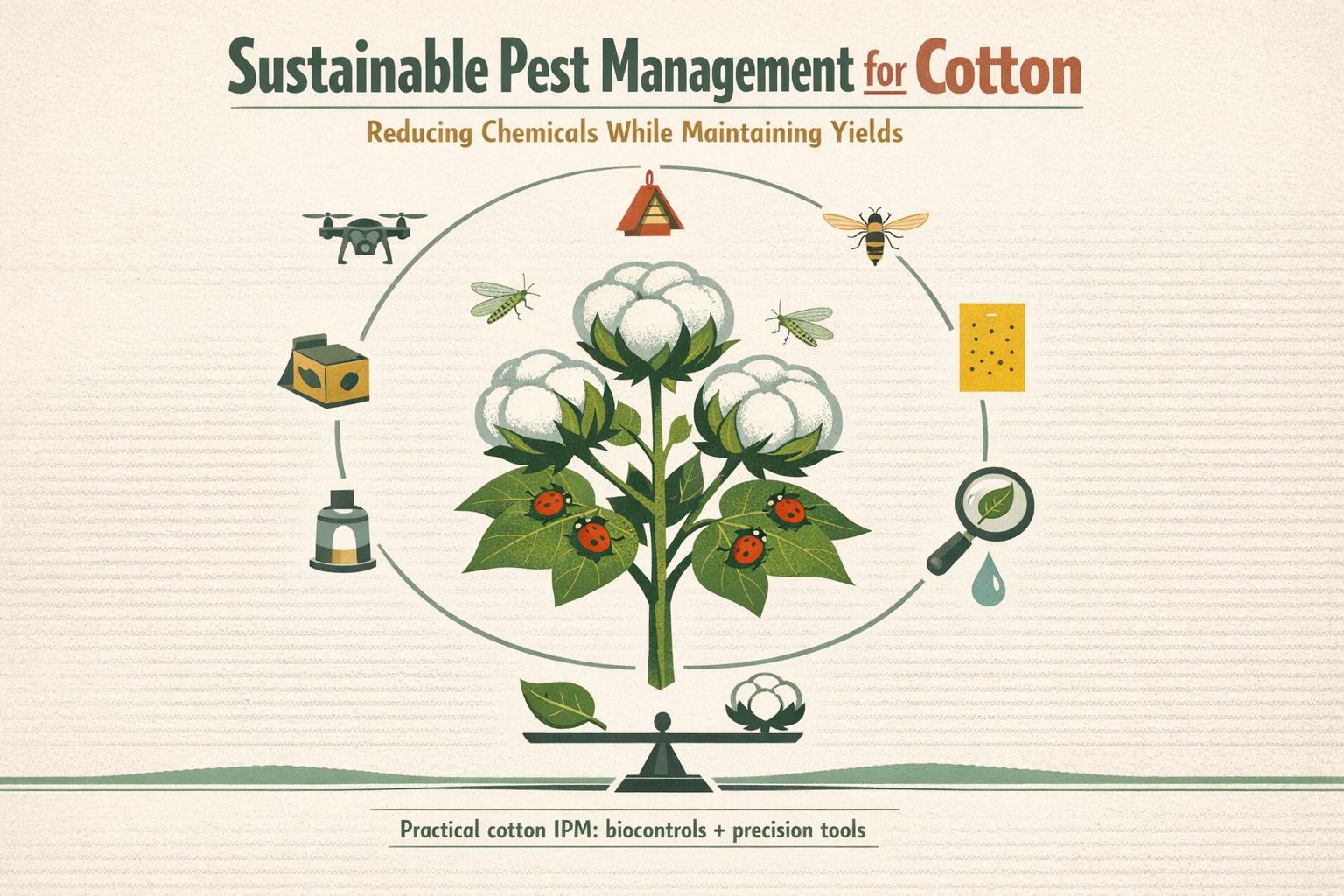
Biopesticides are reshaping cotton farming by offering pest control solutions derived from natural sources. Unlike synthetic pesticides, they target specific pests, protect beneficial insects, and leave no harmful residues. In the U.S., transgenic Bt cotton has reduced insecticide use by up to 81% in Texas from 1996 to 2015, significantly cutting costs and improving worker safety. Farmers also use neem oil and microbial agents to manage pests effectively while supporting natural predators like big-eyed bugs.
Key findings include:
- Bt cotton and IPM programs reduce pesticide use by 38–46%.
- Neem-based biopesticides can match synthetic pesticides in performance, with lower toxicity.
- Resistance to older Bt traits is a growing issue, emphasizing the need for integrated approaches.
- Biopesticides improve cotton quality, reduce ginning issues like sticky cotton, and meet strict export standards.
To maximize results, farmers should combine biopesticides with early applications, natural enemy support, and smart field management. This approach not only maintains yields but also ensures profitability and better-quality cotton for the market.
Methods and Data Sources for Biopesticide Studies
Field Trial Designs Used in Cotton Biopesticide Research
Good research starts with a solid trial design. In U.S. cotton studies, the Randomized Complete Block Design (RCBD) is a go-to method. This approach divides fields into blocks to account for natural factors like soil quality and pest pressure. Each block includes all treatment types - biopesticide plots, conventional plots, and untreated controls - ensuring fair comparisons. This setup helps researchers collect data that reflects real-world conditions.
To simulate actual farming scenarios, researchers often scale these trials up to larger field sizes (20–80 acres). For instance, a six-year study (1996–2001) led by Sean L. Swezey at the University of California, Santa Cruz, compared organic, IPM (Integrated Pest Management), and conventional cotton systems in California’s Northern San Joaquin Valley. The study found that IPM fields reduced insecticide use by 38% compared to conventional fields (0.63 kg AI/ha vs. 1.02 kg AI/ha).
"Organic fields had significantly more generalist insect predators than conventional fields during at least one seasonal interval in all but one year." - Sean L. Swezey, University of California, Santa Cruz
Another key feature in these trials is threshold-based application, which mimics how farmers decide when to apply treatments. This approach provides practical, field-relevant data that goes beyond controlled lab experiments.
Data Metrics That Matter to U.S. Cotton Growers
Once trials are set up, researchers focus on metrics that matter most to cotton growers. They use tools like weekly sweep net samples and visual leaf counts to monitor pests such as bollworms, aphids, and Lygus bugs. Plant mapping, or "box mapping", tracks fruit survival at each node, connecting pest activity to yield outcomes.
To make sense of data across multiple studies, researchers rely on meta-analysis with log response ratios. This method standardizes data from various trials, revealing trends that might be missed in a single experiment. For example, a meta-analysis of 910 field trials across the U.S. Cotton Belt (1996–2015) showed that Bollgard II was 17.9% more effective than WideStrike in reducing heliothine infestations.
"Compiling large numbers of experiments together in a meta-analysis increases the precision of estimation, allowing researchers to detect small changes in susceptibility or other variables that are not possible with individual experiments." - Fleming et al., Mississippi State University
Here are some of the key metrics and how they’re collected:
| Data Metric | Collection Method | Why It Matters |
|---|---|---|
| Pest Incidence | Sweep nets & visual leaf counts | Tracks pests like bollworms, aphids, and Lygus bugs |
| Plant Damage | Fruit retention (box) mapping | Links pest pressure to economic loss in squares and bolls |
| Yield | Gin records (bales/acre) | Evaluates the financial success of the biopesticide program |
| Lint Quality | HVI (High Volume Instrument) classing | Impacts market price based on fiber characteristics |
| Natural Enemy Populations | Predator-to-pest ratio counts | Ensures biopesticides don’t harm beneficial insects |
| Economic Impact | Post-harvest grower interviews | Assesses cost-effectiveness and net returns per acre |
Tracking natural enemies, like minute pirate bugs, lacewings, and big-eyed bugs, is another critical part of these studies. Biopesticide systems consistently support higher populations of these beneficial insects compared to conventional synthetic programs. This highlights their role in promoting long-term field health rather than just focusing on immediate pest control.
sbb-itb-0e617ca
Case Studies: Biopesticide Applications in Cotton Fields
Combining Neem with Reduced Synthetic Insecticides
A six-year study (1996–2001) conducted in California's Northern San Joaquin Valley, led by Sean L. Swezey, explored a combination of early planting, green lacewing larval releases (around 4,860 per acre), and reduced synthetic insecticide use. The results were impressive: insecticide use dropped by 38%, from 0.91 lbs AI/acre in conventional fields to 0.56 lbs AI/acre in IPM fields, all while maintaining Lygus hesperus populations below action thresholds. This approach highlights how biopesticides can integrate effectively into U.S. cotton IPM programs.
In December 2006, a trial in Benin by Université d'Abomey Calavi and Wageningen University tested neem seed extract (about 5.4 lbs/acre) paired with a half-dose synthetic pesticide over six applications. This combination performed as well as a full-dose synthetic program in controlling bollworms, with the added benefit of being more cost-effective.
| Treatment | Bollworm Control | Impact on Natural Enemies | Cost-Effectiveness |
|---|---|---|---|
| Full-Dose Synthetic | High | Highly toxic | Moderate |
| Neem + Half-Dose Synthetic | High | Moderately toxic | High |
| Neem Extract Alone | Moderate | Non-toxic | Moderate |
| Nano-formulated Neem (PONNEEM) | Very High (90.2% mortality) | Low toxicity | High |
These findings point to the potential for broader use of botanical options in bollworm management.
Using Botanical Biopesticides to Control Bollworms
Botanical biopesticides are proving to be a strong option for bollworm control, especially when used repeatedly or in advanced formulations. For example, a 2025 trial at Sindh Agriculture University in Tandojam, Pakistan, led by Perwaiz Paryal and Sohail Ahmed Otho, showed that neem (Azadirachta indica) extract reduced pink bollworm (Pectinophora gossypiella) infestation by 57.2% after the first application, with a second treatment increasing control to 62.7%.
Nano-formulated biopesticides are pushing the boundaries of pest control. A 2025 systematic review highlighted the effectiveness of "PONNEEM", a blend of neem oil, karanj oil, azadirachtin, and karanjin. When encapsulated in chitosan nanoparticles (CSNs-TPP-PONNEEM), it achieved a 90.2% mortality rate against Helicoverpa armigera at a 0.3% concentration, outperforming the 73.6% mortality rate of the non-encapsulated version. Additionally, the nano-carrier delivered an 88.5% antifeedant effect.
"The nano-emulsion formulation allowed for a controlled release of the essential oil, which prolonged the insecticidal effect and improved persistence in the field." - Frontiers in Agronomy
However, challenges remain. A 2026 study in Benin focusing on organic transition programs revealed that while biopesticides effectively controlled bollworms (Earias spp.), they also led to an increase in whitefly (Bemisia tabaci) populations, emphasizing the importance of monitoring for sucking pests. These insights demonstrate the cost benefits and long-term potential of biopesticides while highlighting the need for well-rounded IPM strategies tailored to U.S. cotton growers.
Economic Impact of Biopesticide Use in Cotton
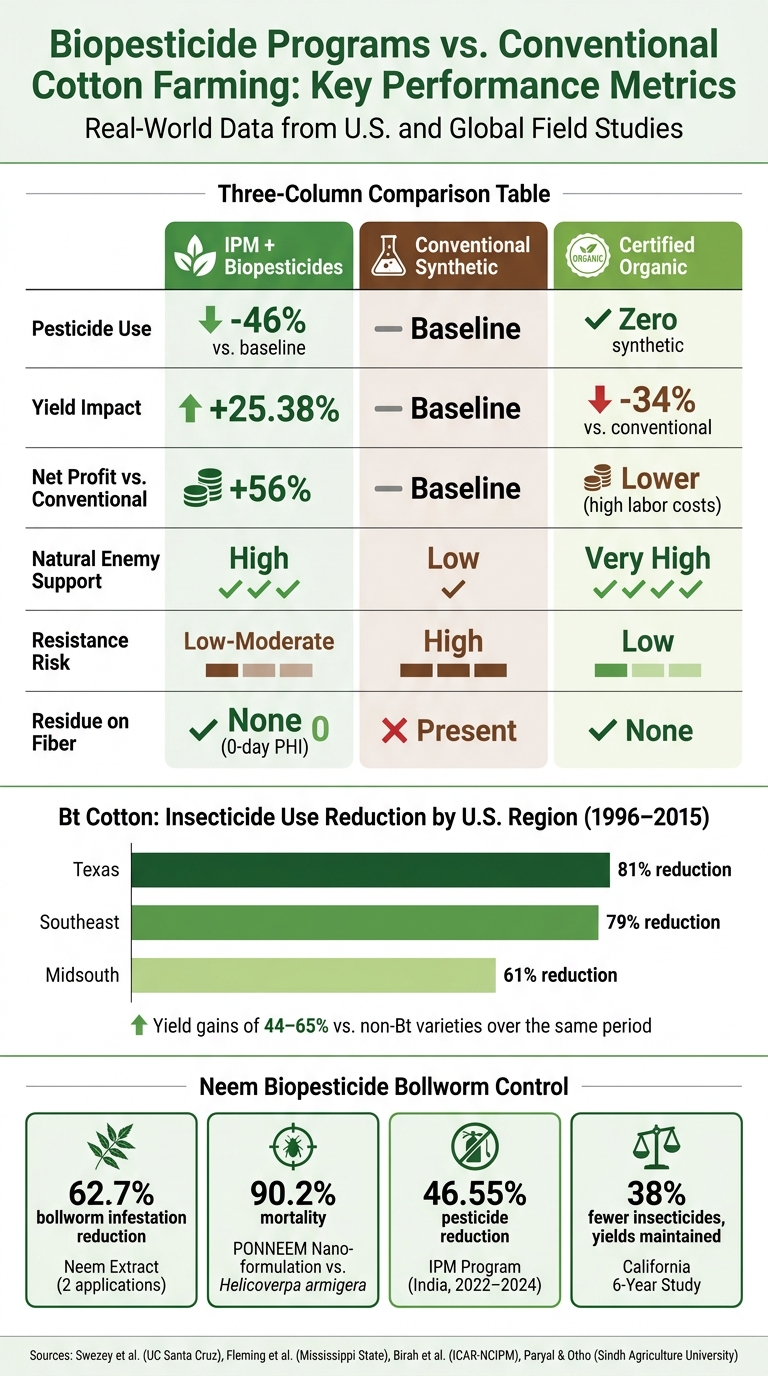
Biopesticide vs. Conventional Cotton Farming: Key Performance Metrics
Cost-Benefit Analysis of Biopesticide Programs
Let’s dive into how biopesticide programs impact cotton farming financially. After reviewing how these strategies perform in the field, it’s time to look at the numbers.
The profitability of biopesticides depends heavily on how they’re used. For example, organic cotton systems come with much higher costs - about 37% more per bale compared to conventional systems. This is largely due to increased labor for hand-weeding and lower yields - 1.8 bales per acre versus 2.7 bales per acre in conventional systems.
On the other hand, integrated pest management (IPM) programs tell a more promising story. A field study conducted between 2022 and 2024 by Ajanta Birah at ICAR’s National Research Institute for Integrated Pest Management in Khandwa, India, tested an IPM approach for Bt cotton. This program combined neem oil (Azadirachtin 1500 ppm), pheromones, and cowpea intercropping. The results were striking:
- Pesticide use dropped by 46.55%.
- Seed cotton yields increased by 25.38%.
- Net returns improved by over 56% compared to standard farmer practices.
"IPM strategy proved highly effective in reducing major cotton pests, ecologically safer by enhancing natural enemy population, and significantly lowering pesticide use across three seasons along with high benefit-cost ratio." - Ajanta Birah et al., ICAR-National Research Institute for Integrated Pest Management
Here’s a quick comparison of key metrics for different cotton farming programs:
| Program Type | Pesticide Use | Yield Impact | Net Profit vs. Conventional |
|---|---|---|---|
| Integrated (IPM + Biopesticides) | Reduced ~46–47% | +25.38% | +56% |
| Conventional Synthetic | Baseline | Baseline | Baseline |
| Certified Organic | Zero synthetic | −34% vs. conventional | Lower (due to high labor costs) |
In the U.S., transgenic Bt cotton - essentially a plant-incorporated biopesticide - has delivered substantial financial benefits. From 1996 to 2015, it cut insecticide use by 61% in the Midsouth, 79% in the Southeast, and 81% in Texas, while boosting yields by 44% to 65% compared to non-Bt varieties.
While these numbers highlight the economic advantages, other factors also play a big role in long-term profitability.
Factors That Affect Profitability
One major challenge is pest resistance. For instance, in the U.S. Midsouth and Southeast, the yield benefits of older dual-gene Bt technologies like Bollgard II and WideStrike started to decline between 2010 and 2015 as pests like Helicoverpa zea developed resistance. Farmers who relied solely on these traits without additional pest management saw their profits shrink. The adoption of newer triple-gene technologies, such as WideStrike 3, helped recover some of these losses.
Cotton quality also impacts profits. Research from the University of Ioannina revealed that seed coatings with Beauveria bassiana (Velifer®) improved plant biomass and chlorophyll levels while reducing Aphis gossypii populations by 29.9%.
For farmers transitioning to organic systems, intercropping cotton with soybeans can provide a financial safety net. A 2026 study in Benin found that biopesticide-treated cotton–soybean intercrops could match or even exceed the profitability of conventional systems during the first year of transition. Soybean income helped offset the lower cotton yields.
"Despite lower cotton yields, intercropping improved overall profitability relative to sole-crops in transition to organic and, in several cases, performed similarly to or better than conventional cotton, mainly due to additional soybean production." - Agriculture, Ecosystems & Environment
These examples show that combining biopesticide use with smart field management can lead to better financial outcomes over time. It’s not just about using biopesticides - it’s about using them as part of a broader, well-thought-out strategy.
Practical Recommendations for U.S. Cotton Growers and Ginners
Integrated Pest Management Strategies Using Biopesticides
To maximize the effectiveness of biopesticides and their economic benefits, proactive application is key. Waiting until pests cause visible damage can reduce the effectiveness of these products. For instance, biopesticides like Chromobacterium subtsugae work by disrupting insect feeding and reproduction, rather than providing an immediate knockdown. This means they perform best when applied early, before pest populations reach their peak.
A layered approach to Integrated Pest Management (IPM) is particularly effective. Begin with a microbial seed coating at planting, such as BASF's Velifer®, which has shown strong field results by reducing the need for foliar sprays. As pest pressure increases, start with a synthetic insecticide to quickly lower pest numbers, followed by biopesticides to maintain control. This method not only suppresses further pest activity but also slows the development of resistance, a common issue when relying on a single control method.
Supporting natural enemies is another important tactic. Practices like cowpea intercropping can encourage beneficial insects, while pheromone formulations such as SPLAT can disrupt pink bollworm mating cycles, further enhancing pest control efforts.
"Integrated programs can increase growers' bottom lines with better yields and quality, which is what is driving the growth and adoption of biopesticides by conventional growers." - Pamela G. Marrone, Founder, Invasive Species Corporation
Proper application techniques are critical for success. Follow label guidelines closely to avoid over-diluting active ingredients, and consult manufacturers about the use of adjuvants. These measures ensure consistent results and contribute to sustainable cotton production. Alongside improved pest control, these strategies can enhance both yield and fiber quality at harvest.
How Biopesticides Affect Cotton Gin Operations
The advantages of biopesticide use extend beyond the field, offering direct benefits to cotton gin operations. Field decisions significantly impact what happens on the gin floor, and this connection is particularly evident with "sticky cotton." Sticky cotton results from honeydew secretions by pests like Aphis gossypii, which encourage the growth of sooty mold (Ascomycetes). This mold not only stains fibers but also clogs gin machinery, slowing processing and increasing cleaning downtime. Researchers from the University of Ioannina highlighted this issue:
"Aphis gossypii secretions can cause the growth of the multi-phytopathogenic fungi, Ascomycetes (Sooty mold), which coats the leaves and blocks sunlight, resulting in low photosynthetic quality." - Vasileios Papantzikos et al., University of Ioannina
Biopesticides, particularly those based on B. bassiana or neem, are effective at controlling aphid populations, reducing the risk of sticky cotton and its associated problems. Cotton grown under biopesticide-heavy IPM programs often arrives at the gin cleaner, leading to faster processing and less mechanical wear.
Another key advantage is residue management. Biopesticides generally have a zero-day pre-harvest interval (PHI), allowing growers to apply them right up to harvest without leaving chemical residues on the fiber. This is especially important for gins serving export markets or buyers with strict Maximum Residue Limits (MRLs). Beyond residue concerns, biopesticides contribute to higher crop quality and smoother gin operations:
"Biopesticides offer the potential for higher crop yields and quality than chemical-only programs. Added benefits include the reduction or elimination of chemical residues, therefore easing export, delay in the development of resistance by pests and pathogens to chemicals, shorter field re-entry, biodegradability and lower carbon footprint." - Pamela G. Marrone, Founder, Invasive Species Corporation
The table below highlights how different biopesticide types impact fiber quality and gin performance:
| Biopesticide Type | Primary Quality Impact | Ginning Benefit |
|---|---|---|
| Microbial (e.g., Bt, B. bassiana) | Reduces sooty mold from aphid honeydew | Prevents sticky cotton and machinery clogs |
| Biochemical (e.g., Neem, Pheromones) | Prevents physical boll damage | Reduces trash and mote content in lint |
| Botanical Nanoformulations | Enhances stability of active compounds | Ensures consistent protection until harvest |
For ginners working with growers who are transitioning to lower-residue or export-focused programs, early communication about these benefits is crucial. Properly timed biopesticide applications can significantly improve fiber quality and ensure smoother operations through to the gin floor.
Conclusion: Key Takeaways on Biopesticide Efficacy
Field studies have consistently shown that biopesticides work best when used as part of an Integrated Pest Management (IPM) strategy rather than as standalone solutions. For instance, combining neem oil, pheromones, and cowpea intercropping in Khandwa District, India (2022–2024), reduced pest infestations by 81% and boosted net returns by 56%. Similarly, a six-year study in California demonstrated a 38% reduction in synthetic insecticide use without compromising yields. These results highlight the importance of integrating biopesticides with other pest control methods to achieve effective and sustainable outcomes.
However, evolving pest resistance continues to challenge these strategies. A key example is the declining effectiveness of older Bt traits, like Bollgard II and WideStrike, against Helicoverpa zea in the Midsouth and Southeast regions of the U.S.
"Resistance of H. zea to several Bt toxins is the most plausible explanation for the observed changes in Bt cotton efficacy." - D. Fleming, Mississippi State University
This growing resistance emphasizes the need for adaptable and integrated pest management approaches. Supplemental tools such as neem, Beauveria bassiana, and pheromones are becoming increasingly critical to maintain yields and reduce reliance on synthetic inputs.
While organic systems offer environmental benefits, their higher costs limit their practicality for widespread adoption in the U.S. This reinforces the value of a hybrid IPM approach, which strikes a better balance between ecological goals and economic viability for most growers. Ultimately, the combination of biopesticides, synthetic inputs, and cultural practices provides a more sustainable path forward for maintaining cotton productivity and profitability.
FAQs
Which cotton pests do biopesticides control best?
Biopesticides can play a crucial role in managing major cotton pests, especially when integrated into broader pest management strategies. For example, nucleopolyhedrovirus-based solutions like Bolldex are highly effective against bollworms, delivering results on par with synthetic pyrethroids.
When it comes to sucking pests such as aphids, whiteflies, and thrips, microbial biopesticides like Beauveria bassiana have shown strong potential to reduce their populations. However, while they can also target tarnished plant bugs, their effectiveness in this area tends to be less consistent compared to traditional chemical options.
How do I time biopesticide sprays for best results?
For the best outcomes, apply biopesticides based on pest thresholds instead of sticking to a rigid schedule. Check your fields 1–2 times a week to track pest activity. Use sampling tools like beat buckets, drop cloths, or sweep nets to assess pest levels effectively. Target critical growth stages for application, such as when 50% of the plants are flowering or when fruit damage reaches 3–4%. Make sure to cover the foliage thoroughly and always follow the product label instructions, particularly regarding timing close to harvest.
How can I prevent Bt and biopesticide resistance?
To tackle the challenge of Bt and biopesticide resistance, adopting integrated pest management (IPM) is essential. Here are some strategies that can make a difference:
- Preserve non-Bt host plant refuges: These refuges help dilute resistant gene pools by providing a safe haven for susceptible pests.
- Rotate crops and insecticides: Switching between crops and insecticides with different modes of action can disrupt pest adaptation.
- Leverage pyramid technologies: Combining multiple toxins in a single crop can make it harder for pests to develop resistance.
- Monitor fields closely: Regular field scouting ensures insecticides are applied only when pest populations surpass economic thresholds, reducing unnecessary use.
For pests with mobile larvae, block-style refuges may offer an added advantage by enhancing control effectiveness.