When buying cotton products labeled as "sustainable", it's important to understand what those claims mean and how to verify them. Certifications like Better Cotton Initiative (BCI), Organic Cotton Standard (OCS), and Fair Trade Cotton ensure cotton is produced under strict environmental and social standards. However, not all certifications guarantee that certified fibers are in the final product due to different tracking systems like "mass balance" or "segregated" models.
Key Takeaways:
- Better Cotton Initiative (BCI): Focuses on improving farming practices and worker conditions. Starting May 2026, only traceable certified cotton will qualify for BCI labels.
- Organic Cotton Standard (OCS): Ensures GMO-free cotton with limited synthetic chemical use, tracked through every supply chain stage.
- Fair Trade Cotton: Prioritizes fair wages and worker safety, with funds supporting community projects.
How to Verify Claims:
- Check Labels: Look for certification logos paired with license or certification numbers.
- Read Descriptions: Ensure claims align with certification standards and avoid vague terms like "eco-friendly."
- Use Public Databases: Verify license numbers via platforms like GOTS, OEKO-TEX, or FLOCERT.
- Request Documentation: For bulk purchases, ask for Scope Certificates and Transaction Certificates.
Pro Tip: Starting May 2026, BCI will require traceable certified cotton for labels, aligning with stricter accountability trends in the cotton industry. Use tools like certification databases and traceability platforms to ensure your purchases support verified practices.
WEBINAR: Sustainable Cotton Production and Certification
sbb-itb-0e617ca
Main Sustainable Cotton Certifications
Understanding sustainable cotton certifications is essential for making informed choices. Below are some key certifications, each with its own focus on environmental care and farmer welfare.
Better Cotton Initiative (BCI)
The Better Cotton Initiative (BCI) is the largest global program promoting sustainable cotton farming, with around 1.6 million farmers participating worldwide. During the 2023–24 period, 5.64 million metric tons of BCI Cotton were produced.
BCI's Farm Standard is rooted in regenerative agriculture, encouraging practices that enhance soil health, conserve water and energy, and limit the use of harmful pesticides. As the organization explains:
"Our Principles and Criteria are regenerative at their core, and all the ways we train farmers to farm use regenerative processes".
The initiative also emphasizes fair working conditions, equitable practices, and economic resilience for farming communities.
Certification involves a rigorous third-party audit system. Independent Certification Bodies, accredited under international standards (ISO 17065), handle decisions, while BCI Country Teams conduct monitoring visits, and farmers complete self-assessments regularly. To display the BCI Cotton label, products must include at least 30% BCI Cotton.
Starting in May 2026, BCI will phase out its mass balance model for consumer-facing labels. After this date, only products containing certified, traceable BCI Cotton will qualify for labeling. In the 2023–24 period, retailers and brands sourced 2.5 million metric tons of BCI Cotton, with the mass balance model generating over €200 million to support cotton farmers.
Next, let’s explore a certification dedicated to organic practices.
Organic Cotton Standard (OCS)
The Organic Content Standard (OCS) guarantees cotton is GMO-free and limits synthetic chemical use. It tracks certified organic materials from the farm to the final product through third-party verification. Each stage of the supply chain is audited by professional certification bodies, and the standard includes a GMO screening policy (OCS-103).
OCS also supports farmers transitioning to organic practices by recognizing "in-conversion" cotton, which can be sold during the three-year shift from conventional farming. The standard is evolving into the "Materials Matter Standard", which will add requirements for managing land, water, energy, chemicals, and waste. These changes will take effect on December 31, 2027.
Now, let’s look at a certification focused on social and economic fairness.
Fair Trade Cotton
Fair Trade Cotton certification highlights social and economic justice for farmers and workers. It ensures fair wages, safe working environments, and community investment through Fair Trade premiums. These premiums allow farming communities to fund projects like education, healthcare, infrastructure, or agricultural improvements.
Compliance with Fair Trade standards is verified through independent third-party audits. These audits ensure democratic decision-making within farming cooperatives and ban forced and child labor. By prioritizing worker safety and rights, Fair Trade Cotton appeals to consumers who value the human impact of their purchases.
Steps to Verify Sustainable Cotton Claims
Understanding sustainable cotton certifications is just the first step. The real challenge lies in verifying whether the claims on products are legitimate. Here’s how you can ensure those sustainable cotton labels are the real deal.
Check Certification Labels
Start by closely examining the product tag. A genuine certification label doesn’t just display a logo - it also includes details like a unique license or certification number. For instance, a GOTS label will feature the GOTS logo (a white shirt inside a green circle), the grade ("Organic" or "Made with organic"), the certifier’s name (like ECOCERT or Control Union), and the license number. Similarly, BCI labels should display the BCI logo, confirm that the product contains at least 30% Better Cotton, and include an official identification number. As sustainable living expert Noah explains:
"If you cannot verify it, you cannot rely on it." - Noah, Author/Sustainable Living Expert, SelfWell
Be cautious of labels that only show a logo without additional details like a number - these are likely unverified. Once you’ve checked the label, make sure the product description aligns with the certification claims.
Read Product Descriptions Carefully
The product description is another key area to scrutinize. It should clearly state which certification applies and align with the certification’s standards. For example, GOTS-certified products claiming "Organic" must contain 95% or more organic fibers, while "Made with organic" requires 70%–94% organic fibers. Cross-check these claims with the fiber content label.
Watch out for vague terms like "eco-friendly", "natural", or "conscious" that lack a certification number - these can often signal greenwashing. Also, determine whether the certification applies to the entire finished product or just the raw materials. Some brands may use certified fabric but process the final product in uncertified facilities, which undermines the certification’s integrity.
Use Public Databases
If label and description checks still leave you uncertain, public certification databases can provide clarity. These tools allow you to verify claims directly:
- For GOTS, enter the license number into the GOTS Public Database to confirm the supplier’s certification.
- OEKO-TEX labels often feature a QR code or certificate number that you can verify using their "Label Check" tool.
- For Fair Trade, search the company name or FLO ID in the FLOCERT directory.
Fashion journalist Lexy Silverstein highlights the importance of digging deeper:
"A tiny logo can look trustworthy, but depending on the brand, it might be more marketing than meaning."
By using these databases, you can cut through misleading claims and ensure transparency.
Research Supplier Transparency
For bulk purchases or B2B transactions, supplier documentation is essential. Request key documents like a Scope Certificate (SC) or a Transaction Certificate (TC) to confirm that the product has undergone proper auditing and traceability. If a supplier hesitates to provide these documents, reach out to the Certification Body listed on the certificate for verification.
Transparency from suppliers is non-negotiable when it comes to authentic certifications. Asking direct questions and demanding proof can help you distinguish between genuine suppliers and those making unsupported claims.
Certification Comparison
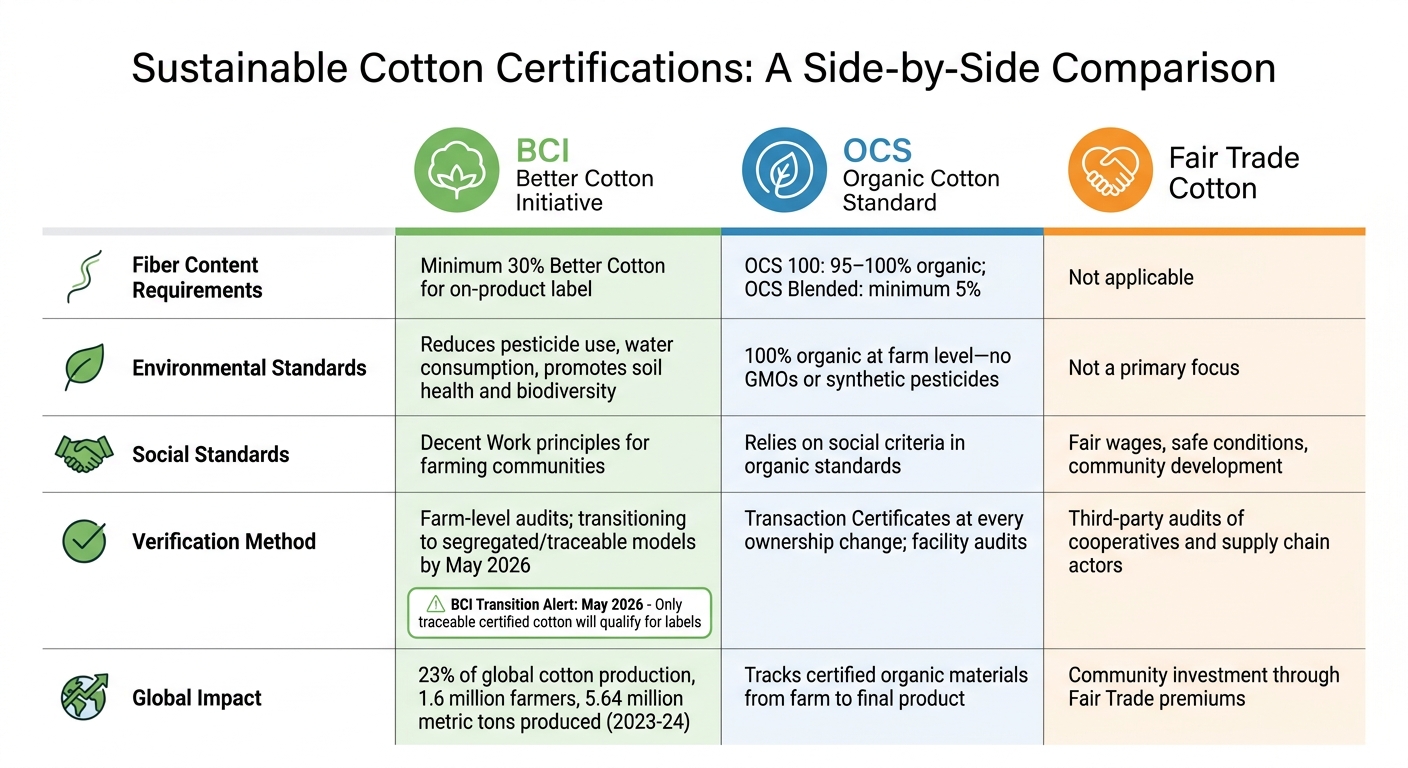
Sustainable Cotton Certifications Comparison: BCI, OCS, and Fair Trade Standards
Understanding the differences between the three major cotton certifications can help you make better decisions - whether you're sourcing materials for a brand, shopping as a consumer, or assessing suppliers.
Better Cotton Initiative (BCI) focuses on scalable progress rather than adhering to strict organic standards. Its goal is to minimize environmental impacts, such as pesticide use and water consumption, while improving the livelihoods of farmers. BCI accounts for about 22% to 23% of global cotton production.
Organic Cotton Standard (OCS) ensures that cotton fibers are grown and processed according to organic principles. It tracks the cotton through every stage of the supply chain, from the gin to the finished product. This certification guarantees no GMOs or synthetic pesticides are used. As Textile Exchange explains:
"The purpose of the OCS is to help strengthen companies' claims that the products they sell contain organically grown fibers."
OCS requires physical segregation and Transaction Certificates at every step of the supply chain, ensuring no mixing with conventional cotton.
Fair Trade Cotton prioritizes social and economic justice. It ensures fair wages, safe working conditions, and community investments through Fair Trade premiums, focusing heavily on the well-being of farmers and workers.
This side-by-side comparison highlights the unique strengths and verification processes of each certification, helping stakeholders make more informed sourcing choices.
Certification Comparison Table
| Feature | Better Cotton Initiative (BCI) | Organic Cotton Standard (OCS) | Fair Trade Cotton |
|---|---|---|---|
| Fiber Content Requirements | Minimum 30% Better Cotton for on-product label | OCS 100: 95–100% organic; OCS Blended: minimum 5% | Not applicable |
| Environmental Standards | Reduces pesticide use, water consumption, promotes soil health and biodiversity | 100% organic at the farm level - no GMOs or synthetic pesticides | Not a primary focus |
| Social Standards | "Decent Work" principles for farming communities | Relies on social criteria in organic standards | Fair wages, safe conditions, community development |
| Verification Method | Farm-level audits; transitioning to segregated/traceable models by May 2026 | Transaction Certificates at every ownership change; facility audits | Third-party audits of cooperatives and supply chain actors |
BCI’s current mass balance model has already directed over $200 million to support cotton farmers. However, starting in May 2026, BCI will require certified, physically traceable cotton for its label, aligning more closely with the stricter traceability that OCS has always upheld. This change reflects a growing demand for transparency in the cotton supply chain.
Tools and Resources for Traceability
Online Verification Platforms
To ensure traceability, several online tools and databases can help verify sustainable cotton certifications in real-time. These platforms are easy to use and provide reliable information.
The GOTS Certified Suppliers Database is a great resource for checking certified entities. You can search by name, location, or product type, with updates sourced directly from GOTS-approved certification bodies. All you need is the license number from a product label or description to confirm if the certification is active.
The Better Cotton Initiative (BCI) traceability platform goes a step further by enabling users to track Physical BCI Cotton back to its country of origin. In some cases, it may even trace back to the farm level. This platform connects you with a network of organizations that source BCI Cotton, offering more visibility into the supply chain. Additionally, GOTS Version 8.0, set for release in March 2026, will include stricter due diligence requirements to enhance accountability.
For those verifying Organic Content Standard (OCS) certifications, Textile Exchange provides tools to trace organic cotton through every stage of its journey. This ensures that claims about organic content are backed by proper documentation.
If online verification doesn't provide enough clarity, you can take the next step by requesting documentation directly from brands.
Requesting Documentation from Brands
For additional assurance, ask brands for key documents like Scope Certificates and Transaction Certificates. Scope Certificates confirm that a facility has been audited, while Transaction Certificates detail the exact volume of certified cotton sold. You can also request the brand's license or certification number and cross-check it using public databases.
Reach out to brands through email or their customer service channels. Consumer demand for transparency often drives brands to improve their disclosure practices. By taking this step, you're contributing to a broader push for accountability in the supply chain.
Conclusion
Understanding sustainable cotton certifications plays a key role in making informed sourcing choices. With BCI Cotton accounting for 23% of global cotton production and more than 1.6 million farmers benefiting from these programs, your decisions have a direct impact on both the environment and the livelihoods of farmers.
Verification is crucial for maintaining credibility and avoiding deceptive marketing practices. As the Better Cotton Initiative emphasizes, "Transparency is key to trust". By using public databases, verifying certification numbers, and requesting documentation from brands, you can separate genuine sustainability efforts from superficial claims.
The industry is shifting toward stricter accountability measures. Starting in May 2026, only products made with certified and traceable cotton will be eligible to carry the BCI label, as outlined earlier in this guide. This marks a significant step toward improving traceability across the supply chain.
Your actions as a consumer or sourcing professional have influence. "The more people ask, the more brands will listen". By verifying claims, requesting proper documentation, and supporting certified suppliers, you contribute to funding initiatives that enhance water efficiency, soil health, and sustainable farming practices.
Take advantage of the verification tools at your disposal. Whether you're checking public certification databases, using BCI's traceability platform, or contacting brands directly, these actions ensure your purchases align with authentic sustainability efforts. These steps are rooted in the principles of transparency and accountability discussed throughout this guide. By staying informed and asking thoughtful questions, you play a part in shaping a more transparent and responsible cotton industry.
FAQs
Does a BCI label mean the cotton in my item is actually Better Cotton?
A BCI label indicates that the cotton in your product aligns with the Better Cotton Initiative's standards for responsible production. While the label doesn't yet ensure complete traceability of the cotton, efforts are underway to achieve full traceability by May 2026.
What’s the quickest way to verify a cotton certification number online?
To quickly verify a cotton certification number, head to the official website of the relevant certification body, such as the Better Cotton Initiative (BCI) or GOTS. These organizations offer online tools where you can enter the certification number to check its validity. This method ensures a fast and reliable way to confirm the authenticity of claims about sustainable cotton.
What document confirms certified cotton was used in a shipment?
A certification document, like a Better Cotton Initiative (BCI) label or another recognized certification, acts as evidence that the cotton in a particular shipment meets certified standards. These documents ensure the cotton complies with established guidelines for sustainable practices.