Maintaining spinning frames in cotton mills is critical for ensuring consistent yarn quality, reducing downtime, and extending machine lifespan. Neglecting maintenance can lead to costly repairs, productivity losses of up to 30%, and yarn inconsistencies. Here’s what you need to know:
- Daily Tasks: Inspect and clean fiber buildup, check belts, rollers, and sensors for wear or misalignment.
- Lubrication: Use the correct lubricant, apply it in the right amount, and clean components beforehand to prevent damage.
- Alignment: Ensure proper roller and spindle alignment to avoid yarn slippage and inconsistencies.
- Inspection: Regularly check rings, travelers, and control systems for wear or calibration issues.
- Scheduling: Follow a structured maintenance plan - daily, weekly, monthly, and quarterly tasks - to prevent unexpected breakdowns.
How to Maintain Autodoffing Ring Frame || Objectives & Action Plan || Sahoo Textile Academy
sbb-itb-0e617ca
Daily Maintenance Tasks
Daily maintenance plays a key role in keeping spinning frames running smoothly. It helps prevent mechanical issues and ensures yarn quality stays consistent.
Visual Inspection and Cleaning
At the start of each shift, take a walk-through of your spinning frames. Begin by checking the drafting system - look for fiber buildup, worn aprons, or any misalignment that might disrupt yarn tension. Then, inspect the travelers and rings for wear that could affect the quality of the yarn.
Pay close attention to the drive components like belts, chains, and couplings. Ensure belts have the right tension - loose belts can slip and strain the motor, while overly tight belts may wear down bearings faster. Check spindle operation to confirm continuous, smooth movement and proper brake engagement.
Don’t forget to examine sensors, pneumatic lines, filters, ducts, and control panels. Fiber buildup in these areas can lead to overheating or electrical problems, so keeping them clean is essential.
Finally, focus on clearing fiber buildup from key components to maintain consistent performance.
Checking for Fiber Buildup in Key Components
After your initial inspection, zero in on fiber buildup that could interfere with machine operations. Even small amounts of lint in the drafting zone can disrupt roller grip and cause yarn inconsistencies. Make it a point to remove visible fibers from this area every day.
Suction areas and pneumatic lines are also critical. Blocked passages can reduce airflow, throw off fiber alignment, and increase yarn breakage. Clean these areas thoroughly to prevent such issues. Similarly, remove any accumulated fiber from travelers and rings, as it can degrade yarn quality and lead to faster mechanical wear. While modern spinning frames are designed for easier maintenance, don’t overlook those tricky, hard-to-reach spots where lint tends to hide.
Daily attention to these tasks ensures your spinning frames operate at their best.
Lubrication and Alignment Procedures
Beyond daily cleaning, proper lubrication and alignment play a key role in extending equipment life and maintaining yarn quality. Stick to the "5 Rights" of Lubrication - Right Product, Right Place, Right Amount, Right Time, and Right Attitude - to keep machinery running smoothly. This method helps avoid common issues like over-greasing, which can lead to damaged seals and overheating.
Drafting System Maintenance
The drafting system calls for a specialized approach, as standard liquid lubricants aren’t suitable. Cots and aprons require specific treatments to prevent fiber winding. For high-hardness cots, apply a coating in a 1:2 to 1:3 ratio. For low-hardness cots, use an anti-winding agent instead.
Before applying any treatments, make sure to clean all parts thoroughly. Remove dust, dirt, old grease, and any fiber buildup. Iron rollers, in particular, are susceptible to rust caused by humidity and residual acid from rubber aprons. Switching to carbon fiber or aluminum-lined rollers can help reduce these risks.
Alignment is equally important for yarn quality. The holding force of the jaw - formed by the cot/apron and roller - must exceed the maximum drawing force. If the drafting system feels loose, adjust the iron roller forward to increase holding force. For polyester cotton, a spacing block that’s too small can create overly tight rubber ring jaws, resulting in slippage and concave upper aprons. Enlarging the spacing block can resolve this issue.
Maintain the workshop’s relative humidity below 60% to prevent fibers from sticking to drafting components. In colder months, keep temperatures at or above 82°F to preserve the elasticity and holding strength of soft elastic cots. For cellulose fibers like viscose, modal, and Tencel, use antistatic oil agents on raw materials to minimize fiber adherence to cots and rollers.
Once the drafting system is properly maintained, the next step is to focus on spindle lubrication.
Spindle Care and Oil Application
After addressing the drafting system, shift attention to spindle care, which requires precise lubrication for dependable performance. The amount of lubricant should be tailored to the bearing size and RPM. Avoid over-greasing, as it can harm seals, cause overheating, and degrade the lubricant. Always calculate grease amounts based on the bearing specifications provided by the manufacturer.
Choose lubricants that match the viscosity grades and boundary film properties recommended for your equipment. Common options include spinning-wheel oil, sewing-machine oil, or 30-weight motor oil. For metal-on-metal contact points, white lithium grease is a good choice. Clean shafts thoroughly using towels or pipe cleaners to remove grime before applying fresh lubricant. Pipe cleaners are especially useful for cleaning bobbins and shafts.
Test lubricants regularly and adjust lubrication intervals according to operating conditions. Clearly label all lubrication points to ensure the correct product is applied to the right area every time. This level of precision keeps your spindles running efficiently and reduces the risk of mechanical issues.
Rings, Travelers, and Rollers: Inspection and Adjustment
Rings and travelers play a crucial role in inserting twist into the yarn, making their condition essential for maintaining production quality. After addressing lubrication and alignment, the next step is inspecting and adjusting rings, travelers, and rollers for consistent yarn performance. Modern high-performance rings often feature advanced coatings, offering a Vickers hardness above 2,000 HV0.2, which enhances their durability. Additionally, the friction coefficient (Ra) should stay below 0.05 to ensure smooth traveler movement.
Traveler and Ring Wear Assessment
Regularly inspect rings and travelers during each shift for signs of wear, scoring, or damage. Discoloration on the ring surface could signal friction problems, while travelers with flat spots or cracks may lead to yarn breaks. For machines operating at speeds of 19,000 rpm or higher, it’s essential to implement a running-in program for new rings. This process helps form a proper lubrication layer, extending the rings' lifespan. With proper care, bearing steel rings can last up to 8 years or more.
To speed up traveler changeovers and minimize downtime, use a traveler gun equipped with a magazine system capable of holding 120 to 360 travelers. This ensures the right traveler is installed quickly and efficiently. Periodic cleaning of rings is also necessary to maintain smooth traveler movement. Rings with advanced chrome coatings can see their lifespan extended by as much as 15%.
Once rings and travelers are inspected and maintained, the focus shifts to adjusting the rollers, which are vital for maintaining consistent twist.
Front Roller Alignment and Cleaning
The alignment of the front rollers has a direct impact on twist consistency. According to Textiles Worldwide, "The twist is inserted in the yarn between the nip of the front rollers and the traveler". To check for front roller eccentricity - often a cause of periodic yarn mass variations and uneven twist - use a dial gauge. Misaligned rollers can lead to slubs and drafting problems, which compromise yarn quality.
Measure the top roller pressure across the frame with a pressure gauge, as uneven pressure can cause fiber slippage and inconsistent twist per inch. Clean the front rollers using appropriately sized roller pickers to remove wax, honeydew, and fiber fragments that might lead to yarn wrapping around the roller. During overhauls, use a spirit level to ensure the roller beam and stands remain perfectly horizontal, verifying alignment for optimal performance.
Drive System and Control Panel Maintenance
Maintaining the drive system and control panels of a spinning frame is essential for keeping production running smoothly. Motors, belts, and electronic controls need regular attention to avoid unexpected breakdowns and ensure efficiency.
Monitoring Motors and Drive Belts
Listen for unusual noises like squeaking or knocking, as these could indicate loose parts or a lack of lubrication. Inspect drive belts frequently for signs of wear, such as fraying, stretching, or visible damage. According to Nicky Crane, Founder of Thread Collective:
"If stretching/looseness is detected, immediately tighten the drive band through tension adjustments".
When the machine is idle, loosen the belt tension to prevent unnecessary strain on components.
To keep the system clean, use compressed air or soft brushes to remove fiber buildup on pulleys and motor housings. Cotton lint can quickly accumulate, leading to increased friction and restricted airflow. After applying lubricating oil to shafts and joints, wipe off any excess oil to minimize fiber dust sticking to the surfaces. For critical motors, consider using predictive monitoring sensors that track temperature and vibration in real time. For instance, TRACTIAN's Smart Trac IoT sensors, available since February 2026, provide continuous monitoring of industrial rotating equipment. These sensors use AI to detect early signs of wear or imbalance and can automatically generate work orders to prevent unplanned downtime.
Control systems also require consistent attention to ensure optimal performance.
Control Panel Calibration and Sensor Checks
Regularly clean sensors, ducts, and control panels to prevent fiber buildup, which can cause electrical faults. Ensure that sensors and gauges are calibrated routinely to maintain accurate machine settings and performance. Billy Cassano, Applications Engineer at TRACTIAN, notes:
"Predictive monitoring aims to reduce possible failures and equipment wear... through data collection, data analysis, and the measurement of variables and performance parameters".
For spinning frames equipped with inverter systems like the E500 or E700 series, monitor spindle speeds and motor load patterns to detect malfunctions early. Always keep genuine OEM spare parts on hand for quick replacements of faulty PLCs, displays, or inverters. LMW Limited emphasized in April 2026 that while non-original parts may seem cost-effective initially, they often lead to compatibility problems and additional damage. Using real-time data platforms can also help identify reasons for stoppages and track energy usage, allowing for quicker troubleshooting when control panel issues arise.
Maintenance Scheduling and Record Keeping
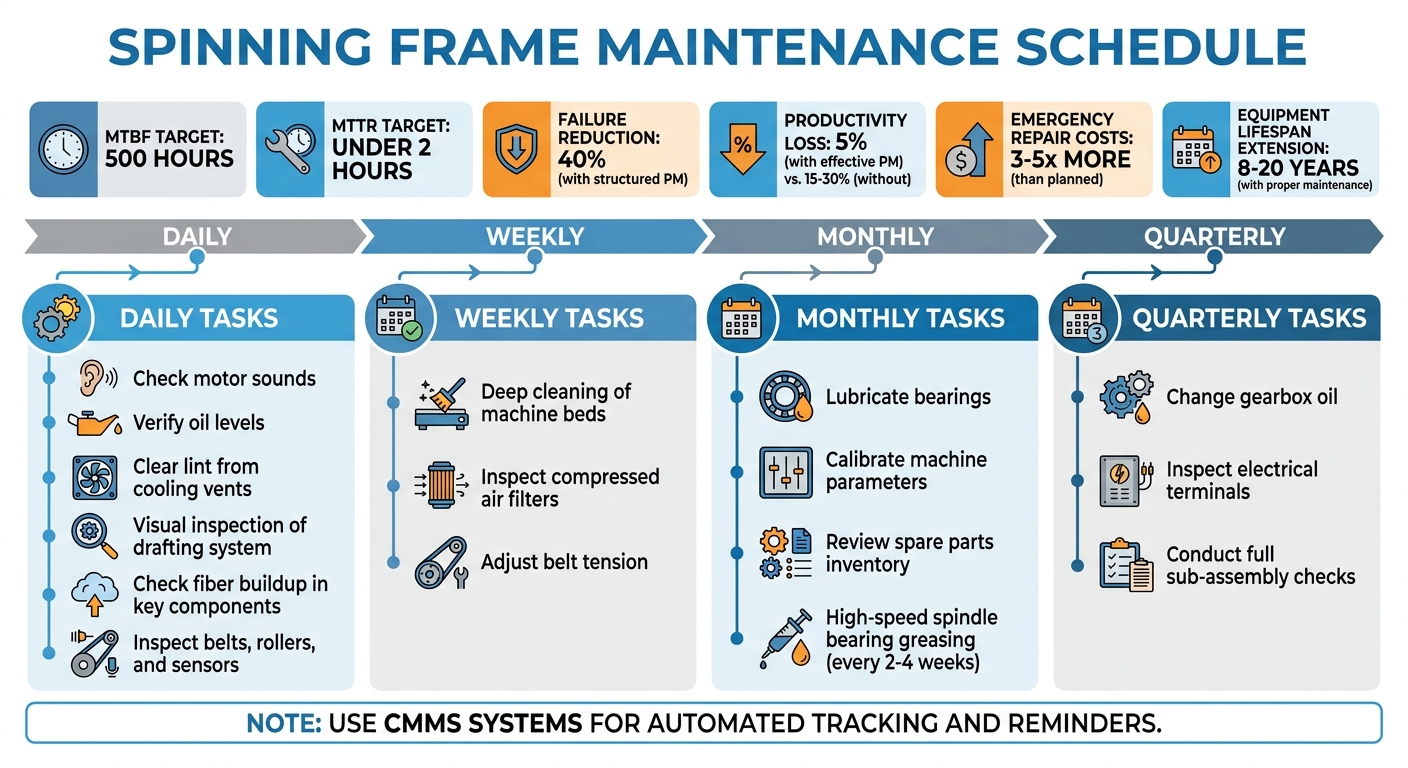
Spinning Frame Maintenance Schedule: Daily, Weekly, Monthly & Quarterly Tasks
A solid maintenance schedule is essential for keeping spinning frames running smoothly. Without it, mills risk unexpected breakdowns and expensive last-minute repairs. The main objective? Spot potential issues before they disrupt production. This organized approach builds on earlier maintenance practices to ensure no task is missed.
Creating a Maintenance Schedule
Divide maintenance tasks into four time-based categories:
- Daily tasks: Check motor sounds, verify oil levels, and clear lint from cooling vents.
- Weekly tasks: Perform deep cleaning of machine beds, inspect compressed air filters, and adjust belt tension.
- Monthly tasks: Lubricate bearings, calibrate machine parameters, and review spare parts inventory.
- Quarterly tasks: Change gearbox oil, inspect electrical terminals, and conduct full sub-assembly checks.
High-speed spindle bearings often need greasing every 2–4 weeks. Record the exact lubricant type, quantity, and application points for each machine. Train operators to do pre-shift inspections, looking for unusual vibrations or oil leaks. Industry benchmarks suggest a Mean Time Between Failures (MTBF) of 500 hours for critical textile machines, while efficient teams aim for a Mean Time To Repair (MTTR) under 2 hours.
Documentation and Tracking Systems
Accurate record-keeping is just as important as scheduling. Move away from paper logs and adopt a Computerized Maintenance Management System (CMMS) like iFactory. These systems automate reminders and digitally track every task. Each work order should include details like the technician's name, time spent, parts used, and a root cause analysis. Adding photos of faults creates a searchable database to help identify recurring problems.
Monitor spare parts usage alongside work orders to calculate average monthly consumption. Maintain stock levels that cover 4–8 weeks of usage, and use automatic reorder alerts to avoid delays. Regularly review MTBF data to pinpoint the five most expensive machines and adjust the preventive maintenance plan accordingly. For mills with modern equipment, tools like LMW Spin Connect provide real-time insights into machine performance, stoppage reasons, and energy consumption via a centralized dashboard.
With a structured preventive maintenance plan, equipment failure rates can drop by 40%. This helps machines reach their full service life instead of operating at just half their potential.
Conclusion
Every maintenance method - whether it's routine checks, lubrication, or advanced digital monitoring - contributes to the ultimate goal: safe and efficient operations. Consistent practices like lubrication, cleaning, calibration, and inspection can extend the lifespan of spinning frames from 8 to 20 years, ensuring dependable performance over time. Key habits such as daily visual inspections, weekly deep cleaning, monthly lubrication schedules, and quarterly system audits form the backbone of reliable operations.
Structured preventive maintenance can lower equipment failure rates by 40%, while emergency repairs often cost 3 to 5 times more than planned maintenance. Neglecting proper upkeep can lead to productivity losses ranging from 15% to 30%, compared to just 5% with effective maintenance strategies. Additionally, using authentic OEM parts helps prevent unnecessary damage and downtime.
Blending traditional maintenance routines with modern digital tools takes efficiency to the next level. Many modern mills now rely on real-time monitoring systems to track critical metrics like vibration levels, energy usage, and stoppage causes. These systems allow technicians to address issues before they escalate into costly breakdowns. Digital logs also shift maintenance from guesswork to precise, data-driven decisions, helping teams identify exactly which machines need attention and when.
Together, these strategies create a reliable framework for operational success. Digital tools complement the three core maintenance pillars - Preventive, Predictive, and Breakdown maintenance. Preventive measures reduce unexpected stoppages, predictive systems improve scheduling and lower spare part expenses, and effective breakdown protocols ensure quick recovery after failures.
"Maintenance is not a background activity; it's a strategic priority. With the right tools, structured processes, and a proactive mindset, mills can enhance productivity, extend the life of their machinery, and ensure superior yarn quality." - LMW Limited
FAQs
What are the first signs my spinning frame is out of alignment?
The first clues that a spinning frame might be misaligned are unusual vibrations and excessive noise during operation. These symptoms often point to shaft misalignment. Tackling these problems early can help avoid more serious damage and keep the equipment running efficiently.
How can I tell if I’m over-lubricating spindles or bearings?
Excess lubrication often reveals itself through visible signs like lubricant spilling over or building up in areas it shouldn’t. This can lead to damage to fibers or machine components. It might also seep into unintended spots, disrupting normal operations. To prevent this, stick to the manufacturer's recommendations regarding the proper amount and timing of lubrication. Regular inspections for any spillage or accumulation around spindles or bearings can also help keep things in check.
Which maintenance checks prevent the most yarn breaks?
Preventing yarn breaks often comes down to a few key maintenance practices that address fiber slippage, tension issues, and mechanical problems. Here's what works best:
- Adjust Roller Pressure and Cots: Maintaining proper tension at the front rollers is crucial. Increase the top roller pressure and opt for softer cots to improve grip and reduce fiber slippage.
- Inspect and Align Components: Regular checks and alignment of drive belts, chains, and couplings are essential. Misaligned parts can cause unnecessary tension peaks and mechanical strain.
- Keep Up with Lubrication and Cleaning: Ensure all moving parts are well-lubricated and clean. This reduces wear and tear and prevents unexpected mechanical failures.
- Replace Worn Parts on Time: Don’t wait for a breakdown. Replace worn-out components promptly to ensure smooth and uninterrupted operation.
By sticking to these practices, you can minimize production disruptions and keep yarn breaks to a minimum.