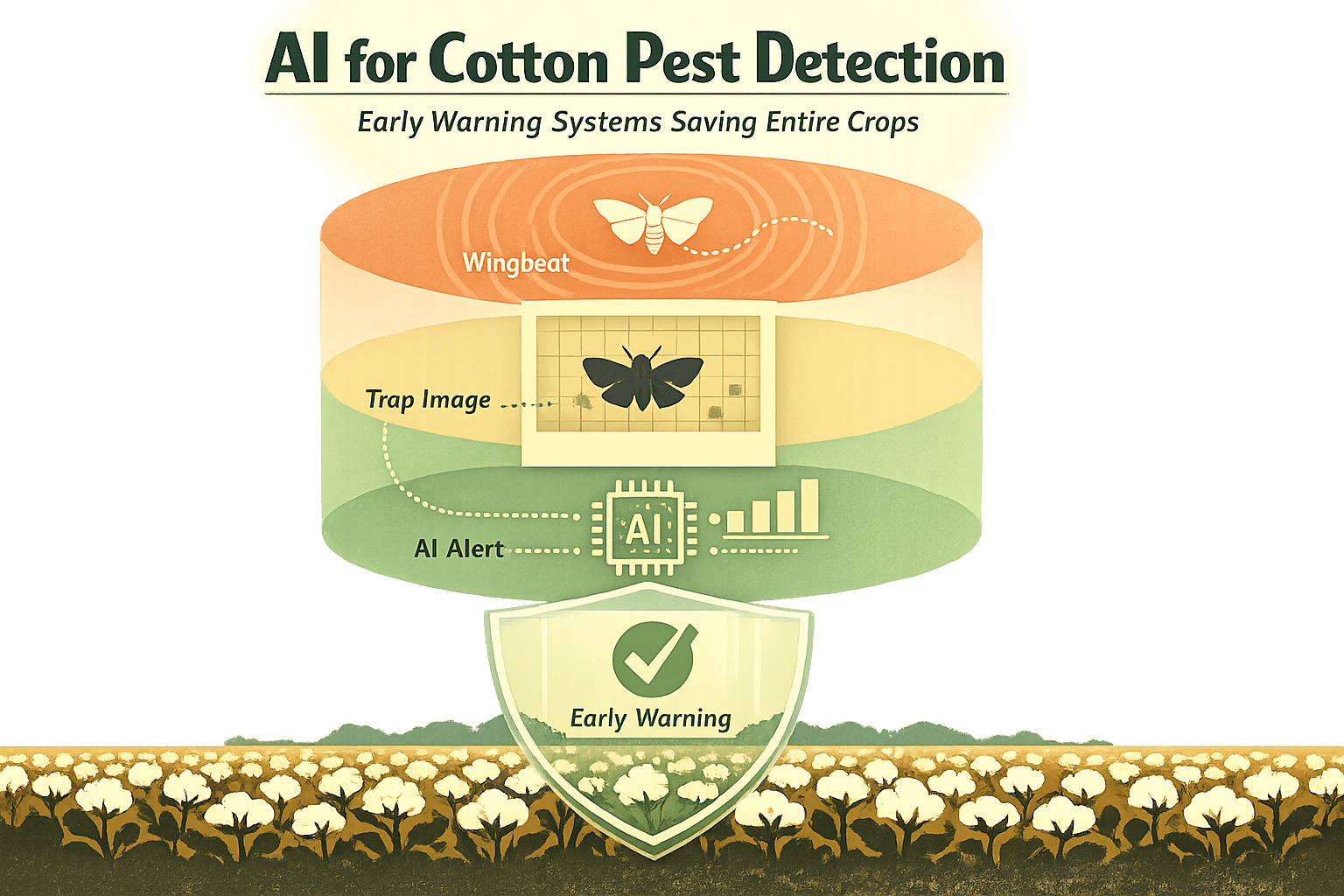
I can sum this up fast: AI helps me find cotton disease and crop stress earlier, check more acres, and make spray and harvest calls with better timing. When target spot hits hard, losses can reach 250 to 400 lb. of lint per acre. A 200 lb./acre hit across 1,000 acres at $0.80/lb. is about $160,000 in lost gross revenue.
Here’s the main takeaway in plain English:
- Manual scouting only checks part of a field
- AI tools scan whole fields or key zones
- Earlier alerts can show up days to weeks before clear visual symptoms
- The main tools are satellites, drones, smartphone apps, and machine-vision systems
- The goal is simple: confirm the problem fast and act on the right acres
I’d think about it like this: satellites watch large acreage, drones zoom in on field trouble spots, phone apps help me check what I’m seeing on a leaf, and machine-vision systems keep watch between field visits. That matters because late disease finds often mean lost photosynthesis, weaker spray timing, lower lint yield, and more fiber-quality risk.
| Tool | What I use it for | Coverage | Lead time |
|---|---|---|---|
| Satellite | Watch many fields at once | Whole farm or region | Days to weeks |
| Drone | Map stressed patches | Single or multiple fields | Days to weeks |
| Phone app | Check disease at leaf level | One plant at a time | Immediate |
| Machine vision | Get steady field alerts | Fixed area or field block | Real-time or near real-time |
If I want better field checks and fewer late surprises, this is the basic workflow: AI alert → scout check → phone-based diagnosis → spray, re-check, or wait.
How AI-Powered Drones Are Revolutionizing Cotton Disease Detection
sbb-itb-0e617ca
Cotton disease and stress problems that manual scouting misses
Manual scouting only shows you a slice of what is happening in a field. Texas A&M guidance says scouts generally inspect 50 to 100 plants, based on field size. In a big cotton field, that means a lot of ground never gets checked on a given pass. Trouble that starts in low spots, interior rows, or far corners can keep moving for days before anyone sees it. That is where AI imaging helps: it points out problem areas before a scout gets there.
Why visual scouting often finds problems too late
Some cotton problems are simply hard to catch from the ground.
Target spot often begins in the lower, inner canopy, which is one of the hardest places to inspect. Once the canopy closes, often in late July to early August, humidity and leaf wetness build up inside the plant canopy and speed disease growth. From outside the row, though, those interior leaves may still seem fine. So when defoliation finally shows up, the disease is often already settled in the lower canopy and moving upward.
Bacterial blight can slip by early too. Its first signs may show up as small, water-soaked spots that look like minor injury or insect feeding until the damage spreads. Nutrient stress can be just as tricky. Nitrogen and potassium shortages may start as small shifts in color or plant vigor, and those shifts can look a lot like drought stress, insect injury, or normal field variation. Without a whole-field view, it is tough to know whether a few pale plants are isolated or part of a bigger pattern.
What late detection costs in yield, spray timing, and fiber quality
The cost of late detection can add up fast.
Documented target spot losses in the Southeast range from 100 to 250 lb lint/acre in many trials, with losses rising to 250 to 400 lb lint/acre in severe outbreaks on susceptible varieties. Put that into dollars and it gets painful fast: a 200 lb lint/acre loss across 1,000 acres at $0.80/lb equals about $160,000 in lost gross revenue.
Spray timing matters too. Research shows fungicide applications made after cutout can reduce defoliation, but they rarely protect yield. In plain English, a late spray may make the crop look better without adding many pounds of lint.
Late detection of bacterial blight carries its own cost. In severe cases, reported yield losses reach 20% to 25% or more. Damaged bolls can also add discolored or weak fibers to harvested cotton. And that does not stay a field-only issue. Those fiber problems can follow the crop to the gin, making processing, bale uniformity, and marketing harder.
LSU AgCenter warns that once target spot is already causing significant defoliation, a rescue application is unlikely to preserve enough foliage to make a meaningful difference.
That is why AI detection matters. It gives growers a better shot at spotting trouble early enough to act on the right acres at the right time.
How AI imaging and remote sensing spot cotton problems weeks sooner
AI turns small, hard-to-see canopy shifts into early warnings growers can use. It can pick up stress signals that the human eye misses - often days or even weeks before spotting, yellowing, or thinning show up in plain sight.
What AI detects before visible damage appears
Vegetation indices help track canopy vigor over time and catch slight dips before visible symptoms start. The main point isn't the index itself. It's using that signal to figure out which field block needs a closer look first.
AI models can also sort disease-related stress from normal field variation. That makes it easier to zero in on the stressed areas instead of treating an entire field. For target spot, bacterial blight, and nutrient-related stress, that means finding the specific acres where canopy decline is starting, rather than flagging a whole field based on one scout's walk.
Why earlier alerts improve treatment windows
Once AI flags a zone, scouts can head to those acres first and confirm whether the issue is disease, nutrient stress, or something else before it spreads. Processing can take only seconds per image, and classification accuracy can top 90%, which gives growers a shot to act before the next field pass instead of waiting for the next routine scouting cycle.
That extra time helps crews confirm the issue early and treat only the acres that need attention. It becomes even more useful when it's built into drone, phone, satellite, and machine-vision workflows.
AI tools growers use for early cotton disease detection
Early alerts matter most when growers know which tool to use next. In practice, each tool handles a different part of the scouting workflow: broad monitoring, targeted scanning, and in-field confirmation. That’s how an alert turns into a field check, and then into a spray call.
Drone imagery for finding stressed patches across entire fields
Start with drones when a satellite alert needs field-level confirmation. One flight can cover dozens to hundreds of acres and produce georeferenced stress maps for site-specific management.
Multispectral sensors pick up red, red-edge, and near-infrared bands. Those bands are especially sensitive to early canopy shifts, including changes that appear in NDVI before symptoms are easy to spot with the naked eye. That gives scouts a head start.
In Texas cotton fields, airborne multispectral imagery mapped cotton root rot with 93.0% to 96.5% accuracy across multiple models. And instead of walking an entire field, scouts can use GPS-tagged points from the drone stress map to go straight to the flagged zones for a closer look.
Smartphone diagnosis apps and machine vision for in-field confirmation
Phone-based image checks help confirm what kind of stress a scout is seeing. A scout snaps a photo of a suspicious leaf, and the app runs that image through a trained deep-learning model. Smartphone apps can classify leaf images with trained deep-learning models.
Some cotton leaf disease classifiers have reported 97.98% accuracy in classifying leaf diseases. That can help separate disease from look-alike issues like nutrient deficiency, herbicide injury, or drought stress before anyone makes a spray decision.
Integrated machine-vision systems push this a step further. They use fixed cameras and sensors for continuous monitoring, then send real-time alerts to a phone or tablet. So instead of checking only when someone happens to be in the field, teams can keep watch all the time.
Satellite monitoring and dashboards for routine field surveillance
Satellite monitoring systems and analytics dashboards give teams continuous surveillance at a scale that drones alone can’t handle efficiently. Sentinel-2 NDVI time-series analysis has identified cotton root rot infection by tracking the gap between healthy cotton, with a peak NDVI of 0.743, and infected cotton, with a peak NDVI of 0.697. That gap appears as yellowing and browning reduce canopy reflectance over time.
Dashboards turn those index shifts into color-coded field maps. That makes it easier for teams to rank blocks by urgency, then use drones and phones to check the cause on the ground.
The table below compares the main tool types.
| Tool | Coverage | Image Detail | Lead Time | Labor Needs | Best Use Case |
|---|---|---|---|---|---|
| Satellite | Entire operation or region | Low to medium | Days to weeks ahead of visible symptoms | Low | Routine surveillance and trend tracking across large acreage |
| Drone | Individual fields or multiple fields | High | Days to weeks | Moderate | Locating stressed patches, post-storm checks, variable-rate maps |
| Smartphone app | Single plant or leaf | High | Immediate in-field classification | Low; requires scout presence | Confirming disease or look-alike stress at the leaf level |
| Machine-vision platform | Fixed cameras or field blocks | High | Real-time or near-real-time alerts | Low once installed | Continuous monitoring and alerting |
Using AI alerts in day-to-day cotton management and gin planning
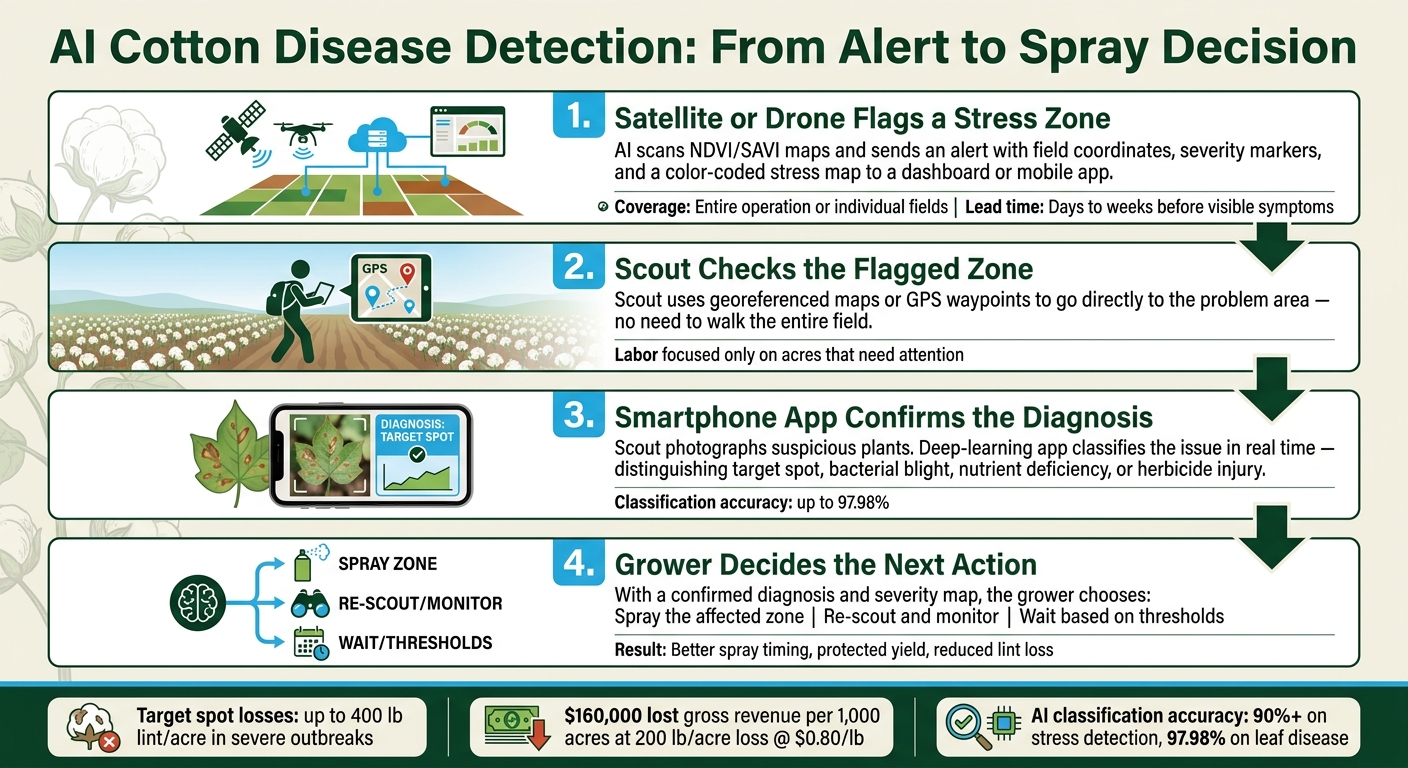
AI Cotton Disease Detection: From Alert to Spray Decision
Once an alert shows up, the next move is pretty straightforward: verify it fast and decide what to do on the right acres.
A step-by-step workflow from alert to spray decision
AI alerts matter when they lead to an actual field call. In practice, the workflow usually looks like this:
- Satellite or drone imagery flags a stress zone The system spots stress in NDVI or SAVI maps and sends an alert to a dashboard or mobile app. That alert usually includes field maps, coordinates, and a severity marker.
- A scout checks the flagged zone Instead of walking an entire field, the scout heads straight to the problem area using georeferenced maps or GPS waypoints. That keeps labor aimed at acres that need attention.
- A smartphone app helps confirm the diagnosis The scout takes photos of plants in the flagged zone. The app can help tell apart target spot, bacterial blight, and nutrient stress in real time before anyone decides to spray.
- The grower chooses the next step With a confirmed diagnosis and a map of severity, the grower can spray, re-scout, or keep watching conditions based on disease pressure and thresholds. That choice supports better spray timing and helps cut yield loss, which is the main upside of finding trouble earlier.
That sequence turns alerts into field decisions. Here’s why that changes things:
| Dimension | Traditional Scouting Only | AI-Enabled Scouting |
|---|---|---|
| Field coverage and detection timing | Scouts cover only part of large fields. Problems usually get found after visible symptoms show up, when damage may already be in motion. | Drones and satellites scan entire fields in a systematic way, picking up spectral stress signals before visible damage appears. |
| Spray timing precision | Responses are often reactive, so part of the best treatment window may already be gone. | Earlier alerts support zone-specific applications closer to the best timing. |
| Yield and quality protection | Later action increases the risk of yield loss and fiber quality issues. | Earlier, targeted action can help protect more bolls and limit quality losses. |
How cottongins.org supports planning across U.S. cotton regions
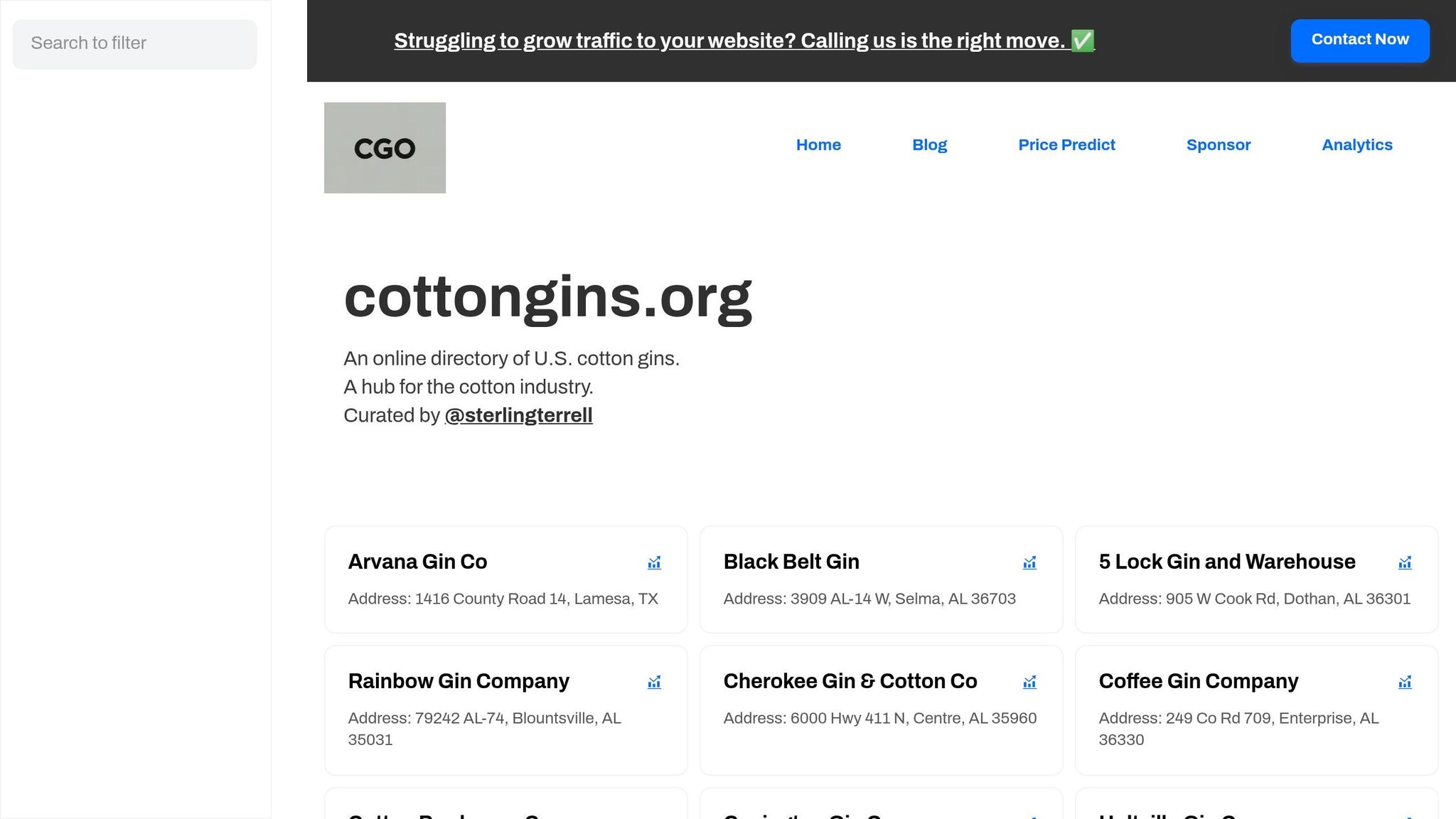
When disease pressure starts building, field alerts need to feed into harvest and gin planning. cottongins.org has a directory of U.S. cotton gins sorted by state and county. Growers can use it to find nearby gins, contact them early about expected fiber quality from stressed fields, and line up harvest so healthier fields move first. Gin operators can use the same information to prepare for quality variation and adjust staffing and equipment schedules before the first bale arrives.
Conclusion: Earlier detection leads to better cotton decisions
Manual scouting on its own usually catches cotton disease and stress after damage has already begun. AI tools - satellite monitoring, drone imagery, and smartphone diagnosis apps - spot those same problems earlier, when treatment can still do more good. That extra time helps scouts focus on the right acres, supports tighter spray timing, and gives growers better information for field-to-gin decisions.
FAQs
How early can AI catch cotton disease?
AI-powered tools and remote sensing can spot cotton stress and early disease up to 2 weeks earlier than old-school field scouting.
They do this by reading spectral data from drones, satellites, and ground sensors. That data can reveal subtle warning signs - like higher canopy temperatures or shifts in chlorophyll - before any visible symptoms show up in the field.
Why does that matter? Because acting early can help protect 10% to 15% of yield in affected areas.
Which AI tool fits my farm best?
The right tool comes down to three things: farm size, main stressors, and budget.
For smaller operations, free satellite services like Landsat or smartphone apps can be enough to map fields and watch long-term trends.
As needs grow, drone systems with multispectral cameras can help spot early thrips damage or nutrient stress. And for larger operations, the best fit is often a platform that brings together satellite, drone, and soil sensor data. That kind of setup can improve predictions and help with irrigation or spray timing.
Do I still need manual scouting with AI?
Yes. AI tools like drone imagery, satellite monitoring, and smartphone diagnostic apps can spot stressed areas earlier than old-school scouting. That kind of early warning matters.
But they don't replace manual scouting.
You still need to walk the field and check what's happening on the ground. That's how you confirm the cause, rule out false positives like shadows, and figure out whether the right move is irrigation or a chemical application.