Cotton growers face increasing challenges, from resistant weeds to unpredictable weather. In 2026, new cotton seed varieties are addressing these issues with advanced traits for pest resistance, yield improvement, and resource efficiency. Key highlights:
- Triple pest control: TwinLink Plus technology uses three insect-control genes.
- Weed management: Axant Flex technology offers four herbicide traits.
- Drought resilience: CRISPR improvements boost water and salt tolerance by 15–25%.
- Higher yields: New seeds increase yields by 18–25% and improve fiber strength by up to 30%.
- Cost savings: Reduced chemical use cuts input costs by 30–50%.
BASF's 2026 Stoneville varieties (ST 4130AXTP, ST 4650AXTP, ST 5260AXTP) are tailored for U.S. regions like the Eastern Cotton Belt and Mid-South, combining pest resistance, bacterial leaf blight protection, and fiber quality improvements. These advancements are reshaping cotton farming for better profitability and sustainability.
Revolutionizing Cotton Breeding Boosting Yield, Quality & Climate Resilience
sbb-itb-0e617ca
Core Traits in Next-Generation Cotton Seeds
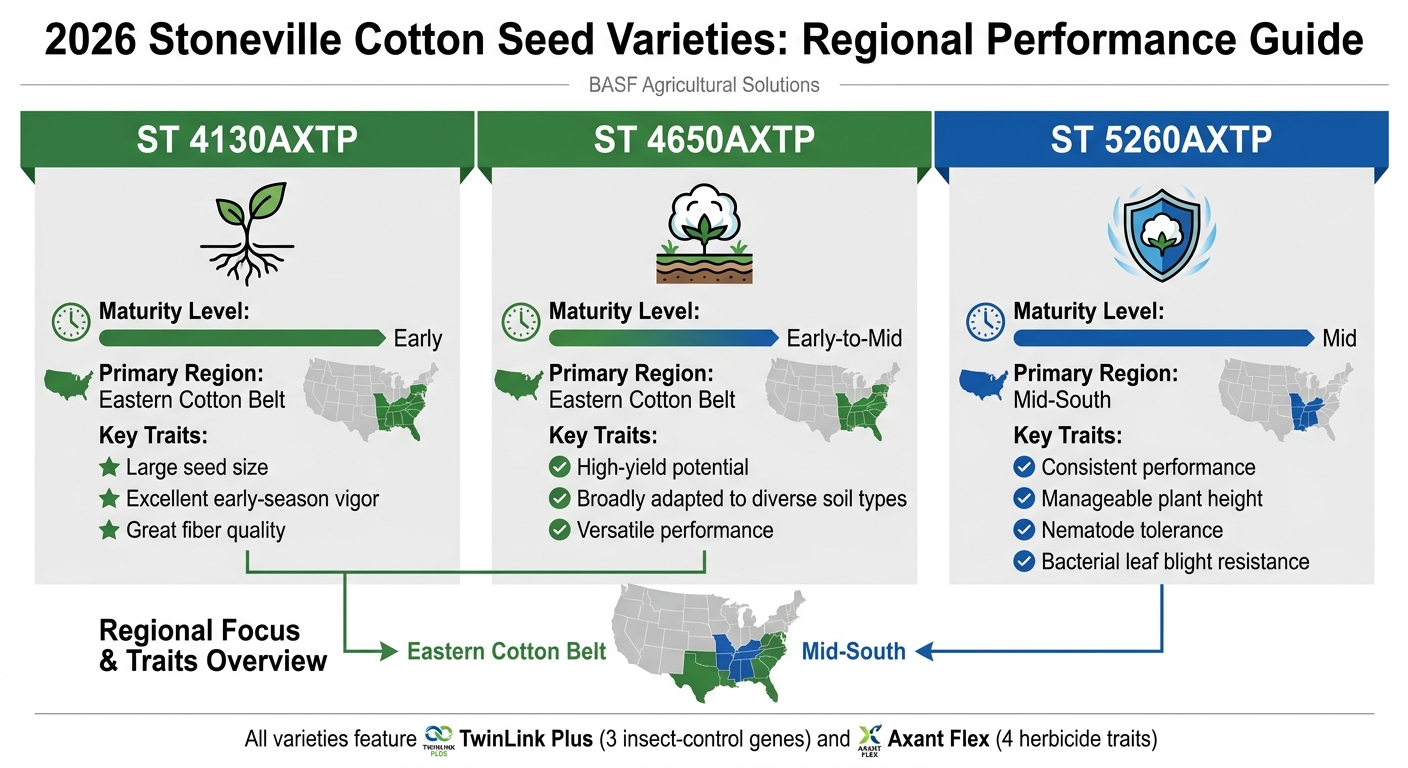
2026 Stoneville Cotton Seed Varieties Comparison Chart
The 2026 lineup of cotton seeds comes packed with advancements in pest and disease resistance, drought resilience, and improvements in yield and fiber quality. By combining multiple traits into a single variety, breeders are addressing the diverse challenges growers face.
Pest and Disease Resistance
Next-generation seeds feature TwinLink Plus technology, which incorporates three distinct insect-control genes. This makes it significantly harder for pests to develop resistance. Additionally, Axant Flex technology integrates four herbicide traits, offering comprehensive weed and pest management solutions.
Soil-borne threats are also being tackled head-on. For example, the ST 5260AXTP variety, released in January 2026 for the Mid-South, is engineered with tolerance to root-knot and reniform nematodes, as well as resistance to bacterial leaf blight. Researchers are also exploring the stacking of multiple natural resistance genes (R genes), which could dramatically cut fungicide use - potentially by over 80%, as shown in studies on cisgenic potato resistance.
These pest-resistant traits are complemented by advancements that strengthen the seeds against environmental challenges.
Drought and Climate Resilience
With water scarcity and unpredictable weather becoming more frequent, breeders are focusing on improving drought tolerance and adaptability to challenging climates. Using CRISPR-Cas9, scientists are targeting specific genes - like DREB and CBF - to enhance drought and salt tolerance. These biotechnological methods show an improvement of 15–25% in drought and salt resilience, compared to the 5–10% gains achieved through traditional breeding.
The 2026 Stoneville varieties are designed to perform well in difficult soil conditions, making them reliable for regions like the Eastern Cotton Belt and the Mid-South. For instance, the ST 4130AXTP variety offers excellent early-season vigor, helping crops establish quickly even in suboptimal conditions. These climate-adapted seeds also require less water and fertilizer, reducing the input burden on farmers and promoting more efficient farming practices.
This adaptability ensures not only survival but also improved yields and fiber quality, which are essential for growers.
Higher Yields and Better Fiber Quality
Yield improvements start with tailoring seeds to specific regions. Each of the three Stoneville varieties released in January 2026 is fine-tuned for particular growing conditions. For example:
- ST 4650AXTP: Designed for the Eastern Cotton Belt, this variety offers high-yield potential and adapts well to diverse soil types.
- ST 5260AXTP: Aimed at the Mid-South, it delivers consistent performance and manageable plant height.
Fiber quality is another key focus. Biotechnology advancements can increase fiber strength by up to 30% compared to traditional breeding methods. The ST 4130AXTP variety is a standout in this category, featuring large seed size and excellent fiber quality. By stacking traits like nematode tolerance and bacterial leaf blight resistance alongside fiber quality improvements, these seeds meet both production challenges and the textile industry's demand for stronger, more uniform fibers.
The table below highlights the main traits of the 2026 Stoneville varieties:
| Variety | Maturity | Primary Region | Yield & Quality Traits |
|---|---|---|---|
| ST 4130AXTP | Early | Eastern Cotton Belt | Large seed size, excellent vigor, great fiber quality |
| ST 4650AXTP | Early-to-Mid | Eastern Cotton Belt | High-yield potential, broadly adapted to soil types |
| ST 5260AXTP | Mid | Mid-South | Consistent performance, manageable plant height |
Research and Development Behind Cotton Seed Advancements
Advances in cotton seed technology owe much to cutting-edge research and collaborative agricultural efforts. Together, these initiatives have significantly reduced the time it takes to move from lab discoveries to seeds ready for the field. This blend of scientific innovation and teamwork is driving major progress in gene-editing techniques.
CRISPR and Genetic Engineering in Cotton Breeding
CRISPR technology has changed the game for developing new cotton varieties. Traditional breeding methods can take 10–15 years, but CRISPR allows scientists to make precise genetic changes much faster. This is especially important for cotton, which has a complex genome with approximately 2.5 billion base pairs. CRISPR can target multiple homologous genes simultaneously, making it an incredibly efficient tool.
Different CRISPR variants, such as Cas9, Cas12a, and Cas12b, are being used to tackle specific challenges in cotton breeding. For instance, a study published in the Journal of Cotton Research showed that using CRISPR/Cas9 to modify the GhFAD2 gene increased the ratio of oleic acid to linoleic acid in cottonseed oil. This created a healthier, more stable oil without introducing foreign genetic material. Additionally, newer versions like Mb2Cas12a have achieved editing efficiencies of over 90%, even in variable field conditions.
Speed breeding has also emerged as a powerful tool. By controlling environmental conditions and extending light exposure, researchers have shortened the cotton generation cycle to just 71–85 days, enabling 3–5 generations per year. When paired with CRISPR, this approach allows scientists to quickly stack and validate traits. The "Cotton 2035" initiative is a prime example of this, combining multi-omics data with AI-driven modeling. Digital agriculture tools now let researchers create digital twins to simulate how specific traits will perform in the field before real-world testing. These breakthroughs, combined with strong industry partnerships, are making the journey from lab to market smoother than ever.
Industry Partnerships and Research Collaborations
Collaborations between research institutions and industry leaders have been crucial in speeding up the transition from research to commercial use. For example, the USDA-ARS oversees the National Cotton Germplasm Collection and developed the Gossypium Diversity Reference Set (GDRS). This curated collection represents about 20% of upland cotton accessions and has been thoroughly genotyped and phenotyped to support global allele discovery and genomic prediction. In China, the Chinese Academy of Agricultural Sciences (CAAS) is leading efforts through its Institute of Cotton Research and the Agricultural Genomics Institute at Shenzhen, focusing on pan-genome development and improving CRISPR efficiency.
These partnerships are also helping to standardize data systems and create interoperable phenotyping frameworks. This ensures a smoother transition from lab discoveries to commercial-scale applications. By combining haplotype mapping with CRISPR, breeders can directly introduce beneficial gene combinations into high-quality germplasm, eliminating the need for lengthy backcrossing processes. Together, these advancements are shaping the future of cotton seed development and influencing market trends.
Market Trends Shaping Cotton Seed Development
The cotton seed market is evolving rapidly, shaped by forces like consumer preferences, government regulations, and economic incentives. These trends are pushing breeders to focus on traits that align with sustainability goals and profitability, helping farmers choose seed technologies that promise better returns in the future.
Growing Demand for Eco-Friendly Cotton
Consumer and brand demand for cotton that’s both traceable and environmentally responsible is on the rise. This shift has led to significant investments in organic and resource-efficient seed varieties. For example, companies like Ralph Lauren and VF Corporation have collaborated with agricultural research initiatives such as the U.S. Regenerative Cotton Fund, which has set a goal to remove 1 million metric tons of carbon dioxide equivalent from the atmosphere by 2026. Market demand is driving innovation, with seeds now offering features like 20% reduced water usage and lower reliance on chemicals.
The financial benefits of sustainable practices are clear. Farmers who have adopted soil health management systems in cotton production report average savings of $74.30 per acre and net income gains of $172.87 per acre. These savings show that eco-friendly farming not only satisfies consumer expectations but also boosts profitability. Breeders are responding by creating seed varieties with natural pest resistance and shorter growth cycles, reducing the need for synthetic pesticides and helping farmers avoid late-season weather risks. Additionally, technology integration is advancing, with new seeds designed to work seamlessly with satellite monitoring, AI-driven advisory tools, and blockchain systems for fiber traceability and sustainability compliance.
Government Policies and Subsidies
Regulatory frameworks are another key driver of cotton seed development. Restrictions from the EPA on herbicide use and mandatory training programs have significantly influenced the adoption of herbicide-tolerant seeds. For instance, between 2016 and 2019, the adoption of dicamba-tolerant cotton seeds surged from 0% to 69%, largely due to the need to manage herbicide-resistant weeds while meeting stricter application deadlines. State-specific rules, like Arkansas's May 25 cutoff and Louisiana's June 15 deadline, add further complexity for growers.
Policies like the Plant Variety Protection Act, which grants up to 25 years of intellectual property rights for new seed varieties, have spurred significant R&D investment. BASF, for example, allocated roughly $1.0 billion to its agricultural research pipeline in 2024. However, these regulations have also contributed to market consolidation, with four major companies - Bayer, Corteva, Sinochem, and BASF - controlling over 60% of global proprietary seed sales. By 2025, genetically engineered, herbicide-tolerant seeds were planted on 93% of U.S. upland cotton acres, with 87% using stacked varieties that combine herbicide tolerance and insect resistance. This concentration reflects how policies and market dynamics favor large-scale, multi-trait technologies, addressing key challenges for U.S. growers while supporting cost efficiency and sustainable practices. These developments highlight the tangible benefits that policy-driven innovation brings to cotton farming in the U.S.
Benefits for U.S. Cotton Growers
Increased Economic Returns
Next-generation cotton seeds are designed to deliver higher profits by increasing yields and improving fiber quality. The 2026 Stoneville varieties - ST 4130AXTP, ST 4650AXTP, and ST 5260AXTP - are prime examples of this, offering advanced performance traits tailored for better results.
Biotechnological developments in these seeds can lead to yield increases of 18%–25% compared to traditional varieties, while fiber strength may improve by as much as 30%. The ST 4130AXTP variety, in particular, stands out for its strong early-season vigor and larger seed size. This combination ensures healthy stand establishment, cuts down on replanting costs, and optimizes the use of available acres. The result? Higher yields paired with better fiber quality that not only boost profits but also help reduce input costs.
Lower Input Costs and Reduced Resource Use
These seeds also come with built-in resistance to pests, diseases, and weeds, which significantly cuts down on the need for chemical treatments. For instance, research from Wageningen University and Research Centre’s "Durable Resistance Against Phytophthora" project showed that stacking resistance genes can decrease fungicide use by over 80%.
Additionally, ongoing work by Laissa Cavallini at North Carolina State University is focusing on Bayer's ThryvOn Bt cotton to evaluate its performance under drought stress. This research aims to reduce the need for repeated insecticide applications following rainfall. Overall, these integrated traits can lower chemical usage by 30%–50% while maintaining robust yields, ultimately reducing production costs. By tackling both cost and yield challenges, these advancements give growers practical solutions to deal with unpredictable weather and pest pressures.
Conclusion
The cotton industry is experiencing a pivotal shift, driven by next-generation seeds that address modern farming challenges. With changing market demands, innovation has become more than a choice - it's a necessity.
These advanced seeds now offer multi-threat protection, combining traits that tackle pests, diseases, and environmental stresses. For U.S. growers, adopting these varieties means achieving better pest resistance, stronger early-season vigor, and ultimately, higher yields. With over 90% of U.S. cotton now derived from genetically enhanced varieties, biotechnology has become a cornerstone of the industry’s competitiveness.
But the benefits don’t stop at pest control. As consumers increasingly seek eco-friendly products, breeders are focusing on developing cotton varieties that require fewer chemicals while maintaining high productivity. This shift reflects the industry’s growing emphasis on sustainability, supported by substantial investments in research and development.
The impact of these advancements reaches beyond the fields.
"A successful season starts with the right seed, and with Stoneville and FiberMax cotton, we're helping farmers lay the groundwork for strong yields and premium fiber quality." - Bryan Perry, Head of U.S. Seeds and Traits for BASF Agricultural Solutions
The integration of genetic engineering with precision agriculture is creating new possibilities for site-specific management, enabling growers to optimize resources and boost economic returns. As climate challenges and pest pressures evolve, these cutting-edge seeds provide farmers with the tools they need to adapt while meeting the textile industry's growing demand for high-quality fiber. This blend of science and technology is setting a new standard for cotton farming, paving the way for a more sustainable and resilient future.
FAQs
Will these new traits need different spray plans?
New traits, such as quad-stacked herbicide tolerance and three-gene insect control, may call for changes to your spray plans. These adjustments are essential for aligning with advanced seed technologies, ensuring effective pest and weed management, and supporting overall crop health and productivity.
How do I pick the right 2026 variety for my region?
When selecting the ideal cotton variety for 2026, it's essential to focus on specific traits like pest resistance, early maturity, and nematode tolerance. For instance, varieties such as ST 4130AXTP and ST 4650AXTP are well-suited for the diverse soils found in the Eastern Cotton Belt.
To make the best decision, consider how these traits align with your farm's unique conditions, including soil type, local climate, and pest challenges. It's also a good idea to consult with agronomists or seed representatives for tailored advice. Pay close attention to factors like disease resistance, maturity timing, and fiber quality to ensure the variety meets the demands of your specific region.
Are CRISPR cotton varieties regulated like GMOs?
Gene-edited cotton varieties developed using CRISPR technology are regulated in much the same way as genetically modified organisms (GMOs). While specific rules differ from one country to another, they generally involve stringent oversight to ensure the crops meet safety and agricultural standards. This regulatory framework helps maintain compliance and addresses any potential concerns.
Related Blog Posts
- How CRISPR Gene Editing is Engineering the Future of Drought-Proof Cotton Yields
- Latest GM Cotton Seed Genetics Research: What’s Reshaping Global Supply
- CRISPR Technology in Cotton Seed Genetics: Latest Research and Farmer Applications
- Genetically Modified Cotton Research: Innovations Driving Higher Yields and Pest Resistance