AI is transforming cotton farming by improving pest detection and reducing crop losses. Traditional methods like manual scouting and sticky traps are often slow, error-prone, and inefficient. However, AI-powered tools like the FarmSense FlightSensor and Wadhwani AI CottonAce offer real-time pest monitoring, species identification, and targeted intervention strategies.
Key Takeaways:
- Real-Time Monitoring: AI systems use infrared sensors and machine learning to detect pests by their wingbeat patterns or analyze images of traps.
- Targeted Pest Control: Farmers can focus treatments on specific areas, cutting costs and pesticide use.
- Proven Results: Trials in Georgia (2025) showed better pest management, reduced pesticide dependency, and improved cotton yields.
- Economic Upside: These tools save time, reduce labor, and protect profits, while also ensuring cleaner cotton for gins.
AI pest detection combines data from sensors, satellite imagery, weather, and historical records to provide actionable insights. Farmers adopting these systems can gain a competitive edge while promoting safer and more efficient farming practices.
How AI Early Warning Systems Work in Cotton Farming
Data Sources That Feed AI Pest Systems
AI pest detection systems rely on a variety of data sources to create a detailed picture of field conditions. One of the most accurate inputs comes from acoustic and optical wingbeat data. Infrared sensors in traps detect the distinct flight patterns of different insect species, essentially capturing their "wingbeat signature." Another key input is image data - smartphone cameras snap photos of pests trapped in the field, and deep learning models analyze these images to determine the species.
In addition to trap-specific data, these systems integrate satellite imagery for an overhead view of the fields, weather station data to link pest activity with environmental factors, and historical scouting records to refine the algorithms over time. Even traditional sticky trap data is incorporated as a baseline. Together, these inputs form a robust dataset that provides insights far beyond what any single method could achieve. This multi-layered approach sets the stage for the advanced analytics that power AI pest detection.
Core Technologies Behind AI Early Warning Systems
Once the data is collected, advanced AI technologies process and analyze it. Machine learning algorithms play a central role, identifying the unique flight patterns of pests like stink bugs, cotton bollworms, corn earworms, tarnished plant bugs, and aphids. Each species has its own distinct flight rhythm, which these algorithms can pinpoint with precision.
For image-based pest identification, Convolutional Neural Networks (CNNs) are the go-to tool. These systems classify pests from photos with impressive accuracy. After identifying the species, the system uses predictive analytics to compare real-time pest counts with historical data and field conditions. This helps forecast potential outbreaks and pinpoint areas at risk. Many of these technologies are designed for edge computing, allowing them to operate on smartphones or low-power devices, even in locations with limited internet access.
"The system uses a machine learning algorithm that was trained to recognize the unique wingbeats of each pest insect species." - Georgia Institute of Technology
How an AI Pest Detection System Works Step by Step
The process from data collection to actionable insights happens quickly. Take, for example, a device like the FarmSense FlightSensor. It uses an invisible infrared beam, known as a "light curtain", across the entrance of a triangular tunnel trap. When an insect enters the trap, it breaks the beam in a species-specific pattern. The onboard algorithm instantly identifies the pest and records the detection.
"The trap is equipped with infrared optical sensors that project an invisible infrared light beam – called a light curtain – across the entrance of a triangular tunnel. A sensor monitors the light curtain and uses the machine learning algorithm to identify each pest species as insects fly into the trap." - Atin Adhikari, Professor, Georgia Southern University
The collected data is then sent to a cloud dashboard or mobile app, where farmers can monitor pest activity in real time. The predictive analytics layer highlights areas where pest counts are rising, giving farmers an early warning. This allows for precise, targeted treatments in the specific areas that need attention, reducing the risk of widespread infestations and unnecessary pesticide use.
Case Study I CottonAce: AI for Indian Farmers
AI Tools and Case Studies in Cotton Pest Detection
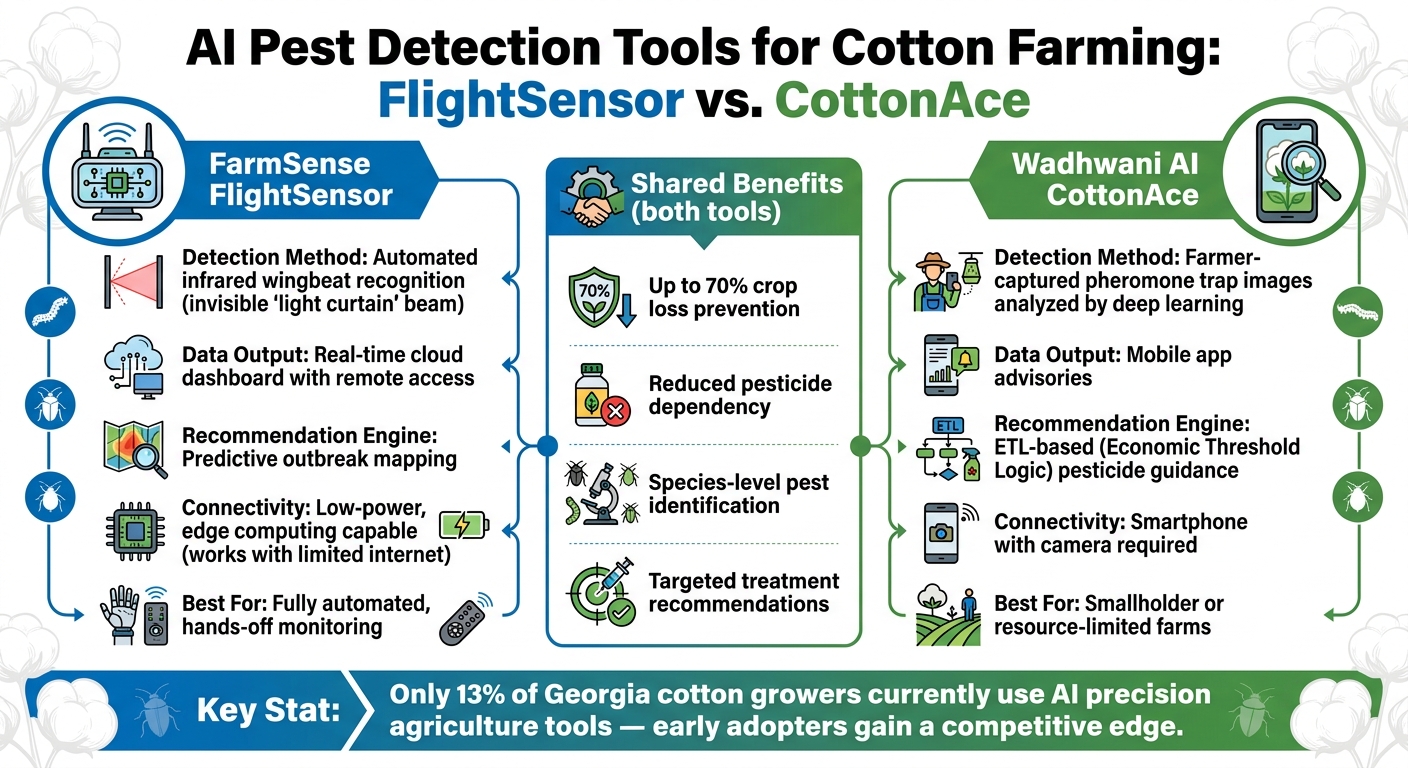
FarmSense FlightSensor vs. Wadhwani AI CottonAce: AI Pest Detection Tools Compared
AI-Powered Traps and Sensors
FarmSense FlightSensor and Wadhwani AI's CottonAce are two standout tools transforming how pests are detected in cotton farming.
The FlightSensor uses an automated IoT system that eliminates the need for manual image capture. It works by instantly identifying pests as they pass through an infrared light curtain, with the algorithm logging the data in real time. On the other hand, CottonAce relies on farmers capturing images of pheromone traps with their smartphones. These images are then analyzed by a deep learning model to determine the severity of infestations. CottonAce also provides stage-specific pesticide recommendations based on Economic Threshold Logic (ETL), ensuring treatments are applied only when necessary.
| Feature | FarmSense FlightSensor | Wadhwani AI CottonAce |
|---|---|---|
| Detection method | Automated infrared wingbeat recognition | Farmer-captured pheromone trap images |
| Data output | Real-time dashboard, remote access | Mobile app advisories |
| Recommendation engine | Predictive outbreak mapping | ETL-based pesticide guidance |
| Connectivity needs | Low-power, edge computing capable | Smartphone with camera |
Case Studies and Pilot Programs in U.S. Cotton
Field trials in the U.S. are showcasing how these advanced tools can benefit cotton farming. One of the most comprehensive studies took place in Jenkins County, Georgia, in September 2025. Researchers from Georgia Southern University, Georgia Tech, and FarmSense, including Atin Adhikari, James E. Thomas, and Debra Lam, deployed FlightSensor devices across eight large cotton fields near Millen. Four fields were actively monitored, while the other four served as control sites. The study focused on pests like stink bugs, cotton bollworms, corn earworms, tarnished plant bugs, and aphids.
Jenkins County, which ranks 173rd out of 765 cotton-producing counties in the U.S., provided an ideal testing ground for mid-scale cotton operations. The project was part of a broader initiative to bring precision agriculture tools to rural areas often overlooked in tech adoption. Local farmers and students also participated in hands-on training, gaining valuable experience with digital agricultural technologies.
Results from Field Deployments
The Jenkins County trial delivered actionable insights that improved crop management and protected yields. Farmers used real-time dashboards to adjust spraying schedules, while also becoming more skilled at identifying pests without relying solely on sensors.
"Preliminary results show that sensors monitor cotton-specific insect populations effectively, and farmers continue to enhance their pest-spotting skills post-deployment." - Debra Lam, Atin Adhikari, and James E. Thomas, Research Team
This knowledge-sharing effect has a long-term impact, extending benefits beyond the trial period. Meanwhile, CottonAce trials in key cotton-growing regions showed that acting on AI-generated advisories can prevent up to 70% of crop loss. This is especially critical for pests like the pink bollworm, which can destroy up to 70% of a cotton yield if left untreated. Early detection and intervention not only save crops but also safeguard farmers' livelihoods.
sbb-itb-0e617ca
How to Implement AI Pest Detection on Cotton Farms
Checking If Your Farm Is Ready
Start by evaluating your farm's connectivity and digital setup. Do your fields have consistent cellular, Wi-Fi, or satellite coverage? If the signal is unreliable, focus on systems that support satellite-based monitoring platforms. Next, assess your team's familiarity with digital tools. While operating an AI dashboard or mobile app doesn’t require advanced tech skills, some basic digital know-how will make the transition easier. With only 13% of cotton growers in Georgia currently using AI systems, adopting this technology early can give you a competitive edge. Once you’ve confirmed connectivity and your team’s readiness, you’re ready to move on to installation.
Installing and Setting Up AI Sensors
The Jenkins County pilot project offers a clear roadmap for setting up AI pest detection systems. Before installing sensors, the team conducted environmental baseline sampling to ensure the system was calibrated to local conditions.
To implement this on your farm, start by installing the FarmSense FlightSensor. Position its infrared light curtains at key insect entry points. These sensors identify pests by analyzing their wingbeat patterns and record detections in real time. The data is sent to an AI dashboard, which you can access from your computer or mobile device, eliminating the need for manual trap inspections.
| Implementation Phase | Key Action | Tool/Technology |
|---|---|---|
| Preparation | Site selection and baseline sampling | Environmental sensors, manual scouting |
| Installation | Deploying automated traps | FlightSensor infrared light curtain |
| Connectivity | Establishing data transmission | Satellite-based monitoring, digital pipelines |
| Operation | Real-time monitoring and analysis | AI dashboards, mobile apps, ML algorithms |
By following these steps, you’ll not only reduce pest risks but also improve overall farm efficiency.
Expanding AI Use Across Your Operation
When scaling AI systems, take it step by step. Begin with one or two fields to get comfortable with the data, then expand gradually. The Jenkins County project demonstrated the value of partnerships - organizations like Georgia Southern University, Georgia Tech, FarmSense, the University of Georgia Cooperative Extension, and local high schools all contributed to its success. Collaborations like these aren’t just for research pilots; they can bring expertise and funding to any farm looking to adopt new technologies.
Don’t overlook staff training. Farmers involved in the Jenkins County pilot continued to refine their pest detection skills even after the sensors were removed, showing that the benefits extend beyond just the technology itself.
"Training students and farmers on AI pest detection is doing more than protecting cotton crops. It's building digital literacy, opening doors to agtech careers and preparing communities for future innovation." - Debra Lam, Founding Director of the Partnership for Inclusive Innovation
As you scale, keep some control fields alongside your AI-monitored areas. This allows you to compare pesticide use and cost savings, providing hard data to justify further investments and demonstrate ROI to lenders or partners. Following this structured approach not only simplifies pest control but also sets the stage for broader economic and operational improvements.
Economic and Environmental Benefits of AI in Cotton Pest Detection
With successful field deployments paving the way, AI-driven pest detection is proving its worth in both economic returns and environmental improvements.
Financial Impact on Farms and Gins
AI pest detection offers a clear financial upside: cutting chemical costs, protecting yields, and increasing profit margins per acre. By enabling precise, targeted treatments, these systems reduce the need for widespread pesticide application and lower labor costs, translating to higher profitability for farms. Gin operators also gain an edge - cleaner, less-damaged cotton ensures smoother processing and higher throughput efficiency.
Environmental and Sustainability Gains
Precision farming powered by AI doesn’t just save money - it’s also better for the planet. By applying pesticides only where and when they’re needed, it minimizes chemical residues in the soil and air. A pilot project in Jenkins County (September 2025) demonstrated this, with the FlightSensor system allowing farmers to adjust spraying schedules based on real-time pest data instead of relying on estimates.
"By using AI to detect pests early and reduce pesticide use, the project aims to lower harmful residues in local soil and air while supporting more sustainable farming." - Debra Lam, Founding Director of the Partnership for Inclusive Innovation
This approach also reduces pesticide exposure for farm workers and nearby communities, offering significant environmental and health benefits, particularly in rural areas.
Beyond these gains, sustainability improvements directly impact production quality.
Better Fiber Quality and Gin Efficiency
Pest issues don’t just hurt yields - they compromise fiber quality, which can disrupt gin operations. Early pest detection, made possible by systems like FlightSensor, identifies threats such as aphids, stink bugs, and bollworms by analyzing their unique wingbeat patterns. This proactive approach keeps fiber cleaner, prevents sticky cotton from clogging machinery, and reduces boll damage that can lower lint grades. The result? Smoother, more efficient gin operations.
"The preliminary results indicate that the proposed sensors can effectively monitor insect populations specific to cotton farms... the AI dashboards and mobile apps help them see how pest populations grow over time and respond to different field conditions." - Georgia Tech News Center
These advancements highlight how AI is reshaping cotton pest management, delivering benefits that extend from the field to the gin.
Conclusion: What AI Means for the Future of Cotton Pest Management
Key Benefits for Cotton Farmers and Gins
AI-powered pest detection is proving to be a game-changer for the cotton industry. By enabling precise, targeted treatments, farmers can protect their yields more effectively, while gin operators benefit from cleaner fiber that simplifies processing. Take the Jenkins County pilot as an example: the use of AI tools not only improved pest detection during the trial but also left farmers better equipped to manage pests long after the technology was deployed.
"AI tools can help farmers pinpoint exactly where pest outbreaks are likely – before they happen. That means they can treat only the areas that need it, saving time, labor and pesticide costs." - Debra Lam, Founding Director of the Partnership for Inclusive Innovation
The advantages are clear, offering a strong foundation for broader implementation across the cotton industry.
Driving Industry-Wide Adoption
Despite these benefits, adoption remains a hurdle. Only 13% of farmers in Georgia currently use precision agriculture technologies, leaving plenty of untapped potential. This gap presents an opportunity for forward-thinking farmers and gin operators to gain a competitive advantage.
Bridging this divide will require more than just advanced technology. Farmers need accessible information, strong peer networks, and practical advice tailored to their specific needs. Platforms like Cottongins.org are stepping up to fill this role by connecting farmers, gin operators, and industry experts. Through resources like lessons from pilot programs - including the FarmSense FlightSensor deployment and the Georgia Southern University–City of Millen collaboration - this hub can help pave the way for a more efficient and sustainable future in cotton farming.
FAQs
How accurate are AI pest ID systems in real field conditions?
AI-powered pest identification systems have proven to be highly accurate under practical farming conditions, effectively pinpointing specific insect species. For instance, tools like FlightSensor leverage machine learning to analyze the unique wingbeat patterns of pests. This precision allows farmers to tackle potential threats early, reducing crop damage and boosting overall yields.
How many sensors or traps do I need per cotton field to get reliable alerts?
For dependable pest monitoring, it's generally suggested to use 1 to 3 sensors or traps per cotton field. The exact number you’ll need depends on the field's size and how active the pests are. This approach helps ensure proper coverage and allows for early detection, making it easier to address pest problems before they get out of hand.
Can these AI tools still work if my farm has weak or no cell service?
Yes, many AI tools are designed to work even with limited or no cell service. Take FlightSensor as an example - it can operate offline by storing data locally. When a connection becomes available, the stored data can be uploaded using satellite-based platforms, ensuring remote accessibility.