I’d choose the yarn package by its next job - not its price. Use cones for most knitting and weaving, dye-house-approved cones or cheeses for package dyeing, cops for transfer to winding, and hanks or skeins for hank dyeing or hand use.
Before ordering, I’d check your yarn specifications, buyer requirements, machine fit, package weight, winding tension, and density. For example, circular-knitting cones typically weigh 3.3–4.4 lb (1.5–2.0 kg), but your machine’s approved size comes first.
Quick Comparison
| Package | Main use | What I’d check | Cost to include |
|---|---|---|---|
| Cones | High-speed knitting and weaving | Dimensions, tension, density, and clearing settings | Winding, clearing waste, and shipping |
| Cheeses | Package dyeing or feeding compatible machines | Core, density, and take-off method | Density control and any rewinding after dyeing |
| Cops | Ring-spinning feed for winders | Tube size, package build, and winder fit | Transfer, winding, and clearing waste |
| Hanks or skeins | Hank dyeing and hand use | Dyeing route, yarn consistency, and buyer format | Reeling, handling, and rewinding for machine use |
My final check is <u>cost per usable pound</u>. That means counting all winding, waste, handling, and freight costs - not just the package price - and confirming labels, traceability, yarn test results, and sample approval before shipment.
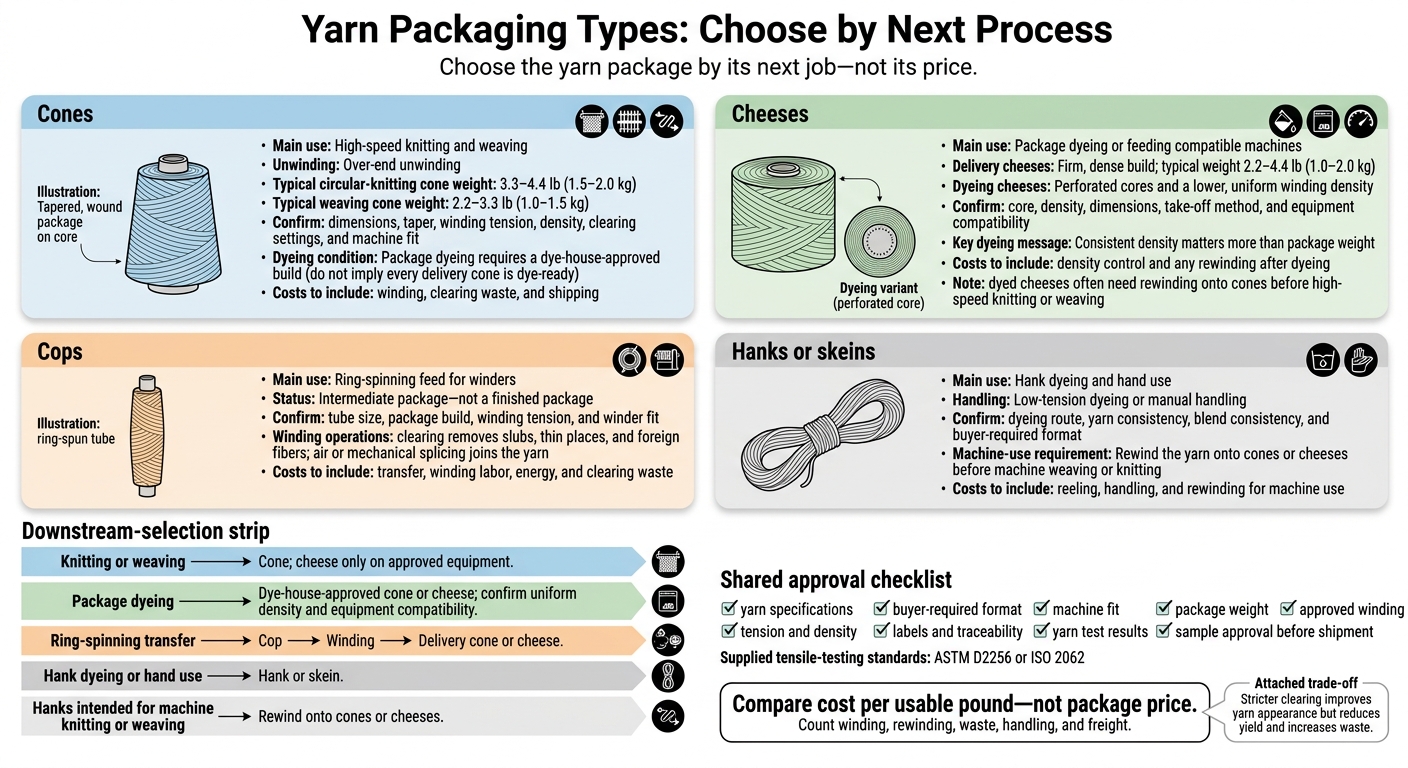
Yarn Packaging Types: Choose by Next Process
1. Cones
Cones are the main yarn package for clean, high-speed unwinding in knitting and weaving.
Construction and Yarn Compatibility
The tapered shape supports over-end unwinding. Incorrect yarn twist can increase breakage when cones unwind at high speed.
Process and Machinery Fit
Typical cone weights are 3.3–4.4 lb (1.5–2.0 kg) for circular knitting and 2.2–3.3 lb (1.0–1.5 kg) for weaving. Heavier cones mean fewer package changes.
Match the cone dimensions, taper, winding density, and tension to the machine’s creel and unwinding speed. Specify air or mechanical splices to keep knots out of the yarn during unwinding.
Unwinding and Dyeing Performance
If the yarn will be dyed, request test data for H-value, U%, and maturity.
Handling and Total Cost
Label each package with its count, lot number, spinning system, and net weight. Use plastic-wrapped pallets to protect the freight. When comparing costs, weigh fewer cone changes against higher package handling costs and waste from over-clearing.
If the next step calls for a different unwind path or package build, compare cones with cheeses.
sbb-itb-0e617ca
2. Cheeses
Construction and Yarn Compatibility
A cheese is a cylindrical, cross-wound package that keeps its shape during handling and transport. Choose cheeses when stable package shape or even dye flow matters more than direct cone unwinding. Fine combed cotton yarns and high-twist yarns need tight tension control to prevent snarling. Compared with cones, cheeses favor package stability and dye penetration over high-speed over-end unwinding.
Process and Machinery Fit
Use delivery cheeses for direct feeding and dyeing cheeses for package dyeing. Delivery cheeses have a firm, dense build and typically weigh 2.2–4.4 lb (1.0–2.0 kg). They suit transport and direct feeding on compatible equipment. Dyeing cheeses need perforated cores and a lower, uniform winding density so dye liquor flows evenly through the package.
Unwinding and Dyeing Performance
For direct feeding, check that the feeder accepts the cheese dimensions and take-off method. For package dyeing, consistent density matters more than package weight. Dense spots restrict liquor flow and can produce uneven shades.
Handling and Total Cost
Reusable plastic or stainless steel cores cut costs in integrated mills. Dyed cheeses often need rewinding onto cones before high-speed knitting or weaving, so include that extra step in the total cost.
If the yarn needs to stay in process for another winding step, cops are a better fit.
3. Cops
Construction and Yarn Compatibility
Cops are small yarn packages produced by ring spinning and sent to winding.
Process and Machinery Fit
Cops are made for transfer, so their shape and tension need to allow smooth rewinding. At automatic winders, clearing removes slubs, thin places, and foreign fibers. Air or mechanical splicing then joins the yarn. Cop build, tube dimensions, and winding tension all affect how smoothly the yarn unwinds.
Unwinding Performance
Uneven build or tension can cause yarn breaks during high-speed unwinding.
Handling and Total Cost
Stricter clearing improves yarn appearance, but it also reduces yield and increases waste.
Hanks and skeins are a better fit when yarn handling involves little machine tension and no rewinding.
4. Hanks and Skeins
Construction and Yarn Compatibility
Unlike cops, hanks and skeins are loose yarn packages intended for manual handling or dyeing.
Process and Machinery Fit
Use hanks or skeins for dyeing, hand use, or other low-tension handling. Before machine weaving or knitting, rewind the yarn onto cones or cheeses.
Unwinding and Dyeing Performance
The loose structure lets dye liquor circulate around the yarn. Keep skeins evenly arranged to help produce consistent shades.
Handling and Total Cost
Include rewinding time and waste when calculating the total package cost.
Comparing Packages in Mill Use
Once you understand the package types, choose based on the yarn specification, the next machine, and the planned process.
Package Construction and Yarn Requirements
Start with the yarn specification - not the package shape. Request reports on count variation, tensile strength, and hairiness, along with agreed blend and twist specifications. The same yarn may need a different package for a different next step.
Here’s how the formats compare in mill use.
| Format | Yarn considerations | Specifications to confirm |
|---|---|---|
| Cones | Suited to high-speed over-end unwinding; fine counts need careful winding. | Count, twist, clearing settings, and weight. |
| Cheeses | Choose when density control or equipment requirements favor cheeses. | Count, blend, winding requirements, and density. |
| Cops | Use as an intermediate package before winding, not as a finished package. | Count, strength, and winder compatibility. |
| Hanks or skeins | Suited to low-tension dyeing or manual handling; blend consistency affects dye uptake. | Count, blend, and buyer-required format. |
Fit for Downstream Processes and Machinery
Ring spinning typically follows this route: cop → winding → delivery cone or cheese.
| Operation | Preferred package | Alternatives | Machinery requirements | Selection risk |
|---|---|---|---|---|
| Knitting | Cone | Cheese on approved equipment | Feeder and package holder that fit the package | Poor fit or unstable feed. |
| Weaving | Cone | Cheese on approved equipment | Approved creel and package weight | Frequent doffs or breakage. |
| Package dyeing | Dye-house-approved cone or cheese | Only formats accepted by the dye house | Confirm density and equipment compatibility | Assuming a delivery package is dye-ready. |
| Hank dyeing | Hank or skein | Only a dye-house-approved alternative | Compatible hank-dyeing equipment | A mismatch with the requested dyeing route. |
| Rewinding | Cops as ring-spinning feed | Hanks when required | Compatible winding equipment | Extra handling or an unnecessary transfer. |
Once machine fit is confirmed, check how the package unwinds or dyes in practice.
Unwinding and Dyeing Performance
Uniform tension and controlled package density help keep unwinding and dyeing consistent. Immature cotton fibers and inconsistent blends can cause shade variation.
| Format | Unwinding behavior | Dyeing suitability | Failure modes to check | Preventive controls |
|---|---|---|---|---|
| Cones | Preferred for high-speed over-end feed | Requires a dyeing specification | Tension variation, package collapse, breaks | Approve winding tension, density, and clearing settings. |
| Cheeses | Works well on approved equipment | Requires a dyeing specification | Edge defects, unstable feed, uneven penetration | Confirm density and equipment compatibility with the dye house. |
| Cops | Small capacity requires frequent feed-package changes | Not a delivery format | Repeated handling and spinning faults | Consolidate through controlled winding and clearing. |
| Hanks or skeins | Not suited to high-speed creel feeding | Intended for hank dyeing | Shade variation from fiber or blend differences | Verify fiber and blend consistency with the dye house. |
Handling and Total Cost
Compare cost per usable pound, not package price. Account for freight protection, and request agreed clearing settings and a packing list before comparing quotes. Include winding, rewinding, and waste when calculating which format has the lowest total usable cost.
| Format | Cost impact |
|---|---|
| Cones | Include winding from cops and clearing waste; direct machine feeding avoids another transfer. |
| Cheeses | Include winding and density control; confirm whether use after dyeing requires rewinding. |
| Cops | Include transfers, winding labor, energy, and waste needed to produce finished packages. |
| Hanks or skeins | Include reeling, manual handling, and any rewinding; choose when the buyer requires hanks or skeins. |
Advantages and Limitations of Each Package
Each format has strengths and limits. Choose based on the process the yarn will serve next.
| Format | Advantages | Key trade-off | Best-fit use |
|---|---|---|---|
| Cones | Common delivery format. | Ring-spun yarn needs winding and clearing. | Direct feed for knitting or weaving; package dyeing with an approved build. |
| Cheeses | Uniform density supports package dyeing. | Less suited to high-speed unwinding. | Package dyeing and compatible weaving equipment. |
| Cops | Compact for internal transfer between processes. | Not a finished package. | Intermediate feed to winding machines. |
| Hanks or skeins | Loose form suits dyeing and hand use. | Handling and rewinding add labor and a risk of tangling. | Hank dyeing and hand-use formats. |
Clearing means balancing quality against usable yield. Tighter settings improve yarn appearance but leave less usable yarn. Agree on acceptable imperfections before approving the winding specification, rather than choosing the tightest settings available.
Match package weight to the buyer-approved machine specification. Apply buyer-required traceability labels to every package.
Final Recommendation: Match the Package to the Next Process
After comparing package types, choose the package based on the next process.
Use cones or cheeses for knitting and weaving. Winding removes defects and prepares yarn for machine feeding. Knitting needs smooth, even yarn, while weaving needs greater strength to handle loom tension. Keep cops as an intermediate ring-spinning package - not a finished package.
For external delivery, match the package to the next operation. Package dyeing requires uniform density and tension, with slubs, thin places, and foreign fibers removed. Choose hanks when the order calls for hank dyeing or hand use.
Before release, check the buyer’s required format, labels, traceability fields, next process, yarn specifications, machine fit, and approved winding density and tension. Request tensile test results under ASTM D2256 or ISO 2062.
Compare total delivered cost, not just the package price. Before bulk shipment, send a lab dip or yarn sample for buyer testing and dye-affinity approval. Base the package choice on the buyer’s next process rather than mill convenience.
FAQs
How can I test package compatibility before ordering?
Run small trials before ordering on the downstream equipment you’ll use. Inspect samples for winding defects, contamination, and overfilling. Perform a “squish test” and check that the package/bobbin fits the winder to prevent wobble or telescoping.
Before placing a bulk order, request lab dips/swatches. Test yarn count, evenness (Uster/CV%), tensile strength, and dye uptake during the relevant winding/unwinding process. Ask for calibrated test reports and sample-approval terms.
How do I check winding density for dyeing?
Keep package density within 0.36–0.40 g/cm³, with no more than 5–6% variation between the inner and outer layers. Take density samples from the top, middle, and inner parts of the package.
Calibrate winding equipment and keep winding tension low and steady to protect the yarn. Check tension devices and yarn guides regularly to keep density stable.
How do I calculate cost per usable pound?
Calculate cost per pound by dividing total production costs by the pounds of usable, saleable yarn produced - not the weight of the raw materials. Include raw materials, energy, labor costs (including benefits and overhead), and machinery depreciation.
Factor in processing waste and quality-related losses, such as rejected yarn and dyeing waste. When comparing spinning methods, also account for differences in winding requirements, labor intensity, energy costs, and how each method uses waste.