Sustainable cotton certifications guide farmers, brands, and consumers toward responsible practices. These certifications address issues like pesticide use, water consumption, and labor conditions, ensuring ethical and eco-conscious cotton production. Programs like the Better Cotton Initiative (BCI), GOTS, and Fair Trade Cotton focus on improving farming methods, worker rights, and supply chain transparency. Each certification has unique standards, from organic content verification to social responsibility. Here's a quick breakdown:
- Better Cotton Initiative (BCI): Covers 23% of global cotton production; emphasizes pesticide reduction, fair wages, and traceability.
- GOTS: Oversees the entire textile process, requiring 70% organic fibers and strict chemical limits.
- Fair Trade Cotton: Ensures fair prices for farmers and ethical labor practices.
- OCS: Focuses solely on verifying organic fiber content, with no additional social or processing standards.
- OEKO-TEX Organic Cotton: Tests for GMOs and harmful substances, offering rigorous traceability.
- USDA Organic: Regulates raw fiber production, banning GMOs and synthetic chemicals.
- U.S. Cotton Trust Protocol: Tracks farm-level improvements in soil, water, and emissions.
These certifications help protect resources, improve working conditions, and meet consumer demands for ethical products. Below is a comparison to help you choose the right certification for your needs.
Quick Comparison
| Certification | Focus Area | Organic Content Required | Social Standards | Traceability Level |
|---|---|---|---|---|
| Better Cotton Initiative | Farm-level sustainability | No | Fair wages, no child labor | Mass Balance, Segregation |
| GOTS | Entire textile process | 70% | ILO labor standards | Dual certificate system |
| Fair Trade Cotton | Ethical trade & farming | No | Democratic farmer groups | Dual certification |
| OCS | Organic fiber verification | 5-100% | None | Transaction Certificates |
| OEKO-TEX Organic Cotton | GMO & substance testing | 70-100% | None | Seven-step verification |
| USDA Organic | Farm-level organic standards | 95% | None | Raw fiber only |
| U.S. Cotton Trust Protocol | Farm improvements & tracking | No | Worker well-being | Digital traceability |
Each program addresses specific needs, from organic verification to ethical labor and farming practices. Choose based on your priorities - whether it's organic content, labor rights, or supply chain accountability.
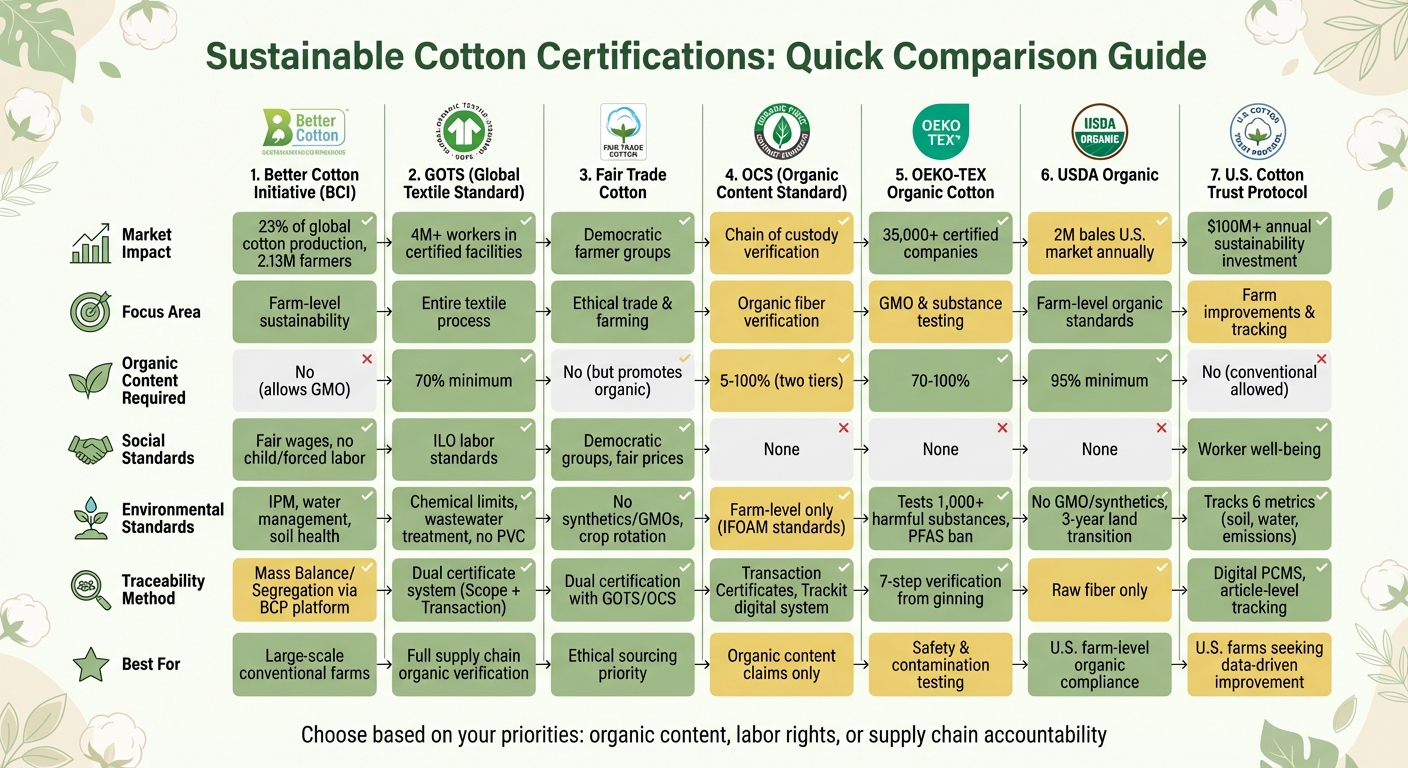
Sustainable Cotton Certifications Comparison: Standards, Requirements, and Traceability
7 Sustainability Certifications You Should Know
1. Better Cotton Initiative (BCI)
The Better Cotton Initiative (BCI) stands out as a major program driving sustainability in cotton production. By 2023–24, BCI accounted for 23% of global cotton production, with 2.13 million licensed farmers across 15 countries. Over 13,000 organizations are involved, and the initiative has raised more than $200 million to train three million farmers and workers. Its mission is to support cotton-growing communities while safeguarding and rejuvenating the environment.
Environmental Standards
BCI promotes regenerative practices to boost soil health and biodiversity, emphasizing responsible land and water management. Farmers are required to implement Integrated Pest Management (IPM) to reduce dependence on synthetic pesticides, and they must phase out Highly Hazardous Pesticides (HHPs). The initiative remains technology-neutral, allowing genetically modified cotton where it’s legally permitted. Climate action is woven into the program, helping farmers adapt to and mitigate climate-related challenges.
Social Requirements
A core element of BCI’s social framework is the "Decent Work" principle, which bans child and forced labor, ensures fair wages, encourages gender equality, and upholds workers’ rights to unionize. Farmers benefit from free training on sustainable practices and health, funded through volume-based fees. This training has reached nearly four million individuals to date.
Supply Chain Traceability
To ensure transparency, BCI uses the Better Cotton Platform (BCP) to track cotton through various Chain of Custody models. Its Mass Balance system tracks credits while allowing Better Cotton to be mixed with conventional cotton. For brands needing physical traceability, BCI offers Segregation (for single-country sourcing) and Controlled Blending models, which trace cotton back to its country of origin. Starting in January 2024, medium to very large retailer and brand members must undergo independent third-party assessments of their annual cotton fiber use. These traceability practices make BCI particularly appealing in markets with strict sustainability expectations.
Relevance to the U.S. Market
BCI’s technology-neutral approach aligns well with U.S. cotton farming, where genetically modified seeds are commonly used. The program acknowledges and rewards the sustainability efforts of large-scale American farms. Notably, major U.S. retailers like Gap Inc. were among BCI’s founding members. Through volume-based fees, brands can contribute directly to field-level improvements. During the 2023–24 season, retailers and brands sourced 2.5 million metric tons of Better Cotton, meeting both U.S. farming practices and the growing domestic demand for sustainable products.
2. Global Organic Textile Standard (GOTS)
GOTS oversees the entire textile production process, from raw fiber to the finished product. Globally, over 4 million people work in GOTS-certified facilities. In the U.S., any textile product labeled "organic" must comply with either USDA organic regulations or GOTS standards. This certification plays a key role in ensuring market access while meeting both consumer and industry expectations.
Minimum Organic Content Thresholds
To qualify for GOTS certification, at least 70% of the fibers used must be certified organic. Additionally, the standard bans synthetic pesticides, herbicides, and genetically modified organisms (GMOs) during fiber production.
Environmental Standards
GOTS imposes strict limits on harmful substances, including heavy metals, toxic dyes, bleaches, and certain printing agents. It also requires wastewater treatment in all wet-processing units and promotes waste reduction. PVC is prohibited in packaging, further aligning the certification with sustainability goals. In Version 7.0, GOTS introduced a six-step due diligence process based on OECD Guidance for Responsible Supply Chains in the Garment and Footwear Sector, adding another layer of accountability.
Social Requirements
GOTS incorporates International Labor Organization (ILO) standards to address social issues. Certified facilities must avoid child and forced labor, provide safe working conditions, and respect workers' rights to collective bargaining. This ensures that the "organic" label also signifies ethical labor practices across the supply chain.
Supply Chain Traceability
GOTS enhances transparency and trust within the cotton supply chain through a robust dual-certificate system. Each facility must have a Scope Certificate, while a Transaction Certificate accompanies every ownership transfer to verify volumes and prevent fraud. Independent third-party certification bodies conduct annual on-site audits, checking records and performing input/output reconciliation to ensure that the organic output matches the certified organic input throughout the supply chain.
Relevance to the U.S. Market
For U.S. processors and manufacturers, GOTS certification offers a significant advantage. Recognized in major global markets, it allows companies to export textiles and garments under a single, transparent standard. Leading certification bodies like Control Union Certifications North America, Oregon Tilth, and EcoCert ICO-USA provide GOTS verification services in the U.S.. As demand for sustainable textiles increases, GOTS certification helps businesses stand out by meeting both domestic regulations and international expectations.
3. Fair Trade Cotton
Fair Trade Cotton combines ethical labor practices with environmentally conscious farming. Unlike certifications that only address environmental concerns, Fair Trade ensures farmers are paid fair prices and can form democratic organizations to negotiate better trade terms collectively. This dual approach not only supports farmers in tackling climate challenges but also guarantees fair trade practices. Let’s dive deeper into the social and environmental standards that make Fair Trade Cotton stand out.
Social Requirements
Fair Trade certification emphasizes the importance of democratic farmer groups. These groups allow farmers to negotiate fair trade terms with buyers rather than simply accepting market rates. Buyers are required to agree to responsible trade terms, ensuring fair pricing and empowering producers. This system also safeguards worker rights, gaining recognition from major U.S. retailers like Amazon.
Environmental Standards
Fair Trade Cotton aligns with organic farming principles by prohibiting synthetic chemicals and GMOs. It promotes soil health through crop rotation, supports biodiversity, and reduces carbon emissions. According to Fairtrade International:
follow ethical and environmental standards, which make environmental protection an integral part of farming.
This commitment to sustainable practices ensures that environmental care is deeply ingrained in every aspect of cotton production.
Supply Chain Traceability
Fair Trade Cotton uses a dual certification system, often paired with organic certifications like the Global Organic Textile Standard (GOTS) or the Organic Content Standard (OCS), to maintain traceability throughout the supply chain. Each transaction is documented with certificates that track specific volumes of cotton, ensuring consistency and transparency at every step of production.
Relevance to the U.S. Market
In the U.S., Fair Trade certification enhances brand credibility while addressing consumers’ growing preference for ethically sourced products. Retailers offering Fair Trade Cotton not only protect worker rights but also reduce supply chain risks. By supporting producers with resources to handle extreme weather and climate challenges, companies strengthen their supply chains and align with ethical sourcing practices.
4. Organic Content Standard (OCS)
The Organic Content Standard (OCS) takes a more specific approach compared to broader certifications like GOTS or Fair Trade. Instead of focusing on processing methods or labor conditions, OCS zeroes in on verifying the organic fiber content in products, tracing it from the gin all the way to the final item.
Minimum Organic Content Thresholds
OCS provides two labeling options based on the percentage of organic fiber in a product. The OCS 100 label applies to items with at least 95% organic fibers, while the OCS Blended label is used for products containing between 5% and 95% organic fibers. This system allows brands to back up their claims for both fully organic and blended textiles.
Supply Chain Traceability
To meet OCS standards, every facility handling organic fiber, from the gin to the finished product, must comply with OCS requirements. A Transaction Certificate (TC) is issued whenever ownership changes, documenting the volume of organic cotton being transferred. This ensures consistency between farm output and the final product. Additionally, OCS’s "Trackit" program digitizes certification data, replacing paper documentation. This not only reduces the risk of fraud but also enhances transparency throughout the supply chain.
Environmental Standards
OCS does not cover areas like processing chemicals, wastewater treatment, or energy use during manufacturing. Instead, it focuses on ensuring that organic materials come from farms certified under IFOAM’s Family of Standards. These standards ban the use of toxic synthetic pesticides, fertilizers, and GMO seeds. Looking ahead, Textile Exchange’s Materials Matter Standard, set to take effect on December 31, 2027, will introduce more detailed environmental requirements.
Relevance to the U.S. Market
In the United States, the USDA National Organic Program (NOP) oversees organic cotton at the farm level but does not regulate "organic" claims once the cotton leaves the farm. OCS fills this gap by providing a verified chain of custody for finished textiles. U.S. brands are encouraged to consult Textile Exchange’s guide, Organic Textile Labeling in the United States, to ensure their claims align with voluntary standards and USDA/FTC guidelines. The OCS Supplier Directory also helps brands verify that their supply chain partners hold up-to-date certifications and that every ownership transfer is backed by a Transaction Certificate.
sbb-itb-0e617ca
5. OEKO-TEX Organic Cotton Certification
Introduced in April 2023, the OEKO-TEX Organic Cotton certification takes a laboratory-driven approach to confirm organic cotton claims, setting it apart in the industry.
Environmental Standards
OEKO-TEX uses quantitative GMO testing to differentiate between accidental contamination and intentional mixing with conventional cotton, ensuring GMO levels stay below 10%. Georg Dieners, Secretary General of OEKO-TEX, highlighted this approach:
Our quantitative GMO test differentiates between contamination and deliberate mixing with conventional cotton.
The certification also screens for over 1,000 harmful substances, including pesticides, PFAS, lead, cadmium, pentachlorophenol, and banned azo colorants. Limits are updated annually to align with the latest scientific and regulatory standards. In 2023, OEKO-TEX implemented a full ban on all PFAS in certified textiles. This comprehensive testing ensures early and precise verification, complementing broader sustainability efforts.
Minimum Organic Content Thresholds
OEKO-TEX offers two labeling categories: OEKO-TEX ORGANIC COTTON for products made entirely from organic cotton and OEKO-TEX ORGANIC COTTON Blended for items containing at least 70% organic cotton. Both labels enforce rigorous GMO and contaminant testing, maintaining the same safety standards as those for 100% organic cotton.
Supply Chain Traceability
To ensure traceability, OEKO-TEX follows a detailed seven-step verification process: application, material sample verification, chain of custody analysis, laboratory testing, result evaluation, on-site inspection, and final certification. This process tracks organic cotton from the ginning stage - where fibers are separated from seeds - through every production phase. Georg Dieners explained:
What's new is that we will start checking for genetically modified cotton at the beginning of the supply chain - at the ginning stage when the cotton fibres are separated from the seed. Then we can follow the flow of goods through all stages.
This method strengthens supply chain transparency and ensures earlier verification.
Relevance to the U.S. Market
OEKO-TEX’s robust environmental and traceability standards offer U.S. brands a practical certification solution. While the USDA National Organic Program focuses on regulating organic cotton at the farm level, its requirements can be challenging for textiles with multiple inputs. OEKO-TEX bridges this gap by providing an organic labeling system that extends beyond farming. It also ensures compliance with the U.S. Consumer Product Safety Improvement Act (CPSIA), particularly regarding lead content limits.
Products are categorized into four classes based on skin contact, with Product Class 1 - designed for babies and children under three - having the strictest standards. U.S. consumers can verify these certifications through the OEKO-TEX Label Check tool online. With over 35,000 certified companies worldwide, OEKO-TEX offers U.S. brands a wide array of sourcing options.
6. USDA Organic for Textiles
The USDA Organic certification defines the legal framework for labeling organic cotton in the U.S. According to the Agricultural Marketing Service:
Organic is a labeling term that indicates that the food or other agricultural product has been produced through approved methods.
For cotton textiles, the certification applies exclusively to the raw fiber, establishing its importance in U.S. market standards.
Environmental Standards
To meet USDA organic standards, farmland must be free of prohibited substances for at least three years before the cotton is harvested. The certification bans the use of genetic engineering (GMOs), sewage sludge, ionizing radiation, synthetic fertilizers, and toxic pesticides. Instead, farmers are required to enhance soil fertility through practices like tillage, crop rotation, and cover cropping. Pest and disease control must rely on mechanical or biological methods. These sustainable practices contribute to healthier soil and greater climate resilience.
Minimum Organic Content Thresholds
For a product to carry the USDA organic seal, it must contain at least 95% certified organic content. Products with 70% or more organic content can use the "made with organic" label but are not permitted to display the USDA seal. Labels may also indicate specific fibers as organic, provided the exact percentage of organic fibers is clearly stated. These guidelines help ensure transparency and build consumer confidence.
Supply Chain Traceability
The USDA National Organic Program (NOP) oversees the handling of raw agricultural fiber to prevent mixing organic and non-organic materials. However, the certification is limited to raw fiber and does not extend to the entire manufacturing process. Finished products cannot claim to be USDA organic or display the USDA organic seal unless they are certified under USDA organic regulations.
Relevance to the U.S. Market
GOTS certification aligns with USDA requirements, bridging the gap between farm-level standards and textile processing. With the U.S. textiles market consuming around two million bales of cotton annually, USDA Organic certification provides legal clarity that benefits both producers and consumers.
7. U.S. Cotton Trust Protocol
The U.S. Cotton Trust Protocol is a voluntary program aimed at supporting American cotton growers in adopting more sustainable practices. Backed by the National Cotton Council and Cotton Council International, it focuses on measurable improvements in farming practices rather than adhering to organic standards. The program tracks six critical areas: land use, soil carbon, water management, soil loss, greenhouse gas emissions, and energy efficiency.
Environmental Standards
To evaluate their environmental impact, growers use the Fieldprint Calculator, developed by Field to Market. All data is verified by third-party organizations such as Control Union Certifications. According to the 2021-22 report, participants achieved a 78% reduction in soil loss, a 25% cut in energy use, and a 21% decrease in greenhouse gas emissions compared to 2015 levels. Farmers are encouraged to adopt regenerative practices like minimal tillage, planting winter cover crops, and using precision agriculture tools such as GPS auto-steer and drones. Unlike traditional certification systems, which often rely on pass/fail criteria, this program prioritizes ongoing improvement, offering farmers actionable insights to refine their methods over time. This comprehensive system not only targets environmental benefits but also promotes better working conditions.
Social Requirements
The program also incorporates social responsibility through its Worker Well-being category in the grower questionnaire. Participating farms must meet standards for worker safety, fair wages, and overall well-being. Farmer John Lindamood shared the following:
We take a real interest in our employees, in their health, in their environment because they're like family. Our farm exceeds minimum wage requirements, offers time-and-a-half pay, and provides retirement plans.
Supply Chain Traceability
One of the standout features of the U.S. Cotton Trust Protocol is its article-level traceability, made possible through the Protocol Consumption Management Solution (PCMS). This digital platform ensures a transparent chain of custody, tracking cotton from the farm to the final product. It includes a detailed transparency map that authenticates the cotton’s origin and identifies all mills and manufacturers involved. The system differentiates between "U.S. Cotton" (verified at the country level) and "Protocol Cotton" (fiber from farms with verified field-level sustainability data). Major brands have embraced this innovation - Carhartt, Inc. joined in June 2024 to enhance supply chain visibility, while KIABI followed in June 2025, integrating Protocol-tracked cotton into its fashion lines and publishing a case study on its implementation. These traceability efforts connect sustainable farming practices directly to industry accountability.
Relevance to the U.S. Market
With over $100 million invested annually in sustainability research, the Trust Protocol provides American cotton growers with a standardized way to demonstrate their sustainable practices to global brands. The program has set ambitious goals for 2025, including reducing water use by 18%, cutting greenhouse gas emissions by 39%, and lowering soil loss by 50%. It has earned recognition from organizations like the Textile Exchange, Sustainable Apparel Coalition, and Partnership for Sustainable Textiles, and aligns with UN Sustainable Development Goals 6, 12, and 13.
Certification Comparison
This section dives into the key distinctions between various certifications, helping you decide which aligns best with your priorities - whether it’s organic content, farm-level practices, or accountability across the entire supply chain. Each certification has its own focus, so understanding their nuances is essential for making an informed choice.
Take GOTS and OCS, for example. GOTS offers a broad scope, addressing both environmental and social criteria throughout the supply chain, from processing to retail. It requires at least 70% certified organic fibers, enforces strict chemical usage limits, mandates wastewater treatment, and ensures labor protections for over 4 million workers in certified facilities globally. On the other hand, OCS is narrowly focused, verifying organic content ranging from 5% to 100%, but without imposing additional environmental or social standards.
Now consider BCI, which emphasizes farm-level sustainability rather than organic certification. Accounting for 23% of global cotton production (5.64 million metric tons in the 2023–24 season), BCI promotes practical measures like Integrated Pest Management and water efficiency while permitting controlled use of synthetic inputs. Similarly, the U.S. Cotton Trust Protocol focuses on improving farm practices and offers digital tracking to connect specific cotton bales to finished products.
In the U.S., certifications like USDA Organic for Textiles and OEKO-TEX Organic Cotton set clear organic standards, while Fair Trade Cotton prioritizes social responsibility. The main difference lies in their scope: farm-level certifications (e.g., BCI, USDA Organic, Trust Protocol) concentrate on agricultural practices, whereas supply chain certifications (e.g., GOTS, OCS) ensure integrity from the cotton gin to finished manufacturing.
Traceability is another critical factor. GOTS and OCS rely on transaction certificates at every ownership transfer, while the Trust Protocol uses digital tracking. Meanwhile, BCI verifies sourcing through supplier sites. These differences are especially important for brands navigating regulatory demands and for consumers seeking verified sustainability.
Conclusion
Sustainable cotton certifications go beyond being just labels - they act as critical frameworks that safeguard the future of the cotton industry. For farmers, these standards offer hands-on training to improve soil health through regenerative methods, while also ensuring fair wages and safe working environments. For businesses, certifications help reduce reputational risks and ensure compliance with tightening regulations. For instance, the EU Directive on Empowering Consumers for the Green Transition is making third-party certification a legal requirement for brands making sustainability claims.
The importance of these certifications is underscored by global data. The Better Cotton Initiative’s (BCI) significant market share and the Global Organic Textile Standard’s (GOTS) large workforce highlight the reach and rigor of these programs. They also bolster supply chain integrity by using verified tracking systems to prevent fraud and ensure certified fibers are not swapped with conventional ones.
Looking ahead, the industry is shifting toward digital traceability systems and outcome-based metrics that go beyond basic practice adoption. The Better Cotton Initiative, for example, has set a goal to double its sustainable cotton production by 2030. Additionally, suppliers will need to secure certification before the 2027/28 season to meet evolving brand requirements. As BCI farmer Todd aptly puts it:
Regenerative agriculture is a journey, not a destination.
These certifications play a vital role in conserving key natural resources - such as soil, water, and biodiversity - that are essential for the cotton industry’s future. They offer the transparency that consumers increasingly demand and provide businesses with the compliance frameworks they need to operate responsibly. Without these standards, the industry risks depleting resources and facing regulatory challenges. This balance between economic goals and sustainable practices is shaping the future of cotton production.
FAQs
What’s the difference between the Better Cotton Initiative (BCI) and GOTS certifications?
The Better Cotton Initiative (BCI) and the Global Organic Textile Standard (GOTS) serve different purposes and take distinct approaches to certification.
BCI concentrates on guiding farmers toward adopting practices that are better for the environment and workers. This includes improving water usage, cutting down on pesticide reliance, and enhancing working conditions. However, BCI's certification applies only to farming practices, offering a "Better Cotton" label for conventional cotton without certifying the final textile product.
GOTS, in contrast, sets a high bar for organic textiles. To meet this standard, products must contain at least 70% organic fibers. GOTS also enforces strict chemical restrictions during production, ensures traceability across the entire supply chain, and requires independent audits to confirm adherence to both environmental and social standards.
In essence, BCI emphasizes gradual improvements in conventional cotton farming, while GOTS provides a thorough certification for organic textiles, addressing both environmental and social aspects at every stage.
What does Fair Trade Cotton do to promote ethical labor practices?
Fair Trade Cotton prioritizes ethical labor by enforcing strict social standards across farms and supply chains. One key requirement is that farmers must be part of democratic producer organizations. These organizations empower workers by giving them a say in decision-making and strengthening their ability to negotiate collectively. This structure helps protect workers' rights and ensures fair representation.
Another cornerstone of Fair Trade certification is the commitment to paying a fair price - a rate above the typical market value. Buyers also contribute an additional premium, which goes toward funding community initiatives such as education, healthcare, and improving workplace safety. To uphold these standards, independent third-party audits are conducted regularly. These audits ensure that workers operate in safe conditions, receive fair wages, and are shielded from exploitation throughout every step of the cotton supply chain.
Why is traceability crucial for sustainable cotton certifications?
Traceability plays a key role in sustainable cotton certifications, ensuring transparency across the entire supply chain. It follows the cotton's path - from the farm where it’s cultivated to the final product - confirming that it meets strict environmental and social standards. Certifications such as GOTS and the Organic Content Standard depend on this system to verify responsible handling at every stage, reducing the risk of fraud and fostering trust.
With clear and verifiable data, traceability addresses the growing market demand for sustainable textiles. It empowers brands to confidently showcase their commitment to ethical practices, giving consumers the confidence that their purchases align with environmental and ethical values. In the bigger picture, traceability helps strengthen the cotton industry by encouraging accountability and driving meaningful progress over time.