Cotton farming can use less water and fewer pesticides while maintaining profitability. Here's how:
- Water Use Reduction: Precision irrigation systems, such as Variable-Rate Irrigation (VRI), deliver water only where needed, improving water productivity by up to 19%. Rainwater harvesting stores water during wet periods for later use, reducing reliance on external sources.
- Pesticide Reduction: Integrated Pest Management (IPM) applies pesticides only when necessary, cutting chemical use significantly. Arizona's IPM program reduced insecticide applications from 11 to fewer than 2 per season, saving $700 million and avoiding 40 million pounds of chemicals.
- Drought-Resistant Varieties: These cotton plants thrive with less water, maintaining yields even in dry conditions. Examples include FH-912 and Acala 1517-16 B2RF, which perform well under water stress.
- Soil Health Practices: Cover cropping and conservation tillage improve soil's water retention and reduce the need for chemicals. No-till farming combined with cover crops can boost yields by 9%.
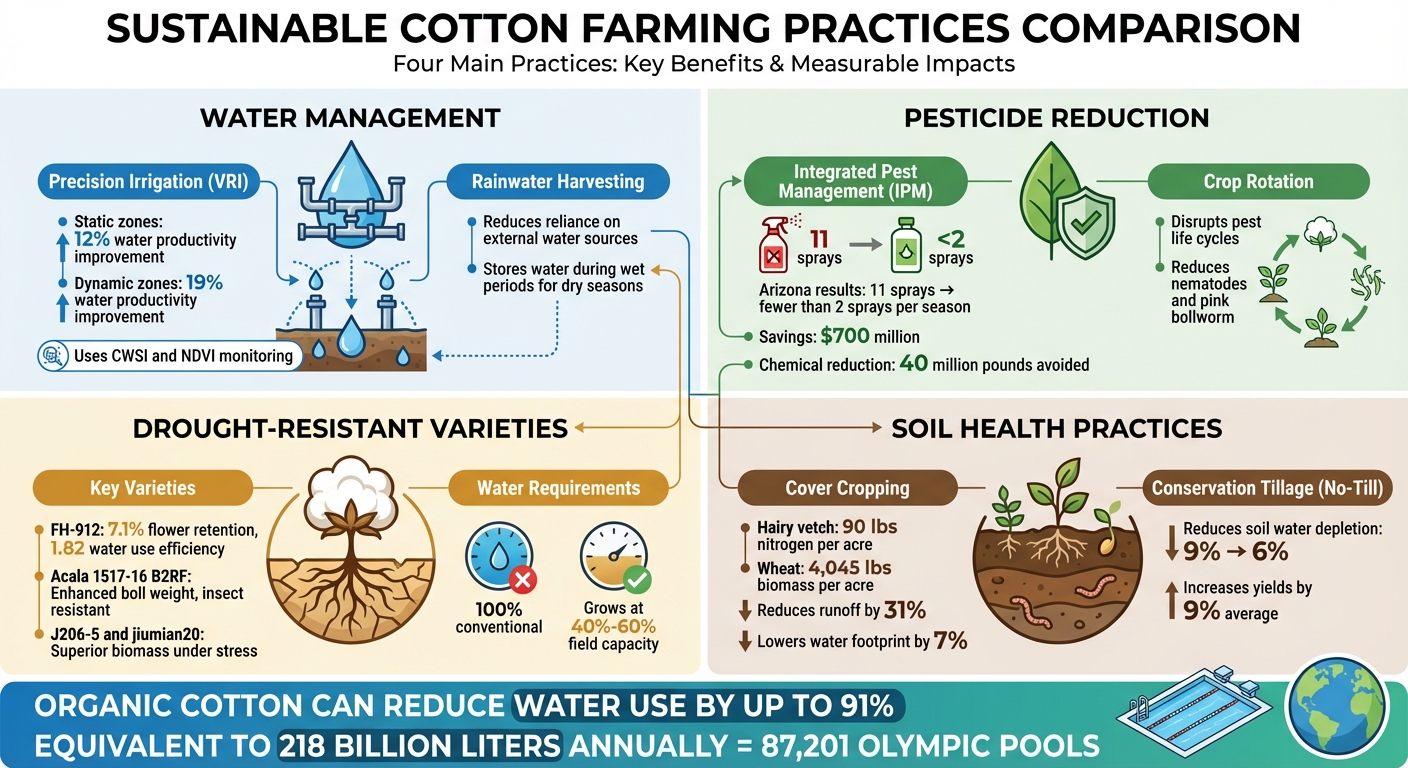
Sustainable Cotton Farming Practices: Water and Pesticide Reduction Methods Comparison
6 Principles of Regenerative Farming – Explained by an Organic Cotton Farmer
sbb-itb-0e617ca
Water Management Practices
Cotton farming relies heavily on water, but traditional irrigation methods often lead to unnecessary waste. By adopting modern techniques, farmers can cut down on water usage while maintaining strong yields. Two standout strategies in this area are precision irrigation and rainwater harvesting.
Precision Irrigation Systems
Precision irrigation flips the script on conventional methods by delivering water only where it's needed. Technologies like Variable-Rate Irrigation (VRI) use tools such as smart center pivot systems to tailor water application to specific field zones. These zones, known as Management Zones, are defined using factors like soil type, elevation, and historical yield data. Farmers can opt for static zones, set before the growing season, or dynamic zones, which are updated weekly based on real-time crop data. Research shows that static zones improve water productivity by 12%, while dynamic zones can achieve a 19% boost compared to uniform irrigation.
A compelling example comes from a study conducted at the Gilat Research Center in Israel between April and October 2021. Researchers tested precision irrigation on a 12.5-hectare (about 31-acre) cotton field using a Reinke VRI center pivot system. Weekly updates to irrigation zones were made using UAV-mounted thermal and multispectral cameras to calculate Crop Water Stress Index (CWSI) and Normalized Difference Vegetation Index (NDVI). This dynamic method led to a 19% increase in water productivity compared to traditional uniform irrigation.
"The objective of precision irrigation is to maintain adequate but not excess storage of water in the soil profile in order to maximize crop yield and optimize irrigation water productivity."
– Springer Nature, Precision Agriculture
Although VRI systems require an upfront investment, they are relatively low-maintenance and reduce the need for manual labor. Weekly aerial imaging, through drones or satellites, helps calculate CWSI and NDVI, while data layers like soil texture, elevation, and historical yields ensure reliable zone management. When combined with rainwater harvesting, these systems can significantly enhance water efficiency.
Rainwater Harvesting and Storage
Rainwater harvesting focuses on collecting and storing water during wet periods for use during drier times. This method reduces dependence on wells or municipal water sources by capturing runoff from fields, rooftops, or other surfaces. The water is then stored in ponds, tanks, or reservoirs for later use. It’s particularly effective in areas with distinct wet and dry seasons, where timing the capture of rainwater can make a huge difference in water availability during critical periods.
Reducing Pesticide Use
In addition to modern water management techniques, cutting back on pesticide use plays a key role in making cotton farming more sustainable. The good news? Reducing reliance on chemical pesticides doesn’t have to mean lower yields. Strategies like Integrated Pest Management (IPM) and crop rotation provide effective ways to manage pests while minimizing synthetic chemicals. These methods focus on smarter pest control and natural disruption of pest life cycles.
Integrated Pest Management (IPM)
IPM takes a smarter, more strategic approach to pest control, moving away from routine chemical use. The idea is simple: apply pesticides only when pest populations hit an action threshold - the point where they pose an economic risk. To determine this, farmers rely on tools like shake sheets and sweep nets for continuous field monitoring. These tools help track both harmful pests and beneficial insects throughout the cotton growth stages, from seedling emergence (targeting pests like spider mites and thrips) to boll development (dealing with aphids and whiteflies).
"Integrated pest management (IPM) is simply using the right tools at the right time to attack common pests."
– National Cotton Council of America
A standout example of IPM in action comes from Arizona. Beginning in 1996, the University of Arizona’s Pest Management Center launched a statewide IPM program. This effort, led by experts like Macey Wildermuth, combined selective insecticides, transgenic cotton varieties, and conservation biological control into a coordinated approach. The results were astounding: pesticide applications dropped from an average of 11 sprays per season to fewer than two. Over the years, this shift saved Arizona cotton growers more than $700 million and eliminated the use of 40 million pounds of insecticide active ingredients.
The success of IPM hinges on protecting natural pest enemies - like predators, parasites, and diseases - that help control pests naturally. When pesticides are necessary, they should be chosen for their cost-effectiveness, efficiency, and low risk of triggering secondary pest outbreaks or resistance. Additionally, proper application techniques, such as optimizing droplet size and spray coverage, ensure effectiveness while avoiding waste or drift. Beyond IPM, incorporating crop rotation and companion planting further reduces pest pressures in a natural way.
Crop Rotation and Companion Planting
While IPM directly targets pest populations, crop rotation and companion planting tackle pest challenges by reshaping the field environment. Rotating cotton with other crops interrupts pest life cycles and limits the buildup of threats like nematodes, Verticillium wilt, and pink bollworm. Including cereals, legumes, or grains in rotation not only disrupts pests but also improves soil health and structure.
Drought-Resistant Cotton Varieties
Selecting the right cotton variety is a powerful way to reduce water needs right from the beginning. Drought-resistant cotton varieties are specifically bred to thrive with minimal water, making them invaluable for farming in dry regions. These plants come equipped with deeper root systems, retain more water in their leaves, and keep photosynthesizing even when soil moisture levels drop. Together, these traits help them maintain stable yields under conditions that would severely impact traditional cotton varieties. When paired with effective water and pest management practices, these varieties contribute to more sustainable farming.
"The inherent genetic diversity in cotton provides a foundation for varied physical and biochemical adaptations to conserve water." – Scientific Reports
These varieties have built-in mechanisms to protect themselves during drought. For instance, when water is scarce, they accumulate compounds like proline and soluble sugars while boosting antioxidant enzyme levels. One such enzyme, superoxide dismutase (SOD), can increase its activity by 2.3 times under severe drought, helping the plant maintain cellular function and combat harmful molecules. Another key advantage is their ability to retain blooms during drought, preventing the flower drop that often leads to reduced yields.
The benefits are clear. Drought-tolerant cotton can sustain growth at 40%-60% field capacity compared to the 100% requirement of conventional varieties. For farmers, this means achieving similar yields while using far less water - a critical advantage in areas with limited water resources.
Examples of Drought-Resistant Varieties
Several drought-resistant cotton varieties have been tested and proven in real-world conditions.
In February 2025, researchers at Pakistan's Nuclear Institute for Agriculture and Biology (NIAB) evaluated multiple genotypes under extreme drought (30% container water holding capacity). Among them, FH-912 stood out. This variety retained 7.1% of its flowers when others failed, achieved a water use efficiency of 1.82, and recorded peak SOD activity of 636 units per gram. These cellular-level defenses translated into better performance in the field.
For farmers in the arid U.S. Southwest, the New Mexico Agricultural Experiment Station introduced Acala 1517-16 B2RF in August 2016. Between 2007 and 2009, this variety underwent 11 field trials, consistently producing lint yields comparable to conventional varieties. It also featured enhanced boll weight, insect resistance, and glyphosate tolerance, reducing stress on plants during drought.
In China, researchers from Tarim University screened 202 cotton lines in June 2025 and identified J206-5 and jiumian20 as highly drought-resistant. These varieties maintained their height and biomass under stress, with SOD activity peaking at 3.51 units per milligram by day 19 of drought treatment. Pakistan has also developed resilient varieties like FH-189, N-5016, and N-868, which exhibit superior photosynthetic activity and lower transpiration rates under water-limited conditions.
Soil Health and Conservation Practices
Healthy soil is the backbone of cotton farming, offering the dual benefits of retaining more water and reducing the need for chemical inputs. By improving soil quality, farmers can conserve water and cut back on pesticides, aligning with sustainable farming methods. Two standout practices - cover cropping and conservation tillage - help preserve and enhance soil health. These approaches not only protect the soil but also create an environment where cotton can grow with less irrigation and fewer chemicals. Together, they complement advanced irrigation and pest management techniques, paving the way for more sustainable cotton production.
Cover Cropping
Cover cropping does wonders for soil, boosting organic matter, strengthening soil structure, and creating a mulch layer that helps retain moisture. This keeps the soil healthier and better equipped to support cotton growth.
Take leguminous cover crops like hairy vetch and Austrian winter pea, for example. These crops naturally add nitrogen to the soil. Hairy vetch can contribute around 90 lbs of nitrogen per acre, which is enough to grow two bales of cotton per acre without needing synthetic fertilizers. This not only cuts costs but also reduces reliance on chemical inputs. On the other hand, wheat cover crops generate higher biomass - about 4,045 lbs per acre - and are excellent for conserving soil water in rain-fed systems, though they provide less nitrogen (approximately 38 lbs per acre) compared to vetch.
Between 2020 and 2021, USDA-ARS researcher Madhav Dhakal studied Austrian winter pea cover crops at the Long-Term Agroecosystem Research site in Stoneville, MS. His findings were striking: no-till treatments reduced runoff by 31% compared to conventional tillage. Additionally, no-till cover cropping lowered the water footprint of cotton production by 7% without any drop in yield.
"Cover cropping and conservation tillage should be used to complement each other to conserve water and reduce irrigation draft" – Madhav Dhakal
For the best results, pair cover crops with no-till farming. Cover crops improve soil's water-holding capacity in no-till systems, but conventional tillage can undermine these benefits by disturbing soil structure and burying residue. To maximize effectiveness, terminate cover crops three weeks before planting cotton. Use herbicides or rolling to create a flat residue layer that locks in soil moisture while making planting easier. This synergy between cover cropping and no-till farming naturally leads us to the benefits of conservation tillage.
Conservation Tillage
Methods like no-till and reduced-till farming protect soil by leaving crop residue on the surface. This reduces erosion, enhances water infiltration, and supports beneficial soil organisms. The residue also acts like a blanket, keeping moisture in the soil where cotton roots can access it.
The data paints a clear picture. Conventional tillage depletes soil water storage by 9% during the growing season, while no-till reduces this loss to just 6%. Over time, these small differences add up, making no-till farming increasingly beneficial as soil quality improves.
Long-term studies by Donald J. Boquet, Robert L. Hutchinson, and Kenneth Paxton at LSU AgCenter's Macon Ridge Research Station in Winnsboro, LA, provide more evidence. Between 1987 and 2002, they tested cotton growth using no-till methods and various cover crops on Gigger silt loam. After five years, no-till farming boosted cotton yields by an average of 9%. In rain-fed conditions, combining no-till with a winter wheat cover crop delivered the highest yields and economic returns because the residue conserved vital soil moisture.
"The wheat cover crop was more beneficial to yield in rain-fed than in irrigated cotton, probably because the residue helped to conserve soil water" – Donald J. Boquet
Conservation tillage offers more than just water savings. It also helps reduce pollution by preventing sediment and nutrient runoff. Undisturbed soil supports earthworms, microbes, and fungi that naturally suppress pests and diseases, cutting down on the need for chemical pesticides. For cotton farmers grappling with water shortages or rising input costs, these practices provide a reliable way to improve efficiency and strengthen resilience.
Case Studies of Successful Implementation
When it comes to sustainable farming practices like irrigation, pest management, and soil care, real-life examples show just how effective these methods can be. Across the U.S., farmers adopting these approaches have significantly cut back on chemical use while maintaining strong yields and profitability.
Cleaner Cotton™ Program
In California's Fresno, Madera, and Merced counties, the Sustainable Cotton Project (SCP) introduced the Cleaner Cotton™ program to help family farmers improve their cotton-growing methods. Since 1996, farmers such as John Teixeira have worked with UC IPM and UC Cooperative Extension to implement biological strategies. By applying treatments only when economically necessary and planting hedgerows to encourage natural predators, these farmers reduced chemical use by as much as 73% while increasing yields.
The results speak for themselves: growers cut chemical use by 50%–73% and achieved yields exceeding 1,250 pounds per acre - well above the 925 pounds per acre typical for organic cotton production. Additionally, Cleaner Cotton™ required less water per pound of harvested fiber due to its higher yield per acre. Backed by the California State Water Resources Control Board, the program also rewarded farmers with a premium of 10 to 15 cents per pound of fiber for their sustainable efforts.
"Because Cleaner Cotton™ maintained fiber yields, it presented less economic risk to the grower and was therefore a more effective tool than organic for converting farmers and acres to biological practices." – Sustainable Cotton Project
Farmer Success Stories
Arizona farmers have also seen success with sustainable pest management. In August 2024, researchers Peter C. Ellsworth and Alfred Fournier demonstrated the effectiveness of predator-based thresholds on over 10 million acres of cotton. By relying on natural predators for whitefly control instead of automatic insecticide spraying, farmers completely eliminated the need for whitefly insecticides - without any economic losses.
The project also revealed that five out of six highly hazardous pesticides were used on less than 5% of cotton acreage, showing that these chemicals could be phased out with little to no impact on yields.
"Commercial-scale on-farm demonstrations in Arizona showed that predator-based thresholds eliminated the need for whitefly sprays without economic loss." – Peter C. Ellsworth and Alfred Fournier, University of Arizona
These case studies highlight how thoughtful water and pesticide management can protect the environment while improving farm profitability.
Comparison of Practices
Choosing sustainable cotton practices depends on factors like your budget, water availability, and environmental goals. Each method comes with its own costs and advantages.
For managing water, precision irrigation offers targeted water application but requires a larger initial investment. On the other hand, rainwater harvesting is a more budget-friendly option, though its success depends on the amount of local rainfall.
To cut down on pesticide use, preventative biological controls can significantly reduce reliance on chemicals. Additionally, soil conservation techniques - such as cover cropping and reduced tillage - not only improve soil health but also support better water retention and help control pest populations over time. Incorporating drought-resistant cotton varieties ensures steady productivity even in water-scarce conditions and works well alongside these practices.
Conclusion
This guide has explored how practices like precision irrigation, integrated pest management, and drought-resistant crop varieties can bring practical benefits to cotton growers. Sustainable cotton farming isn’t just about addressing environmental concerns - it’s also a smart, forward-thinking approach for the industry. Techniques such as rainwater harvesting, targeted irrigation, and reducing pesticide reliance offer effective ways to tackle the water and chemical challenges that growers face today.
Consider this: organic cotton farming can slash water use by up to 91%, saving an astounding 218 billion liters annually. That’s equivalent to filling about 87,201 Olympic-sized swimming pools. Beyond saving water, these methods help safeguard water quality, reduce the need for chemical inputs, and create more resilient farming systems.
Whether you’re running a small family farm or managing a large-scale operation, adopting even a few of these strategies can lead to better resource management and improved profitability. These methods not only conserve resources but also empower farmers to make a meaningful difference. As Abby Wilson from Pact points out:
"Where we choose to spend our dollars can affect entire nations"
FAQs
What’s the cheapest way to start saving irrigation water in cotton?
Surface irrigation is the cheapest option for conserving water in cotton farming. While it requires less investment upfront compared to other methods, it typically uses water less efficiently. To make it more effective over time, you can slowly adopt advanced irrigation technologies as your budget permits.
How do I know when pests justify spraying under IPM?
Under Integrated Pest Management (IPM), only spray for pests when monitoring indicates they've reached the action threshold - the point at which they can cause economic harm. Consistently scout your cotton fields to monitor pest levels, and take action only when it's truly needed. This method keeps pest control focused, minimizes unnecessary pesticide use, and promotes a more balanced and eco-friendly approach.
Which cover crops work best in cotton without stealing moisture?
Cover crops like legumes and grasses - such as cowpeas, vetch, and cereal grains - play a key role in cotton farming. They improve soil health, help control weed growth, and reduce moisture loss. These benefits make them a practical choice for cotton growers aiming for more sustainable farming practices.
Related Blog Posts
- Top 5 Sustainable Cotton Farming Practices Revolutionizing the Industry
- How Precision Water Monitoring Reduces Cotton Water Use
- Efficient Irrigation Strategies for Cotton Farming: Optimizing Water Use and Yield
- Advanced Cotton Crop Management: Digital Innovations and Sustainable Practices for Enhanced Yield