If you want to cut irrigation costs in cotton, the first wins usually come from better timing, not more water. Cotton often needs 8 to 12 acre-inches in a season, and pumping that water can cost about $9 per acre-inch with electric or $12 per acre-inch with diesel. On 500 acres, that can mean $45,000 to $60,000 in pumping costs alone.
Here’s the short version: I’d focus on soil moisture sensors, weather-based scheduling, pivot telemetry, drip automation, and variable-rate irrigation only when field-to-field differences justify the spend. The main goal is simple: keep water available during flowering, boll set, and boll fill, where cotton is most sensitive to stress and profit can swing the most.
A few takeaways stand out:
- Early-season stress can be tolerated more than many growers think.
- Flowering through boll development is the highest-risk window for yield loss.
- A 45-kPa soil water tension trigger performed well in Georgia loamy sand work.
- Dynamic VRI improved water productivity by 19% versus uniform irrigation in one study.
- Better scheduling can also help protect fiber quality, not just yield.
- I’d start with the lowest-cost fix for the main field problem, then track water use, pumping cost, labor time, yield, and HVI fiber results.
If I had to sum up the article in one line, it would be this: measure the root zone, time irrigation to crop stage, and spend on hardware only where it pays back.
Smart irrigation basics in cotton: water demand, timing, and field data
Smart irrigation cuts water use by matching irrigation to cotton’s changing needs across the season. Calendar-based scheduling works on fixed intervals. Smart irrigation doesn’t. It uses soil sensors, weather data, and crop models, so each irrigation decision reflects what’s happening in the field at that moment.
One of the main numbers here is ETc (daily crop water use). ETc estimates how much water cotton uses each day. It’s calculated by multiplying local weather-based ETo by a cotton crop coefficient, or Kc, which shifts by growth stage. Kc starts low early in the season, then peaks during flowering and boll set.
That leads to the big management issue: when is cotton most sensitive to water stress?
Cotton growth stages that need the closest irrigation attention
Cotton doesn’t face the same level of risk at every stage. Early vegetative growth and squaring are more tolerant of water stress than many growers assume. University of Georgia research found that letting soil water potential reach -100 kPa before flowering cut prebloom irrigation by 17% with no drop in final lint yield. In plain terms, some early-season water can be held back without hurting yield.
The story changes once flowering begins. Stress during flowering can limit node production, push the crop into cutout earlier, and reduce boll count. During boll fill, too little water can lead to less mature fibers and lower micronaire values. So timing matters just as much as total water applied.
| Growth Stage | Crop Coefficient (Kc) | Irrigation Sensitivity |
|---|---|---|
| Initial (planting to first square) | 0.35–0.50 | Low - early-season deficit irrigation may be possible |
| Development (squaring to first flower) | 0.70–0.85 | Moderate |
| Mid-Season (flowering/boll set) | 1.15–1.20 | High - critical for yield |
| Late Season (boll fill to maturity) | 0.40–0.70 | High - critical for fiber quality |
(Source: FAO-56 guidelines and MDPI Algorithms, 2025)
Growth stage shows when water matters most. Soil and weather data show when to act.
How soil moisture readings and weather data work together
ET estimates show how much water the crop is expected to use. Soil moisture sensors show how much water is still sitting in the root zone. You need both. One tells you the drawdown rate; the other tells you what’s left in the tank.
At the UGA Stripling Irrigation Research Park near Camilla, GA, research showed that a 45-kPa soil water tension threshold was one of the top-performing irrigation triggers for cotton grown in loamy sand soils. Weather data then sharpens ETc and rainfall estimates, which helps fine-tune irrigation timing.
"If you don't put science behind your irrigation scheduling, you lose on the bottom line." - Wes Porter, Associate Professor, University of Georgia
Those inputs feed the tools covered next: soil sensors, automated drip systems, telemetry-enabled pivots, and variable-rate irrigation.
sbb-itb-0e617ca
Tools that reduce water use in cotton fields
Knowing when cotton needs water only helps if that decision makes it all the way to the field. That’s where the right tools come in. They take soil and weather data and turn it into irrigation moves you can act on.
Soil moisture sensors and telemetry for root-zone decisions
Soil moisture sensors are a solid starting point for many cotton fields. They sit in the root zone and show what the soil is holding at that moment. That matters because crop stress doesn’t care what the forecast said yesterday.
Watermark sensors measure soil water tension in kilopascals (kPa) and give growers a low-cost way to set irrigation triggers based on thresholds. At the University of Georgia's Stripling Irrigation Research Park, researchers tested this approach in loamy sand soils and found that a 45-kPa soil water tension threshold was one of the best irrigation triggers for advanced scheduling.
Placement is just as important as the sensor itself. A sensor in the wrong spot can give you a false read, plain and simple. Install sensors at multiple depths, ideally down to about 3 feet, so you can follow moisture through the full root zone. Telemetry sends those readings wirelessly to a phone or desktop dashboard, which makes it much easier to react in time. Fewer unneeded irrigation events also cut energy use and help protect nutrients in the root zone.
| Sensor Type | Typical Use | Strengths | Limitations |
|---|---|---|---|
| Watermark (SWT) | Root-zone tension monitoring | Reliable, low-cost, threshold-based scheduling | Measures one spot at a time; needs representative placement |
| Capacitance Probes | Volumetric moisture at multiple depths | Multi-depth data up to about 3 feet; tracks how far water moves through the profile | Requires careful soil-specific calibration |
Those readings become far more useful when they connect to pivots, drip systems, and variable-rate setups that can respond right away.
Drip and subsurface drip automation for precise water delivery
Subsurface drip irrigation (SDI) puts water right into the root zone, which cuts evaporation and runoff. In cotton, that can boost lint yield and fiber quality while reducing those losses. Put another way: you can get more marketable lint per acre-inch of water applied.
When SDI is automated and linked to soil sensor data, irrigation timing gets tighter and more exact. It also supports fertigation through the drip lines, which adds another layer of control. The catch, of course, is cost. SDI usually comes with a higher upfront price tag and more upkeep.
That kind of precision matters most in fields where one uniform irrigation pass ends up wasting water in some areas and missing the mark in others.
Telemetry-enabled pivots, weather tools, and variable-rate irrigation
Telemetry-enabled pivots let growers check and adjust irrigation from a phone or desktop as field conditions shift. That alone can make day-to-day water management a lot more practical.
Weather-based scheduling apps add another layer. The UGA SmartIrrigation Cotton app, which was named one of the top-performing advanced scheduling tools in multi-year Georgia trials, uses local ET estimates and rainfall data to recommend when to irrigate and how much water to apply. Paired with soil sensors, these tools help tighten irrigation timing and cut overwatering.
Once water demand starts changing across different parts of the same field, zone-based control becomes the next move. Variable-rate irrigation (VRI) does exactly that by applying different amounts of water across zones during a single pivot pass.
A 2020–2021 study at the Gilat Research Center showed how far this can go. Researchers used a Reinke VRI system on a 12.5-acre cotton field and adjusted irrigation zones using weekly UAV-acquired NDVI and thermal Crop Water Stress Index (CWSI) data as stress moved across the field. That dynamic zone-based approach reduced field variability and improved water productivity by 19% compared with uniform commercial irrigation and by 12% compared with static zones.
| Irrigation Method | Water Savings | Complexity | Yield Impact |
|---|---|---|---|
| Calendar-Based | Low | Low | Variable; prone to over- or under-watering |
| Weather-Based (e.g., SmartIrrigation Cotton app) | Moderate–High | Medium | High; optimizes timing based on ET |
| Sensor-Supported (SWT) | High | Medium | High; prevents stress at critical stages |
| Dynamic VRI (UAV-supported) | Highest | High | Highest; improves water productivity by up to 19% |
Water savings, yield effects, and return on investment
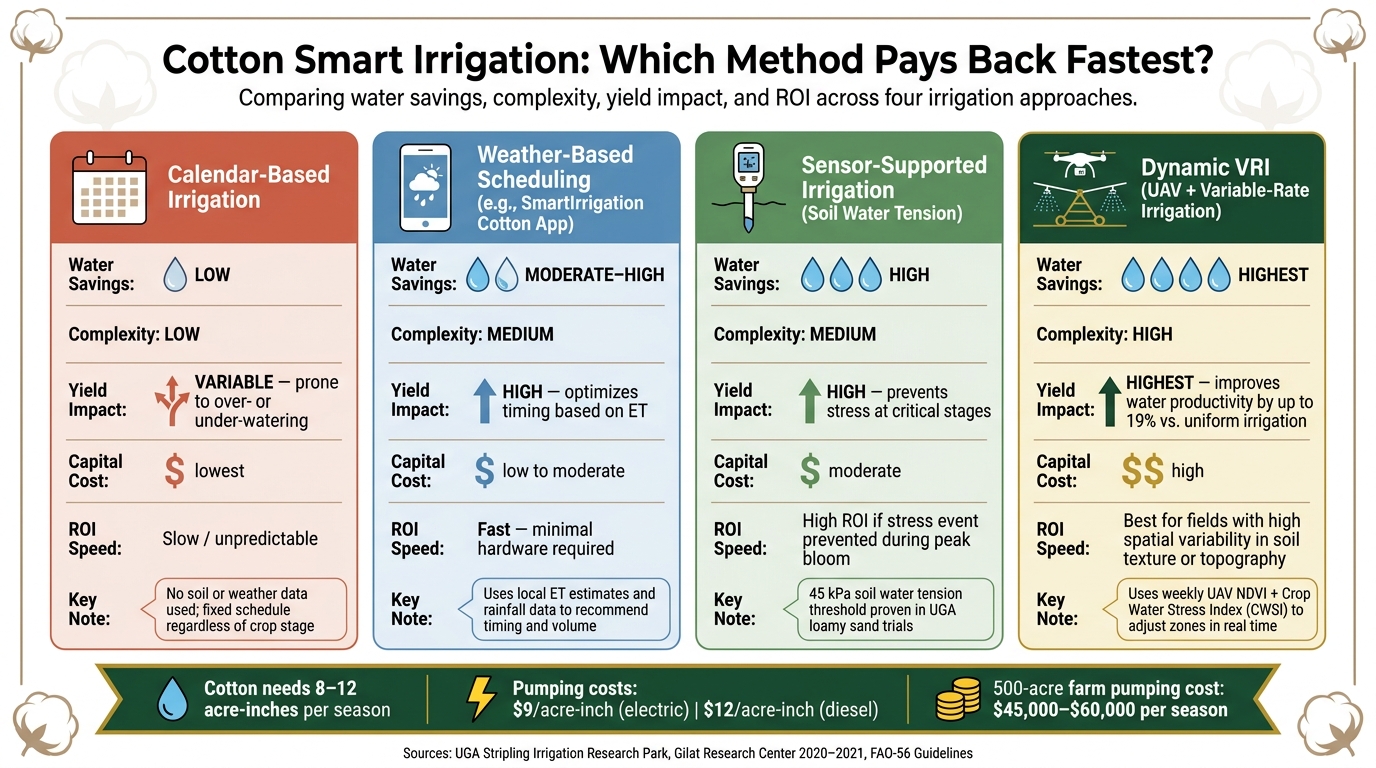
Cotton Smart Irrigation Methods: Water Savings, Cost & ROI Compared
Once these tools are in place, the next step is pretty simple: which upgrade pays back first?
Smart irrigation earns its keep when it does three things well: cuts pumping costs, protects yield, and improves timing. How much you get back depends on water cost, field-to-field variation, and crop stage.
Where the financial gains usually come from
Pumping is usually the first cost growers notice. The estimated cost to irrigate an acre of cotton runs $9 per acre-inch for electric pumps and $12 per acre-inch for diesel pumps at $3 per gallon. On a 500-acre farm applying 10 inches of water over the season, that comes to $45,000 with electric pumps or $60,000 with diesel pumps alone.
That’s why even a small drop in water use can matter. Better scheduling doesn’t just save water on paper. It can put cash back into the operation.
But pumping isn’t the whole story. In many cases, the bigger gain comes from protecting yield when the crop needs water most. Targeted irrigation during boll fill raised profit 110% over medium-capacity irrigation. That says a lot about the value packed into the last stretch of the season, especially during bloom and boll fill.
Good timing also helps fiber quality. It supports uniformity, strength, and staple length, which can help avoid gin discounts. More precise watering can also improve nitrogen use, with some research showing a 17% to 23% increase in nutrient-use efficiency under smart irrigation practices.
At that point, the decision becomes less about the gadget itself and more about how fast it pays for itself.
A simple framework for choosing the right upgrade path
Not every farm needs to jump straight into VRI or SDI. A better way to think about it is to match the spend to the field conditions and water costs you’re dealing with right now.
Start with sensors. Add automation when field variation is costing you money. Look at SDI when water limits start driving the math.
| Upgrade Path | Capital Cost Range | Main Payback | Typical Payback Considerations |
|---|---|---|---|
| Sensors Only - low-cost trigger for avoiding stress at key stages | Moderate | High yield protection in critical stages; helps avoid overwatering | High ROI if it prevents a stress event during peak bloom |
| Sensors + Weather Apps - lowest-cost scheduling upgrade with fast payback | Low to Moderate | Optimized timing; reduced labor for manual checks | Fast payback; requires minimal hardware |
| Pivot Automation / VRI - best where zone-to-zone variability drives losses | High | 12–19% improvement in water productivity | Best for fields with high spatial variability in soil texture or topography |
| Drip / SDI Automation - best where water is scarce and pumping cost is high | Very High | Similar net returns at 25% less water use (75% ET replacement) | Long-term investment; most effective in arid regions with limited aquifer access |
SDI makes the most sense in arid fields where water loss and pumping costs are high enough to justify the upfront spend.
The next step is tracking the first-season metrics that show whether the return is there.
Implementation steps for cotton growers and conclusion
After you pick an upgrade path, begin with the field that loses the most water. The first season needs to prove two simple things: you used less water, and you didn't give up lint quality.
Before buying hardware, figure out where the water loss is coming from. Maybe you're overwatering sandy areas. Maybe the pivot is still running on a fixed schedule even after a rain. Maybe crop stress is slipping by during reproductive growth and boll set. That early diagnosis sets the direction for everything that follows.
Then match the upgrade to the system already in place. If the main problem is scheduling, start with weather-based scheduling and soil moisture sensors. If soil texture or elevation shifts across the pivot, VRI makes more sense. In water-limited regions, drip or subsurface drip automation is often the better fit. The goal is simple: pick the tool that fixes the field's main weak spot.
What to measure in the first season
The first season shouldn't just ask whether irrigation got more efficient. It should show whether water savings led to better net return. A good way to do that is to keep one field or block on the old calendar-based schedule as a control and document both sides all season.
Track these five metrics:
| Metric | Why It Matters |
|---|---|
| Applied water by field (inches) | Tracks actual use against past averages |
| Soil moisture trends | Checks whether sensors are keeping target thresholds, such as 45 kPa |
| Pumping cost per acre-inch | Puts a dollar figure on savings from lower water volume |
| Labor time for irrigation decisions | Shows time saved from automation or app-based scheduling |
| Lint yield and fiber quality | Confirms that lower water use isn't hurting length, strength, micronaire, or uniformity |
Use HVI testing to compare irrigated and control plots for both yield and fiber quality. In USDA-ARS work in Lubbock, Texas, irrigated cotton produced better fiber strength and micronaire than rainfed plots, which shows that precise water delivery can help lint quality as well.
Smart irrigation pays off when it improves timing, cuts wasted water, and turns those gains into better net return. That's how it cuts water use, protects lint quality, and improves profit.
FAQs
How many soil moisture sensors do I need per cotton field?
The number of soil moisture sensors you need comes down to one thing: how much your field changes from one area to another.
In some fields, a single sensor location is enough. That spot is often placed about one-half to two-thirds down the row.
But if your field has major shifts in soil type or clear drainage differences, one location may not tell the whole story. In that case, it usually makes more sense to place sensors in those separate areas. Most setups are still kept fairly simple, with three or four locations in total.
When does variable-rate irrigation make sense in cotton?
Variable-rate irrigation (VRI) works well in cotton when a field doesn’t behave like one uniform block. If soil, topography, or crop conditions change from one area to another, VRI lets you apply water where it’s needed and hold back where it isn’t. The goal is simple: keep soil moisture in the right range without overwatering.
It becomes even more useful when paired with growth-stage-based irrigation strategies. In that setup, growers use sensor data and crop models to fine-tune water application as the season moves along. That includes the period after peak bloom or cutout, when cotton is less sensitive to water stress and irrigation can be adjusted with more care.
How soon can smart irrigation pay for itself?
Payback depends on the technology you choose and the conditions on your farm. But in some cases, smart irrigation systems can pay for themselves within the first year.
Take subsurface drip irrigation. Studies found that stronger yields and higher gross revenue can cover in-field system costs during the installation year.
Soil moisture sensors show a similar upside. On average, they have the potential to increase net income by $202.28 per acre.