Yes - live field data can cut cotton irrigation water use by about 20% to 30% when you use it to time sets, shorten run times, and avoid watering every zone the same way. On U.S. cotton farms, that can mean lower pumping costs, fewer wasted acre-inches, and better control from first square through boll opening.
If I had to boil the article down, it comes to this:
- Cotton water use is expensive. A 500-acre farm applying 10 inches can spend more than $52,500 in one season on irrigation.
- Most waste comes from poor timing and uniform watering. Fixed schedules and field-average decisions miss what is happening in the root zone.
- The main tools are simple: soil moisture probes, weather stations, flow meters, and mobile dashboards.
- The goal is not to water less everywhere. The goal is to water the right place, at the right time, for the right length of time.
- Field studies back this up. Reported results include up to 24.9% water savings, 19% higher water productivity, and up to 17% less early-season water use without measured yield loss in some cases.
- Best starting point: put probes in key management zones, track rainfall and ET, and compare applied water with yield and pumping hours.
A quick way to think about it: probes show what the soil has, weather shows what the crop is losing, and flow meters show what the system delivered. When I put those three data points together, irrigation decisions get tighter and waste drops.
| Tool | What it tells you | Main irrigation use |
|---|---|---|
| Soil moisture probes | Root-zone water status | When to start or stop irrigation |
| Weather stations | Crop water demand | How fast the field is drying |
| Flow meters | Applied water volume | Whether the system put out what you expected |
| Mobile dashboards | All data in one place | Remote checks, alerts, and zone review |
Bottom line: if you want to cut water use in cotton without making blind cutbacks, sensor-based irrigation gives you a clearer way to do it.
How IoT Irrigation Systems Work in Cotton Production
IoT irrigation takes live field readings and turns them into watering decisions.
Sensors in the field track soil moisture, temperature, canopy heat, and weather. A gateway sends those readings to a dashboard. Then the software blends that data with forecast data and crop data to show water use and crop stress. That live view is what connects raw numbers to irrigation timing.
Instead of sticking to a fixed schedule, growers can respond to what’s happening in the root zone right now. Live readings make it possible to shorten or extend irrigation runs based on root-zone moisture. They also help growers target dry areas instead of watering the whole field the same way. That keeps water where the crop can actually use it.
A useful rule of thumb: irrigate when crop water use drops to about 50% to 60% of its potential rate.
The next step is picking the right tools: soil probes, weather stations, flow meters, and mobile dashboards.
sbb-itb-0e617ca
The Sensor Tools Behind Better Cotton Irrigation Decisions
Each tool answers a different part of the irrigation puzzle: how wet the root zone is, how fast the crop is using water, and how much water the system delivered.
Soil Moisture Probes and Weather Stations
Soil moisture probes are the main in-field sensor for cotton irrigation. They’re usually installed to about 3 feet, with readings taken every 4 inches, so they give direct root-zone moisture data. Those readings can show when crop water use drops to about 50% to 60% of potential, which points to moderate stress. In plain terms, that helps growers decide when to irrigate, how long to keep water running, and which zones should get water first.
Weather data covers the demand side of that same call. On-farm weather stations track temperature, rainfall, wind, sunlight, and humidity to estimate daily crop water use. That matters because a cotton field can lose water fast under hot, dry, windy conditions. For the data to mean much, the station should sit in the field or right next to it, so it reflects local conditions instead of data pulled from a public station miles away.
Flow Meters and Mobile Irrigation Dashboards
It also helps to know what the system actually put out. A digital flow meter shows how much water is moving through wells and irrigation lines, both in gallons per minute and in total applied volume. That gives growers a direct record of system output instead of guesswork.
Mobile dashboards pull soil, weather, and flow data into one screen. From a phone or desktop, growers can check alerts, review trends, and look at zone maps without bouncing between tools.
Where Each Tool Adds the Most Value in Cotton Fields
Each tool does a different job. That makes it easier to decide where to start and what to add next.
| Tool | Decision it supports | Key Measurement | Typical Cotton Use Case |
|---|---|---|---|
| Soil Moisture Probes | Root-zone timing | Volumetric water content / soil tension | Determining when to trigger a pivot or drip cycle |
| Weather Stations | Daily crop demand | Temperature, rainfall, wind, sunlight, humidity | Calculating daily ET to guide irrigation timing |
| Flow Meters | Applied-water accountability | Gallons per minute / total volume applied | Confirming how much water moves through the system |
| Mobile Dashboards | Remote decision support | Integrated alerts and trend charts | Managing multiple fields and viewing zone-level stress maps |
Probe placement matters. They should go into distinct management zones, not into a single field-average spot. Those zones are shaped by soil, slope, and yield history, so each probe reflects conditions that are useful for irrigation calls.
Used together, these tools help turn field readings into tighter irrigation timing and shorter run times.
How Real-Time Data Can Cut Water Use by 30%
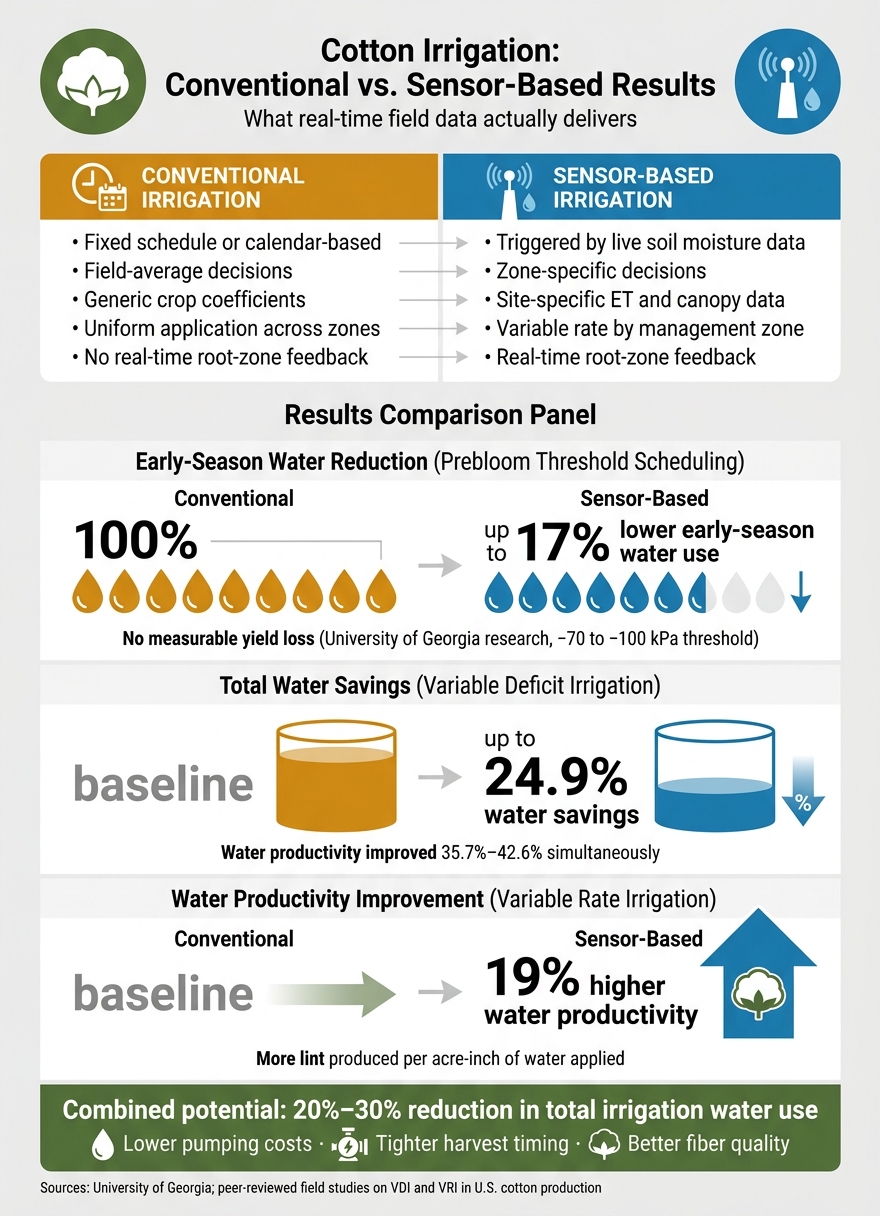
IoT Sensor-Based vs. Conventional Cotton Irrigation: Water Savings Compared
Real-time data helps cut water use by tightening when, how long, and where irrigation runs. Probes, weather stations, and flow meters are the starting point. The payoff comes from the choices they change in the field.
Scheduling Changes That Lower Applied Water
Cotton needs very little water from emergence to first square, so early irrigation often isn't needed unless the field is severely depleted. University of Georgia research found that prebloom thresholds of −70 to −100 kPa cut early-season water use by up to 17% without measurable yield loss. That matters because mild stress at this stage can help check excess vegetative growth and support boll retention.
That same timing discipline matters even more once the crop hits peak demand. About 70% of a cotton crop's water use happens between first flower and boll burst. If rainfall is recorded, growers can skip a set or shorten it instead of sticking to a fixed calendar. That's a simple shift, but it helps avoid overwatering, which can leach nutrients and hurt root health. Later, as bolls open, sensor readings show when crop demand starts to drop. That gives growers a cue to taper irrigation in a way that supports harvest conditions and fiber quality.
Zone-level data adds another layer of control. Instead of watering an entire field by the average, growers can adjust pivot speed or valve timing by management zone. That's a big deal in fields where soil type, slope, and yield history pull water demand in different directions. In one field study, this approach improved water productivity by 19% compared with commercial uniform irrigation.
How to Compare Conventional vs. Sensor-Based Irrigation Results
The best way to judge sensor-based irrigation isn't water use by itself. It's water productivity - how much lint is produced per unit of water applied. Conventional scheduling usually leans on fixed calendars or generic crop coefficients. Sensor-based scheduling uses site-specific soil moisture and canopy data to match irrigation to actual field conditions.
| Scheduling Method | Typical Result |
|---|---|
| Conventional (Uniform/Calendar) | Baseline; fixed schedule |
| Threshold-Based Sensor Scheduling | Up to 17% lower early-season water use without measurable yield loss |
| Variable Deficit Irrigation (VDI) | Up to 24.9% water savings and 35.7%–42.6% higher water productivity |
| Dynamic Management Zones (VRI) | 19% higher water productivity |
Tracking pumping hours next to yield makes the value easier to see. Flow meters confirm how much water was actually applied, which helps growers compare one season with another and verify that the water cuts are real. Lower applied water also means less pump runtime and lower energy use. Those gains add up fastest when the same timing discipline is used across the full operation.
Putting IoT Irrigation Into Practice Across Cotton Operations
Where to Start With Deployment in U.S. Cotton Fields
After the data tools are set up, begin with the fields where better information can change decisions the fastest. That usually means fields with tight water supplies, mixed soil types, or the highest irrigation risk. A field with sandy areas right next to heavier clay ground is a good example. In that kind of setup, fixed-schedule irrigation often applies too much water in one spot and not enough in another.
For a first rollout, soil moisture sensors are the most practical place to begin. Put probes in each main management zone so you can track root-zone moisture after irrigation. On the farm side, it also helps to assign one person to check the dashboard on a regular basis during the season, especially from first square to peak bloom, when stress can do the most damage to yield. Integrated dashboards can pull sensor, satellite, and weather data into one view, which means less jumping between tools during the season. From there, expand field by field once the first season’s results are clear.
How Better Irrigation Timing Supports Harvest and Gin Planning
Late-season sensor readings matter just as much, because irrigation timing shapes how evenly the crop finishes. When irrigation is reduced after boll opening, the crop tends to finish more evenly, defoliation gets easier, and harvest timing is easier to predict. That gives producers a better shot at lining up harvest and delivery plans with gin schedules.
Conclusion: Less Water Waste, Clearer Decisions, Stronger Irrigation Control
Cotton irrigation wastes water when schedules are based on habit instead of actual field conditions. Soil moisture probes, weather stations, flow meters, and mobile dashboards give growers live data they can use to make better calls. In studies, real-time data-driven irrigation reduced water application by up to 24.9%, and dynamic management zones improved water productivity by 19% compared with uniform irrigation. Better measurement can lower water use, reduce pumping costs, and tighten up harvest timing.
FAQs
How many probes does one cotton field need?
It depends on the size of the field and how the irrigation management zones are set up. In trials, teams have used nine sensor nodes for single plots and networks that cover 16 zones.
Probe placement should match the crop’s root zone and the conditions on that site, such as soil texture and soil depth. In many cases, growers install multiple sensors in each zone at depths of 6, 12, 18, and 24 inches.
What does it cost to start with IoT irrigation?
Startup costs for IoT irrigation depend on how simple or advanced the system is.
A basic DIY setup built with a microcontroller like Arduino will usually cost less up front. On the other hand, a professional setup with soil moisture sensors, weather-based models, and automated scheduling software takes a bigger initial budget.
The key is to compare that startup spend with possible savings on pumping energy. For many growers, those savings average $7.00 to $20.00 per acre-inch, depending on whether the pumps run on electricity or diesel.
Can sensor-based irrigation improve yield too?
Yes. Sensor-based irrigation can improve cotton yields because it uses real-time, field-specific data to fine-tune when irrigation starts and how long it runs. That means the crop gets water when it needs it, instead of relying on rough estimates or fixed schedules.
The main aim is often better water-use efficiency. But there’s another upside: tighter scheduling can keep soil moisture in a better range for plant growth. That can support higher yields and stronger net profit. In some cases, profitability has improved by nearly 20%.