I’d choose rotor diameter by yarn count and accepted output - not rpm alone. Cotton-spinning rotors range from 31–56 mm (1.22–2.20 in.): smaller rotors allow higher speeds and generally suit finer yarns, while larger rotors provide space for coarser yarns.
Here’s how I’d compare them:
- Fit: Match diameter to yarn count, fiber length, and short-fiber content.
- Quality: Check strength, evenness, imperfections, and hairiness with cotton, count, twist, and rpm held constant.
- Output: Then test usable speeds, tracking delivery, waste, and stoppages.
My rule: choose the setting that produces the most <u>saleable yarn within your quality limits</u>. A higher rpm isn’t a win if more yarn fails inspection.
Quick Comparison
| Criterion | Smaller rotors | Larger rotors |
|---|---|---|
| Yarn-count fit | Generally finer yarns | Generally coarser yarns |
| Speed | More room for higher rpm | Higher peripheral speed at the same rpm |
| Fiber capacity | Less groove space | More groove space |
| Quality and output | Verify through matched trials | Verify through matched trials |
1. Smaller Rotors
Cotton and Yarn-Count Fit
Smaller rotors offer more room to increase speed for finer yarns (higher Ne), supporting efficient production and adequate twist insertion. Use HVI and AFIS data - especially Upper Half Mean Length (UHML) and Short Fiber Content (SFC) - to match fiber length to machine speed. Balance speed with yarn count, twist, and sliver properties instead of simply choosing the highest available rpm.
Yarn Quality
Low UHML and high SFC limit yarn tenacity and uniformity. Smaller rotors work best when fiber length and short-fiber content suit the selected speed and twist range.
Output That Meets Quality Standards
With fiber length and short-fiber content well matched, judge output by how much yarn meets CVm% and Imperfections Index (IPI) limits, not by rpm alone. If quality drops, adjust fiber selection and preparation before increasing speed.
sbb-itb-0e617ca
2. Larger Rotors
Cotton and Yarn-Count Fit
Larger rotors suit coarser yarn counts because their grooves can hold more fiber. Matching rotor size to yarn count matters most when the yarn still needs to meet strength and uniformity targets.
Yarn Quality
A larger rotor alone does not improve strength, evenness, imperfections, or hairiness when speed, twist, and fiber properties stay the same.
Once rotor size fits the yarn count, the next step is to test whether size changes these qualities under the same operating conditions.
Yarn Quality: Strength, Evenness, Imperfections, and Hairiness
Judge rotor diameter alongside yarn count, twist, speed, and fiber properties. To isolate diameter’s effect, keep the cotton lot and spinning conditions constant, and record HVI/AFIS data using the same test method. A high-speed trial measures diameter and speed together - not diameter alone. Fixed test conditions let you compare smaller and larger rotors on quality alone.
Use USTER Tester for CVm% and imperfections, and HVI/AFIS for fiber properties. Keep thresholds and test settings the same across trials. This helps show whether a rotor change improved yarn quality or simply changed output.
For thin places, thick places, and neps, use a consistent threshold for each measure and keep the tested length unchanged.
| Metric | Test method and reporting | Comparison note |
|---|---|---|
| Tenacity | Tensile tester; cN/tex | Match yarn count, twist, and rotor speed |
| Count-strength product (CSP) | Report alongside yarn count and strength data | Compare only at matched yarn count |
| Breaking force | Tensile tester; N, alongside yarn count | Read force together with yarn count and tenacity |
| CVm% | USTER Tester | Keep tested length unchanged |
| Thin places | USTER Tester; −50% threshold | Keep the threshold and tested length unchanged |
| Thick places | USTER Tester; +50% threshold | Keep the threshold and tested length unchanged |
| Neps | USTER Tester; +200% or +280% threshold | Use the same selected threshold and tested length |
| Hairiness | USTER H-value or Zweigle S3 | Use the same instrument and metric |
Record test speed, tested length, and repeat count so testing variation isn’t mistaken for a quality difference.
Compare quality at matched settings before testing each rotor’s practical speed limit. Once quality is fixed, test output.
Rotor Diameter, Speed, and Saleable Output
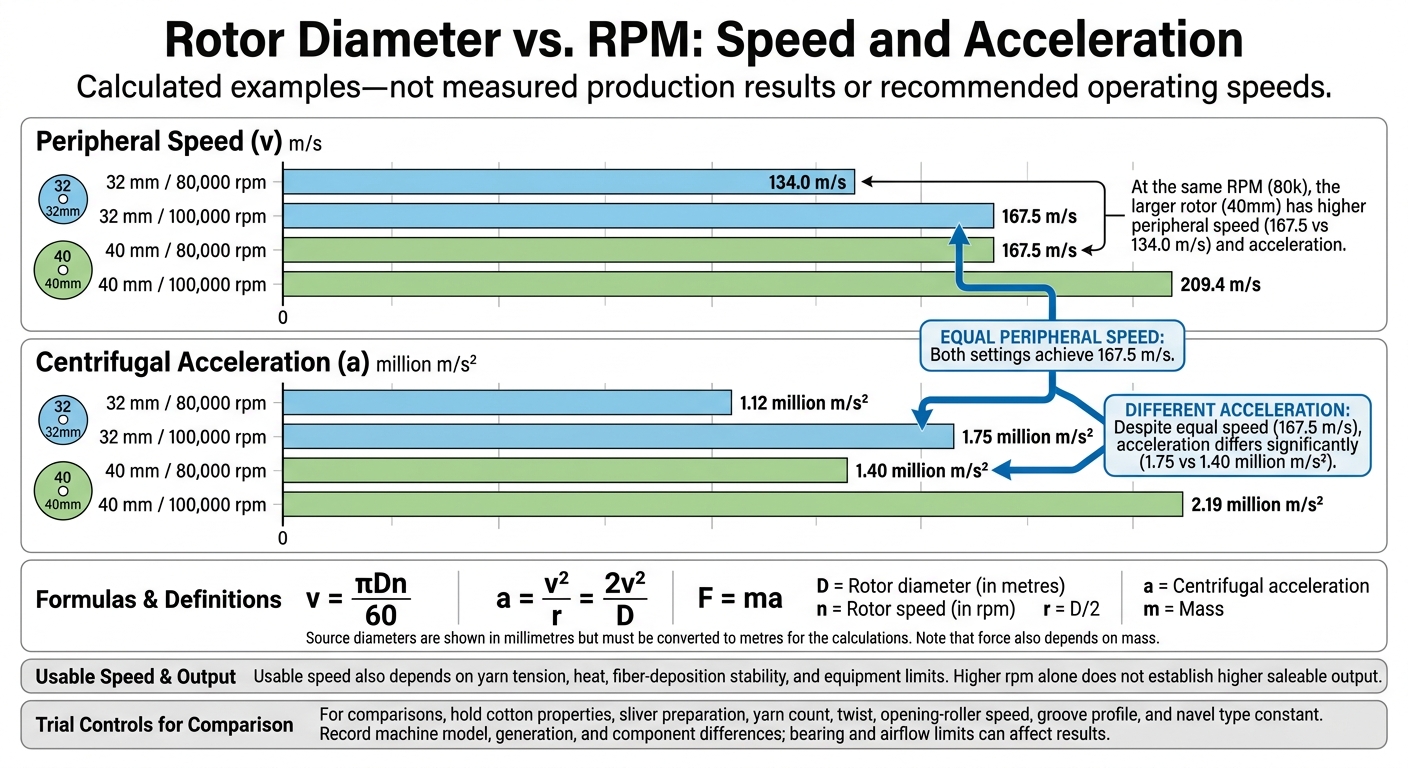
Rotor Diameter vs. RPM: Speed and Acceleration
With quality held constant, compare how rotor diameter affects usable speed and saleable output.
Diameter and Speed
Peripheral speed increases with diameter and rpm: v = πDn/60. Centrifugal acceleration is a = v²/r = 2v²/D, while force also depends on mass: F = ma.
The calculated settings below let you compare diameter and rpm. They are not measured production results or recommended operating speeds. Dimensions use metric units for these engineering calculations.
| Rotor diameter | Rotor speed | Peripheral speed | Acceleration |
|---|---|---|---|
| 32 mm | 80,000 rpm | 134.0 m/s | 1.12 million m/s² |
| 32 mm | 100,000 rpm | 167.5 m/s | 1.75 million m/s² |
| 40 mm | 80,000 rpm | 167.5 m/s | 1.40 million m/s² |
| 40 mm | 100,000 rpm | 209.4 m/s | 2.19 million m/s² |
Keep cotton properties, sliver preparation, yarn count, twist, opening-roller speed, groove profile, and navel type constant. Record the machine model, generation, and component differences, too. Bearing and airflow limits can affect the results.
Output That Meets Quality Standards
At fixed twist, higher rpm increases delivery rate. Smaller rotors can allow higher rpm at a lower peripheral speed than larger rotors. But yarn tension, heat, fiber-deposition stability, and equipment limits still set the usable speed.
Track each diameter–rpm setting using the same measures:
| Measure | Record for every diameter–rpm setting | What it reveals |
|---|---|---|
| Rotor speed | Actual rpm | Speed required for output gains |
| Delivery speed | m/min at matched twist | Production potential |
| Output per position | kg/h | Production while spinning |
| Waste | Percentage, using the same measurement basis | Material lost |
| Stoppages | Events per 1,000 rotor-hours | Process stability |
| Saleable output | Accepted kg/h after stoppages and waste | Accepted production |
Conclusion: Match Rotor Size to Quality and Output
No rotor diameter fits every cotton, yarn count, or quality target. Match diameter to fiber length, yarn count, target speed, and quality limits - not just the highest possible rpm.
Separate diameter from speed, then compare fit, quality, and usable output.
| Production priority | Conditional choice | Check before adoption |
|---|---|---|
| Higher speed or finer counts | Smaller rotors | Confirm strength, CVm%, imperfections, and hairiness at the target count and speed. |
| Coarse counts | Larger rotors | Verify that groove space matches fiber flow. |
For mill trials, keep cotton preparation identical and match yarn count and twist. Test selected diameter–rpm combinations, and repeat yarn tests rather than relying on a single result.
Report quality and output metrics side by side. Choose the setting that delivers the most saleable output at spec, not just the highest production rate.
FAQs
How do I know my rotor diameter is wrong?
Check your target yarn count against standard rotor diameter ranges. Cotton rotors typically measure 33–54 mm in diameter. Smaller rotors suit finer yarns, such as Ne 30, while larger rotors suit coarser yarns, such as Ne 10.
If neps persist or fibers deposit poorly, the rotor diameter may not match the fiber staple length or yarn count. The wrong diameter can make it hard to achieve adequate packing density, resulting in inconsistent yarn quality.
Should I change rotor size or adjust twist first?
Start by choosing the rotor diameter for your target yarn count. The diameter determines the count range: smaller rotors typically suit finer yarns, such as Ne 30, while larger rotors suit bulkier yarns, such as Ne 10.
Next, adjust the twist multiplier - typically 3.5 to 4.0 for cotton - to balance fiber cohesion, strength, and softness. Working in this order helps match the setup to the yarn’s structural needs.
How many trial runs make a rotor comparison reliable?
There’s no set number of trials. For reliable comparisons, collect consistent data across multiple runs. Industry best practice is to log rotor RPM against breaks each week.
Keep testing speeds, capacitive length zones, and sample lengths the same across trials, following standards such as ASTM D1425 or ISO 2649. Take samples from the top, middle, and inner parts of yarn packages to better reflect process performance.